Page 222 of 251
Fuses
All the electrical circuits in your vehicle have fuses to protect them
from a short circuit or overload.
These fuses are located in two or three fuse boxes.
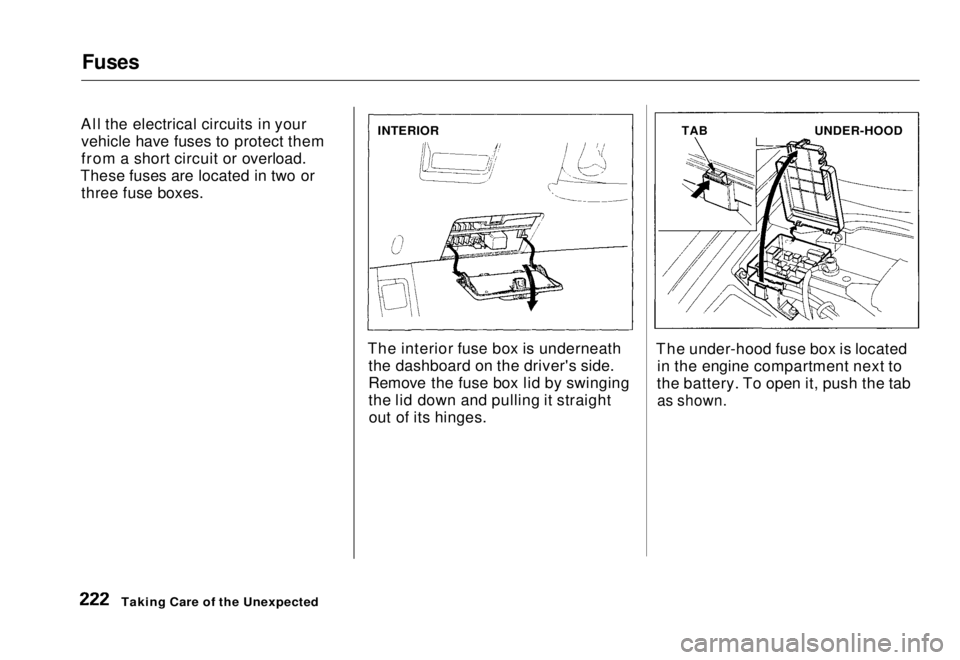
The interior fuse box is underneaththe dashboard on the driver's side.
Remove the fuse box lid by swinging
the lid down and pulling it straightout of its hinges. The under-hood fuse box is located
in the engine compartment next to
the battery. To open it, push the tab
as shown.
Taking Care of the Unexpected
INTERIOR
TAB
UNDER-HOODMain Menu Table of Contents s t
Page 223 of 251
Fuses
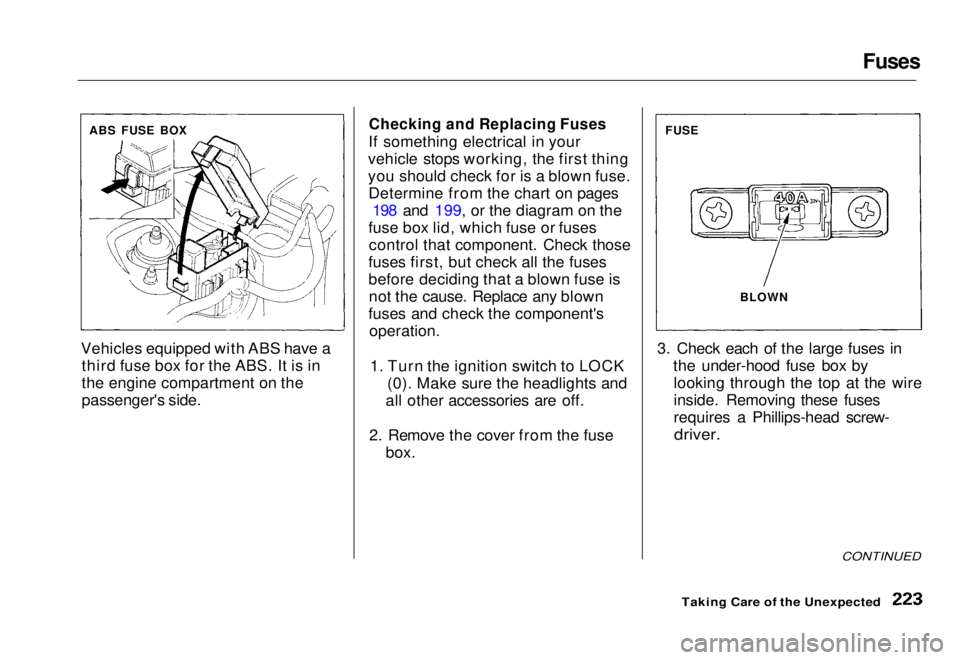
Vehicles equipped with ABS have a third fuse box for the ABS. It is in
the engine compartment on the
passenger's side.
Checking and Replacing Fuses
If something electrical in your
vehicle stops working, the first thing
you should check for is a blown fuse. Determine from the chart on pages 198 and 199, or the diagram on the
fuse box lid, which fuse or fuses control that component. Check those
fuses first, but check all the fuses
before deciding that a blown fuse is not the cause. Replace any blown
fuses and check the component's
operation.
1. Turn the ignition switch to LOCK (0). Make sure the headlights and
all other accessories are off.
2. Remove the cover from the fuse box. 3. Check each of the large fuses in
the under-hood fuse box bylooking through the top at the wire
inside. Removing these fuses
requires a Phillips-head screw-
driver.
CONTINUED
Taking Care of the Unexpected
ABS FUSE BOX
FUSE
BLOWNMain Menu Table of Contents s t
Page 227 of 251
Emergency Towing
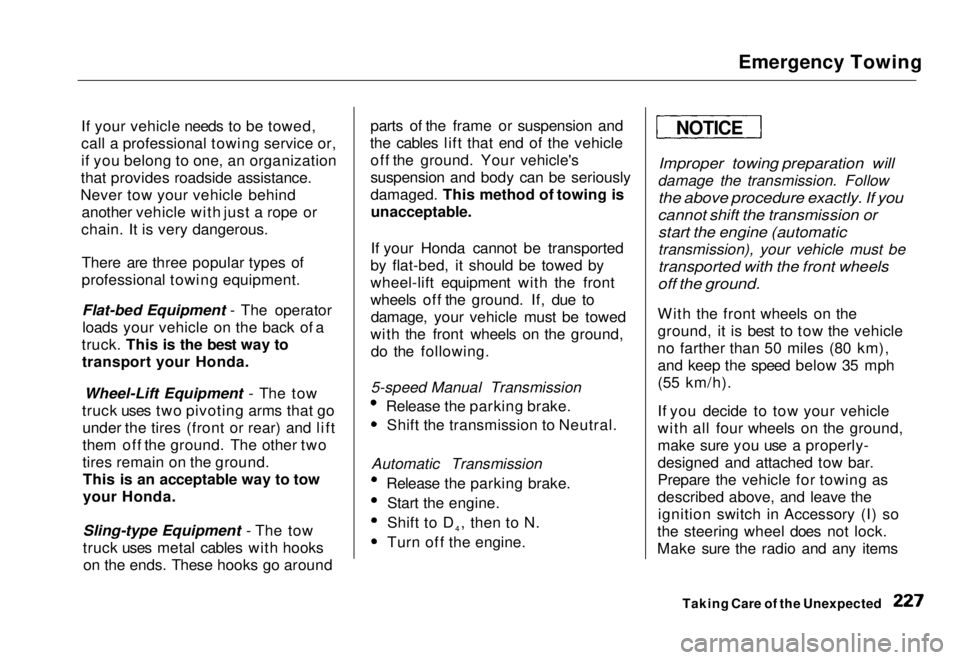
If your vehicle needs to be towed,
call a professional towing service or,
if you belong to one, an organization
that provides roadside assistance.
Never tow your vehicle behind another vehicle with just a rope or
chain. It is very dangerous.
There are three popular types of
professional towing equipment.Flat-bed Equipment - The operatorloads your vehicle on the back of a
truck. This is the best way to transport your Honda.
Wheel-Lift Equipment - The tow
truck uses two pivoting arms that go under the tires (front or rear) and lift
them off the ground. The other two
tires remain on the ground.This is an acceptable way to tow
your Honda.
Sling-type Equipment - The tow
truck uses metal cables with hookson the ends. These hooks go around parts of the frame or suspension and
the cables lift that end of the vehicle off the ground. Your vehicle's
suspension and body can be seriously
damaged. This method of towing is
unacceptable.
If your Honda cannot be transported
by flat-bed, it should be towed by
wheel-lift equipment with the front
wheels off the ground. If, due to damage, your vehicle must be towed
with the front wheels on the ground, do the following.
5-speed Manual Transmission
Release the parking brake.Shift the transmission to Neutral.
Automatic Transmission Release the parking brake.Start the engine.
Shift to D4, then to N.
Turn off the engine.
Improper towing preparation will
damage the transmission. Follow
the above procedure exactly. If you
cannot shift the transmission or
start the engine (automatic
transmission), your vehicle must be
transported with the front wheels
off the ground.
With the front wheels on the
ground, it is best to tow the vehicle
no farther than 50 miles (80 km), and keep the speed below 35 mph
(55 km/h).
If you decide to tow your vehicle
with all four wheels on the ground,
make sure you use a properly-
designed and attached tow bar.
Prepare the vehicle for towing as
described above, and leave theignition switch in Accessory (I) so
the steering wheel does not lock.
Make sure the radio and any items
Taking Care of the Unexpected
NOTICEMain Menu Table of Contents s t
Page 230 of 251
Identification Numbers
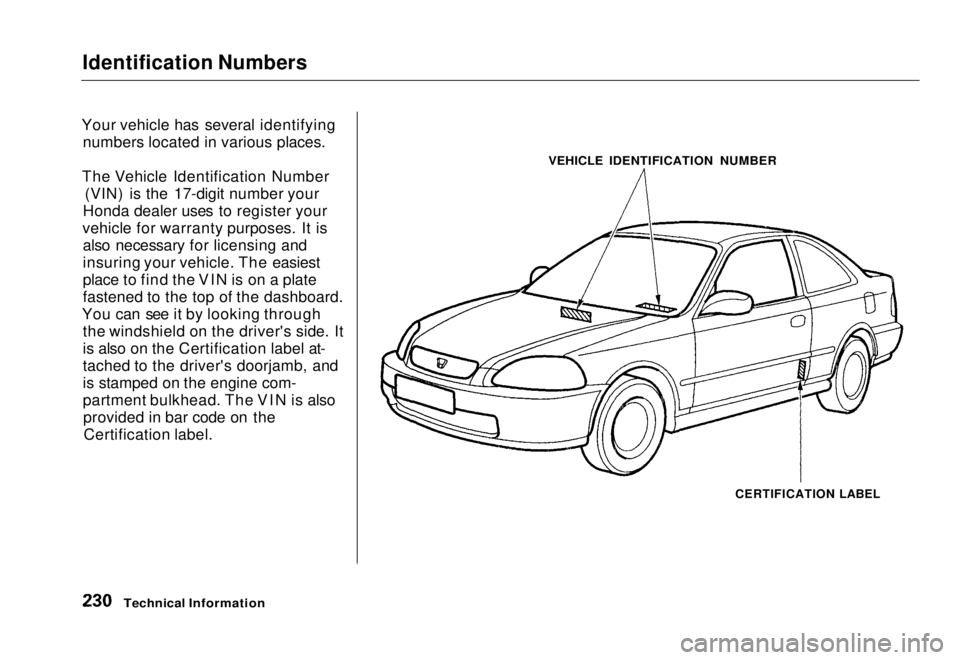
Your vehicle has several identifying numbers located in various places.
The Vehicle Identification Number (VIN) is the 17-digit number your
Honda dealer uses to register your
vehicle for warranty purposes. It is also necessary for licensing and
insuring your vehicle. The easiest
place to find the VIN is on a plate
fastened to the top of the dashboard.
You can see it by looking through the windshield on the driver's side. It
is also on the Certification label at-
tached to the driver's doorjamb, and
is stamped on the engine com-
partment bulkhead. The VIN is alsoprovided in bar code on theCertification label.
Technical Information
VEHICLE IDENTIFICATION NUMBER
CERTIFICATION LABELMain Menu Table of Contents s t
Page 231 of 251
Identification Numbers
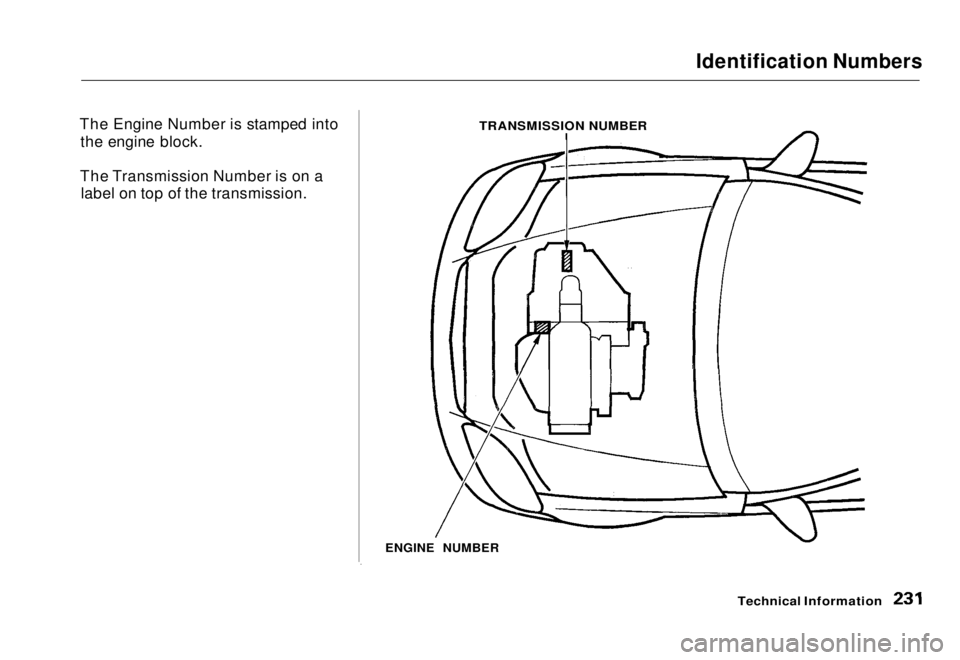
The Engine Number is stamped into the engine block.
The Transmission Number is on a label on top of the transmission.
Technical Information
ENGINE NUMBER
TRANSMISSION NUMBERMain Menu Table of Contents s t
Page 233 of 251
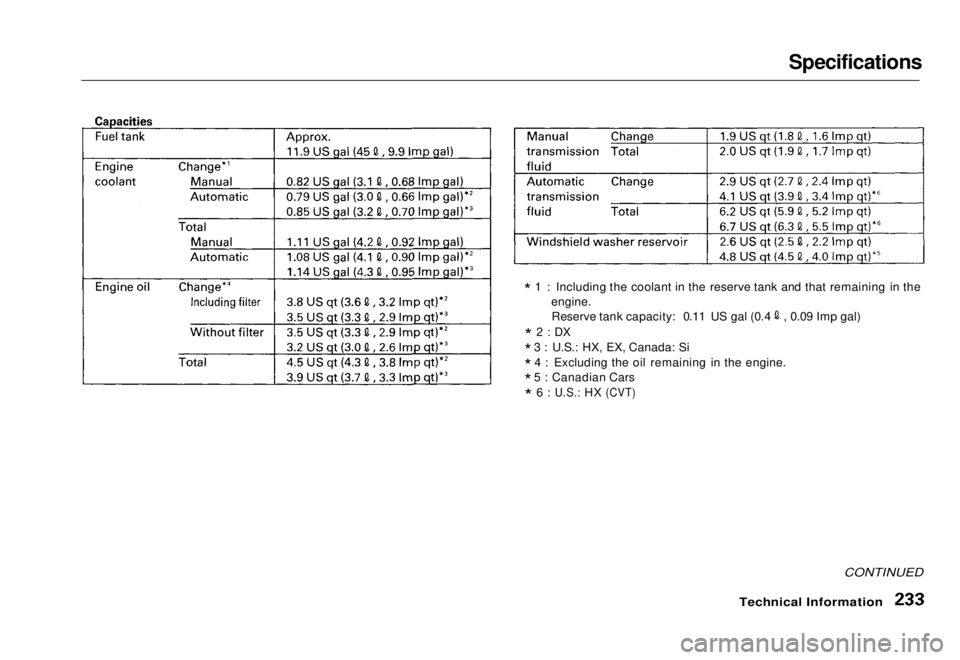
Specifications
* 1 : Including the coolant in the reserve tank and that remaining in the
engine. Reserve tank capacity: 0.11 US gal (0.4 , 0.09 Imp gal)
*
2
:
DX
* 3 : U.S.: HX, EX, Canada: Si
* 4 : Excluding the oil remaining in the engine.
* 5 : Canadian Cars
*
6
:
U.S.:
HX
(CVT)
CONTINUED
Technical InformationMain Menu Table of Contents s t
Page 240 of 251

Emissions Controls
The burning of gasoline in your vehicle's engine produces several by-products. Some of these are carbon
monoxide (CO), oxides of nitrogen (NOx) and hydrocarbons (HC).
Gasoline evaporating from the tank
also produces hydrocarbons. Con-
trolling the production of NOx, CO, and HC is important to the environ-
ment. Under certain conditions ofsunlight and climate, NOx and HC
react to form photochemical "smog." Carbon monoxide does not contri-
bute to smog creation, but it is a
poisonous gas.
The Clean Air Act
The United States Clean Air Act*
sets standards for automobile
emissions. It also requires that
automobile manufacturers explain toowners how their emissions controls
work and what to do to maintain
them. This section summarizes how the emissions controls work.
Scheduled maintenance is on page
142.
* In Canada, Honda vehicles comply
with the Canadian Motor Vehicle Safety Standards (CMVSS) for
Emissions valid at the time they are
manufactured. Crankcase Emissions Control
System
Your vehicle has a Positive Crankcase Ventilation System. This
keeps gasses that build up in the engine's crankcase from going into
the atmosphere. The Positive Crank-
case Ventilation valve routes them
from the crankcase back to the intake manifold. They are thendrawn into the engine and burned.
Evaporative Emissions Control
System
As gasoline evaporates in the fuel tank, an evaporative emissions
control canister filled with charcoaladsorbs the vapor. It is stored in this
canister while the engine is off. After
the engine is started and warmed up, the vapor is drawn into the engine
and burned during driving.
Technical InformationMain Menu Table of Contents s t
Page 241 of 251
Emissions Controls
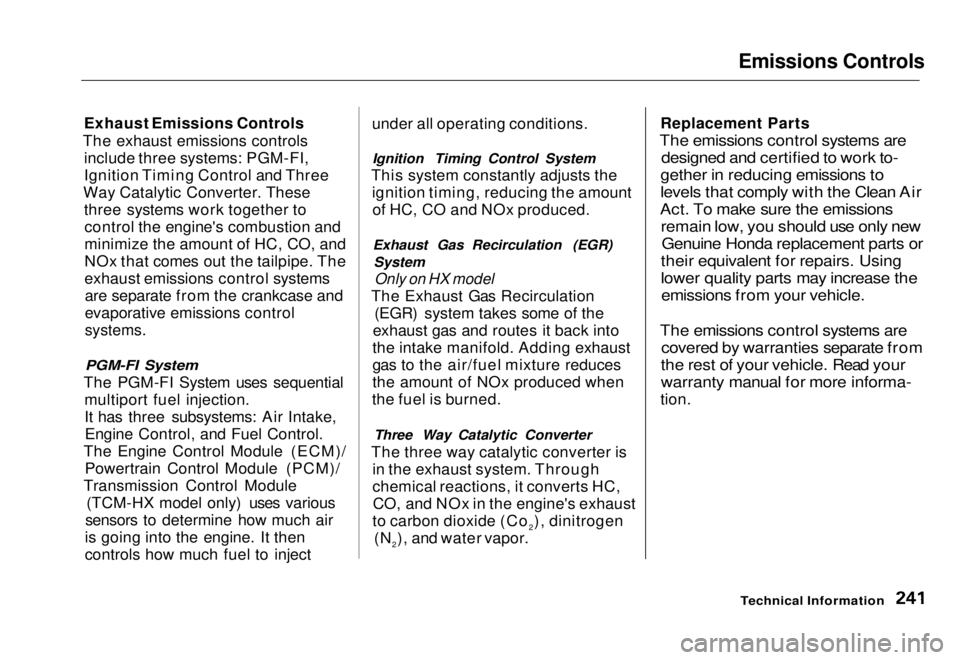
Exhaust Emissions Controls
The exhaust emissions controls include three systems: PGM-FI,
Ignition Timing Control and Three
Way Catalytic Converter. These three systems work together tocontrol the engine's combustion and
minimize the amount of HC, CO, and
NOx that comes out the tailpipe. The
exhaust emissions control systemsare separate from the crankcase and
evaporative emissions control
systems.
PGM-FI System
The PGM-FI System uses sequential multiport fuel injection.
It has three subsystems: Air Intake,Engine Control, and Fuel Control.
The Engine Control Module (ECM)/ Powertrain Control Module (PCM)/
Transmission Control Module (TCM-HX model only) uses various
sensors to determine how much air
is going into the engine. It then
controls how much fuel to inject under all operating conditions.
Ignition Timing Control System
This system constantly adjusts the ignition timing, reducing the amountof HC, CO and NOx produced.
Exhaust Gas Recirculation (EGR)
System
Only on HX model
The Exhaust Gas Recirculation (EGR) system takes some of the
exhaust gas and routes it back into
the intake manifold. Adding exhaust
gas to the air/fuel mixture reduces
the amount of NOx produced when
the fuel is burned.
Three Way Catalytic Converter
The three way catalytic converter is in the exhaust system. Through
chemical reactions, it converts HC,CO, and NOx in the engine's exhaust
to carbon dioxide (Co2), dinitrogen (N2), and water vapor. Replacement Parts
The emissions control systems are designed and certified to work to-
gether in reducing emissions to
levels that comply with the Clean Air
Act. To make sure the emissions remain low, you should use only newGenuine Honda replacement parts or
their equivalent for repairs. Using
lower quality parts may increase the
emissions from your vehicle.
The emissions control systems are covered by warranties separate from
the rest of your vehicle. Read your
warranty manual for more informa-
tion.
Technical InformationMain Menu Table of Contents s t