1998 GMC SIERRA clock
[x] Cancel search: clockPage 161 of 452

Section 3 Comfort Controls and Audio Systems
In this section, you’ll find out how to operate the comfort control and audio systems offered with your vehicle. Be
sure to read about the particular systems supplied with your vehicle.
3-2 3
-4
3-5
3-5
3-6
3-6 3
-7
3-7
3-7
3-8
3-9
3-12 Comfort
Controls
Air Conditioning
Heating
Ventilation System
Defogging and Defrosting Rear Window Defogger
(If Equipped)
Audio Systems Setting the Clock
AM-FM Stereo Radio
Playing the Radio
AM-FM Stereo with Cassette
Tape Player
(If Equipped)
AM-FM Stereo with Cassette Tape and
Automatic
Tone Control (If Equipped) 3-
15
3- 16
3-20
3-2
1
3-23
3-24
3-25
3-26
3-26
3-26 CD
Adapter
Kit
AM-FM Stereo with Compact Disc Player and
Automatic Tone Control
(If Equipped)
Remote Compact Disc Player (If Equipped)
Theft-Deterrent Feature
Understanding Radio Reception
Tips About Your Audio System
Care of Your Cassette Tape Player
Care
of Your Compact Discs
Care of Your Compact Disc Player
Fixed Mast Antenna
3-1
ProCarManuals.com
Page 167 of 452

.
NOTICE:
Don’t use a razor blade or something else sharp
on the inside
of the rear window. If you do, you
could cut
or damage the warming grid, and the
repairs wouldn’t be covered
by your warranty.
Audio Systems
Your Delco Electronics audio system has been designed
to operate easily and give years of listening pleasure.
You will get the most enjoyment out of it if you acquaint
yourself with
it first. Find out what your Delco
Electronics system can do and how to operate
all its
controls,
to be sure you’re getting the most out of the
advanced engineering that went into it.
Setting the Clock for Systems without
Automatic Tone Control
Press SET. Within five seconds, press and hold the
SEEK right arrow
until the correct minute appears on
the display. Press and
hold the SEEK left arrow until the
correct hour appears
on the display.
Setting the Clock for Systems with
Automatic Tone
Control
Press and hold HR until the correct hour appears on the
display. Press and hold
MN until the correct minute
appears on the display.
To display the clock with the
ignition
off, press RECALL or HR/MN and the time
will be displayed for a few seconds. There is an initial
two-second delay before the clock goes into the
time-set mode.
AM-FM Stereo
3-7
ProCarManuals.com
Page 198 of 452
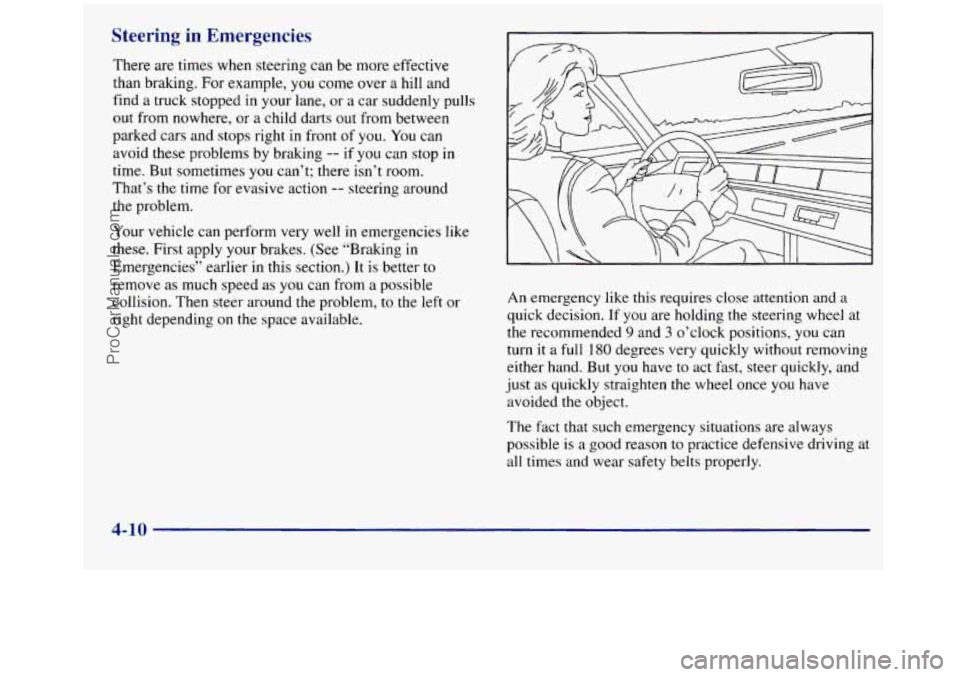
Steering in Emergencies
There are times when steering can be more effective
than braking. For example, you come over a hill and
find a truck stopped in your lane, or
a car suddenly pulls
out from nowhere, or
a child darts out from between
parked cars and stops right in front
of you. You can
avoid these problems by braking
-- if you can stop in
time. But sometimes you can’t; there isn’t room.
That’s
the time for evasive action -- steering around
the problem.
Your vehicle can perform very well
in emergencies like
these. First apply your brakes. (See “Braking in
Emergencies’’ earlier in this section.)
It is better to
remove as much speed as you can from a possible
collision. Then steer around the problem, to the left or
right depending on the space available. An
emergency like this requires close attention
and a
quick decision. If you are holding the steering wheel at
the recommended
9 and 3 o’clock positions, you can
turn it
a full 180 degrees very quickly without removing
either hand. But
you have to act fast, steer quickly, and
just as quickly straighten the wheel once you have
avoided
the object.
The fact that such emergency situations are always
possible is a good reason to practice defensive driving at
all times and wear safety belts properly.
4-10
ProCarManuals.com
Page 208 of 452
What should I do if my vehicle stalls, or is about
to stall, and I can’t make it up the hill?
A: If this happens, there are some things you should
do, and there
are some things you must not do.
First, here’s what you
should do:
0 Push the brake pedal to stop the vehicle and keep it
from rolling backwards.
Also, apply the parking brake.
0 If your engine is still running, shift the transmission
to REVERSE (R), release the parking brake, and
slowly back down the hill in REVERSE (R).
0 If your engine has stopped running, you’ll need to
restart
it. With the brake pedal depressed and the
parking brake still applied, shift the transmission to
PARK
(P) (or, shift to NEUTRAL (N) if your
vehicle has a manual transmission) and restart the
engine. Then, shift to REVERSE (R), release the
parking brake, and slowly back down the hill as
straight as possible in REVERSE (R).
0 As you are backing down the hill, put your left hand
on the steering wheel at the 12 o’clock position. This
way, you’ll be able to tell if your wheels are straight
and maneuver as you back down. It’s best that you back down
the hill with your wheels straight rather
than in the left or right direction. Turning the wheel
too far to the left or right will increase the possibility
of a rollover.
Here are some things you
must not do if you stall, or are
about to stall, when going up a hill.
0 Never attempt to prevent a stall by shifting into
NEUTRAL (N) (or depressing the clutch, if you
have a manual transmission) to “rev-up” the engine
and regain forward momentum. This won’t work.
Your vehicle will roll backwards very quickly and
you could
go out of control.
Instead, apply the regular brake to stop the vehicle.
Then apply the parking brake. Shift to
REVERSE (R), release the parking brake, and slowly back straight down.
Never attempt to turn around if you are about to stall
when going up a hill. If the hill is steep enough
to
stall your vehicle, it’s steep enough to cause you to
roll over if
you turn around. If you can’t make it up
the hill,
you must back straight down the hill.
4-20
ProCarManuals.com
Page 272 of 452
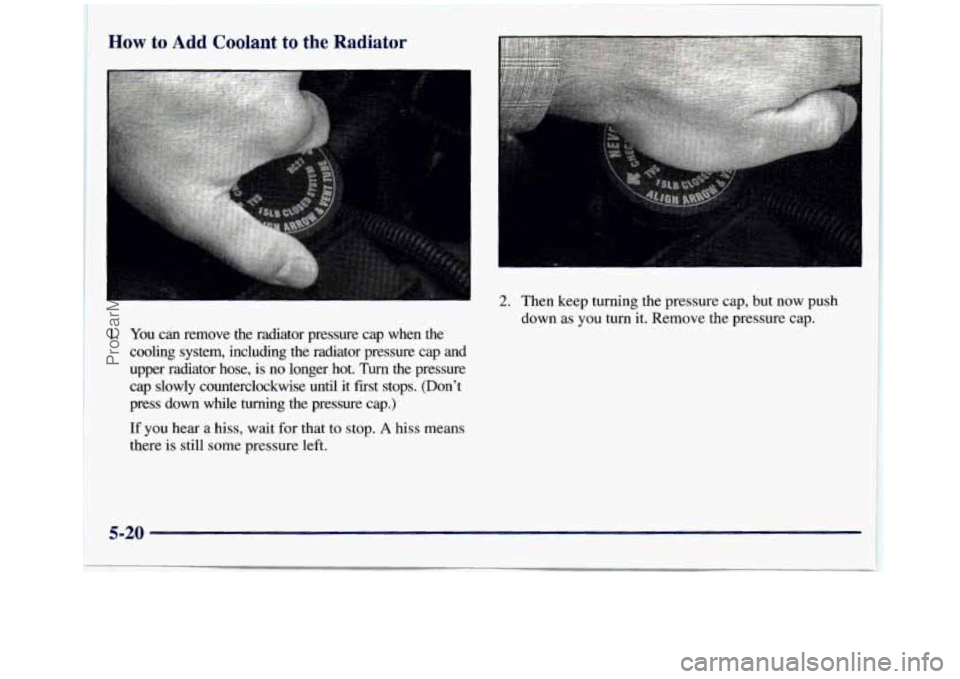
How to Add Coolant to the Radiator
1. You can remove the radiator pressure cap when the
cooling system, including the radiator pressure cap and
upper radiator hose,
is no longer hot. Turn the pressure
cap slowly counterclockwise until it first stops. (Don't
press down while
turning the pressure cap.)
2. Then keep turning the pressure cap, but now push
down
as you turn it. Remove the pressure cap.
If you hear
a hiss, wait for that to stop. A hiss means
there is still some pressure left.
5-20
ProCarManuals.com
Page 297 of 452
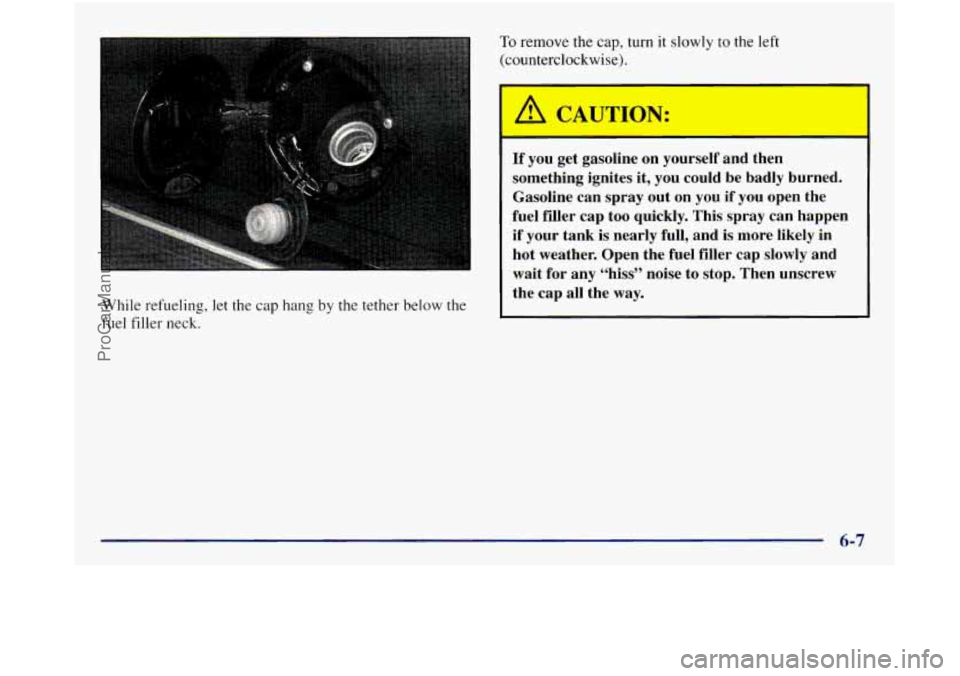
While refueling, let the cap hang by the tether below the
fuel filler neck.
To remove the cap, turn it slowly to the left
(counterclockwise).
If you get gasoline on yourself and then
something ignites it, you could be badly burnea.
Gasoline can spray out on you if you open the
fuel filler cap
too quickly. This spray can happen
if your tank is nearly full, and is more likely in
hot weather. Open the fuel filler cap slowly and
wait for any “hiss” noise to stop. Then unscrew
the cap
all the way.
6-7
ProCarManuals.com
Page 298 of 452
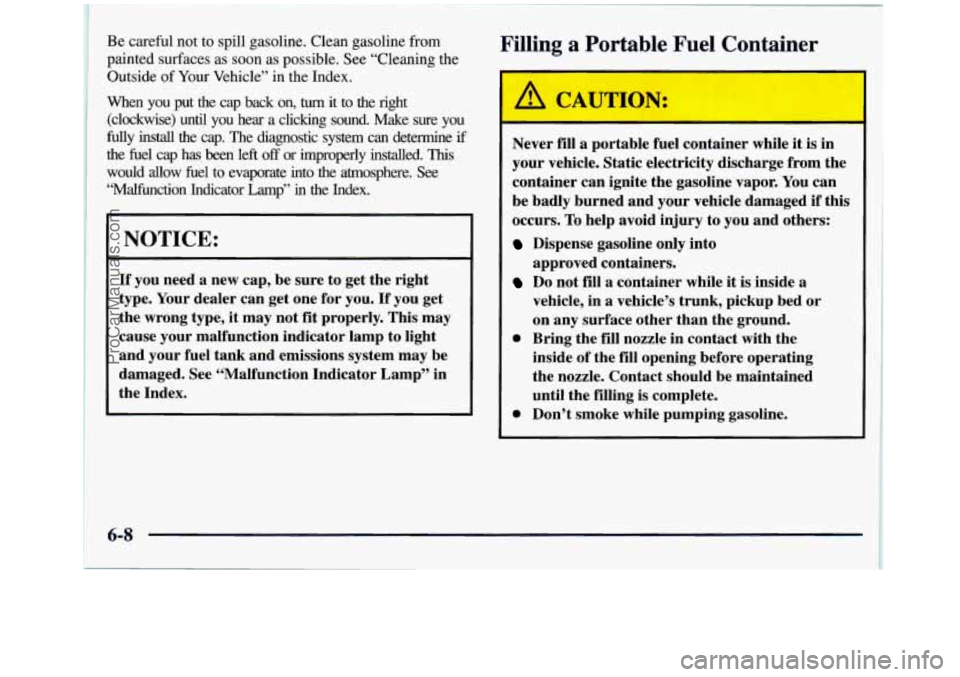
~ Be
careful not to spill gasoline. Clean gasoline from
~ painted surfaces as soon as possible. See “Cleaning the
i Outside of Your Vehicle” in the Index.
When you put
the cap back on, turn it to the right
(clockwise)
until you hear a clicking sound. Make sure you
fully install the cap. The diagnostic system can determine if
the fuel cap has been left off or improperly installed. This
would allow fuel to evaporate into the atmosphere. See
“Malfunction Indicator Lamp”
in the Index.
NOTICE:
If you need a new cap, be sure to get the right
type. Your dealer can get one for you. If you get
the wrong type, it may not
fit properly. This may
cause your malfunction indicator lamp to light
and your fuel tank and emissions system may be
damaged. See ‘LMalfunction Indicator Lamp” in
the Index.
Filling a Portable Fuel Container
Never fill a portable fuel container while it is in
your vehicle. Static electricity discharge from the
container can ignite the gasoline vapor. You can
be badly burned and your vehicle damaged
if this
occurs.
To help avoid injury to you and others:
Dispense gasoline only into
approved containers.
Do not fill a container while it is inside a
vehicle, in
a vehicle’s trunk, pickup bed or
on any surface other than the ground.
inside of the
fill opening before operating
the nozzle. Contact should be maintained
until the filling is complete.
0 Bring the fill nozzle in contact with the
0 Don’t smoke while pumping gasoline.
6-8
I
ProCarManuals.com
Page 437 of 452
Vinyl ....................................... 6-63
Wheels
..................................... 6-67
Windshield and Wiper Blades
................... 6-65
Clock. Setting the ................................ 3-7
Clutch Fluid. Hydraulic
..................... 6-25. 7-46
Clutch. System Check
........................... 7-41
Comfort Controls
................................ 3-2
Comfort Guides. Rear
........................... 1-40
Compact Disc Care
............................. 3-26
Compact Disc Player
.......................
3-16 . 3-20
Compact Disc Player Care
........................ 3-26
Compass. Rearview Mirror
with ................... 2-46
Console Storage
................................ 2-54
Control
of a Vehicle .............................. 4-5
Convex Outside Mirror .......................... 2-SO
Coolant ............................. 6-28.6-79.7-46
Heater
. Engine ............................... 2- 14
Recovery Tank ............................... 5- I5
Cooling System ................................ 5- IS
Courtesy Transportation ........................... 8-8
Cruise Control
................................. 2-38
Cupholders
.......................... 2.54.2.55. 2-56
Customer Assistance Information ................... 8- I
Customer Satisfaction Procedure .................... 8-2
Climate Control System ....................... 3.2 . 3-3
Customer Assistance for Text Telephone Users
......... 8-4
Damage. Finish
............................... 6-68
Darnage. Sheet Metal
............................ 6-67
Daytime Running Lamps
......................... 2-42
Daytime Running Lamps Indicator Lighl
............ 2-74
Dead Battery
................................... 5-3
Defects. Reporting Safety ........................ 8- 10
Defensive Driving ............................... 4-2
Defogger. Rear Window .......................... 3-6
Defoggng
and Defrosting ......................... 3-6
Dolby B Noise Reduction
....................... 3-15
Dome Lamps
.................................. 2-44
DO0
I.
Locks ....................................... 2-5
Storage Pocket ............................... 2-51
Third
........................................ 2-4
Downshifting
.................................. 2-20
Driver Position ................................. 1-14
Driving City
........................................ 4-31
Defensive
.................................... 4-2
Drunken
..................................... 4-3
Freeway
.................................... 4-32
In a Blizzard ................................. 4-38
In the Rain .................................. 4-28
Night
...................................... 4-27
Off-Road
................................... 4-14
On Curves
................................... 4-9
On Grades While Towing a Trailer ............... 4-58
On Hill and Mountain Roads .................... 4-34
On Snow and Ice
............................. 4-37
Through Water
............................... 4-30
Wet Roads
.................................. 4-28
Winte
l- ...................................... 4-36
With
a Trailer ................................ 4-56
Drunken Driving
................................ 4-3
Dual Tire Operation
............................. 6-56
9-3
ProCarManuals.com