Page 258 of 452
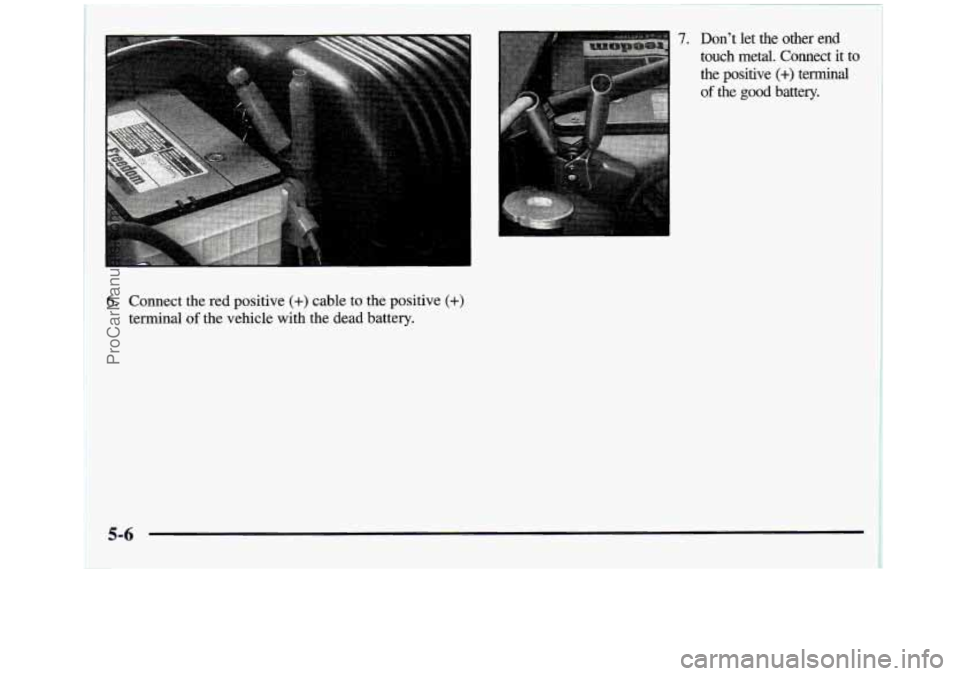
6. Connect the red positive (+) cable to the positive (+)
terminal of the vehicle with the dead battery.
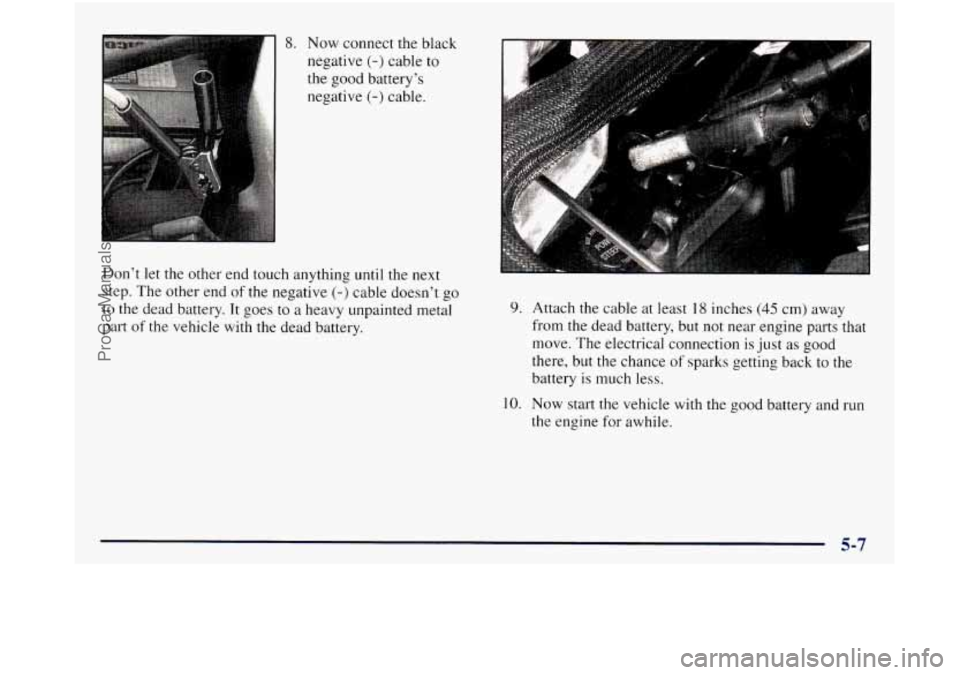
7. Don’t let the other end
touch metal. Connect it to the positive
(+) terminal
of the good battery.
5-6 i
ProCarManuals.com
Page 259 of 452
8. Now connect the black
negative
(-) cable to
the good battery’s negative
(-) cable.
Don’t
let the other end touch anything until the next
step. The other end
of the negative (-) cable doesn’t go
to the dead battery. It goes to
a heavy unpainted metal
part
of the vehicle with the dead battery.
9. Attach the cable at least 18 inches (45 cm) away
from the dead battery, but not near engine parts that
move. The electrical connection is just
as good
there, but the chance
of sparks getting back to the
battery is much less.
10. Now start the vehicle with the good battery and run
the engine
for awhile.
5-7
ProCarManuals.com
Page 260 of 452
11. Try to start the vehicle with the dead battery.
If it won’t start after
a few tries, it probably
needs service.
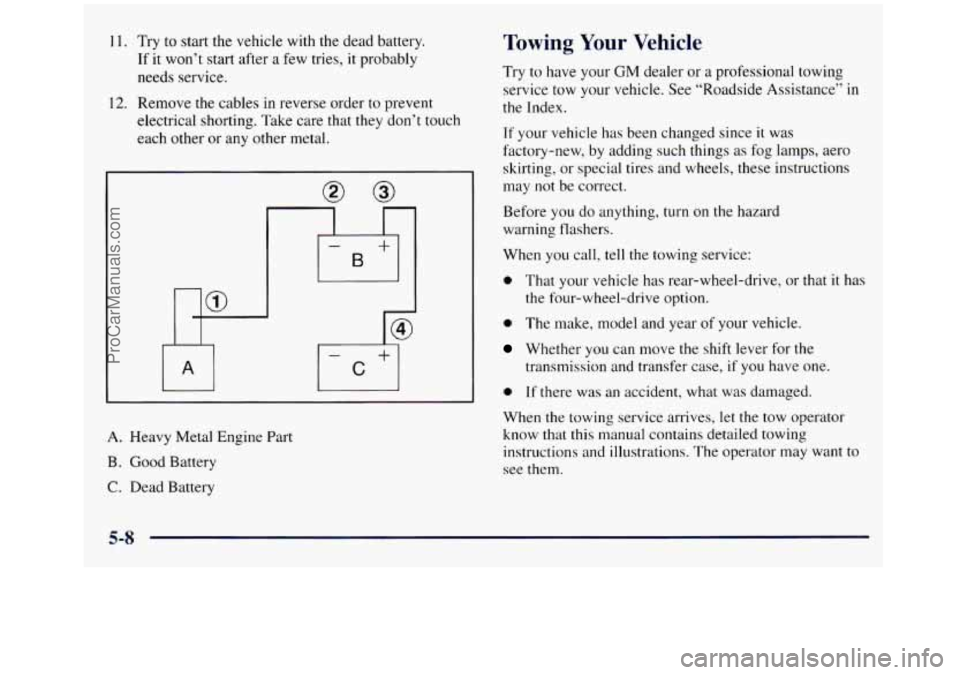
12. Remove the cables in reverse order to prevent
electrical shorting. Take care that they don’t touch
each other or any other metal.
A. Heavy Metal Engine Part
B. Good Battery
C. Dead Battery
Towing Your Vehicle
Try to have your GM dealer or a professional towing
service tow your vehicle. See “Roadside Assistance’’
in
the Index.
If your vehicle has been changed since it was
factory-new, by adding such things
as fog lamps, aero
skirting, or special tires and wheels, these instructions
may not be correct.
Before you do anything, turn on the hazard
warning flashers.
When you call, tell the towing service:
0 That your vehicle has rear-wheel-drive, or that it has
the four-wheel-drive option.
0 The make, model and year of your vehicle.
Whether you can move the shift lever for the
0 If there was an accident, what was damaged.
When
the towing service arrives, let the tow operator
know that this manual contains detailed towing
instructions and illustrations. The operator may want to
see
them.
transmission and transfer case, if you have one.
5-8
ProCarManuals.com
Page 291 of 452

Section 6 Service and Appearance Care
Here you will find information about the care of your vehicle. This section begins with service and fuel information,
and then it shows how to check important fluid and lubricant levels. There is also technical information about your
vehicle, and
a part devoted to its appearance care.
6-2
6-3
6-5
6-6
6- 8
6-9
6- 13
6- 14
6-18
6-2
I
6-24
6- 25
6-26
6-26
6-28 6-32
6-32 Service
Fuel (Gasoline Engine)
Fuels
in Foreign Countries (Gasoline Engines)
Filling Your Tank (Gasoline Engine)
Filling a Portable Fuel Container
Checking Things Under the Hood
Noise Control System
Engine Oil (Gasoline Engine)
Air Cleaner Filter (Gasoline Engine)
Automatic Transmission Fluid
Manual Transmission Fluid
Hydraulic Clutch
Rear Axle
Four-wheel Drive
Engine Coolant Radiator Pressure Cap (Gasoline Engine)
Thermostat
, 6-33
6-3 3
6-35
6-39
6-39
6-50
6-5
1
6-6 1
6-62
6-65 6-69
6-70
6-70
' 6-76
6-77 6-79 Power
Steering Fluid
Windshield Washer Fluid
Brakes
Battery
Bulb Replacement
Windshield Wiper Blade Replacement
Tires
Appearance Care
Cleaning the Inside
of Your Vehicle
Cleaning the Outside of Your Vehicle
Appearance Care Materials Chart
Vehicle Identification Number (VIN)
Electrical System Replacement
Bulbs
Capacities and Specifications
Air Conditioning Refrigerants
6-1
ProCarManuals.com
Page 301 of 452
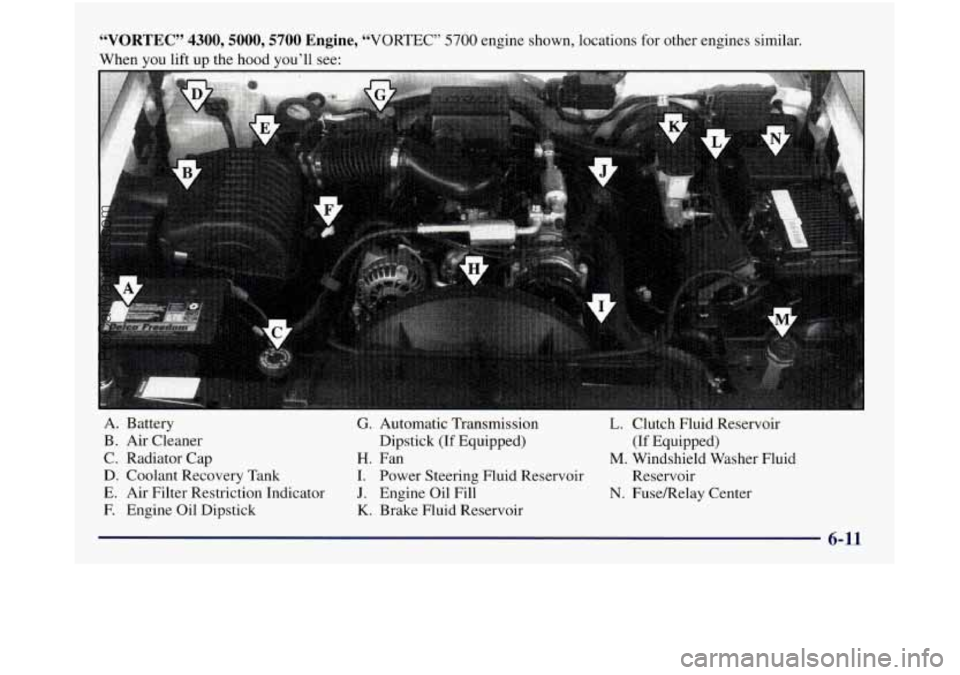
“VORTEC” 4300,5000,5700 Engine, “VORTEC” 5700 engine shown, locations for other engines similar.
When you lift
up the hood you’ll see:
A. Battery
G. Automatic Transmission L. Clutch Fluid Reservoir
B. Air Cleaner
Dipstick
(If Equipped) (If Equipped)
C. Radiator Cap H. Fan M. Windshield Washer Fluid
D. Coolant Recovery Tank I. Power Steering Fluid Reservoir Reservoir
E. Air Filter Restriction Indicator J. Engine Oil Fill N. FuseRelay Center
F. Engine Oil Dipstick K. Brake Fluid Reservoir
6-11
ProCarManuals.com
Page 302 of 452
“VORTEC” 7400 Engine
A. Battery
B. Coolant Recovery Tank
C. Air Cleaner
D. Radiator Cap
E. Air Filter Restriction Indicator
F. Engine Oil Dipstick
G. Automatic Transmission L. Clutch Fluid Reservoir
Dipstick (If Equipped)
(If Equipped)
H. Engine Oil Fill M. Windshield Washer
I. Fan Fluid Reservoir
J. Power Steering Fluid Reservoir N. Fusemelay Center
K. Brake Fluid Reservoir
ProCarManuals.com
Page 308 of 452
What to Do with Used Oil
Did you know that used engine oil contains certain
e.lements
that may be unhealthy for your skin and could
even cause cancer? Don’t let used oil stay on your skin
for very long. Clean your skin and nails with soap and
water, or a good hand cleaner. Wash or properly throw
away clothing or rags containing used engine oil. (See
the manufacturer’s warnings about
the use and disposal
of oil products.)
Used oil can be a real threat
to the environment. If you
change your own
oil, be sure to drain all free-flowing oil
from the filter before disposal. Don’t ever dispose of oil
by putting
it in the trash, pouring it on the ground, into
sewers, or into streams
or bodies of water. Instead,
recycle it by taking it to a place that collects used oil.
If
you have a problem properly disposing of your used oil,
ask your dealer, a service station or a local recycling
center for help.
Air Cleaner (Gasoline Engines)
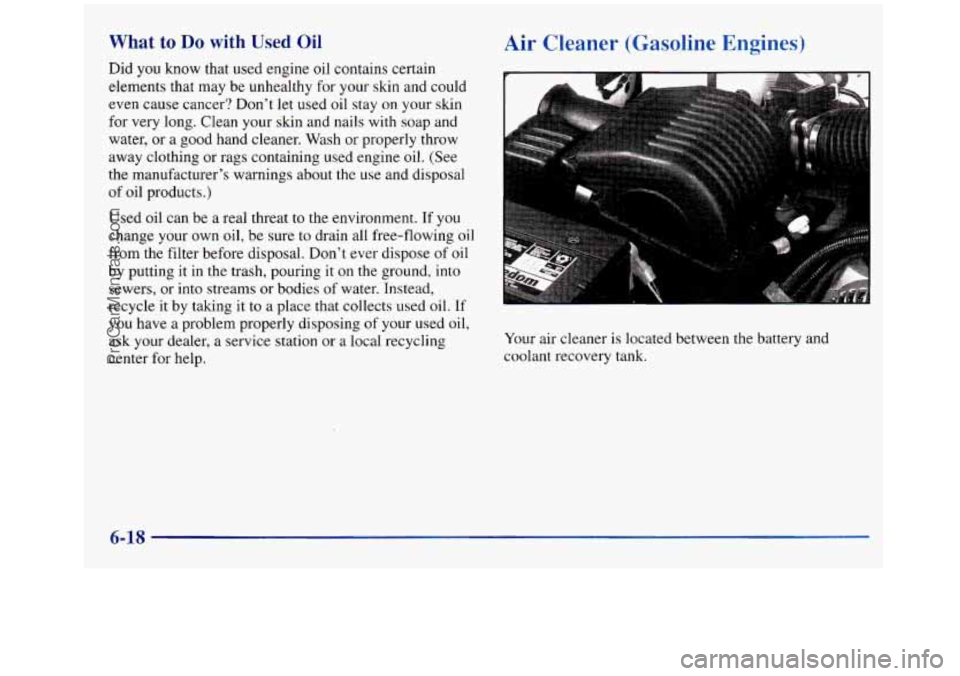
Your air cleaner is located between the battery and
coolant recovery tank.
6-18
ProCarManuals.com
Page 329 of 452
Battery
Every new vehicle has an ACDelco Freedom@ battery.
You never have to add water to one of these. When it’s
time for a new battery, we recommend an ACDelco
Freedom battery. Get one that has the replacement
number shown
on the original battery’s label.
Vehicle Storage
If you’re not going to drive your vehicle for 25 days
or more, remove the black, negative
(-) cable from
the battery. This
will help keep your battery from
running down.
Batteries have acid that can burn you and gas
that can explode. You can be badly hurt if
you
aren’t careful. See “Jump Starting” in the Index
for tips on working around
a battery without
getting hurt. Contact
your dealer to learn how
to prepare your vehicle
for longer storage periods.
Also, for your audio system. see “Theft-Deterrent
Feature”
in the Index.
Bulb Replacement
Before you replace any bulbs, be sure that all the lamps
are off and the engine isn‘t running. See “Replacement
Bulbs”
in the Index for the proper types of bulbs to use.
1 6!!, CAUTION:
Halogen bulbs have pressurized gas inside and
can burst if you drop or scratch the bulb.
You or
others could be injured. Be sure to read
and
follow the instructions on the bulb package.
6-39
ProCarManuals.com