Page 211 of 386

Trailer Wiring Harness
The heavy-duty trailer wiring is an eight-wire harness
assembly. The harness is stored under the vehicle, on the
driver’s side corner frame rear crossmember. The
heavy-duty trailer wiring has a 30-amp feed wire
with
an in-line fuse located by the junct.ion block. See “Fuses
and Circuit Breakers”
in the Index. The harness does not
have a cannector and should be wired by
a qualified
electrical technician. The technician can use the
following color code chart when connecting the wiring
harness
to your trailer.
0
0
0
0
0
0
0
0
Dark Blue: Use for electric trailer brakes or
auxiliary wiring.
Red: Use for battery charging;
it connects to the
starter solenoid.
Light Green: Back-up lamps.
Brown: Taillamps and parking lamps.
Yellow: Left stoplamp and turn signal.
Dark Green: Right stoplamp
and turn signal.
White (Heavy Gage): Ground wire.
White (Light Gage): Auxiliary stoplamp.
Securely attach the harness to the trailer, then tape or
strap
it to your vehicle’s frame rail. Be sure you leave it
loose enough so the wiring doesn’t bend or break, but
not
so loose that it drags on the ground. Store the
harness
in its original place. Wrap the harness together
and tie
it neatly so it won’t be damaged.
4-52
ProCarManuals.com
Page 219 of 386
JTION:
A vehicle can fall from a car carrier if it isn’t
adequately secured. This can cause
a collision,
serious personal injury and vehicle damage. The
vehicle should be tightly secured with chains or
steel cables before it is transported.
Don’t use substitutes (ropes, leather straps,
canvas webbing, etc.) that can be cut by sharp
edges underneath the towed vehicle. Always use
T-hooks inserted in the T-hook slots. Never use
J-hooks. They will damage drivetrain and
suspension components.
When your vehicle is being towed, have the ignition key
turned
to the OFF position. The steering wheel should
be clamped
in a straight-ahead position with a clamping
device designed for towing service.
Do not use the
vehicle’s steering column lock for this. The transmission
should be in NEUTRAL
(N) and the transfer case
should be
in 2HI. The parking brake should be released.
If your vehicle has no electrical power, the electrical
solenoid lock
must be overridden to shift from
PARK (P) to NEUTRAL (N). Follow these steps:
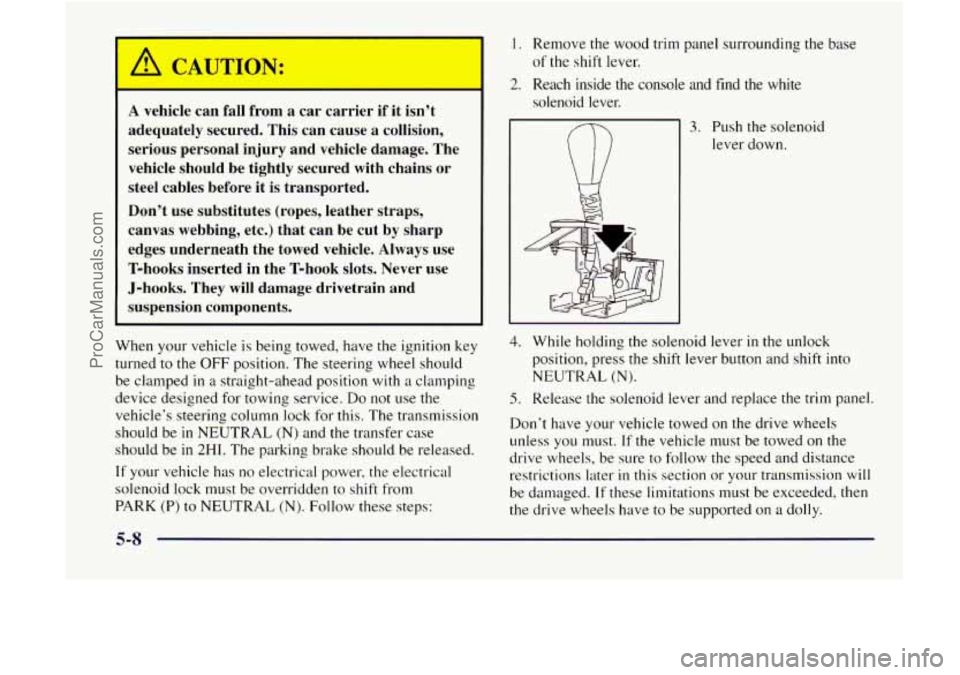
1 I Remove the wood trim panel surrounding the base
2. Reach inside the console and find the white of the shift lever.
solenoid lever.
(ii
3. Push the solenoid
lever down.
4. While holding the solenoid lever in the unlock
position, press the shift lever button and shift into
NEUTRAL
(N).
5. Release the solenoid lever and replace the trim panel.
Don’t have your vehicle towed on the drive wheels
unless
you must. If the vehicle must be towed on the
drive wheels, be sure to follow the speed and distance
restrictions later
in this section or your transmission will
be damaged. If these limitations must be exceeded, then
the drive wheels have to be supported
on a dolly.
5-8
ProCarManuals.com
Page 228 of 386
How to Add Coolant to the Radiator
2. Then keep turning the pressure cap, but now push
down as you
turn it. Remove the pressure cap.
I. You can remove the radiator pressure cap when the
cooling
system. including the radiator pressure cap and
upper radiator hose, is no longer hot. Turn the pressure
cap slowly counterclockwise
until it first stops. (Don’t
press down while turning the pressure cap.)
If you hear a hiss, wait for that to stop. A hiss means
there is still some pressure left.
5-17
ProCarManuals.com
Page 232 of 386
Changing a Flat Tire
If a tire goes flat, avoid further tire and wheel damage
by driving slowly to a level place. Turn on
your hazard
warning flashers.
A CAUTION:
I
Changing a tire can cause an injury. The vdcle
can slip
off the jack and roll over you or other
people. You and they could be badly injured.
Find a level place to change your tire. To help
prevent the vehicle from moving:
1. Set the parking brake firmly.
2. Put the shift lever in PARK (P).
3. lbrn off the engine.
4. Put the wheel blocks at the front and
rear of the tire farthest away from the
one being changed. That would be the
tire on the other side of the vehicle,
at
the opposite end.
The following steps will tell you how to use the jack and
change a tire.
5-21
ProCarManuals.com
Page 233 of 386
Removing the Spare Tire and Tools
The jacking equipment you’ll need is stored along the
driver’s side inner rear quarter panel. Your vehicle is
also equipped with work gloves and a plastic ground
mat to assist in the changing
of a flat tire.
To remove your jack
cover, pull up on the latches
on the cover. Remove the
wheel blocks, jack and
wheel wrench.
NOTICE:
Never remove or restow a tire frodto a stowage
position under the vehicle while the vehicle is
supported by a jack. Always tighten the tire
fully against the underside of the vehicle
when restowing.
5-22
ProCarManuals.com
Page 241 of 386
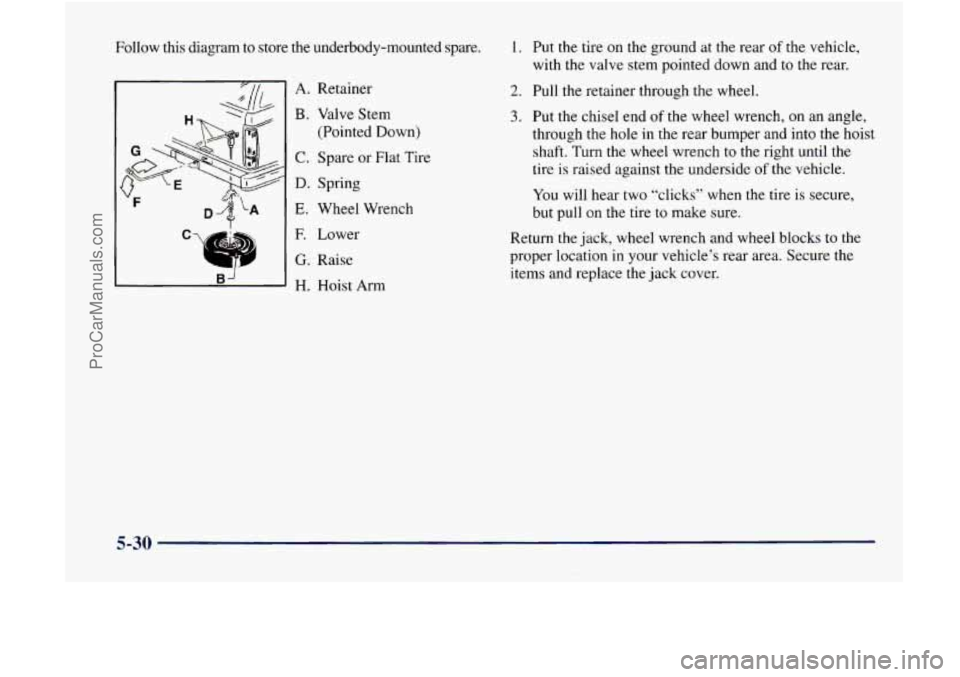
Follow this diagram to store the underbody-mounted spare.
Retainer Valve Stem
(Pointed Down)
Spare or Flat Tire
Spring
Wheel Wrench
“3 -1- b
E Lower
G. Raise
I BJ I H. Hoist Arm
1. Put the tire on the ground at the rear of the vehicle,
with the valve stem pointed down and to the rear.
2. Pull the retainer through the wheel.
3. Put the chisel end of the wheel wrench, on an angle,
through
the hole in the rear bumper and into the hoist
shaft. Turn the wheel wrench to the right until the
tire is raised against the underside
of the vehicle.
You will hear two “clicks” when the tire is secure,
but pull on
the tire to make sure.
Return the jack, wheel wrench and wheel blocks
to the
proper location
in your vehicle’s rear area. Secure the
items and replace the jack cover.
5-30
ProCarManuals.com
Page 242 of 386
L
A. Retainer
B. Rubber Band (Some Models)
C. Work Gloves
D. Ground Mat
E. Jack Storage Cover
E Wheel Blocks
G. Wheel Wrench
H. Jack
1. Jacking Instructions
-
/I CAUTION:
Make sure the tire and carrier are secure.
Driving with the tire or carrier unlatched could
injure pedestrians
or damage the vehicle.
5-31
ProCarManuals.com
Page 253 of 386

- , . . .. . , .. , . . . . . . . .
Gasoline vapor is highly flammable. It burns
violently, and that can cause very bad injuries.
Don’t smoke if you’re near gasoline or refueling
your vehicle. Keep sparks, flames and smoking
materials away from gasoline.
While refueling, hang the cap by the tether from the
hook on the filler door.
To remove the cap, turn it slowly to the left
(counterclockwise). The cap has a
spring in it; if you let
go of the cap too
soon, it will spring back to the right.
A CAUTION:
I
If you get gasoline on yourself and then
something ignites it, you could be badly burned.
Gasoline can spray out on you
if you open the
fuel filler cap too quickly. This spray can happen
if your tank
is nearly full, and is more likely in
hot weather. Open the fuel filler cap slowly and
wait for any “hiss” noise
to stop. Then unscrew
the cap all the way.
Be careful not to spill gasoline. Clean gasoline from
painted surfaces as soon as possible. See “Cleaning the
Outside
of Your Vehicle” in the Index.
6-6
ProCarManuals.com