1998 GMC ENVOY weight
[x] Cancel search: weightPage 200 of 386
Using heavier suspension components to get added
durability might not change your weight ratings. Ask
your dealer to help you load your vehicle the right way.
-
NOTICE:
Your warranty does not cover parts or
components that fail because of overloading.
If you put things inside your vehicle -- like suitcases,
tools, packages, or anything else
-- they will go as fast
as the vehicle goes. If you have to stop or turn quickly,
or if there is a crash, they’ll keep going.
A CAUmmdN:
Things you put inside your vehicle can strike and
injure people in a sudden stop or turn, or in
a crash.
0 Put things in the cargo area of your vehicle.
0 Never stack heavier things, like suitcases,
Try to spread the weight evenly.
inside the vehicle
so that some of them are
above the tops of the seats.
0 Don’t leave an unsecured child restraint in
your vehicle.
0 When you carry something inside the
vehicle, secure
it whenever you can.
0 Don’t leave a seat folded down unless you
need to.
There’s also important loading information for off-road
driving in this manual. See “Loading Your Vehicle for
Off-Road Driving” in the Index.
4-41
ProCarManuals.com
Page 201 of 386

Payload
The payload capacity is shown on the CertificationRire
label. This is the maximum load capacity that your
vehicle can carry. Be sure to include the weight of the
occupants as part
of your load. If you added any
accessories or equipment after your vehicle left the
factory, remember to subtract the weight
of these things
from the payload.
Your dealer can help you with this.
Electronic Level Control
The rear of the vehicle is automatically kept level as you
load
or unload your vehicle. However, you should still
not exceed the
GVWR or the GAWR.
The ignition has to be on for the level control to work.
The system includes a small electric air compressor and
air-adjustable rear shock absorbers.
You may hear the compressor operating when you load
or unload your vehicle, and periodically
as the system
self-adjusts. This is normal. The compressor should operate for
brief periods
of time
If the sound continues for an extended period of time,
your vehicle needs service.
To keep your battery from
being drained. you may want to remove the
LD LEV
fuse in the fuse control panel until you can get your
vehicle serviced (see “Fuses and Circuit Breakers”
in
the Index).
Using heavier suspension components to get added
durability might not change your weight ratings.
Ask
your dealer to help you load your vehicle the right way.
NOTICE:
Your warranty does not cover parts or
components that fail because
of overloading.
ProCarManuals.com
Page 203 of 386

Every vehicle is ready for some trailer towing. If yours
was built with trailering options, as many are, it’s ready
for heavier trailers. But trailering is different than just
driving your vehicle by itself. Trailering means changes
in handling, durability and fuel economy. Successful,
safe trailering takes correct equipment, and
it has to be
used properly.
That’s
the reason for this part. In it are many
time-tested, important trailering tips and safety rules. Many
of these are important for your safety and that of
your passengers.
So please read this section carefully
before you pull a trailer.
If You Do Decide To Pull A Trailer
If you do, here are some important points:
0
0
There are many different laws, including speed limit
restrictions, having to do with trailering. Make sure
your rig will be legal, not only where you live but
also where you’ll be driving.
A good source for this
information can be state or provincial police.
Consider using a sway control if your trailer
will
weigh 2,000 lbs. (900 kg) or less. You should always
use a sway control if your trailer will weigh more
than
2,000 Ibs. (900 kg). You can ask a hitch dealer
about sway controls.
0
0
0
Don’t tow a trailer at all during the first 500 miles
(800 km) your new vehicle is driven. Your engine,
axle or other parts could be damaged.
Then, during the first
500 miles (800 km) that you
tow a trailer, don’t drive over 50 mph (80 km/h) and
don’t make starts at full throttle. This helps your
engine and other parts of
your vehicle wear in at the
heavier loads.
You should use DRIVE
(D) (or, as you need to, a
lower gear) when towing a trailer. Operating your
vehicle
in DRIVE (D) when towing a trailer will
minimize heat buildup and extend the life
of
your transmission.
Three important considerations have to
do with weight:
the weight of the trailer,
0 the weight of the trailer tongue
0 and the weight on your vehicle’s tires.
4-44
ProCarManuals.com
Page 204 of 386
Weight of the Trailer
How heavy can a trailer safely be?
It depends on how you plan to use your rig. For
example, speed, altitude, road grades, outside
temperature and how much
your vehicle is used to pull a
trailer are all important. And,
it can also depend on any
special equipment that you have
on your vehicle.
The trailer should never weigh more than
5,000 lbs.
(2 268 kg). But even that can be too heavy.
Maximum trailer weight is calculated assuming the
driver and one passenger are
in the tow vehicle and it
has all the required trailering equipment. The weight of
additional optional equipment, passengers and cargo
in
the tow vehicle must be subtracted from the maximum
trailer weight.
You can ask your dealer for OUT trailering information or
advice, or you can write us
at the address listed in your
Warranty and Owner Assistance Information Booklet.
In Canada. write to:
General Motors of Canada Limited
Customer Communication Centre 1908 Colonel Sam Drive
Oshawa, Ontario
LlH 8P7
Weight of the Trailer Tongue
The tongue load (A) of any trailer is an important
weight to measure because it affects the total or gross
weight of your vehicle. The Gross Vehicle Weight
(GVW) includes the curb weight
of the vehicle, any
cargo you may carry
in it, and the people who will be
riding in the vehicle. And
if you will tow a trailer, you
must add the tongue load to the GVW because your
vehicle will be carrying that weight, too, See “Loading
Your Vehicle”
in the Index for more information about
your vehicle’s maximum load capacity.
4-45
1
ProCarManuals.com
Page 205 of 386
A B
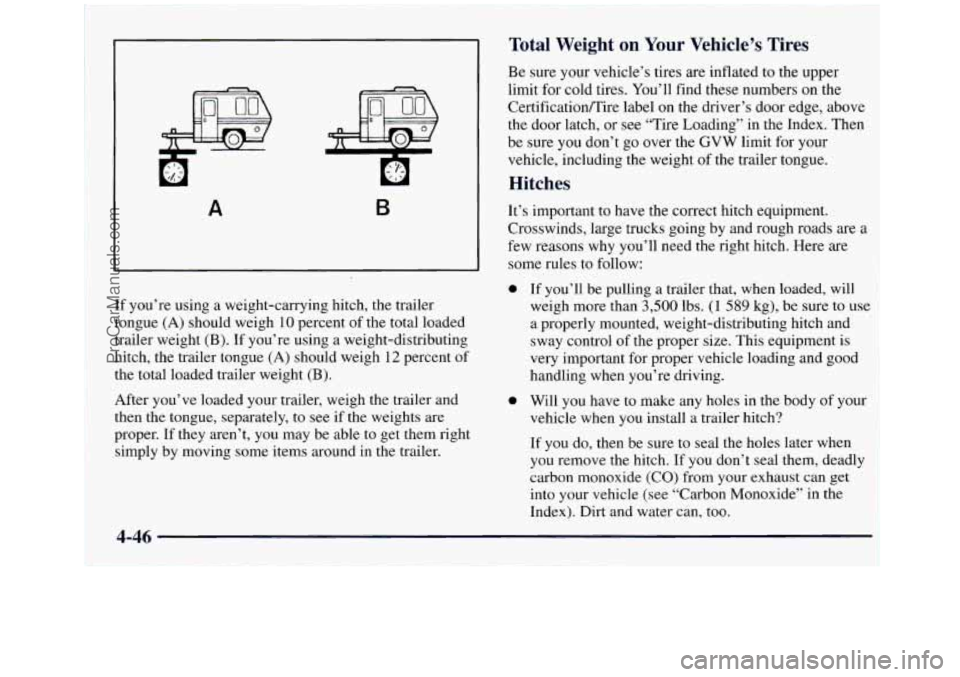
If you’re using a weight-carrying hitch, the trailer
tongue (A) should weigh
10 percent of the total loaded
trailer weight
(B). If you’re using a weight-distributing
hitch, the trailer tongue
(A) should weigh 12 percent of
the total loaded trailer weight (B).
After you’ve loaded your trailer, weigh the trailer and
then the tongue, separately, to see if the weights are
proper. If they aren’t,
you may be able to get them right
simply by moving some items around in the trailer.
1 Total Weight on Your Vehicle’s Tires
Be sure your vehicle’s tires are inflated to the upper
limit for cold tires. You’ll find these numbers on the
CertificatiodTire label on the driver’s door edge, above
the door latch, or see “Tire Loading”
in the Index. Then
be sure
you don’t go over the GVW limit for your
vehicle, including the weight
of the trailer tongue.
Hitches
It’s important to have the correct hitch equipment.
Crosswinds, large trucks going by and rough roads are a
few reasons why you’ll need the right hitch. Here are
some rules to follow:
0 If you’ll be pulling a trailer that, when loaded, will
weigh more than
3,500 lbs. (1 589 kg), be sure to use
a properly mounted, weight-distributing hitch and
sway control of the proper size. This equipment is
very important for proper vehicle loading and good
handling when you’re driving.
0 Will you have to make any holes in the body of your
vehicle when you install
a trailer hitch?
If you do, then be sure to seal the holes later when
you remove the hitch. If you don’t seal them, deadly
carbon monoxide (CO) from your exhaust can get
into your vehicle (see “Carbon Monoxide” in the
Index). Dirt and water can, too.
4-46
ProCarManuals.com
Page 207 of 386

Driving with a Trailer
A CAUTION: I
0
0
0
If you have a rear-most window open and you
pull a trailer with your vehicle, carbon monoxide
(CO) could come into your vehicle. You can’t see
or smell
CO. It can cause unconsciousness or
death. (See ‘(Engine Exhaust” in the Index.) To
maximize your safety when towing a trailer:
Have your exhaust system inspected for
leaks, and make necessary repairs before
starting on your trip.
Keep the rear-most windows closed.
If exhaust does come into your vehicle
through a window in the rear or another
opening, drive with your front, main
heating or cooling system on and with the
fan on any speed. This will bring fresh,
outside air into your vehicle.
Do not use
RECIRCULATION because it only
recirculates the air inside your vehicle. (See
“Comfort Controls” in the Index.)
Towing a trailer requires a certain amount of experience, ~
Before setting out for the open road, you’ll want to get
to know your rig. Acquaint yourself with the feel of
handling and braking with the added weight of the
trailer. And always keep in mind that the vehicle you
arc
driving is now a good deal longer and not nearly as
responsive as your vehicle is by itself.
Before you
start, check the trailer hitch and platform
(and attachments), safety chains, electrical connector,
lamps, tires and mirror adjustment. If the trailer has
electric brakes, start your vehicle and trailer moving and
then apply the trailer brake controller by hand to be sure
the brakes are working. This lets you check your
electrical connection at the same time.
During your trip, check occasionally to
be sure that the
load is secure, and that the lamps and any trailer brakes
are still working.
Following Distance
Stay at least twice as far behind the vehicle ahead as you 1
would when driving your vehicle without a trailer. This
can help you avoid situations that require heavy braking
and sudden turns.
4-48
ProCarManuals.com
Page 378 of 386

GloveBox .................................... 2-42
Gross Axle Weight Rating ........................ 4-40
Gross Vehicle Weight Rating ...................... 4-40
Guide en Franpis
11 .. .................................
GVWR ....................................... 4-40
Halogen Bulbs
................................ 6-32
Hazard Warning Flashers
.......................... 5-2
Head Restraints
................................. 1-5
Headlamps .................................... 2-36
Bulb Replacement
............................ 6-32
HighLow Beam Changer
...................... 2-3 1
On Reminder ................................ 2-37
Hearing Impaired. Customer Assistance
.............. 8-4
Heated Front Seats
............................... 1-3
Heated Outside Rearview Mirror ................... 2-42
High Intensity Discharge Lighting
.................. 6-3 1
Highway Hypnosis .............................. 4-34
Hill and Mountain Roads
......................... 4-34
Hitches. Trailer
................................. 4-46
Hood
.......................................... 6-8
Horn ......................................... 2-29
Hydroplaning
.................................. 4-30
Heating
........................................ 3-5
Ignition Positions
.................................... 2-14
Transmission Lock Check
...................... 7-42
Ignition Transmission Lock Check
................. 7-42
Illuminated Entry
............................... 2-39
Inflation. Tire
............................. 6-37. 7-39 Inflator
. Accessory .............................. 2-50
Inspections
Brakesystem
................................ 7-44
Engine Cooling Systetn
........................ 7-43
Exhaust Systems
............................. 7-43
Front Drive Axle Boot Seal
..................... 7-43
Steering
.................................... 7-43
Suspension
.................................. 7-43
Throttle System
.............................. 7-44
Transfer
Case ................................ 7-44
Instrument Panel
............................... 2-58
Cleaning
.................................... 6-48
Cluster
..................................... 2-60
FuseBlock
.................................. 6-56
Interior Lamps ................................. 2-39
Jacking Equipment
............................. 5-24
Jump Starting
................................... 5-3
Key
in the Ignition ............................. 2-11
Key Lock Cylinders Service
...................... 7-40
Keyless Entry System
............................ 2-6
Keys
.......................................... 2-2
Labels
Certification/Tire
............................. 4-40
Fuse
.................................. 6.56. 6.58
Safety Belt
.................................. 1-53
Service Parts Identification ..................... 6-54
Vehicle Identification Number
................... 6-54
ProCarManuals.com
Page 383 of 386

Tires (Continued)
Uniform Quality Grading
. . . . . . . . . . . . . . . . . . . . . . . 6-41
Wear Indicators
. . . . . . . . . . . . . . . . . . . . , . . . . . . . . . 6-40
When It’s Time for New
. . . . . . . . . . . . . . . . . . . . . . 6-40
TopStrap
..................................... 1-43
TorqueLock
.,..................................2-23
Torque, Wheel Nut . . . . . . . . . . . . . . . . . . . . . . . . . 5-29,6-60
Towing a Trailer
. . . . . . . . . . . . . . . . . . . . . . . . . . . . . . . . 4-43
Towing, Recreational Vehicle
. . . . . . . . . . . . . . . . . . . . . 4-39
Towing Your Vehicle
. . . . . . . . . . . . . . . . . . . . . . . . . . . . . 5-7
Trailer Brakes
.....................................4-47
Driving on Grades . . . . . . . . . . . . . . . . . . . . . . . . . . . . 4-50
Driving with a Trailer . . . . . . . . . , , . . . . . . . . . . . . . . . 4-48
Hitches
.........................................
Maintenance When Towing . . . . . . . . . . . . . . . . . . . . . 4-5 1
Parking on Hills . . . . . . . . . . . . , . . . . . . . . . . . . . . . . . 4-50
Safety Chains
. . . . . . . . . . . . . . . . . . . . . . . . . . . . . . . . 4-47
Tongueweight
...............................4-45
Total Weight on Tires . . . . , . . . . . . . . . . . . . . . . . . . . . 4-46
Towing
.........................................
TurnSignals .....................................
Weight .....................................4-45
Wiring Harness . . . . . . . . . . . . . . . . . . . . . . . . . . . . . . . 4-52
Transfer Case
. . . . . . . . . . . . . . . . . . . . . . . . . . . . . . . . . . 6-20
Electronic
. . . . . . . . . . . . . . . . . . . . . . . . . . . . . . . . . . 2-26
Transmission Fluid, Automatic
. . . . . . . . . . . . , . . . . . . . 6- 15
Transmitters, Keyless Entry . . . . . . . . . . . . . . . . . . . . . . . . 2-6
Transportation, Courtesy
. . . . . . . . . . . . . . . . . . . . . . . . . . 8-8
Trip, Before Leaving . . . . . . . . . . . . . . . . . . . . . . . . . . . . 4-33 Trip Odometer
. . . . . . . . . . . . . . . . . . . . . . . . . . . . . . . . . 2-61
TTYUsers
..................................... 8-4
Turn Signal and Lane Change Signals . . . . . . . . . . . . . . . 2-31
Turn Signals When Towing a Trailer
. . . . . . . . . . . . . . . . 4-49
Underbody Flushing
. . . . . . . . . . . . . . . . . . . . . . . . . . . 7-42
Underbody Maintenance
......................... 6-52
Universal Transmitter
. . . . . . . . . . . . . . . . . . . . . . . . . . . . 2-53
Accessories
.....................................
Erasing Channels . . . . . . . . . . . . . . . . . . . . . , . . . . . . . 2-57
Operation
. . . . . . . . . . . . . . , . . . . . . . . . . . . . . . . , . . . 2-55
Programming
................................2-54
Rolling Code Openers . . . . . . . . . . . . . . . . . . . . . . . . . 2-56
Used Replacement Wheels
. . . . . . . . . . . . . . . . . . . . . . . . 6-44
Vehicle Control
. . . . . . . . . . . . . . . . . . . . . . . . . . . . . . . . 4-6
Vehicle Damage Warnings
. . . . . . . . . . . . . . . . . . . . . . . . . . iv
Vehicle Dimensions
. . . . , . . . . . . . . . . . . . . . . . . . . . . . . 6-62
Vehicle Identification Number
. . . . . . . . . . . . . . . . . . . . . 6-54
Vehicle Loading
. . . . . . . . . . . . . . . . . . . . . . . . . . . . . . . 4-40
Vehiclestorage
....................................
Ventilation System . . . . . , . . . . . . . . . . . . . . . . . . . . . . . . . 3-5
Visors, Sun
. . . . , . . . . . . . . . . . . . . . . . . . . . . . . . . . . . . . 2-50
Voltmeter
........,............................2-64
warning Devices . . . . . . . . . . . . . . . . . . . . . . . . . . . . . . . 5-2
Warning Lights, Gages and Indicators
. . . . . . . . . . . . . . . 2-62
Washer Fluid, Windshield
. . . . . . . . . . . . . . . . . . . . , . . . 6-26
Washing Your Vehicle
. . . . . . . , . . . . . . . . . . . . . . . . , . . 6-5 1
9-10
ProCarManuals.com