Page 106 of 192
Trailer brakes
Electric brakes and manual, automatic or surge-type
brakes are safe if installed properly and adjusted to
the manufacturer's specifications. The trailer brakes
must meet local and Federal regulations.
Do not connect a trailer's hydraulic brake
system directly to your vehicle's brake
system. Your vehicle may not have enough braking
power and your chances of having a collision
greatly increase.
The braking system of the tow vehicle is rated for
operation at the GVWR not GCWR.
Trailer lamps
Trailer lamps are required on most towed vehicles.
Make sure your trailer lamps conform to local and
Federal regulations. See your dealer or trailer rental
agency for proper instructions and equipment for
hooking up trailer lamps.
Driving while you tow
Do not drive faster than 88 km/h (55 mph) when
towing a trailer. Do not drive faster than 72 km/h
(45 mph) with any weight on the trailer while
towing on a hot day or in hilly country.
Speed control may shut off if you are towing on
long, steep grades.
When towing a trailer:
²Use D (Drive) or a lower gear when towing up or
down steep hills. This will eliminate excessive
downshifting and upshifting for optimum fuel
economy and transaxle cooling.
²Anticipate stops and brake gradually.
Driving
106
Page 136 of 192
BRAKE FLUID
Checking and adding brake fluid
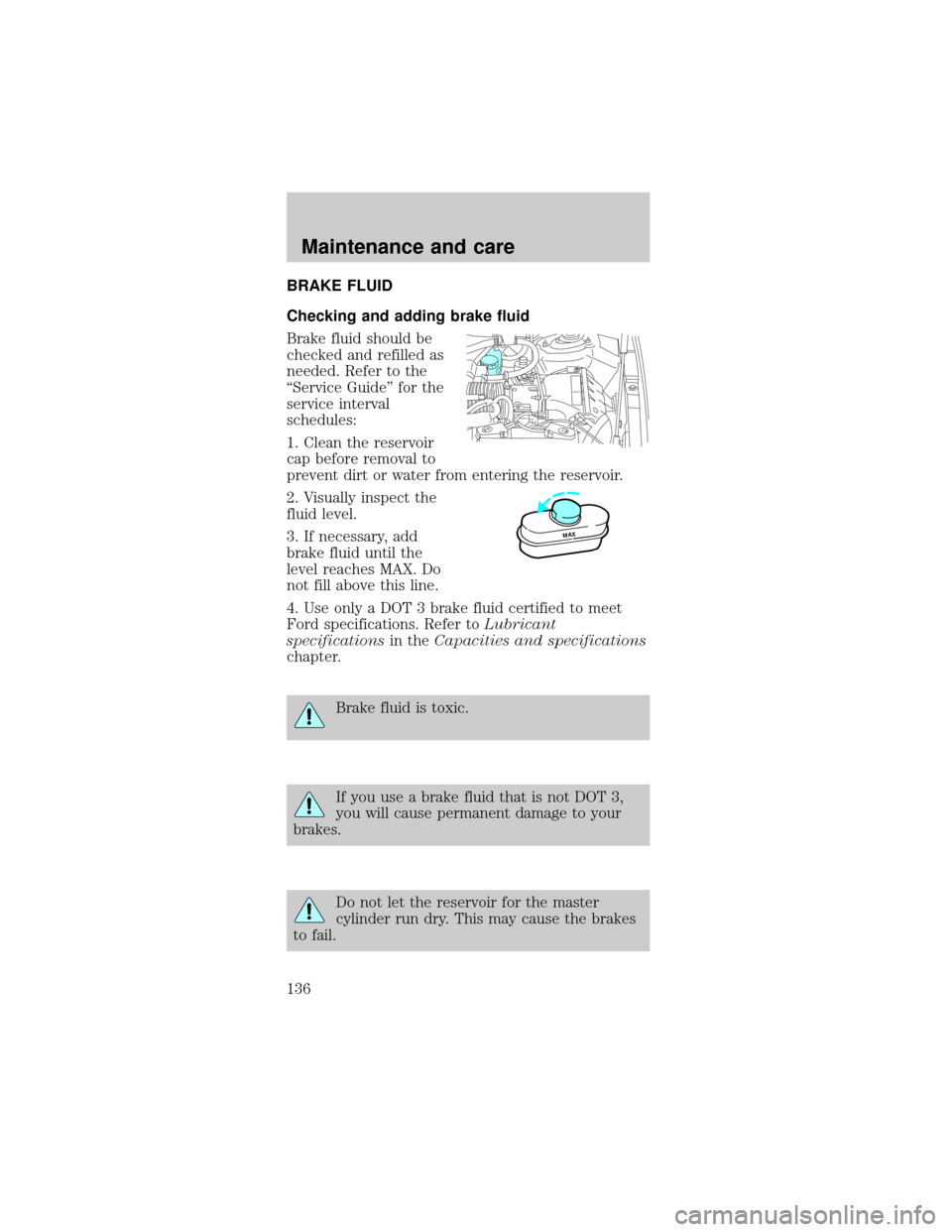
Brake fluid should be
checked and refilled as
needed. Refer to the
ªService Guideº for the
service interval
schedules:
1. Clean the reservoir
cap before removal to
prevent dirt or water from entering the reservoir.
2. Visually inspect the
fluid level.
3. If necessary, add
brake fluid until the
level reaches MAX. Do
not fill above this line.
4. Use only a DOT 3 brake fluid certified to meet
Ford specifications. Refer toLubricant
specificationsin theCapacities and specifications
chapter.
Brake fluid is toxic.
If you use a brake fluid that is not DOT 3,
you will cause permanent damage to your
brakes.
Do not let the reservoir for the master
cylinder run dry. This may cause the brakes
to fail.
MAX
Maintenance and care
136
Page 170 of 192

After washing, apply the brakes several times to dry
them.
Waxing your vehicle
Wax when water stops beading on the surface. This
could be every three or four months, depending on
operating conditions.
Use only carnauba or synthetic-based waxes. Use
cleaning fluid or alcohol with a clean cloth to remove
any bugs and tar before waxing vehicle. Use tar
remover to remove any tar spots.
Avoid getting wax on the windshield. If you have
wax applied at a commercial car wash, it is
recommended that you clean the wiper blades and
windshield as described inCleaning the wiper
blades and windshield.
Repairing paint chips
Minor scratches or paint damage from road debris
may be repaired with touch-up paint, repair foil or
aerosol paint spray from the Ford accessory line.
Observe the application instructions on the
products.
Remove particles such as bird droppings, tree sap,
insect remains, tar spots, road salt and industrial
fallout immediately.
Cleaning the wheels
Wash with the same detergent as the body of your
vehicle. Do not use acid-based or alcohol-based
wheel cleaners, steel wool, fuel or strong detergents.
Never use abrasives that will damage the finish of
special wheel surfaces. Use a tar remover to remove
grease and tar.
Cleaning the engine
Engines are more efficient when they are clean
because grease and dirt buildup keep the engine
warmer than normal. When washing:
Maintenance and care
170
Page 186 of 192

Air bag supplemental
restraint system ........ 67
and child safety
seats ......................... 69
description .............. 67
disposal .................... 72
indicator light ......... 72
passenger air bag ... 70
Air conditioning
automatic temperature
control
system . 22,23,24,25,27
Anti-theft system ...... 47
arming the system .. 47
Automatic transaxle . 94
driving
with ......... 97,98,99,100
Brakes ........................ 90
anti-lock ................... 90
anti-lock brake
system (ABS)
warning light ........... 91
fluid, checking and
adding .................... 136
shift interlock .......... 94
Break-in period ........... 3
Cargo cover .......... 42,43
Cargo net .............. 41,42
Cellular telephone
(see your Cellular
Phone Guide) ............ 40
Child safety seats
attaching with tether
straps ....................... 79
in rear seat ......... 76,78
tether anchorage
hardware ................. 79
Cleaning your
vehicle ...................... 169
built-in
child seat ....... 80,81,84engine
compartment .. 170,172
exterior lamps ....... 173
plastic parts .......... 172
washing .................. 169
waxing ................... 170
wheels .................... 170
wiper blades .......... 173
Console ...................... 39
Controls
power seat ............... 56
Coolant .................... 140
checking
and adding ............ 138
refill capacities ...... 140
Defrost
rear window ............ 18
Doors
central
unlocking ............ 37,38
Emission control
system ...................... 160
Engine
coolant ................... 137
idle speed control . 144
service
points ....... 130,131,132
starting after a
collision ................. 109
Engine block heater . 88
Engine oil
checking and
adding .................... 134
dipstick .................. 133
specifications . 133,135
Exhaust fumes .......... 88
Floor mats ................. 40
Fuel
choosing the
right fuel ................ 158
detergent in fuel ... 160
Index
186
Page 187 of 192

filling your vehicle
with fuel ......... 155,156
quality .................... 159
running out of fuel 160
safety information
relating to
automotive fuels ... 155
Fuses ................. 110,111
Hazard flashers ....... 109
Head restraints ......... 55
Headlamps
high beam ............... 16
Heating ...................... 18
heating and air
conditioning
system ........... 18,19,20
Hood ........................ 129
Ignition ..................... 180
Inspection/maintenance
(I/M) testing ............ 162
Instrument panel
cleaning ................. 173
Keyless entry system
autolock ................... 52
keypad ..................... 50
locking and
unlocking doors ...... 51
programming entry
code .................... 50,51
Keys
key in ignition
chime ....................... 12
positions of the
ignition .................... 28
Lamps ...................... 163
autolamp system ..... 17
daytime running
light .......................... 16
headlamps ............... 16
headlamps, flash to
pass .......................... 17instrument panel,
dimming ................... 17
interior lamps ....... 166
replacing
bulbs ............... 163,166
Lane change indicator
(see Turn signal) ...... 33
Liftgate ...................... 44
remote release ........ 41
Lights, warning and
indicator
air bag ...................... 11
anti-lock brakes
(ABS) ...................... 10
anti-theft ................... 9
brake ........................ 10
charging system ...... 11
cruise indicator ....... 10
door ajar .................... 7
low coolant ................ 9
low fuel ...................... 9
oil pressure ............. 10
overdrive off .............. 9
safety belt ................. 7
service engine
soon ........................ 7,8
speed control .......... 32
turn signal indicator . 6
Locks .......................... 53
childproof ................ 39
Luggage rack ........... 108
Lumbar support,
seats ...................... 56,57
Mirrors
heated ...................... 38
side view mirrors
(power) ................... 38
Moon roof .................. 35
Motorcraft parts ...... 160
Octane rating ... 158,159
Odometer ................... 14
Overdrive .............. 95,96
Index
187