1998 FORD TAURUS change time
[x] Cancel search: change timePage 3 of 192

BREAKING-IN YOUR VEHICLE
There are no particular breaking-in rules for your
vehicle. During the first 1 600 km (1 000 miles) of
driving, vary speeds frequently. This is necessary to
give the moving parts a chance to break in.
If possible, you should avoid full use of the brakes
for the first 1 600 km (1 000 miles).
INFORMATION ABOUT THIS GUIDE
The information found in this guide was in effect at
the time of printing. Ford may change the contents
without notice and without incurring obligation.
Introduction
3
Page 24 of 192
For continuous maximum cooling, push the
temperature control until 16ÉC (60ÉF) is shown in
the display window. The EATC will continue
maximum cooling (disregarding the displayed
temperature) until a warmer temperature is selected
by pressing the temperature control.
For continuous maximum heating, push the
temperature control until 32ÉC (90ÉF) is shown in
the display window. The EATC will continue
maximum heating (disregarding the displayed
temperature) until a cooler temperature is selected
by pressing the temperature control.
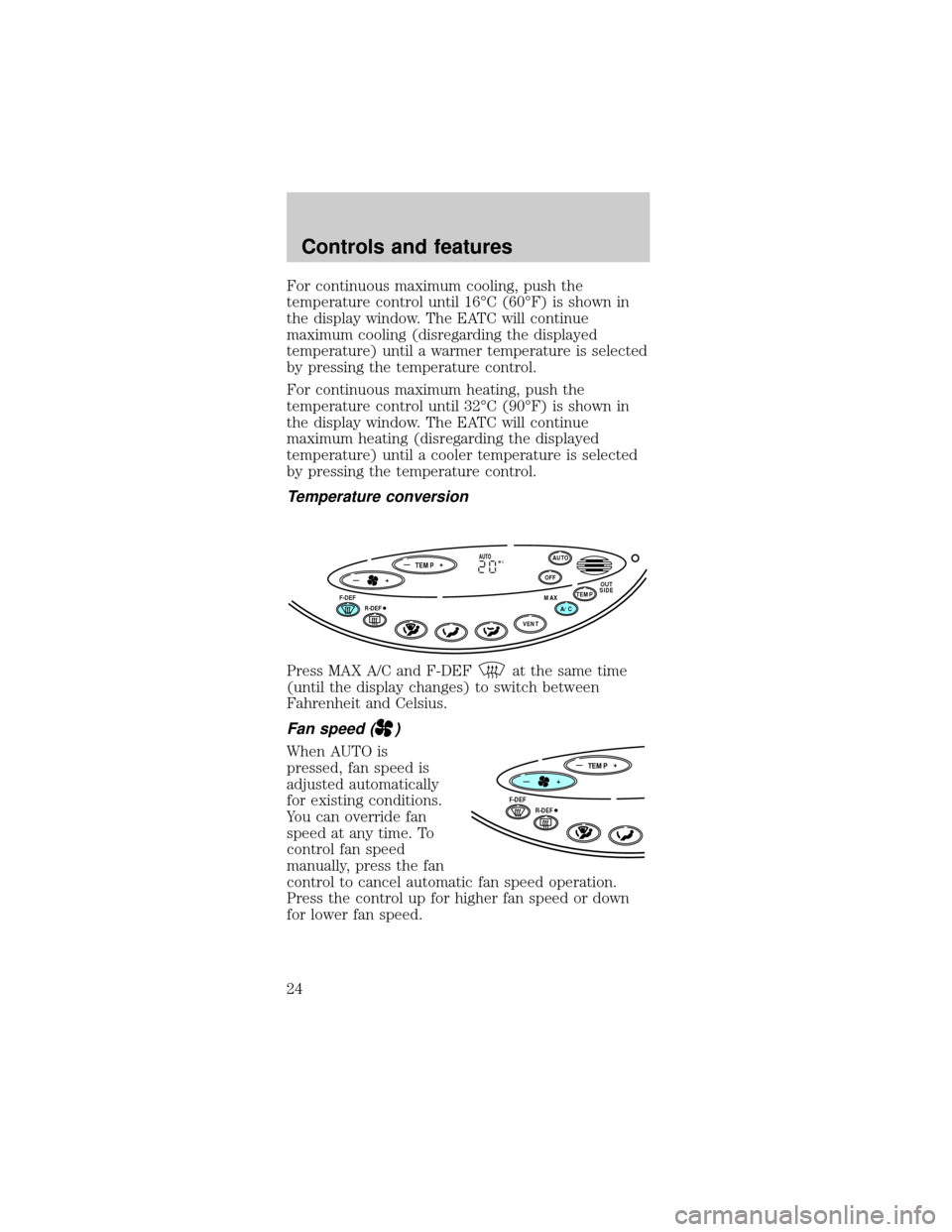
Temperature conversion
Press MAX A/C and F-DEFat the same time
(until the display changes) to switch between
Fahrenheit and Celsius.
Fan speed ()
When AUTO is
pressed, fan speed is
adjusted automatically
for existing conditions.
You can override fan
speed at any time. To
control fan speed
manually, press the fan
control to cancel automatic fan speed operation.
Press the control up for higher fan speed or down
for lower fan speed.
TEMP
—+OFFAUTO
TEMPOUT
SIDEA/C MAXF-DEF
R-DEF
VENT
—+AUTOC
TEMP
—+
F-DEF
R-DEF
—+
Controls and features
24
Page 53 of 192

You must complete steps 1 through 5 within 30
seconds or the procedure will have to be repeated. If
the procedure needs to be repeated, you must wait
30 seconds.
1. Turn the ignition key from OFF to RUN/ACC.
2. Press the power door UNLOCK control three
times.
3. Turn the ignition key from RUN/ACC to OFF.
4. Press the power door UNLOCK control three
times.
5. Turn the ignition key from OFF to RUN/ACC. A
horn chirp indicates the enable/disable feature is
entered.
6. Press the power door UNLOCK control one time.
7. Press the power door LOCK control to toggle the
Autolock/Relock state. You will receive a horn chirp
followed by either a long honk, autolock/relock is
enabled, or no honk, autolock/relock is disabled.
8. Turn ignition to OFF.
If autolock/relock has been changed, the horn will
chirp to confirm procedure is complete.
SECURILOCKYANTI-THEFT SYSTEM
The SecuriLockyanti-theft system provides an
advanced level of vehicle theft protection. Your
vehicle's engine can only be started with the two
special SecuriLockyelectronically coded keys
provided with your vehicle. Each time you start your
vehicle, the SecuriLockykey is read by the
SecuriLockyanti-theft system. If the SecuriLocky
key identification code matches the code stored in
the SecuriLockyanti-theft system, the vehicle's
engine is allowed to start. If the SecuriLockykey
identification code does not match the code stored
in the system or if a SecuriLockykey is not
detected (vehicle theft situation), the vehicle's
engine will not operate.
Controls and features
53
Page 65 of 192

Due to folding rear seats, sometimes the buckles and
tongues toward the center of the vehicle may be
hidden by the rear edge of the seat cushion. Pull
them out so they will be accessible.
While you are fastened in the seat belt, the shoulder
belt adjusts to your movement. However, if you
brake hard, turn hard or your vehicle receives an
impact of 8 km/h (5 mph) or more, the safety belt
will become locked and help reduce your forward
movement.
To unfasten the belt, push the red release button on
the end of the buckle. This allows the tongue to
unlatch from the buckle. While the belt retracts,
guide the tongue to its original position to prevent it
from striking you or the vehicle.
Safety belt extension assembly
If the safety belt assembly is too short, even when
fully extended, 20 cm (8 inches) can be added to
the safety belt assembly by adding a safety belt
extension assembly (part number 611C22). Safety
belt extension assemblies can be obtained from your
dealer at no cost.
Use only extensions manufactured by the same
supplier as the safety belt. Manufacturer
identification is located at the end of the webbing on
the label. Also, use the safety belt extension only if
the safety belt is too short for you when fully
extended. Do not use extensions to change the fit of
the shoulder belt across the torso.
Safety belt warning light and indicator chime
The seat belt warning light illuminates in the
instrument cluster and a chime sounds to remind
the occupants to fasten their safety belts.
Seating and safety restraints
65
Page 89 of 192

If you ever smell exhaust fumes of any kind
inside your vehicle, have your dealer inspect
and fix your vehicle immediately. Do not drive if
you smell exhaust fumes. These fumes are harmful
and could kill you.
Have the exhaust and body ventilation systems
checked whenever:
²the vehicle is raised for service.
²the sound of the exhaust system changes.
²the vehicle has been damaged in a collision.
Engine exhaust, some of its constituents,
and certain vehicle components contain or
emit chemicals known to the State of California to
cause cancer, and birth defects or other
reproductive harm.
Important ventilating information
If the engine is idling while the vehicle is stopped in
an open area for long periods of time, open the
windows at least 2.5 cm (one inch).
Adjust the heating or air conditioning (if equipped)
to bring in fresh air.
Improve vehicle
ventilation by keeping
all air inlet vents clear
of snow, leaves and
other debris.
Starting
89
Page 115 of 192

Fuse/
Relay
LocationFuse
Amp
RatingDescription
7 40A** Rear Window Defrost Relay
8 30A** Thermactor Air ByPass
Solenoid, EAM Solid State
Relay
9 40A** High Speed Cooling Fan Relay,
Low Speed Cooling Fan Relay
10 20A** Fuel Pump Relay
11 40A** Blower Motor Relay
12 20A** Semi-Active Ride Control
Module
13 40A** Anti-Lock Brake Module
14 Ð Not Used
15 15A* Daytime Running Lamps
(DRL) Module
16 10A* Air Bag Diagnostic Monitor
17 20A* Rear Control Unit, CD Changer
18 30A* Anti-Lock Brake Module
19 15A* Horn Relay, Powertrain
Control Module (PCM)
20 15A* Headlamp Switch, Autolamp
Park Relay
21 Ð Not Used
22 30A* Autolamps Relay,
Multi-Function Switch,
Headlamp Switch
23 Ð Blower Motor Relay
24 Ð Starter Relay
25 Ð A/C Clutch Relay
26 30A* Generator/Voltage Regulator
27 10A* A/C Clutch Relay
28 15A* Heated Oxygen Sensors,
Canister Vent
Roadside emergencies
115
Page 138 of 192

If the engine coolant has not been checked at the
above recommended interval, the engine coolant
reservoir may become empty. If this occurs, add
engine coolant to the reservoir. For more
information on engine coolant maintenance, refer to
Adding engine coolantin this chapter.
Automotive fluids are not interchangeable; do not
use engine coolant, antifreeze or windshield washer
fluid outside of its specified function and vehicle
location.
Adding engine coolant
Do not put engine coolant in the reservoir
for the windshield washer fluid.
Do not mix conventional green coolant, orange
coolant or recycled coolants together in your
vehicle. Use only the type of coolant that your
vehicle was originally equipped with . If you
are unsure which type of coolant your vehicle
requires, contact your local dealer.
If sprayed on the windshield, engine coolant could
make it difficult to see through the windshield.
When the engine is cool, add a 50/50 mixture of
engine coolant and water to the engine coolant
reservoir. Add straight water only in an emergency,
but you should replace it with a 50/50 mixture of
coolant and distilled water as soon as possible.
Check the coolant level in the coolant reservoir the
next few times you drive the vehicle. If necessary,
add enough of a 50/50 mixture of coolant and water
to bring the liquid level to the fill line on the
reservoir.
Maintenance and care
138
Page 187 of 192

filling your vehicle
with fuel ......... 155,156
quality .................... 159
running out of fuel 160
safety information
relating to
automotive fuels ... 155
Fuses ................. 110,111
Hazard flashers ....... 109
Head restraints ......... 55
Headlamps
high beam ............... 16
Heating ...................... 18
heating and air
conditioning
system ........... 18,19,20
Hood ........................ 129
Ignition ..................... 180
Inspection/maintenance
(I/M) testing ............ 162
Instrument panel
cleaning ................. 173
Keyless entry system
autolock ................... 52
keypad ..................... 50
locking and
unlocking doors ...... 51
programming entry
code .................... 50,51
Keys
key in ignition
chime ....................... 12
positions of the
ignition .................... 28
Lamps ...................... 163
autolamp system ..... 17
daytime running
light .......................... 16
headlamps ............... 16
headlamps, flash to
pass .......................... 17instrument panel,
dimming ................... 17
interior lamps ....... 166
replacing
bulbs ............... 163,166
Lane change indicator
(see Turn signal) ...... 33
Liftgate ...................... 44
remote release ........ 41
Lights, warning and
indicator
air bag ...................... 11
anti-lock brakes
(ABS) ...................... 10
anti-theft ................... 9
brake ........................ 10
charging system ...... 11
cruise indicator ....... 10
door ajar .................... 7
low coolant ................ 9
low fuel ...................... 9
oil pressure ............. 10
overdrive off .............. 9
safety belt ................. 7
service engine
soon ........................ 7,8
speed control .......... 32
turn signal indicator . 6
Locks .......................... 53
childproof ................ 39
Luggage rack ........... 108
Lumbar support,
seats ...................... 56,57
Mirrors
heated ...................... 38
side view mirrors
(power) ................... 38
Moon roof .................. 35
Motorcraft parts ...... 160
Octane rating ... 158,159
Odometer ................... 14
Overdrive .............. 95,96
Index
187