Page 89 of 219
is possible that a fuse has blown
and the vehicle's brakelamps may
not be operating properly. Refer to
Fuses and relaysin theRoadside
emergencieschapter.
Do not drive your vehicle
until you verify that the
brakelamps are working.
If your vehicle gets stuck in mud
or snow it may be rocked out by
shifting from forward and reverse
gears in a steady pattern. Press
lightly on the accelerator in each
gear.
Do not rock the vehicle for
more than a few minutes. The
transmission and tires may be
damaged or the engine may
overheat.
Always set the parking
brake fully and make sure
the gearshift is latched in P
(Park). Turn off the ignition
whenever you leave your vehicle.
Driving with a 4±speed
automatic transmission
Understanding gearshift
positions
Pull the gearshift lever towards
you and downward to move the
automatic gearshift.
Driving
89
Page 94 of 219
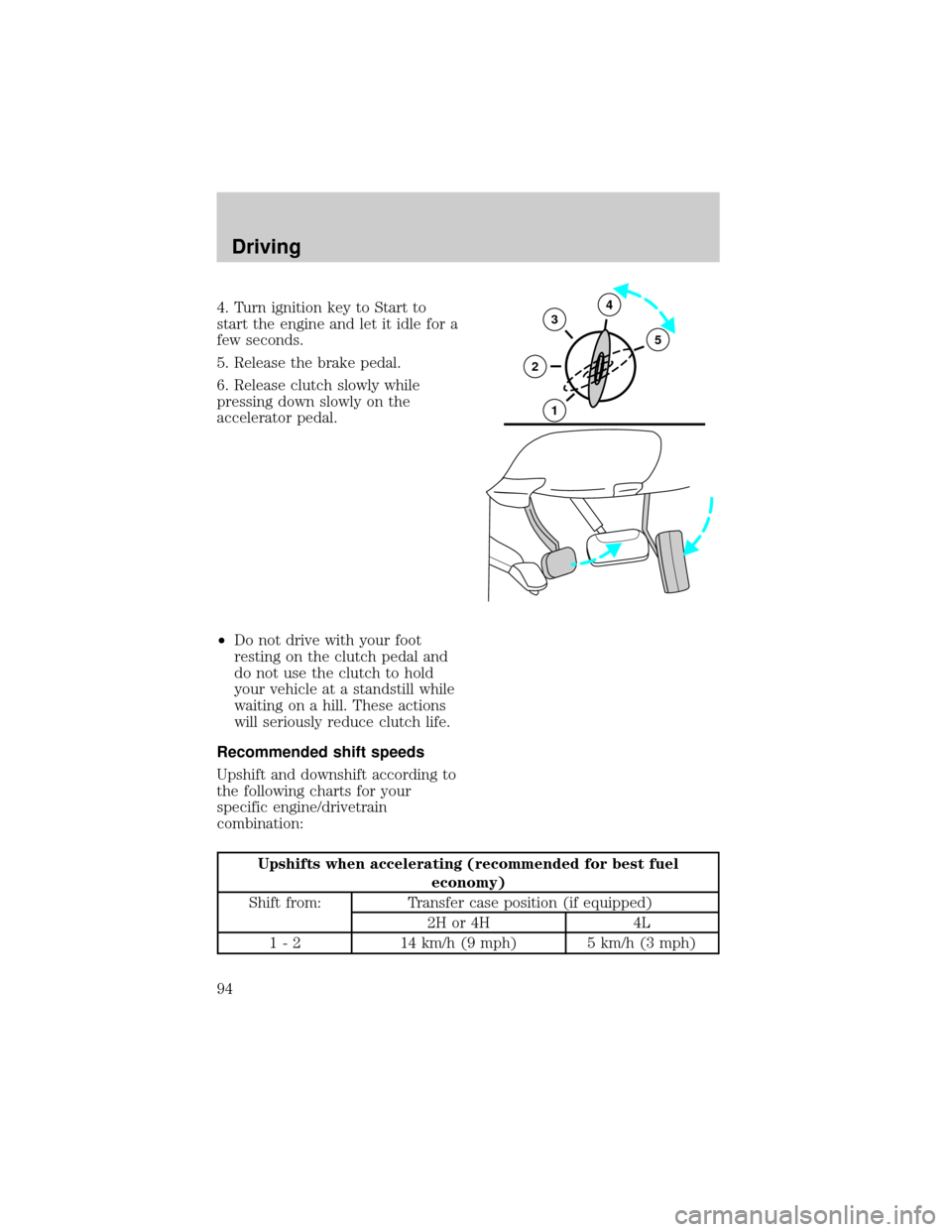
4. Turn ignition key to Start to
start the engine and let it idle for a
few seconds.
5. Release the brake pedal.
6. Release clutch slowly while
pressing down slowly on the
accelerator pedal.
²Do not drive with your foot
resting on the clutch pedal and
do not use the clutch to hold
your vehicle at a standstill while
waiting on a hill. These actions
will seriously reduce clutch life.
Recommended shift speeds
Upshift and downshift according to
the following charts for your
specific engine/drivetrain
combination:
Upshifts when accelerating (recommended for best fuel
economy)
Shift from: Transfer case position (if equipped)
2H or 4H 4L
1 - 2 14 km/h (9 mph) 5 km/h (3 mph)
34
5
2
1
Driving
94
Page 97 of 219
4. Turn ignition to Off.
Do not park your vehicle
in Neutral, it may move
unexpectedly and injure
someone. Use 1 (First) gear and
set the parking brake fully.
Reverse
Make sure that your vehicle is at a
complete stop before you shift into
R (Reverse). Failure to do so may
damage the transmission.
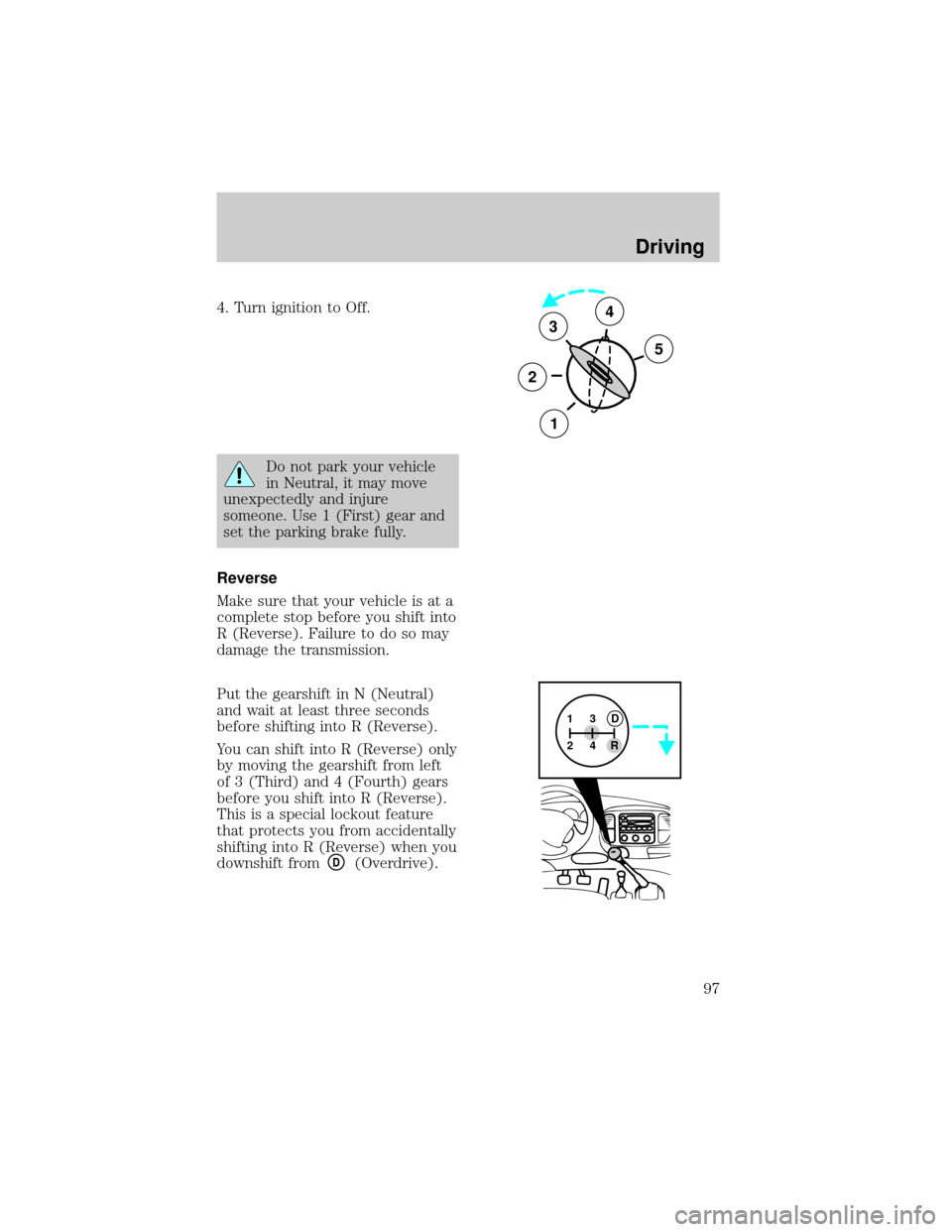
Put the gearshift in N (Neutral)
and wait at least three seconds
before shifting into R (Reverse).
You can shift into R (Reverse) only
by moving the gearshift from left
of 3 (Third) and 4 (Fourth) gears
before you shift into R (Reverse).
This is a special lockout feature
that protects you from accidentally
shifting into R (Reverse) when you
downshift from
D(Overdrive).
3
2
1
5
4
13
24RD
Driving
97
Page 98 of 219
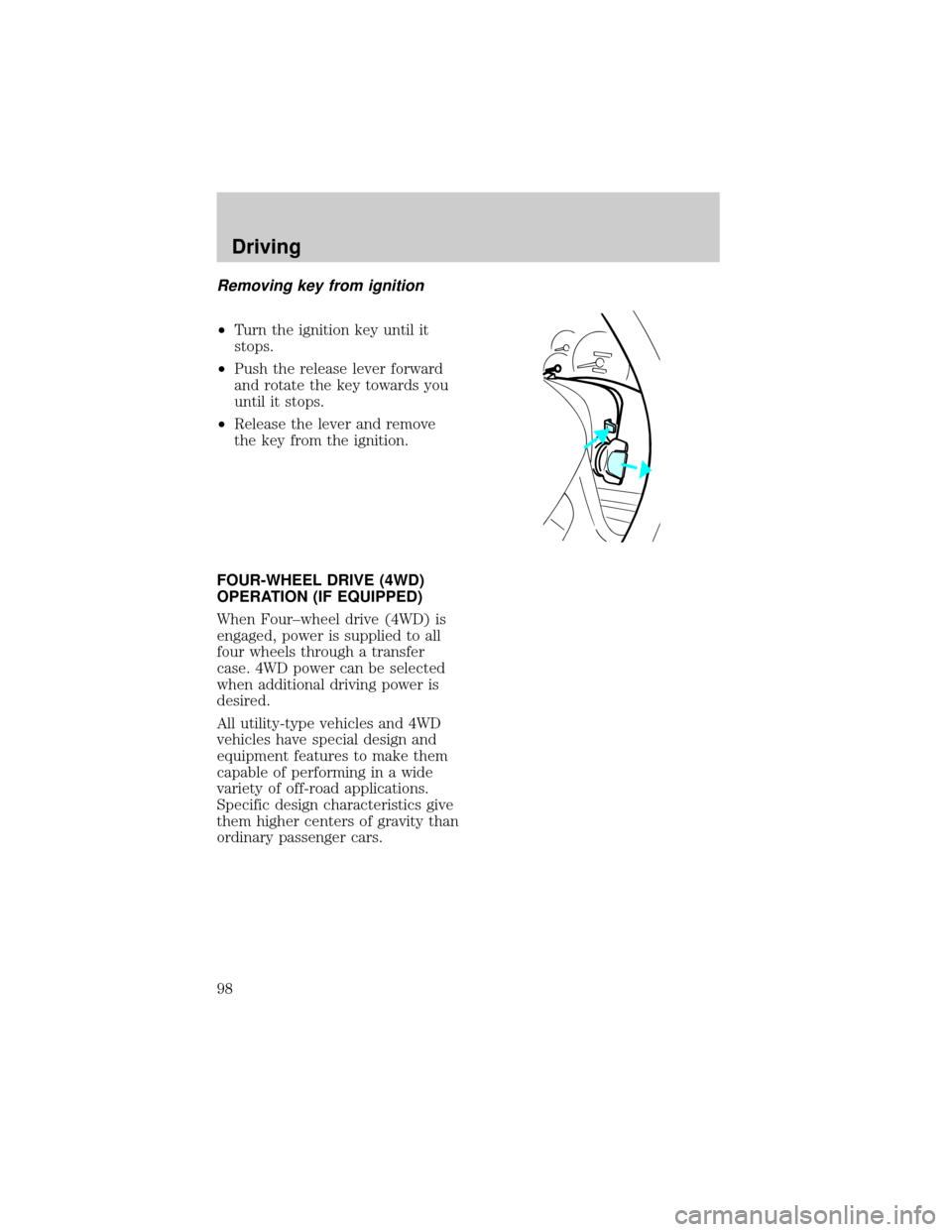
Removing key from ignition
²Turn the ignition key until it
stops.
²Push the release lever forward
and rotate the key towards you
until it stops.
²Release the lever and remove
the key from the ignition.
FOUR-WHEEL DRIVE (4WD)
OPERATION (IF EQUIPPED)
When Four±wheel drive (4WD) is
engaged, power is supplied to all
four wheels through a transfer
case. 4WD power can be selected
when additional driving power is
desired.
All utility-type vehicles and 4WD
vehicles have special design and
equipment features to make them
capable of performing in a wide
variety of off-road applications.
Specific design characteristics give
them higher centers of gravity than
ordinary passenger cars.
Driving
98
Page 99 of 219
Utility and four-wheel
drive vehicles arenot
designed for cornering at speeds
as high as passenger cars any
more than low-slung sports cars
are designed to perform
satisfactorily under off-road
conditions. Avoid sharp turns or
abrupt maneuvers in these
vehicles.
4WD operation is not
recommended on dry pavement.
Doing so could result in difficult
disengagement of the transfer
case, increased tire wear and
decreased fuel economy.
4WD system indicator lights
The 4WD system indicator lights
illuminate only under the following
conditions. If these lights
illuminate during normal driving,
have your vehicle serviced.
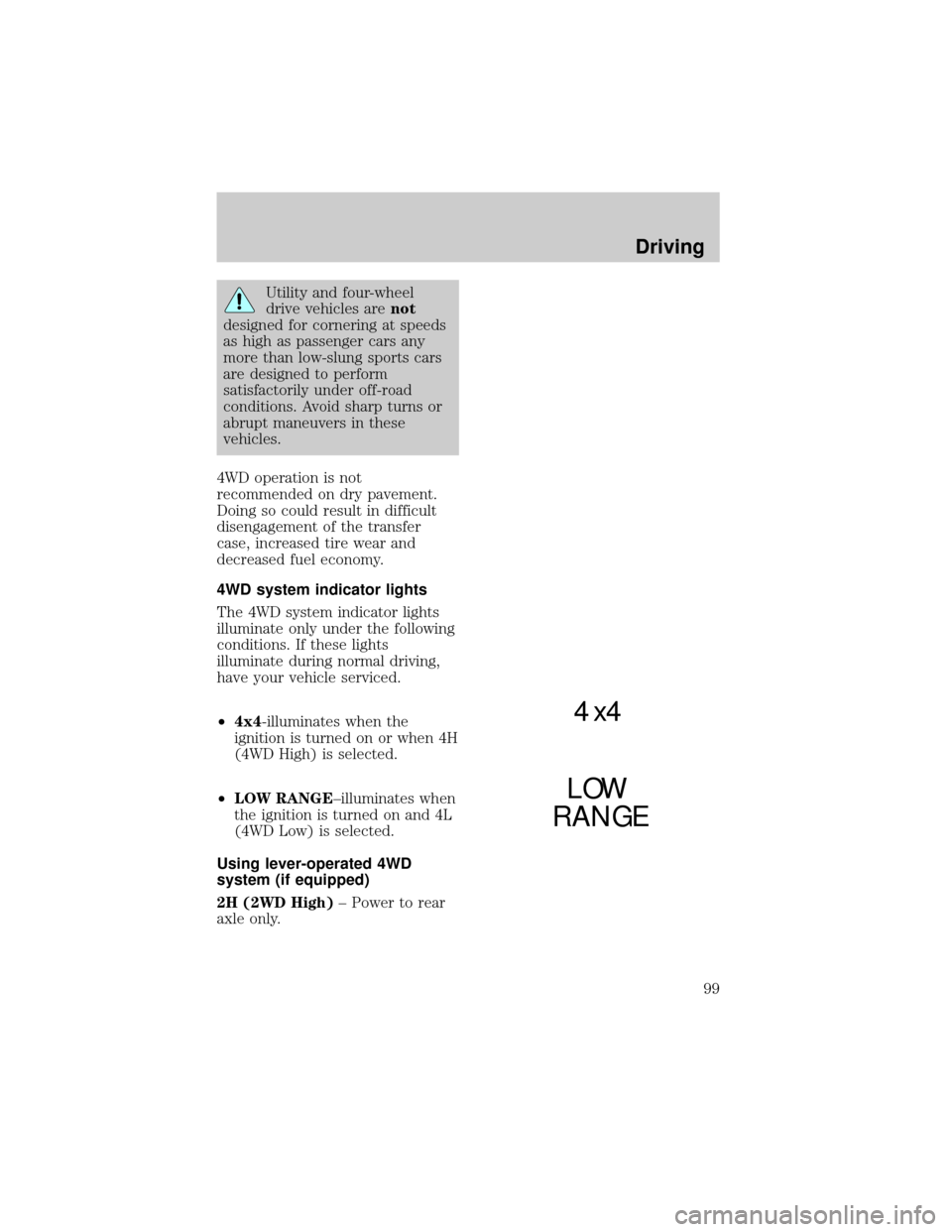
²4x4-illuminates when the
ignition is turned on or when 4H
(4WD High) is selected.
²LOW RANGE±illuminates when
the ignition is turned on and 4L
(4WD Low) is selected.
Using lever-operated 4WD
system (if equipped)
2H (2WD High)± Power to rear
axle only.
4x4
LOW
RANGE
Driving
99
Page 102 of 219
transmission and puts the
vehicle in neutral regardless of
transmission gearshift lever
position. The vehicle can move
forward or backwards. Make
sure the parking brake is
applied and the vehicle is never
left unattended with the
transfer case in neutral.
This position should only be used
when towing the vehicle. Refer to
Wrecker towingin theRoadside
emergencieschapter.
Do not leave the vehicle
unattended with the
transfer case in the N (Neutral)
position. Always set the parking
brake fully and turn off the
ignition when leaving the vehicle.
Using the electronic shift 4WD
system (if equipped)
Positions of the electronic shift
system
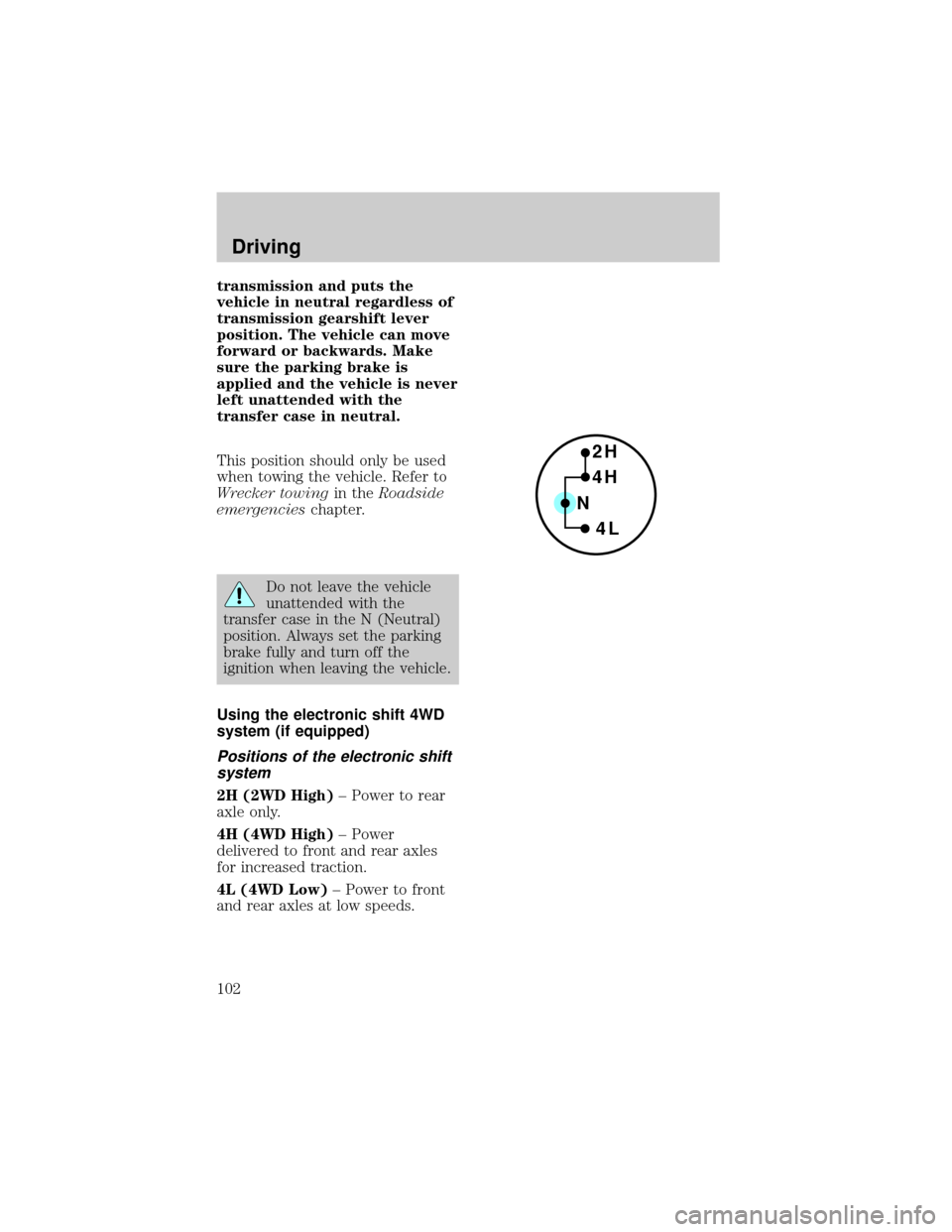
2H (2WD High)± Power to rear
axle only.
4H (4WD High)± Power
delivered to front and rear axles
for increased traction.
4L (4WD Low)± Power to front
and rear axles at low speeds.
2H
4H
4L N
Driving
102
Page 105 of 219
If your vehicle gets stuck
If the vehicle is stuck, shift the
transmission in a steady motion
between forward and reverse
gears. Allow the transmission to
engage, then press lightly on the
accelerator.
DO NOT rock the vehicle
for more than a few
minutes. The transmission and
tires may be damaged or the
engine can overheat.
Do not spin the wheels at
over 35 mph (55 km/h).
The tires may fail and injure a
passenger or bystander.
Sand
When driving over sand, try to
keep all four wheels on the most
solid area of the trail. Do not
reduce the tire pressures but shift
to a lower gear and drive steadily
through the terrain. Apply the
accelerator slowly and avoid
spinning the wheels.
Mud and water
If you must drive through high
water, drive slowly. Traction or
brake capability may be limited.
When driving through water,
determine the depth; avoid water
higher than the bottom of the hubs
(if possible) and proceed slowly. If
the ignition system gets wet, the
vehicle may stall.
Driving
105
Page 111 of 219
on the following charts. This is the
maximum trailer weight your
vehicle can tow and must fall
below the maximum shown under
maximum trailer weight on the
chart.
DRIVING THROUGH WATER
Do not drive quickly through
standing water, especially if the
depth is unknown. Traction or
brake capability may be limited
and if the ignition system gets wet,
your engine may stall. Water may
also enter your engine's air intake
and severely damage your engine.
If driving through deep or standing
water is unavoidable, proceed very
slowly. Never drive through water
that is higher than the bottom of
the hubs (truck)/wheel rims (car).
Once through the water, always try
the brakes. Wet brakes do not stop
the vehicle as effectively as dry
brakes. Drying can be improved by
moving your vehicle slowly while
applying light pressure on the
brake pedal.
Driving
111