Page 58 of 219

belt. Manufacturer identification is
located at the end of the webbing
on the label. Also, use the safety
belt extension only if the safety
belt is too short for you when fully
extended. Do not use extensions
to change the fit of the shoulder
belt across the torso.
Safety belt warning light and
indicator chime
The seat belt warning light
illuminates in the instrument
cluster and a chime sounds to
remind the occupants to fasten
their safety belts.
Conditions of operation
If... Then...
The driver's safety belt is not
buckled before the ignition key
is turned to ON...The safety belt warning light
illuminates for one to two minutes and
the warning chime sounds for four to
eight seconds.
The driver's safety belt is
buckled while the indicator
light is illuminated and the
warning chime is sounding...The safety belt warning light turns off.
The driver's safety belt is
buckled before the ignition key
is turned to ON...The safety belt warning light remains
off.
Safety belt maintenance
Check the safety belt systems
periodically to make sure they
work properly and are not
damaged. Check the safety belts to
make sure there are no nicks,
wears or cuts. All safety belt
Seating and safety restraints
58
Page 64 of 219
Instrumentationchapter. Routine
maintenance of the air bag is not
required.
A difficulty with the system is
indicated by one or more of the
following:
²The readiness light will either
flash or stay lit.
²The readiness light will not
illuminate immediately after
ignition is turned on.
²A series of five beeps will be
heard. The tone pattern will
repeat periodically until the
problem and light are repaired.
If any of these things happen, even
intermittently, have the SRS
serviced at your dealership or by a
qualified technician immediately.
Unless serviced, the system may
not function properly in the event
of a collision.
Disposal of air bags and air bag
equipped vehicles
For disposal of air bags or air bag
equipped vehicles, see your local
dealership or qualified technician.
Air bags MUST BE disposed of by
qualified personnel.
Seating and safety restraints
64
Page 66 of 219
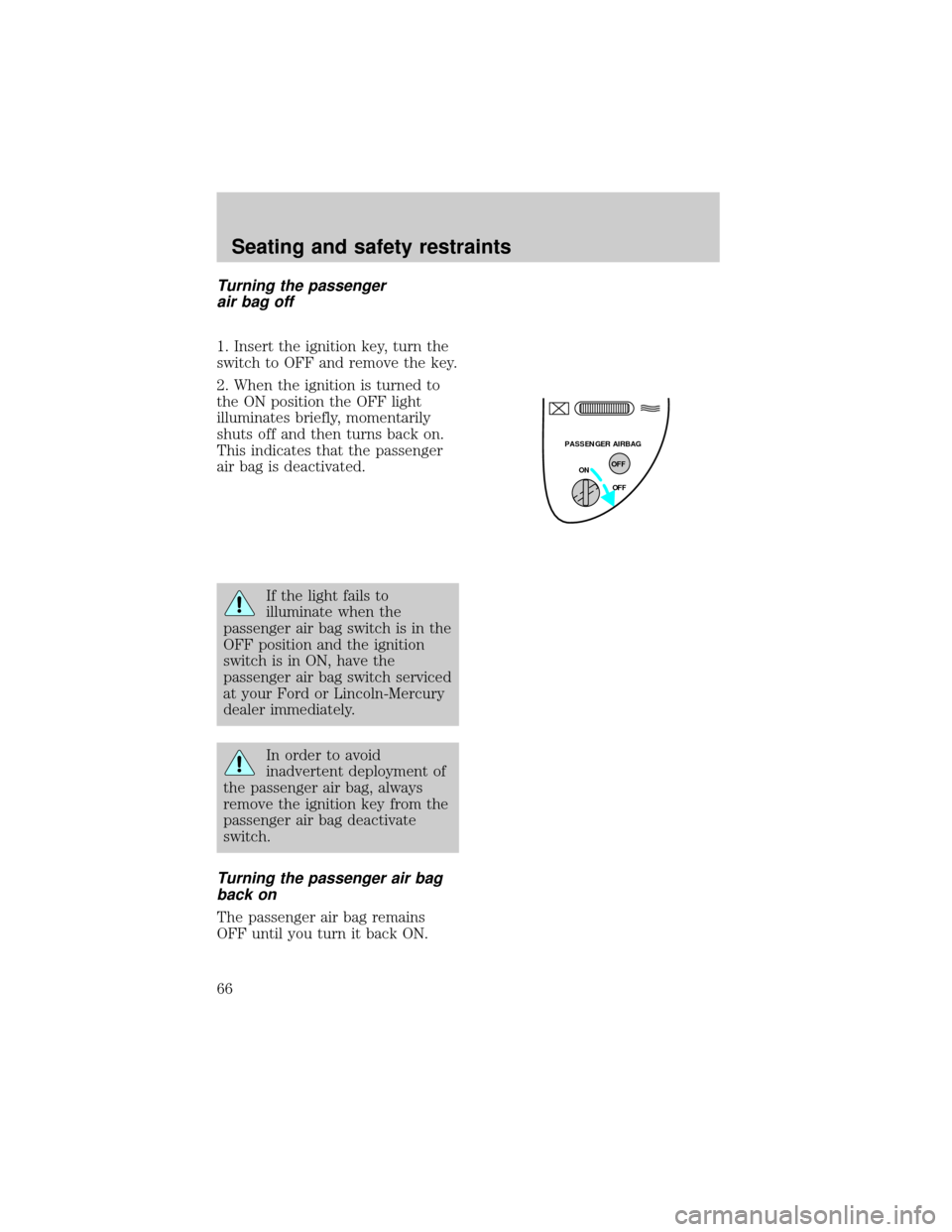
Turning the passenger
air bag off
1. Insert the ignition key, turn the
switch to OFF and remove the key.
2. When the ignition is turned to
the ON position the OFF light
illuminates briefly, momentarily
shuts off and then turns back on.
This indicates that the passenger
air bag is deactivated.
If the light fails to
illuminate when the
passenger air bag switch is in the
OFF position and the ignition
switch is in ON, have the
passenger air bag switch serviced
at your Ford or Lincoln-Mercury
dealer immediately.
In order to avoid
inadvertent deployment of
the passenger air bag, always
remove the ignition key from the
passenger air bag deactivate
switch.
Turning the passenger air bag
back on
The passenger air bag remains
OFF until you turn it back ON.
PASSENGER AIRBAG
ON
OFF OFF
Seating and safety restraints
66
Page 67 of 219
1. Insert the ignition key and turn
the switch to ON.
2. The OFF light will briefly
illuminate when the ignition is
turned to On. This indicates that
the passenger air bag is
operational.
If the light is illuminated
when the passenger air
bag switch is in the ON position
and the ignition switch is in ON,
have the passenger air bag
switch serviced at your Ford or
Lincoln-Mercury dealer
immediately.
Keep the passenger air bag
turned on unless there is a
child seat installed in the front
seat. When the passenger air bag
switch is turned off, the
passenger air bag will not inflate
in a collision.
PASSENGER AIRBAG
ON
OFF OFF
Seating and safety restraints
67
Page 76 of 219
PREPARING TO START YOUR
VEHICLE
Engine starting is controlled by the
spark ignition system. This system
meets all Canadian
Interference-Causing Equipment
standard requirements regulating
the impulse electrical field strength
of radio noise.
When starting a fuel-injected
engine, avoid pressing the
accelerator before or during
starting. Only use the accelerator
when you have difficulty starting
the engine. For more information
on starting the vehicle, refer to
Starting the enginein this
chapter.
Extended idling at high
engine speeds can produce
very high temperatures in the
engine and exhaust system,
creating the risk of fire or other
damage.
Do not park, idle, or drive
your vehicle in dry grass
or other dry ground cover. The
emission system heats up the
engine compartment and exhaust
system, which can start a fire.
Starting
76
Page 85 of 219
there is sufficient space, will
enable you to avoid obstacles
and bring the vehicle to a
controlled stop.
²We recommend that you
familiarize yourself with this
braking technique. However,
avoid taking any unnecessary
risks.
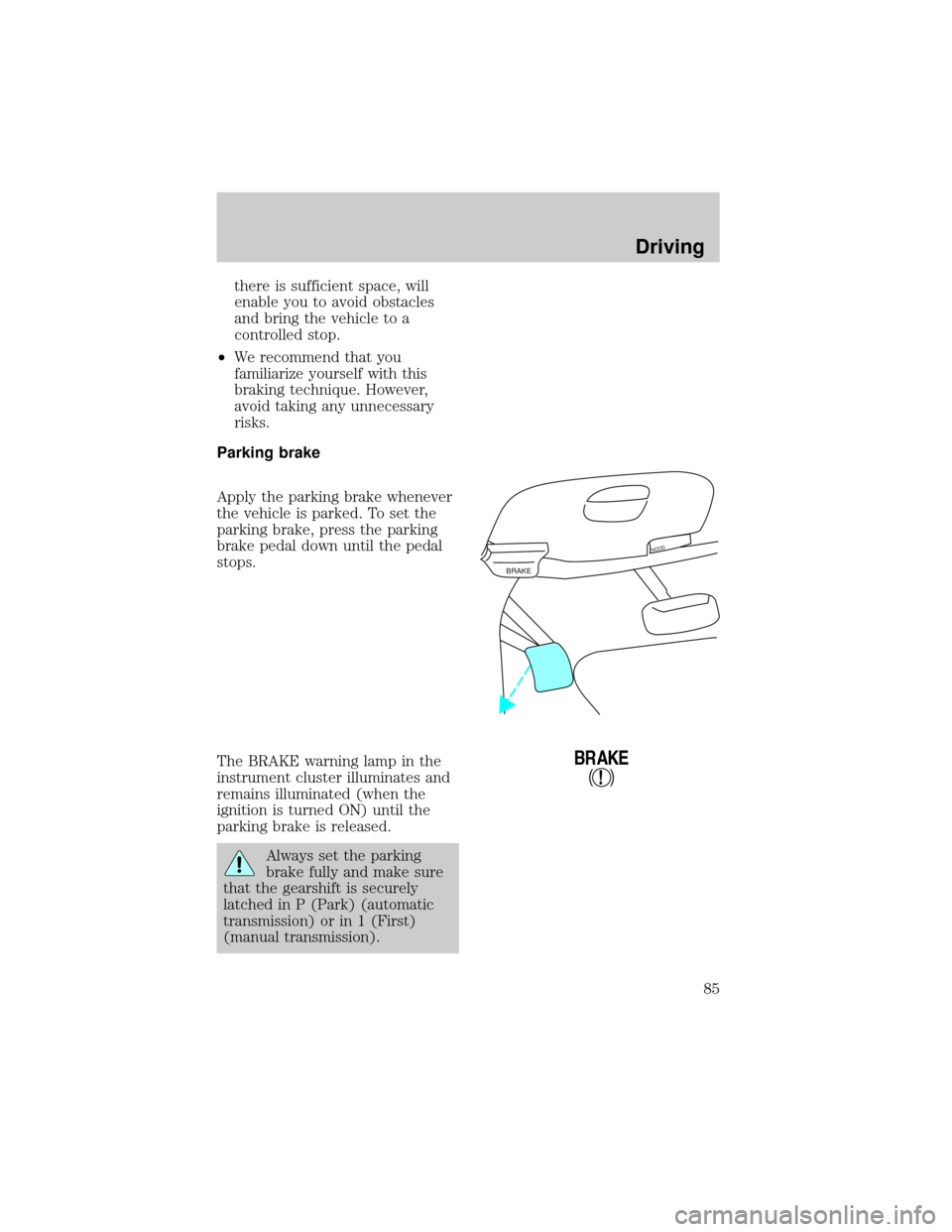
Parking brake
Apply the parking brake whenever
the vehicle is parked. To set the
parking brake, press the parking
brake pedal down until the pedal
stops.
The BRAKE warning lamp in the
instrument cluster illuminates and
remains illuminated (when the
ignition is turned ON) until the
parking brake is released.
Always set the parking
brake fully and make sure
that the gearshift is securely
latched in P (Park) (automatic
transmission) or in 1 (First)
(manual transmission).
BRAKE
HOOD
!
BRAKE
Driving
85
Page 87 of 219
normal driving and should not be
noticeable to the driver.
To avoid injury, never run
the engine with one wheel
off the ground, such as when
changing a tire.
AIR SUSPENSION SYSTEM (IF
EQUIPPED)
The air suspension system is
designed to improve ride, handling
and general vehicle performance
for static, on and off-road driving
conditions.
²The load leveling feature of the
air suspension automatically
keeps the vehicle at a constant
level if a load is added or
removed from the vehicle.
²The height adjustment feature
automatically controls the
vehicle height over a range of
approximately 5 cm (2 inches)
based on vehicle speed, ignition
position and selection of two or
four-wheel drive modes.
Driving
87
Page 88 of 219
The air suspension shut-off switch
is located behind an access panel
underneath the passenger side
instrument panel.
On vehicles equipped with
Air Suspension, turn OFF
the Air Suspension switch prior
to jacking, hoisting or towing
your vehicle.
Normal vehicle operation does not
require any action by the driver.
TRANSMISSION OPERATION
Automatic transmission
operation
Brake-shift interlock
This vehicle is equipped with a
brake-shift interlock feature that
prevents the gearshift from being
moved from P (Park) unless the
brake pedal is depressed.
If you cannot move the gearshift
out of P (Park) with the brake
pedal depressed:
1. Apply the parking brake, turn
ignition key to LOCK, then remove
the key.
2. Insert the key and turn it to
OFF. Apply the brake pedal and
shift to N (Neutral).
3. Start the vehicle.
If it is necessary to use the above
procedure to move the gearshift, it
AIR SUSPENSION
SWITCH
INTERRUPTEUR DE
LA SUSPENSION
PNEUMATIQUE
OFF
Driving
88