Page 121 of 219

²Use D (Drive) or a lower gear
when towing up or down steep
hills. This will eliminate
excessive downshifting and
upshifting for optimum fuel
economy and transmission
cooling.
²Anticipate stops and brake
gradually.
Servicing after towing
If you tow a trailer for long
distances, your vehicle will require
more frequent service intervals.
Refer to the Severe Duty Schedule
in your ªService Guideº for more
information.
Trailer towing tips
²Practice turning, stopping and
backing up in an area before
starting on a trip to get the feel
of the vehicle trailer
combination. When turning,
make wider turns so the trailer
wheels will clear curbs and
other obstacles.
²Allow more distance for
stopping with a trailer attached.
²The trailer tongue weight should
be 10±15% of the loaded trailer
weight.
²After you have traveled 80 km
(50 miles), thoroughly check
your hitch, electrical
connections and trailer wheel
lug nuts.
²When stopped in traffic for long
periods of time in hot weather,
place the gearshift in P (Park)
Driving
121
Page 122 of 219

(automatic transmissions) or 1
(First) (manual transmissions)
and increase idle speed. This
aids engine cooling and air
conditioner efficiency.
²Vehicles with trailers should not
be parked on a grade. If you
must park on a grade, place
wheel chocks under the trailer's
wheels.
Launching or retrieving a boat
When backing down a ramp during
boat launching or retrieval,
²Do not allow the static water
level to rise above the bottom
edge of the rear bumper and
²Do not allow waves to break
higher than 15 cm (six inches)
above the bottom edge of the
rear bumper.
Exceeding these limits may allow
water to enter critical vehicle
components, adversely affecting
driveability, emissions and
reliability.
If the rear axle is submerged in
water, the rear axle lubricant
should be checked and changed, if
necessary. The rear axle is filled
with a synthetic lubricant and does
not normally require a lubricant
change for the life of the vehicle.
Rear axle lubricant quantities
should not need to be checked
unless a leak is suspected.
Driving
122
Page 123 of 219
Recreational towing (all wheels
on the ground)
Follow these guidelines for your
specific powertrain combination to
tow your vehicle with all four
wheels on the ground (such as
behind a recreational vehicle).
These guidelines are designed to
ensure that your transmission is
not damaged due to insufficient
lubrication.
2WD (manual and automatic
transmissions)
1. Place transmission in N
(Neutral).
2. Maximum speed is 56 km/h
(35 mph).
3. Maximum distance is 80 km
(50 miles).
If a distance of 80 km (50 miles)
or a speed of 56 km/h (35 mph)
must be exceeded, you must
disconnect the rear driveshaft.
With the rear driveshaft
disconnected, the maximum speed
is 88 km/h (55 mph) and there are
no mileage restrictions.
See your dealer for help with
disconnecting the driveshaft.
4WD ± Lever operated transfer
case (manual and automatic
transmissions)
1. Place transmission in P (Park).
2. Shift the transfer case to N
(Neutral).
Driving
123
Page 125 of 219
²F-150/F±250 4WD Regular Cab
long wheelbase
²4.6L or 5.4L engine
²Heavy duty service package
²Super engine cooling
²Heavy duty front suspension
package
²Automatic transmission with
auxiliary automatic transmission
fluid cooling
²All-terrain tires
Do not install a snowplow and
plow with your vehicle until it has
been driven at least 800 km (500
miles).
Installing snowplow
Read the following instructions
before installing a snowplow:
²Front GAWR must not exceed
63% of the GVW. Add ballast
weight to the back of the
vehicle, if necessary. Refer to
the Safety Compliance
Certification Label to find Front
GAWR.
²The Front Axle Accessory
Reserve Capacity and the Total
Accessory Reserve Capacity
listed on the bottom right of the
Safety Compliance Certification
Label will determine whether or
not the addition of a snowplow
will overload your vehicle.
²The weight of the snowplow and
supporting components
distributed to the front axle
Driving
125
Page 129 of 219
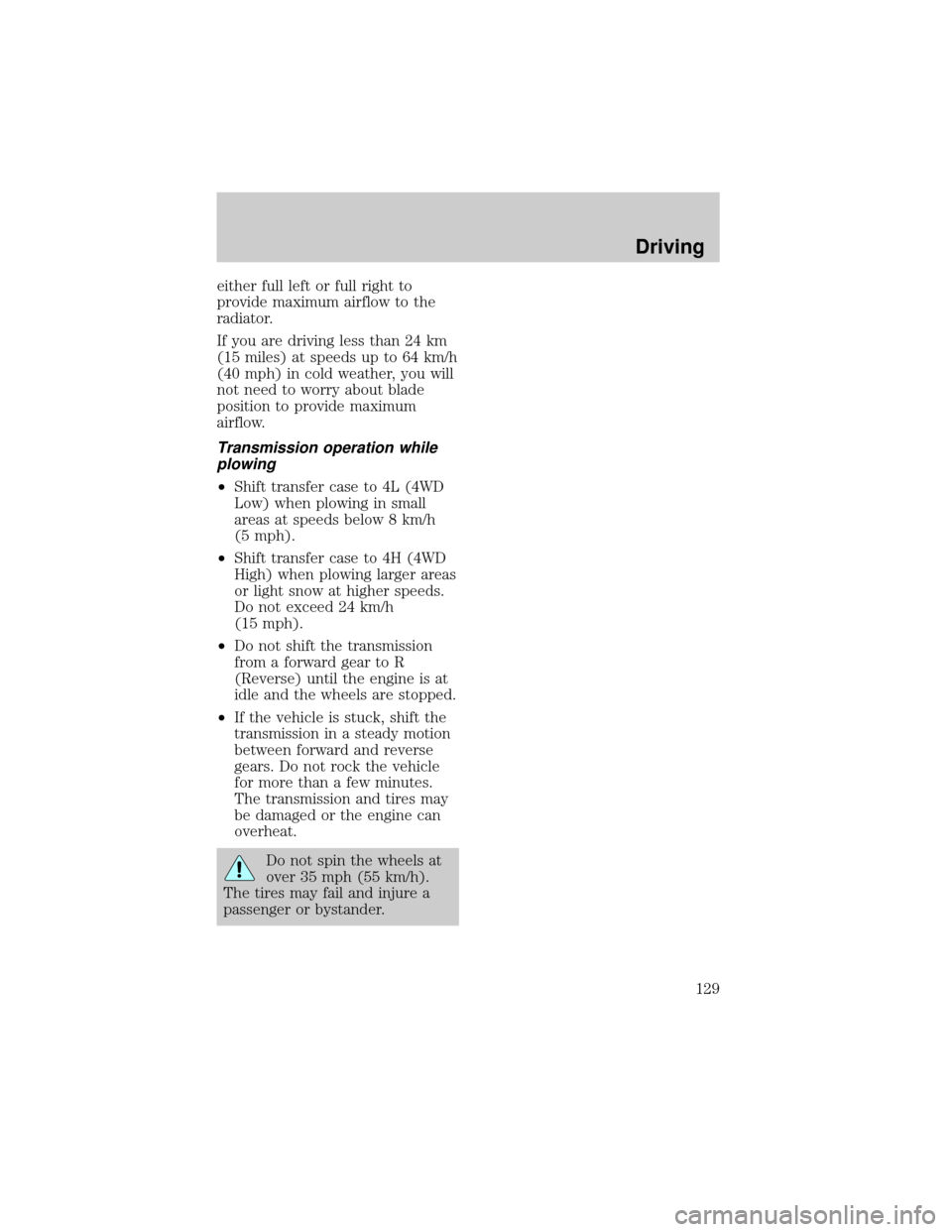
either full left or full right to
provide maximum airflow to the
radiator.
If you are driving less than 24 km
(15 miles) at speeds up to 64 km/h
(40 mph) in cold weather, you will
not need to worry about blade
position to provide maximum
airflow.
Transmission operation while
plowing
²Shift transfer case to 4L (4WD
Low) when plowing in small
areas at speeds below 8 km/h
(5 mph).
²Shift transfer case to 4H (4WD
High) when plowing larger areas
or light snow at higher speeds.
Do not exceed 24 km/h
(15 mph).
²Do not shift the transmission
from a forward gear to R
(Reverse) until the engine is at
idle and the wheels are stopped.
²If the vehicle is stuck, shift the
transmission in a steady motion
between forward and reverse
gears. Do not rock the vehicle
for more than a few minutes.
The transmission and tires may
be damaged or the engine can
overheat.
Do not spin the wheels at
over 35 mph (55 km/h).
The tires may fail and injure a
passenger or bystander.
Driving
129
Page 133 of 219
Always replace a fuse with
one that has the specified
amperage rating. Using a fuse
with a higher amperage rating
can cause severe wire damage
and could start a fire.
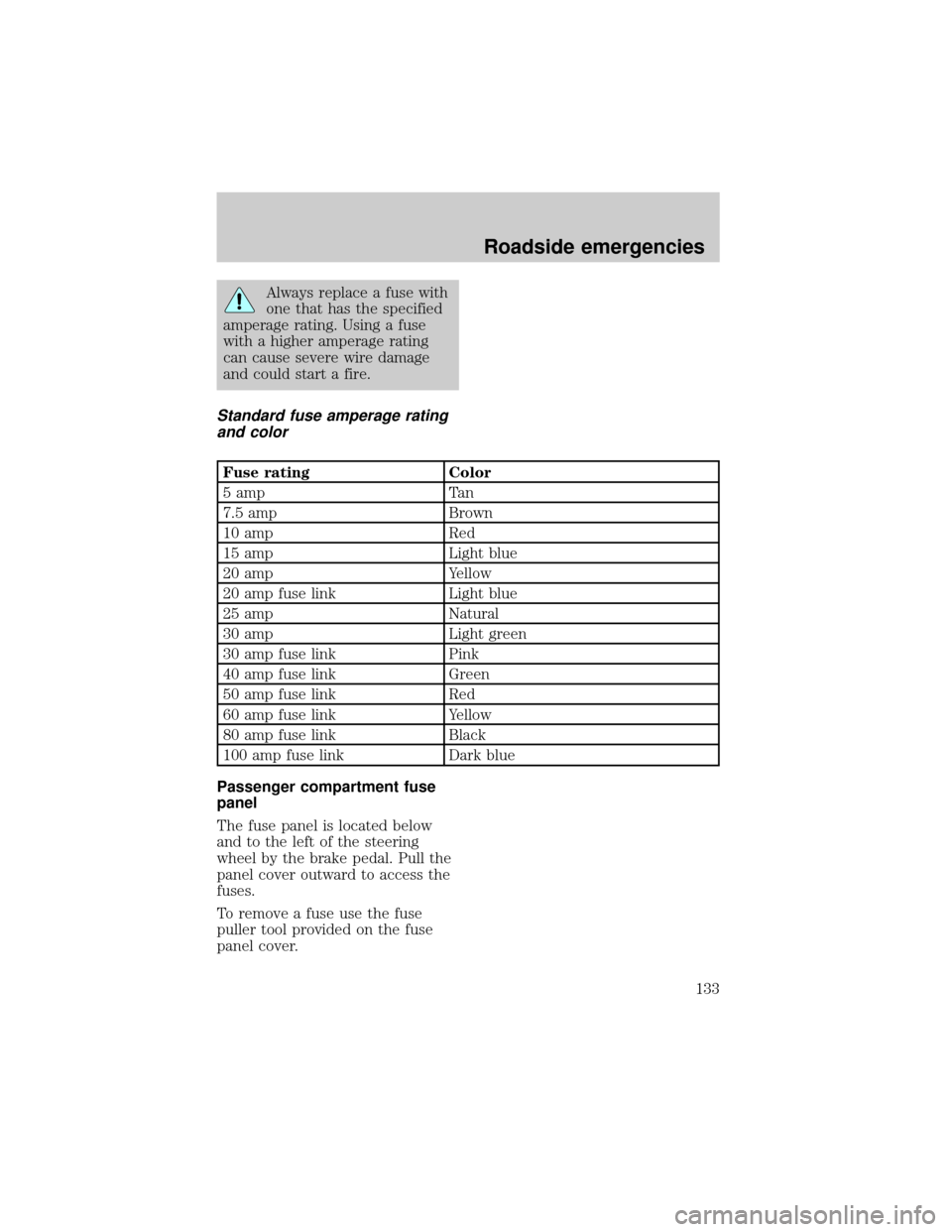
Standard fuse amperage rating
and color
Fuse rating Color
5 amp Tan
7.5 amp Brown
10 amp Red
15 amp Light blue
20 amp Yellow
20 amp fuse link Light blue
25 amp Natural
30 amp Light green
30 amp fuse link Pink
40 amp fuse link Green
50 amp fuse link Red
60 amp fuse link Yellow
80 amp fuse link Black
100 amp fuse link Dark blue
Passenger compartment fuse
panel
The fuse panel is located below
and to the left of the steering
wheel by the brake pedal. Pull the
panel cover outward to access the
fuses.
To remove a fuse use the fuse
puller tool provided on the fuse
panel cover.
Roadside emergencies
133
Page 137 of 219
Fuse/Relay Location Fuse Amp Rating Description
21 15A Clutch Pedal Position
(CPP) Switch (W/O
RAP), Starter
Interrupt Relay
(W/RAP)
22 10A Air Bag Diagnostic
Monitor, Passive
De-Activation (PAD)
Module
23 10A Trailer tow Battery
Charge Relay, 4X4
Hub Solenoid, 4X2
Hub Solenoid, Flasher
Relay, Shift on the Fly
Relay
24 10A Blower Relay
25 5A 4 Wheel Anti-Lock
Brake System
(4WABS) Module,
4WABS Relay
26 10A Daytime Running
Lamps (DRL) Module,
Right Headlamp
27 5A Main Light Switch,
Fog Lamp Relay
28 10A Left Headlamp
29 5A Autolamp Module,
Instrument Cluster,
Transmission Control
Switch (TCS), Brake
Warning
Resistor/Diode
Assembly (W/RABS)
Roadside emergencies
137
Page 140 of 219
Fuse/Relay Location Fuse Amp Rating Description
4 15A* Rear Air Suspension
(RAS)
5 20A* Horn Relay
6 15A* Radio, Premium Sound
Amplifier, CD Changer
7 15A* Main Light Switch,
Park Lamp Relay
8 30A* Main Light Switch,
Headlamp Relay,
Multi-Function Switch
9 15A* Daytime Running
Lamps (DRL) Module,
Fog Lamp Relay
10 25A* Auxiliary Power
Socket
11 Ð Not Used
12 Ð Not Used
13 Ð Not Used
14 60A**/20A** 4 Wheel Anti-Lock
Brake System
(4WABS)
Module/Ignition Switch
(W/RABS Only)
15 50A** Rear Air Suspension
Compressor
16 40A** Trailer Tow Battery
Charge Relay, Engine
Fuse Module (Fuse 2)
17 30A** Shift on the Fly Relay,
Transfer Case Shift
Relay
18 30A** Power Seat Control
Switch
19 20A** Fuel Pump Relay
Roadside emergencies
140