Page 141 of 219
Fuse/Relay Location Fuse Amp Rating Description
20 50A** Ignition Switch
21 50A** Ignition Switch
22 50A** Junction Box
Fuse/Relay Panel
Battery Feed
23 40A** Blower Relay
24 30A** PCM Power Relay,
Engine Fuse Module
(Fuse 1)
25 30A** Junction Box
Fuse/Relay Panel, ACC
Delay Relay
26 Ð Not Used
27 Ð Not Used
28 30A** Trailer Electronic
Brake Controller
29 Ð Not Used
*Mini fuses **Maxi
fuses
CHANGING THE TIRES
If you get a flat tire while driving,
do not apply the brake heavily.
Instead, gradually decrease your
speed. Hold the steering wheel
firmly and slowly move to a safe
place on the side of the road.
Spare tire information
Your vehicle is equipped with a
spare tire that may be used as a
spare or a regular tire. The spare
tire is not equipped with wheel
trim. The wheel trim from the
original wheel/tire may be used on
the spare.
Roadside emergencies
141
Page 143 of 219
2. Slide the wheel under the
vehicle and install the retainer
through the wheel center.
3. Turn the jack handle clockwise
until the tire is raised to its
original position underneath the
vehicle. The jack handle ratchets
when the tire is raised to the
stowed position. It will not allow
you to overtighten.
Tire change procedure
On vehicles equipped with
Air Suspension, turn OFF
the Air Suspension switch prior
to jacking, hoisting or towing
your vehicle.
Refer to the instruction sheet
(located behind the interior trim
access panel with the jack) for
detailed tire change instructions.
1. Park on a level surface, activate
hazard flashers and set the parking
brake.
2. Place gearshift lever in P (Park).
BRAKE
HOOD
Roadside emergencies
143
Page 144 of 219
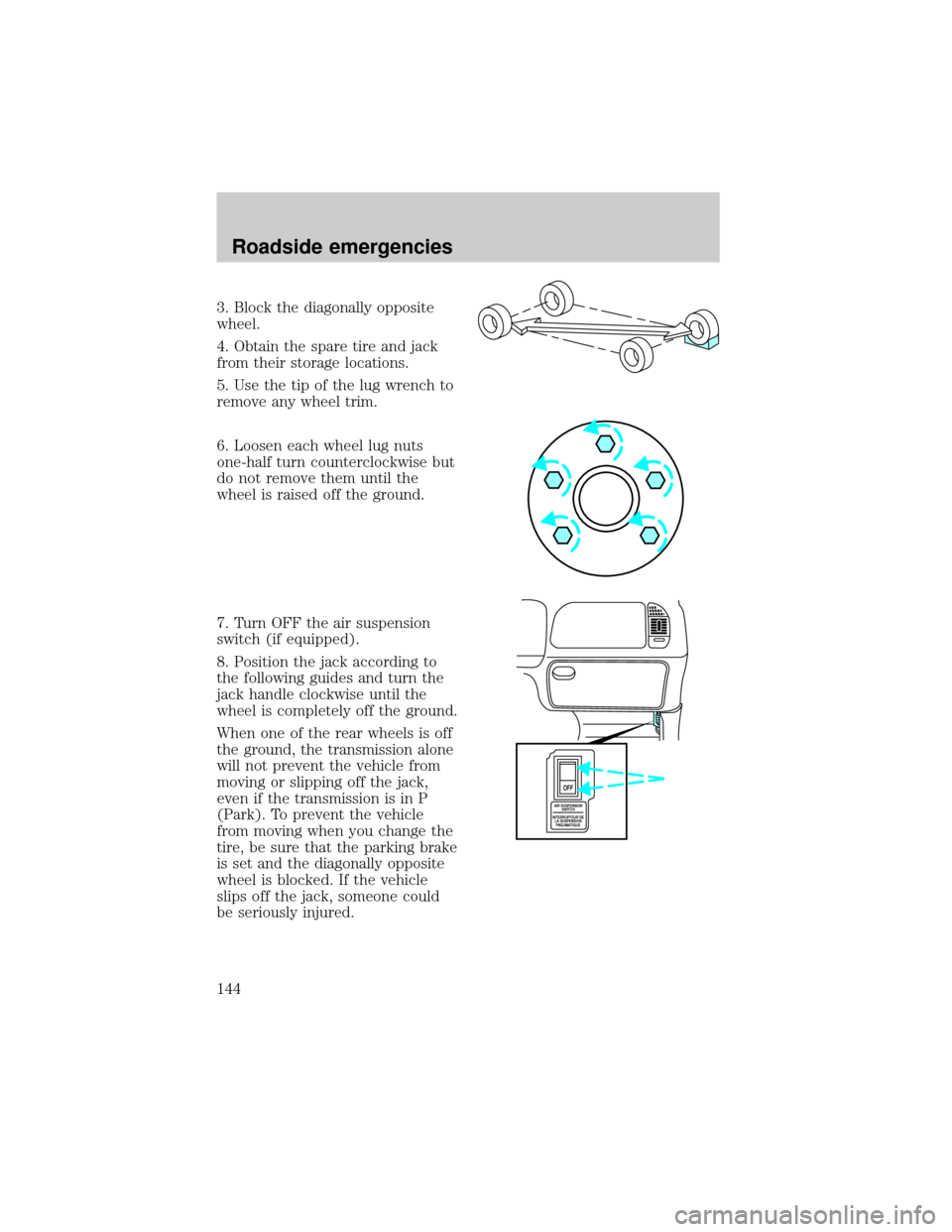
3. Block the diagonally opposite
wheel.
4. Obtain the spare tire and jack
from their storage locations.
5. Use the tip of the lug wrench to
remove any wheel trim.
6. Loosen each wheel lug nuts
one-half turn counterclockwise but
do not remove them until the
wheel is raised off the ground.
7. Turn OFF the air suspension
switch (if equipped).
8. Position the jack according to
the following guides and turn the
jack handle clockwise until the
wheel is completely off the ground.
When one of the rear wheels is off
the ground, the transmission alone
will not prevent the vehicle from
moving or slipping off the jack,
even if the transmission is in P
(Park). To prevent the vehicle
from moving when you change the
tire, be sure that the parking brake
is set and the diagonally opposite
wheel is blocked. If the vehicle
slips off the jack, someone could
be seriously injured.
AIR SUSPENSION
SWITCH
INTERRUPTEUR DE
LA SUSPENSION
PNEUMATIQUE
OFF
Roadside emergencies
144
Page 146 of 219
²Never use the front or rear
differential as a jacking
point.
9. Remove the lug nuts with the
lug wrench.
10. Replace the flat tire with the
spare tire, making sure the valve
stem is facing outward. Reinstall
the lug nuts until the wheel is snug
against the hub. Do not fully
tighten the lug nuts until the
wheel has been lowered.
11. Lower the wheel by turning the
jack handle counterclockwise.
12. Remove the jack and fully
tighten the lug nuts in the order
shown.
13. Put flat tire, jack and lug
wrench away. Make sure the jack is
fastened so it does not rattle when
you drive.
14. Unblock the wheels.
15. Turn on the air suspension
switch (if equipped).
1
4 3
52
Roadside emergencies
146
Page 150 of 219
WRECKER TOWING
If you need to have your vehicle
towed, contact a professional
towing service or, if you are a
member, your roadside assistance
center.
On 4x2 vehicles, it is acceptable to
tow the vehicle with the front
wheels on the ground and the rear
wheels off the ground.
On 4x4 vehicles, it is
recommended that your vehicle be
towed with a wheel lift or flatbed
equipment.
Do not tow with slingbelt
equipment. Ford Motor Company
has not developed or approved a
slingbelt towing procedure.
Roadside emergencies
150
Page 153 of 219
²Do not work on a vehicle with
the engine running in an
enclosed space, unless you are
sure you have enough
ventilation.
²Keep all lit cigarettes, open
flames and other lit material
away from the battery and all
fuel related parts.
If you disconnect the battery, the
engine must ªrelearnº its idle
conditions before your vehicle will
drive properly, as explained in
Batteryin this chapter.
Working with the engine off
²Automatic transmission:
1. Set the parking brake fully and
ensure the gearshift is securely
latched in P (Park).
2. Turn off the engine and remove
the key.
3. Block the wheels to prevent the
vehicle from moving unexpectedly.
²Manual transmission:
1. Set the parking brake, depress
the clutch and place the gearshift
in 1 (First).
2. Turn off the engine and remove
the key.
3. Block the wheels to prevent the
vehicle from moving unexpectedly.
Maintenance and care
153
Page 154 of 219
Working with the engine on
²Automatic transmission:
1. Set the parking brake fully and
ensure the gearshift is securely
latched in P (Park).
2. Block the wheels to prevent the
vehicle from moving unexpectedly.
Do not start your engine
with the air cleaner
removed and do not remove it
while the engine is running.
²Manual transmission:
1. Set the parking brake, depress
the clutch and place the gearshift
in 1 (First).
2. Block the wheels to prevent the
vehicle from moving unexpectedly.
OPENING THE HOOD
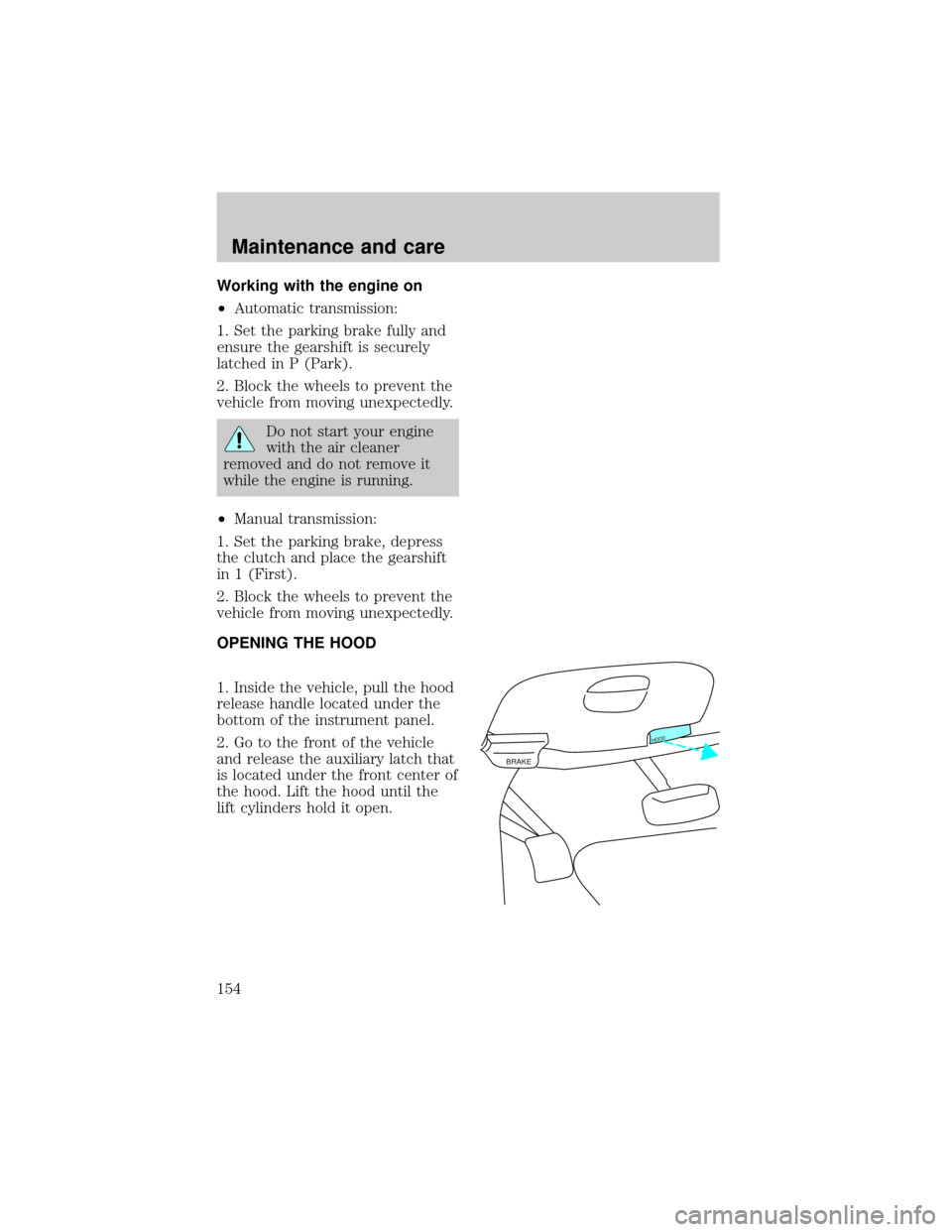
1. Inside the vehicle, pull the hood
release handle located under the
bottom of the instrument panel.
2. Go to the front of the vehicle
and release the auxiliary latch that
is located under the front center of
the hood. Lift the hood until the
lift cylinders hold it open.
BRAKE
HOOD
Maintenance and care
154
Page 169 of 219
As the engine temperature cools,
the engine may be re-started. Take
your vehicle to a service facility as
soon as possible to minimize
engine damage.
When fail-safe mode is
activated
²Pull off the road as soon as
possible.
²Immediately turn the engine off
to prevent severe engine
damage.
²Wait for the engine to cool.
²Check the coolant level.
CHECKING AND ADDING
POWER STEERING FLUID
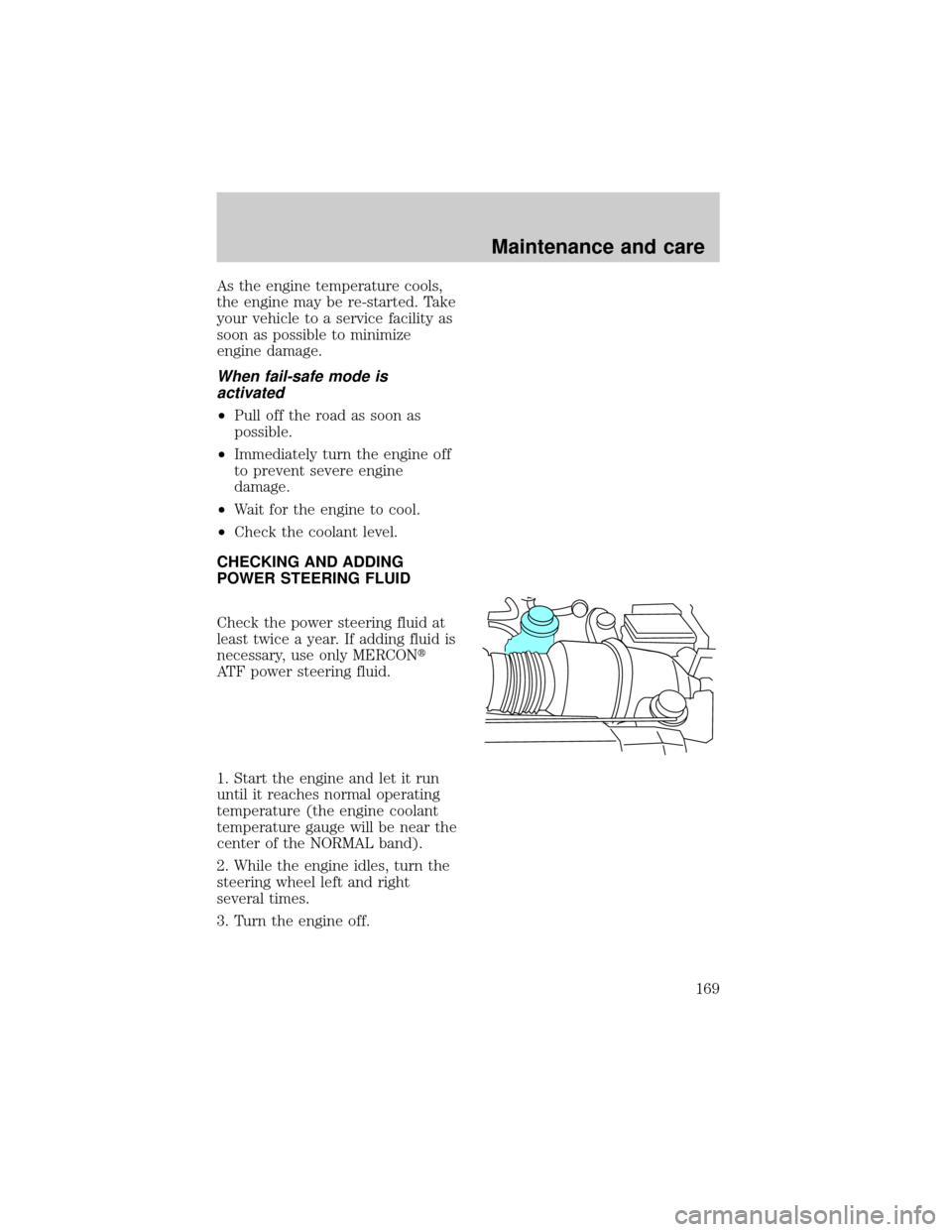
Check the power steering fluid at
least twice a year. If adding fluid is
necessary, use only MERCONt
ATF power steering fluid.
1. Start the engine and let it run
until it reaches normal operating
temperature (the engine coolant
temperature gauge will be near the
center of the NORMAL band).
2. While the engine idles, turn the
steering wheel left and right
several times.
3. Turn the engine off.
Maintenance and care
169