1998 FORD EXPLORER wheel
[x] Cancel search: wheelPage 157 of 210
3. Turn off the engine and remove the key.
4. Block the wheels to prevent the vehicle from moving unexpectedly.
Working with the engine on
²Automatic transmission:
1. Set the parking brake and
ensure the gearshift is securely latched in P (Park).
2. Block the wheels to prevent the vehicle from moving unexpectedly.
Do not start your engine with the air cleaner removed and do
not remove it while the engine is running.
²Manual transmission:
1. Set the parking brake,
depress the clutch and place the gearshift in N (Neutral).
2. Block the wheels to prevent the vehicle from moving unexpectedly.
Do not start your engine with the air cleaner removed and do
not remove it while the engine is running.
OPENING THE HOOD
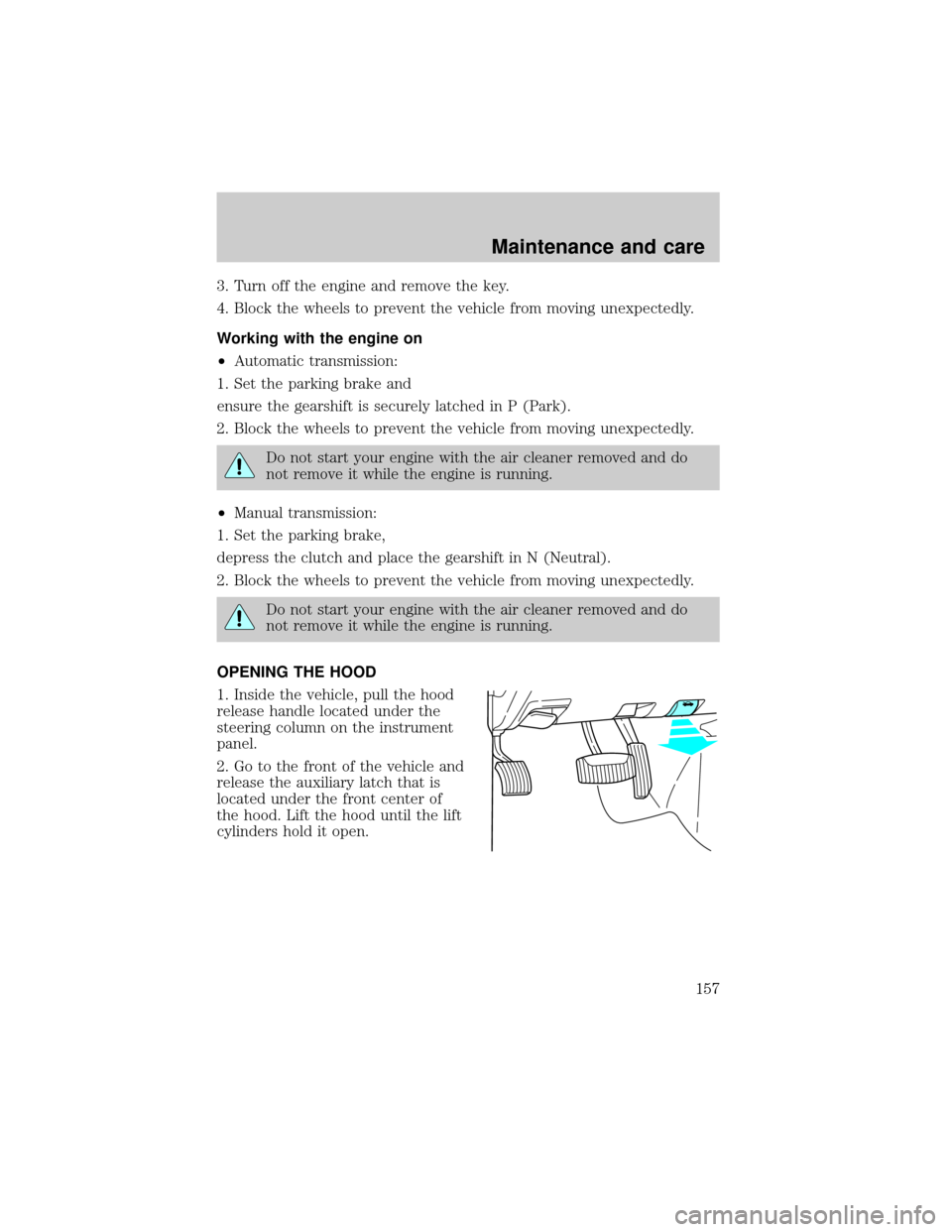
1. Inside the vehicle, pull the hood
release handle located under the
steering column on the instrument
panel.
2. Go to the front of the vehicle and
release the auxiliary latch that is
located under the front center of
the hood. Lift the hood until the lift
cylinders hold it open.
Maintenance and care
157
Page 170 of 210

²5.0L engine
1. Start the engine and let it run until it reaches normal operating
temperature (the engine coolant temperature gauge will be near the
center of the NORMAL band).
2. While the engine idles, turn the steering wheel left and right several
times.
3. Turn the engine off.
4. Check the fluid level in the reservoir.
5.If your vehicle is equipped with a 4.0L EFI engine,the fluid level
should be in the FULL HOT range. Do not add fluid if the level is in this
range.
6.If your vehicle is equipped with a 4.0L SOHC engine or a 5.0L
engine,the fluid level should be between the MIN and MAX lines. Do
not add fluid if the level is in this range.
7. If the fluid is low, add fluid in small amounts, continuously checking
the level until it reaches the correct operating range. Be sure to put the
cap back on the reservoir.
TRANSMISSION FLUID
Checking and adding automatic transmission fluid
Follow the scheduled service intervals outlined in the ``Service Guide''.
Before adding any fluid, make sure the correct type is used. The type of
fluid used is normally indicated on the dipstick and/or dipstick handle
and also in theLubricant specificationssection in theCapacities and
specificationschapter.
Maintenance and care
170
Page 178 of 210
grade 100. The relative performance of tires depends upon the actual
conditions of their use, however, and may depart significantly from the
norm due to variations in driving habits, service practices, and
differences in road characteristics and climate.
Traction A B C
The traction grades, from highest to lowest are A, B, and C, and they
represent the tire's ability to stop on wet pavement as measured under
test surfaces of asphalt and concrete. A tire marked C may have poor
traction performance.
The traction grade assigned to this tire is based on braking
(straight ahead) traction tests and does not include cornering
(turning) traction.
Temperature A B C
The temperature grades are A (the highest), B, and C, representing the
tire's resistance to the generation of heat and its ability to dissipate heat
when tested under controlled conditions on a specified indoor laboratory
test wheel. Sustained high temperature can cause the material of the tire
to degenerate and reduce tire life, and excessive temperature can lead to
sudden tire failure. The grade C corresponds to a level of performance
which all passenger car tires must meet under the Federal Motor Vehicle
Safety Standard No. 109. Grades B and A represent higher levels of
performance on the laboratory test wheel than the minimum required by
law.
The temperature grade for this tire is established for a tire that
is properly inflated and not overloaded. Excessive speed,
underinflation, or excessive loading, either separately or in
combination, can cause heat buildup and possible tire failure.
SERVICING YOUR TIRES
Checking the tire pressure
²Use an accurate tire pressure gauge.
²Check the tire pressure when tires are cold, after the vehicle has been
parked for at least one hour or has been driven less than 5 km (3
miles).
Maintenance and care
178
Page 181 of 210
Make sure that all replacement tires are of the same size, type,
load-carrying capacity and tread design (e.g., ``All Terrain'', etc.),
as originally offered by Ford.
Failure to follow these precautions may adversely affect the
handling of the vehicle and make it easier to lose control and roll
over.
Tires that are larger or smaller than your vehicle's original tires may also
affect the accuracy of your speedometer.
USING SNOW TIRES AND TRACTION DEVICES
Snow tires must be the same size and grade as the tires you
currently have on your vehicle.
The tires on your vehicle have all-weather treads to provide traction in
rain and snow. However, in some climates, using snow tires and traction
devices may be necessary. Ford offers tire cables as a Ford approved
accessory and recommends use of these or their equivalents. See your
dealer or qualified service technician for more information on tire cables
for your vehicle.
Follow these guidelines when using snow tires and traction devices:
²Do not use tire chains on aluminum wheels. Chains may chip the
wheels.
²Install cables securely, verifying that the cables do not touch any
wiring, brake lines or fuel lines.
²Drive cautiously. If you hear the cables rub or bang against the
vehicle, stop and retighten them. If this does not work, remove the
cables to prevent vehicle damage.
²Avoid overloading your vehicle.
²Remove the tire cables when they are no longer needed.
²Do not use cables on dry roads.
²The suspension insulation and bumpers will help prevent vehicle
damage. Do not remove these components from the vehicle when
using snow tires and traction devices.
²Do not exceed 48 km/h (30 mph) with tire cables on your vehicle.
Maintenance and care
181
Page 194 of 210

Cleaning the wheels
Wash with the same detergent as the body of your vehicle. Do not use
acid-based wheel cleaners, steel wool, fuel or strong detergents. Never
use abrasives that will damage the finish of special wheel surfaces. Use a
tar remover to remove grease and tar.
Cleaning plastic exterior parts
Use vinyl cleaner for routine cleaning. Clean with a tar remover if
necessary. Do not clean plastic parts with thinners, solvents or
petroleum-based cleaners.
Cleaning the exterior lamps
Wash with the same detergent as the exterior of your vehicle. Use glass
cleaner or tar remover if necessary.
To avoid scratching the lamps, do not use a dry paper towel, chemical
solvents or abrasive cleaners.
Cleaning the wiper blades
If the wiper blades do not wipe properly, clean the windshield and wiper
blades with undiluted windshield wiper solution or a mild detergent.
Rinse thoroughly with clean water. To avoid damaging the blades, do not
use fuel, kerosene, paint thinner or other solvents.
Cleaning the instrument panel
Clean with a damp cloth, then dry with a dry cloth.
Avoid cleaner or polish that increases the gloss of the upper portion of
the instrument panel. The dull finish in this area helps protect the driver
from undesirable windshield reflection.
Cleaning the interior fabric
Remove dust and loose dirt with a whisk broom or a vacuum cleaner.
Remove fresh spots immediately. Follow the directions that come with
the cleaner.
Cleaning and maintaining the safety belts
Clean the safety belts with a mild soap solution recommended for
cleaning upholstery or carpets. Do not bleach or dye the belts, because
these actions may weaken the belt webbing.
Maintenance and care
194
Page 201 of 210

FluidFord Part
Name or
equivalentFord Part
NumberFord
Specification
Power steering
reservoirMotorcraft
MERCONtAT FXT-2-QDX MERCONt
Ford
conventional and
traction lok rear
axlesRefer to
footnotes 1, 2
and 3Refer to
footnotes 1, 2
and 3Refer to
footnotes 1, 2
and 3
Front axle 4x4 Gear Oil F1TZ-19580-A WSL-M2C191-A
Transfer case -
Four wheel
driveMotorcraft
MERCONtAT FXT-2-QDX MERCONt
5-speed manual
transmissionMotorcraft
MERCONtAT FXT-2-QDX MERCONt
Transfer case
Front Output
Slip ShaftPremium
Long-Life GreaseXG-1-G or K ESA-M1C75-B
14.0L vehicles with conventional and Traction-lok rear axles are filled
with Motorcraft SAE 80W90 Premium Rear Axle Lube, part number
XY-80W90±QL, Ford specification WSP-M2C197±A.
24.0L vehicles with limited slip differentials and all 5.0L applications use
rear axles that are filled with Motorcraft SAE 75W140 High Performance
Synthetic Rear Axle Lube, part number F1TZ-19580±B, Ford
specification WSL-M2C192±A.
34.0L vehicles with limited slip differentials and all 5.0L applications
must add 118 ml (4 oz) of additive friction modifier C8AZ-19B546±A,
Ford specification EST-M2C118±A to the rear axle whenever the axle has
been serviced.
Capacities and specifications
201
Page 202 of 210

ENGINE DATA
Engine4.0L EFI
engine4.0L SOHC
engine5.0L engine
Cubic inches 245 245 302
Horsepower 160 @ 4200 rpm 205 @ 5000 rpm 215 @ 4200 rpm
Torque 225 lb. ft. @
2750 rpm250 lb. ft. @
3000 rpm288 lbs.ft. @
3300 rpm
Required fuel
grade87 octane 87 octane 87 octane
Firing order 1-4-2-5-3-6 1-4-2-5-3-6 1-3-7-2-6-5-4-8
Spark plug gap 1.3 mm-1.4 mm
(0.052-.056
inch)1.3 mm-1.4 mm
(0.052-.056
inch)1.3 mm-1.4 mm
(0.052-.056
inch)
Ignition system EDIS EDIS EDIS
Compression
ratio9.0:1 9.7:1 9.0:1
VEHICLE DIMENSIONS
Dimensions 4 Door mm (in.) 2 Door mm (in.)
(1) Overall length 4 788 (188.5) 4 536 (178.6)
(2) Overall width 1 783 (70.2) 1 783 (70.2)
(3) Maximum
height1 72.5 (67.9) 1 722 (67.8)
(4) Wheelbase 2 835 (111.6) 2 585 (101.8)
(5) Front track /
rear1 486/1 487 (58.5/58.5) 1 486/1 487 (58.5/58.5)
Capacities and specifications
202
Page 206 of 210

Air bag supplemental
restraint system ........................82
and child safety seats ..............83
description ................................82
disposal ......................................86
indicator light ...........................85
passenger air bag .....................84
Air conditioning
manual heating and air
conditioning system ............23,25
Air suspension
description ..............................106
All wheel drive (AWD) .............121
Ambulance packages ....................3
Anti-lock brake system (ABS)
description ..............................104
Anti-theft system ........................67
Autolamp system (see
Headlamps) .................................48
Automatic dimming mirror ...48,49
Battery .......................................175
voltage gauge ............................14
Brake fluid
checking and adding ..............164
Brakes ........................................104
anti-lock ...................................104
anti-lock brake system (ABS)
warning light ...........................104
fluid, checking and adding ....164
Brake-shift interlock .................107
Break-in period .............................2
Bulbs, replacing ........................186
headlamps ...............................187
specifications ..........................188
Cargo cover .................................57
Changing a tire .........................144
Child safety seats ........................87
built-in child seat ......91,92,96,97
Childproof locks ..........................52
Chime
headlamps on ............................11
Cleaning your vehicle ...............191built-in child seat ...................195
engine compartment ..............192
fabric ........................................194
instrument panel ....................194
plastic parts ............................194
safety belts ..............................194
tail lamps .................................194
washing ....................................191
waxing .....................................192
wheels ......................................194
windows ..................................196
woodtone trim ........................196
Climate control system
automatic temperature
control .........26,27,28,29,30,31,32
Clutch
fluid ..........................................165
Compass, electronic ...............45,46
calibration .................................48
set zone adjustment .................47
Console, description ...................54
Control trac 4WD system .........116
Controls ..................................53,54
Cupholder (s) .............................55
Defrost
rear window ..............................34
Driving under special
conditions .........................120,122
high water ........................120,123
slippery roads ....120,121,123,124
Emission control system ..........185
Engine ........................................202
service points ............158,159,160
Engine block heater .................102
Engine coolant
checking and adding .......166,167
disposal ....................................168
refill capacities ........................168
Engine oil ...........................160,163
changing oil and oil filter .......163
checking and adding .......160,162
Exhaust fumes ..........................103
Index
206