Page 142 of 210
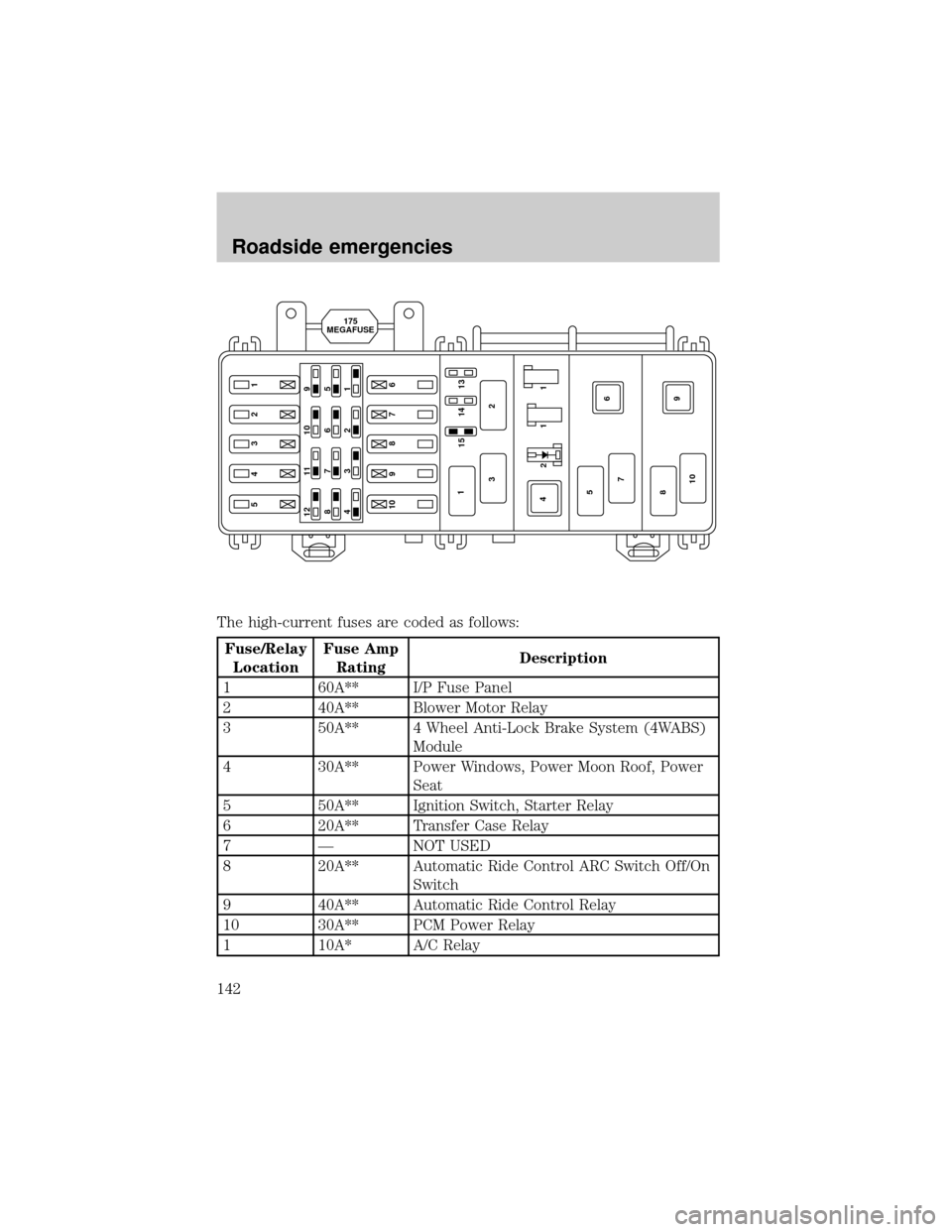
The high-current fuses are coded as follows:
Fuse/Relay
LocationFuse Amp
RatingDescription
1 60A** I/P Fuse Panel
2 40A** Blower Motor Relay
3 50A** 4 Wheel Anti-Lock Brake System (4WABS)
Module
4 30A** Power Windows, Power Moon Roof, Power
Seat
5 50A** Ignition Switch, Starter Relay
6 20A** Transfer Case Relay
7 Ð NOT USED
8 20A** Automatic Ride Control ARC Switch Off/On
Switch
9 40A** Automatic Ride Control Relay
10 30A** PCM Power Relay
1 10A* A/C Relay
5432110 9 8 7 612 11 10 9
876 5
432 1
14 15 13
211
9 6
10 87 5 41
2 3
175
MEGAFUSE
Roadside emergencies
142
Page 143 of 210
Fuse/Relay
LocationFuse Amp
RatingDescription
2 - NOT USED
3 30A* Heated Backlight
4 15A* Fog Lamps and Daytime Running Lamps
5 10A* Air Bag Diagnostic Monitor
6 10A* Powertrain Control Module
7 30A* 4 Wheel Anti-Lock System (4WABS)
Module
8 15A* Rear Wiper Motor
9 20A* Fuel Pump Relay and RAP Module
10 15A* Horn Relay
11 15A* Parklamps Relay and Mainlight Switch
12 30A* Mainlight Switch and Multifunction Switch
13 15A* Heated Oxygen Sensor, EGR Vacuum
Regulator, EVR Solenoid, Camshaft Position
(CMP) Sensor, Canister Vent Solenoid
14 30A* Generator/Voltage Regulator
15 - NOT USED
1 - Wiper Park Relay
2 - A/C Relay
3 - Wiper High/Low Relay
4 - PCM Power Relay
5 - Fuel Pump Relay
6 - Starter Relay
7 - Horn Relay
8 - Rear Wipe Down Relay
9 - Blower Motor Relay
10 - Rear Wipe Up Relay
1 - NOT USED
1 - NOT USED
2 - Electronic Engine Controls Diode
* Mini Fuses ** Maxi Fuses
15.0L Engines Only
Roadside emergencies
143
Page 144 of 210
CHANGING THE TIRES
If you get a flat tire while driving, do not apply the brake heavily.
Instead, gradually decrease your speed. Hold the steering wheel firmly
and slowly move to a safe place on the side of the road.
Spare tire information
Your vehicle is equipped with a spare tire that may be used as a spare or
a regular tire. The spare tire is not equipped with wheel trim. The wheel
trim from the original wheel/tire may be used on the spare.
If your vehicle is equipped with 4WD or AWD, a spare tire of a
different size than the road tires should not be used. Such a tire
could result in damage to driveline components and make the
vehicle difficult to control.
Location of the spare tire and tools
The spare tire and tools for your vehicle are stowed in the following
locations:
Tool Location
Spare tire Under the vehicle, just in front of the rear
bumper
Jack, lug nut wrench Left rear quarter panel behind interior trim
Jack handle Behind rear seats, under carpet
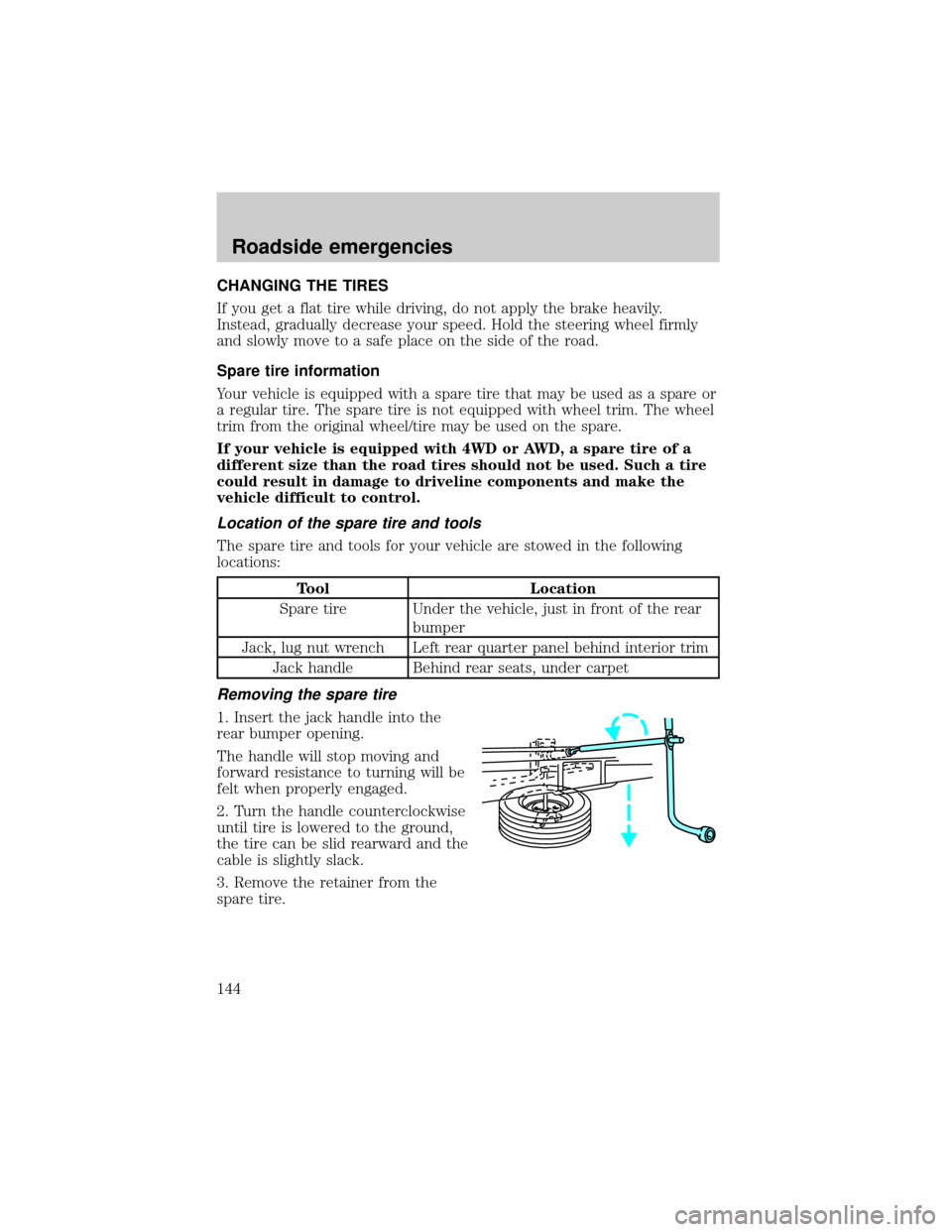
Removing the spare tire
1. Insert the jack handle into the
rear bumper opening.
The handle will stop moving and
forward resistance to turning will be
felt when properly engaged.
2. Turn the handle counterclockwise
until tire is lowered to the ground,
the tire can be slid rearward and the
cable is slightly slack.
3. Remove the retainer from the
spare tire.
Roadside emergencies
144
Page 145 of 210
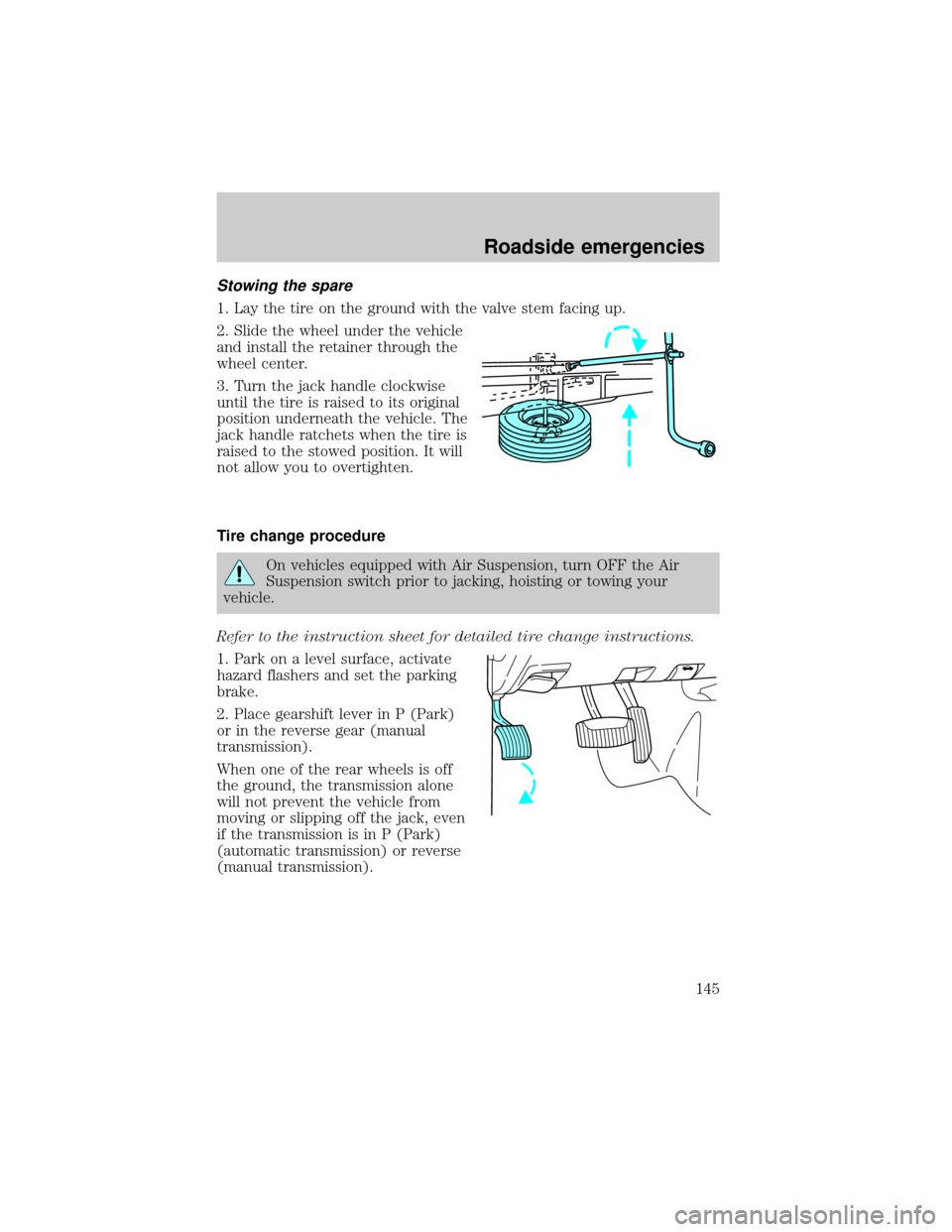
Stowing the spare
1. Lay the tire on the ground with the valve stem facing up.
2. Slide the wheel under the vehicle
and install the retainer through the
wheel center.
3. Turn the jack handle clockwise
until the tire is raised to its original
position underneath the vehicle. The
jack handle ratchets when the tire is
raised to the stowed position. It will
not allow you to overtighten.
Tire change procedure
On vehicles equipped with Air Suspension, turn OFF the Air
Suspension switch prior to jacking, hoisting or towing your
vehicle.
Refer to the instruction sheet for detailed tire change instructions.
1. Park on a level surface, activate
hazard flashers and set the parking
brake.
2. Place gearshift lever in P (Park)
or in the reverse gear (manual
transmission).
When one of the rear wheels is off
the ground, the transmission alone
will not prevent the vehicle from
moving or slipping off the jack, even
if the transmission is in P (Park)
(automatic transmission) or reverse
(manual transmission).
Roadside emergencies
145
Page 146 of 210
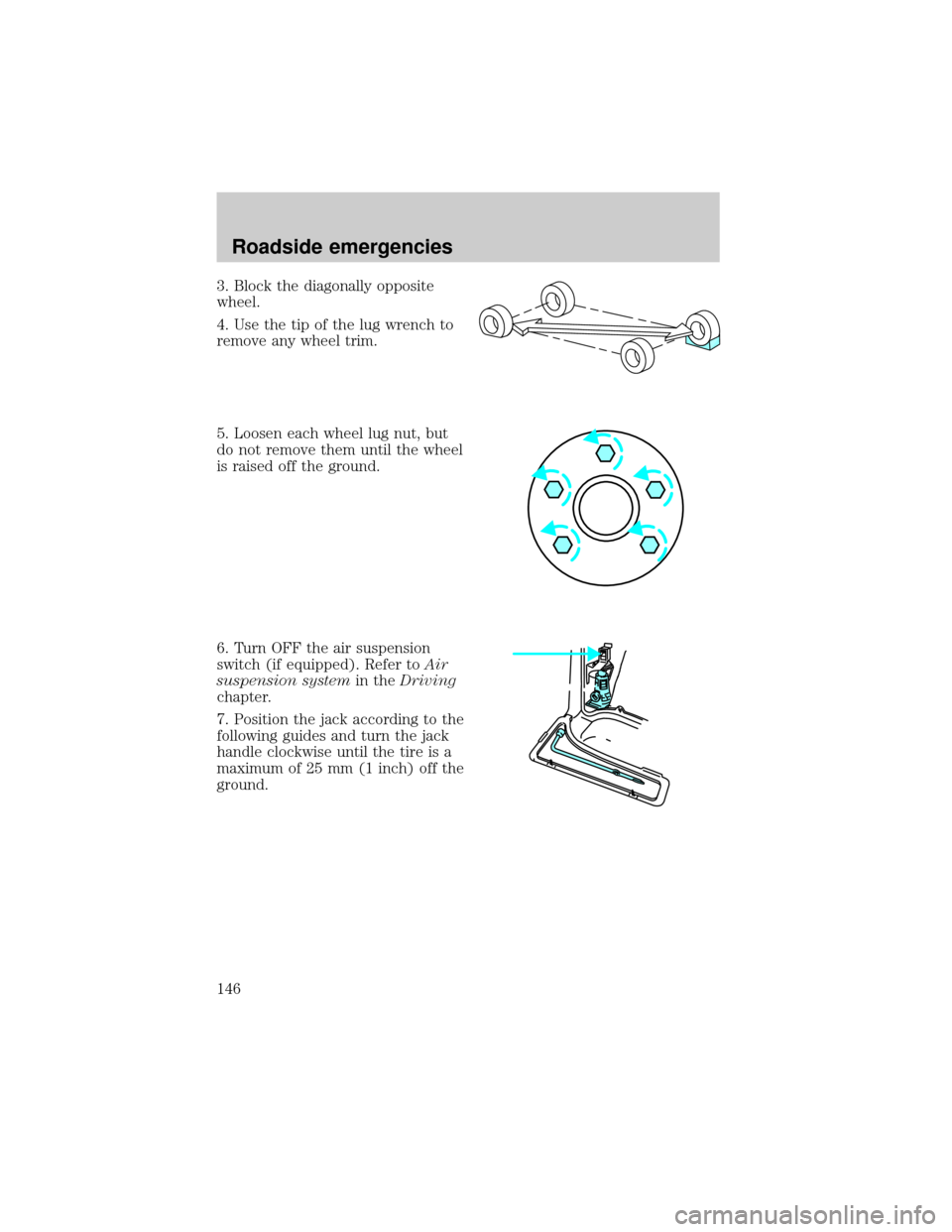
3. Block the diagonally opposite
wheel.
4. Use the tip of the lug wrench to
remove any wheel trim.
5. Loosen each wheel lug nut, but
do not remove them until the wheel
is raised off the ground.
6. Turn OFF the air suspension
switch (if equipped). Refer toAir
suspension systemin theDriving
chapter.
7. Position the jack according to the
following guides and turn the jack
handle clockwise until the tire is a
maximum of 25 mm (1 inch) off the
ground.
Roadside emergencies
146
Page 148 of 210
²Never use the front or rear
differential as a jacking point.
8. Remove the lug nuts with the lug
wrench.
9. Replace the flat tire with the
spare tire, making sure the valve
stem is facing outward. Reinstall the
lug nuts, cone side in, until the
wheel is snug against the hub. Do
not fully tighten the lug nuts until
the wheel has been lowered.
10. Lower the wheel by turning the
jack handle counterclockwise.
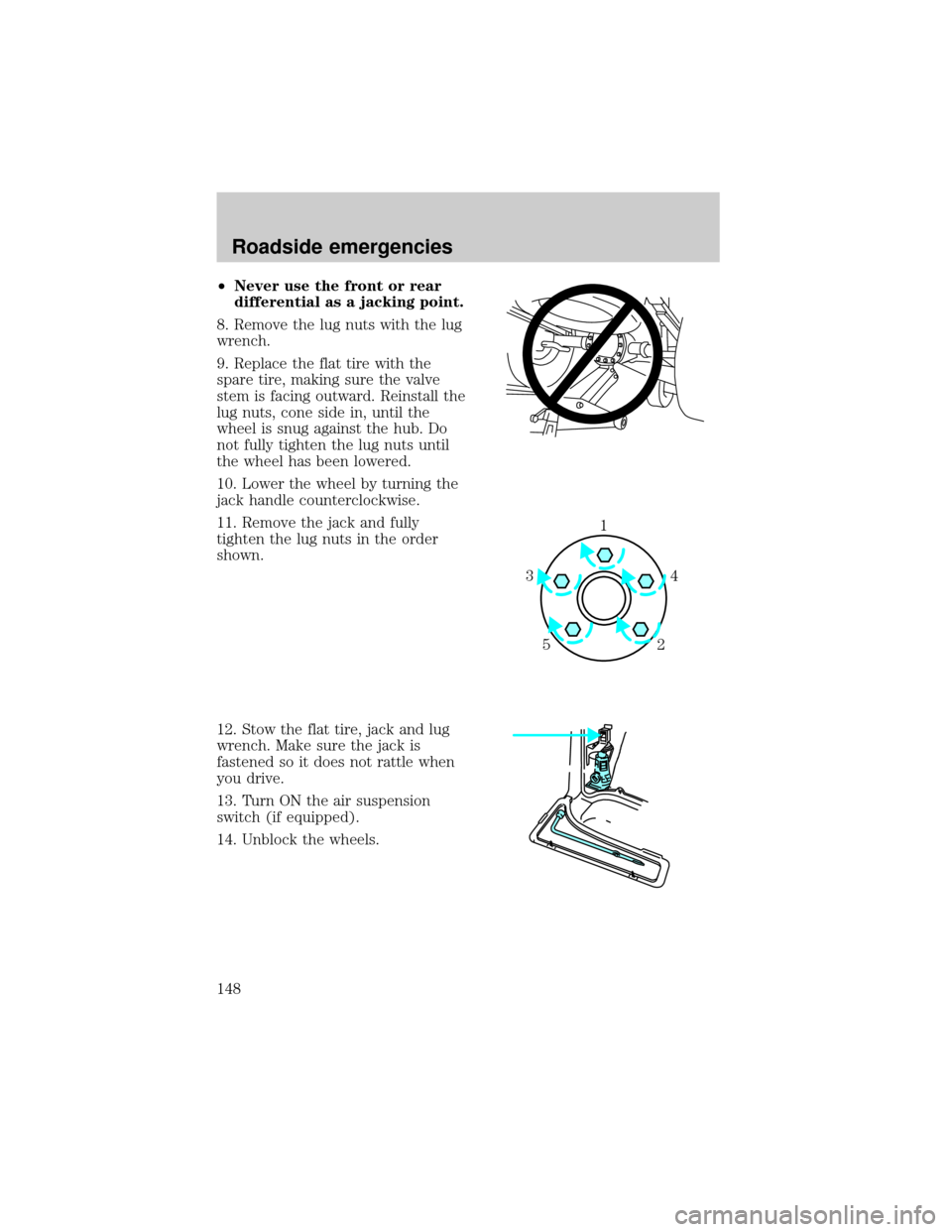
11. Remove the jack and fully
tighten the lug nuts in the order
shown.
12. Stow the flat tire, jack and lug
wrench. Make sure the jack is
fastened so it does not rattle when
you drive.
13. Turn ON the air suspension
switch (if equipped).
14. Unblock the wheels.
1
4 3
52
Roadside emergencies
148
Page 154 of 210
WRECKER TOWING
If you need to have your vehicle towed, contact a professional towing
service or, if you are a member, your roadside assistance center.
If equipped with air suspension, the air suspension control must be
turned to the OFF position.
The Ford approved towing procedure is flatbed or wheel lift with
dollies.
On 4x2 vehicles, it is acceptable to tow the vehicle with the front wheels
on the ground (without dollies) and the rear wheels off the ground.
If the vehicle is towed by other means or incorrectly, vehicle
damage may occur.
Do not tow with slingbelt equipment. Ford Motor Company has not
developed or approved a slingbelt towing procedure.
Roadside emergencies
154
Page 156 of 210

SERVICE RECOMMENDATIONS
To help you service your vehicle:
²We highlight do-it-yourself items in the engine compartment for easy
location.
²We provide a ``Service Guide'' which makes tracking routine service
easy.
If your vehicle requires professional service, your dealership can provide
necessary parts and service. Check your ``Warranty Guide'' to find out
which parts and services are covered.
Use only recommended fuels, lubricants, fluids and service parts
conforming to specifications. Motorcraft parts are designed and built to
provide the best performance in your vehicle.
PRECAUTIONS WHEN SERVICING YOUR VEHICLE
Be especially careful when inspecting or servicing your vehicle.
²Do not work on a hot engine.
²When the engine is running, make sure that loose clothing, jewelry or
long hair does not get caught up in moving parts.
²Do not work on a vehicle with the engine running in an enclosed
space, unless you are sure you have enough ventilation.
²Keep all lit cigarettes, open flames and other lit material away from
the battery and all fuel related parts.
If you disconnect the battery, the engine must ``relearn'' its idle
conditions before your vehicle will drive properly, as explained inBattery
in this chapter.
Working with the engine off
²Automatic transmission:
1. Set the parking brake and
ensure the gearshift is securely latched in P (Park).
2. Turn off the engine and remove the key.
3. Block the wheels to prevent the vehicle from moving unexpectedly.
²Manual transmission:
1. Set the parking brake.
2. Depress the clutch and place the gearshift in 1 (First).
Maintenance and care
156