Page 106 of 216
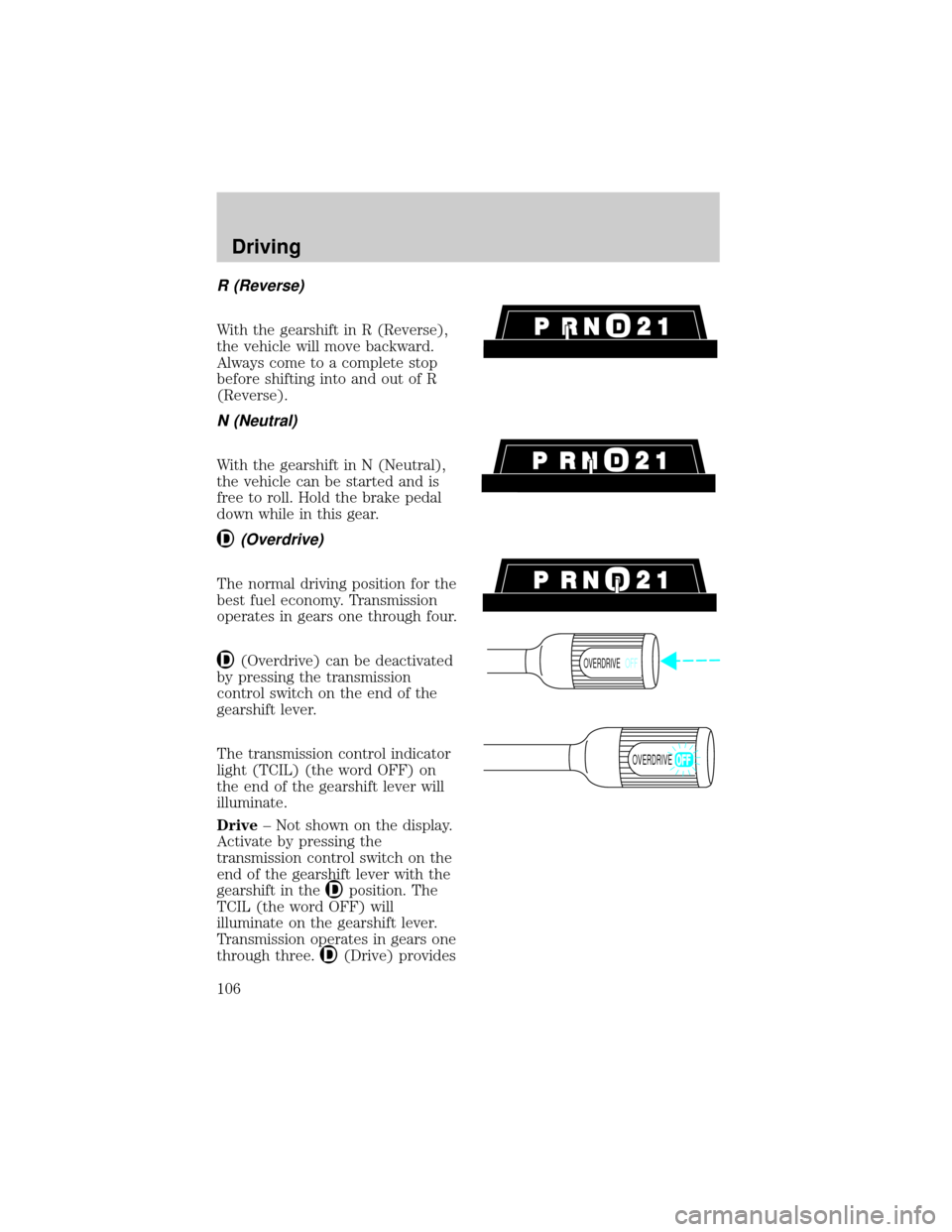
R (Reverse)
With the gearshift in R (Reverse),
the vehicle will move backward.
Always come to a complete stop
before shifting into and out of R
(Reverse).
N (Neutral)
With the gearshift in N (Neutral),
the vehicle can be started and is
free to roll. Hold the brake pedal
down while in this gear.
(Overdrive)
The normal driving position for the
best fuel economy. Transmission
operates in gears one through four.
(Overdrive) can be deactivated
by pressing the transmission
control switch on the end of the
gearshift lever.
The transmission control indicator
light (TCIL) (the word OFF) on
the end of the gearshift lever will
illuminate.
Drive± Not shown on the display.
Activate by pressing the
transmission control switch on the
end of the gearshift lever with the
gearshift in the
position. The
TCIL (the word OFF) will
illuminate on the gearshift lever.
Transmission operates in gears one
through three.
(Drive) provides
OVERDRIVEOFF
OVERDRIVE
Driving
106
Page 124 of 216
upshifting for optimum fuel
economy and transmission
cooling.
²Anticipate stops and brake
gradually.
Servicing after towing
If you tow a trailer for long
distances, your vehicle will require
more frequent service intervals.
Refer to the Severe Duty Schedule
in your ªService Guideº for more
information.
Towing behind another vehicle
Do not tow your vehicle behind
another vehicle, such as an RV.
Your vehicle cannot be flat towed
with all wheels on the ground.
Trailer towing tips
²Practice turning, stopping and
backing up in an area before
starting on a trip to get the feel
of the vehicle trailer
combination. When turning,
make wider turns so the trailer
wheels will clear curbs and
other obstacles.
²Allow more distance for
stopping with a trailer attached.
²The trailer tongue weight should
be 10±15% of the loaded trailer
weight.
²After you have traveled 80 km
(50 miles), thoroughly check
your hitch, electrical
connections and trailer wheel
lug nuts.
Driving
124
Page 126 of 216
LUGGAGE RACK
Load luggage at the front crossbar
and adjust the rear crossbar as
necessary.
²Do not exceed 90.7 kg (200 lb)
of luggage if the weight is
placed directly on the crossbars.
²Do not exceed 68 kg (150 lb) if
the weight is resting directly on
the roof.
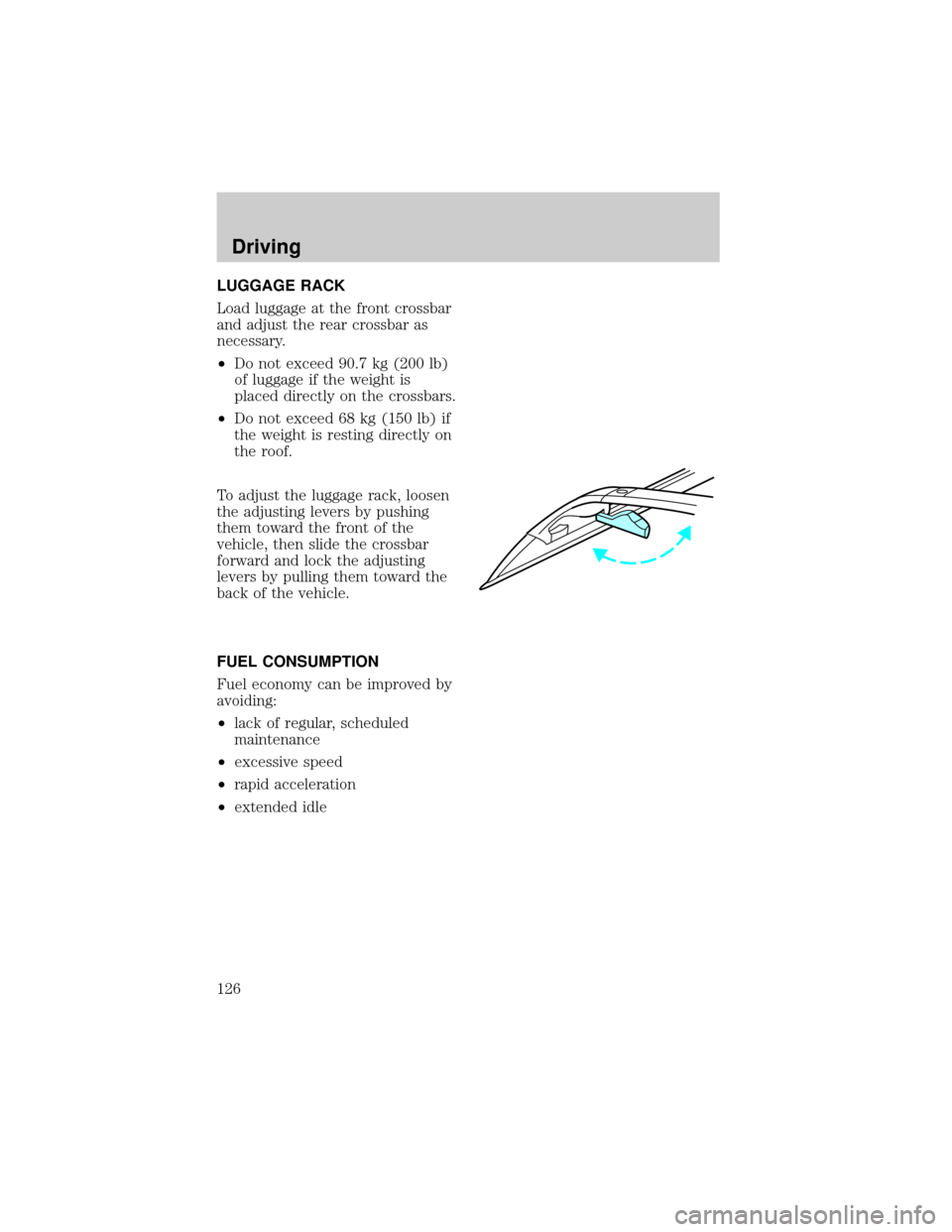
To adjust the luggage rack, loosen
the adjusting levers by pushing
them toward the front of the
vehicle, then slide the crossbar
forward and lock the adjusting
levers by pulling them toward the
back of the vehicle.
FUEL CONSUMPTION
Fuel economy can be improved by
avoiding:
²lack of regular, scheduled
maintenance
²excessive speed
²rapid acceleration
²extended idle
Driving
126
Page 127 of 216
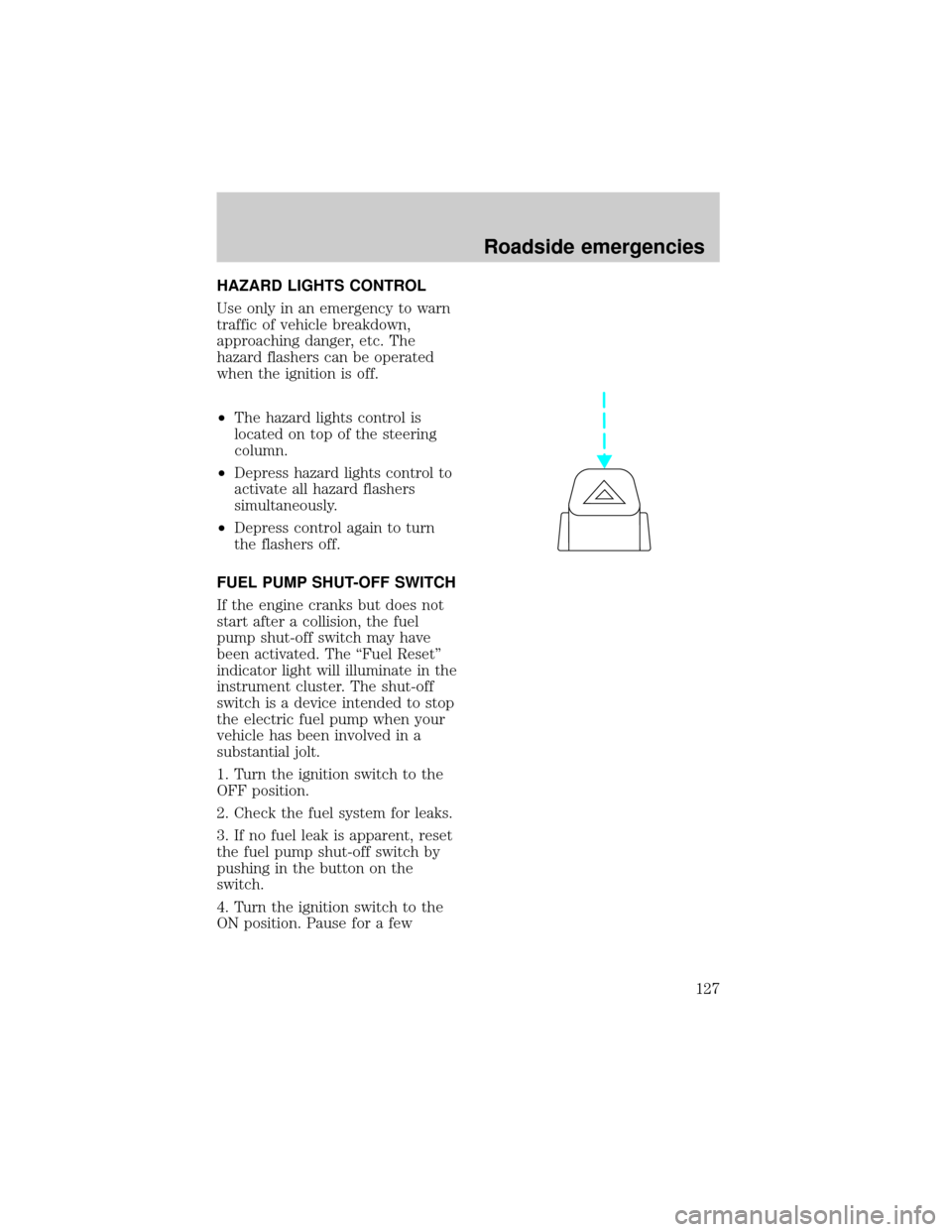
HAZARD LIGHTS CONTROL
Use only in an emergency to warn
traffic of vehicle breakdown,
approaching danger, etc. The
hazard flashers can be operated
when the ignition is off.
²The hazard lights control is
located on top of the steering
column.
²Depress hazard lights control to
activate all hazard flashers
simultaneously.
²Depress control again to turn
the flashers off.
FUEL PUMP SHUT-OFF SWITCH
If the engine cranks but does not
start after a collision, the fuel
pump shut-off switch may have
been activated. The ªFuel Resetº
indicator light will illuminate in the
instrument cluster. The shut-off
switch is a device intended to stop
the electric fuel pump when your
vehicle has been involved in a
substantial jolt.
1. Turn the ignition switch to the
OFF position.
2. Check the fuel system for leaks.
3. If no fuel leak is apparent, reset
the fuel pump shut-off switch by
pushing in the button on the
switch.
4. Turn the ignition switch to the
ON position. Pause for a few
Roadside emergencies
127
Page 128 of 216
seconds and return the key to the
OFF position.
5. Make a further check for leaks
in the fuel system.
The fuel pump shut-off switch is
located in the passenger's foot
well, behind the kick panel.
FUSES AND RELAYS
Fuses
If electrical components in the
vehicle are not working, a fuse
may have blown. Blown fuses are
identified by a broken wire within
the fuse. Check the appropriate
fuses before replacing any
electrical components.
1515
Roadside emergencies
128
Page 134 of 216
The high-current fuses are coded
as follows.
Fuse/Relay
LocationFuse Amp
RatingDescription
1 20A* Trailer Tow Running Lamp Relay,
Trailer Tow Backup Lamp Relay
2 10A* Air Bag Diagnostic Monitor
3 30A* All Unlock Relay, All Lock Relay,
Driver's Unlock Relay
4 15A* Air Suspension Service Switch
5 20A* Horn Relay
6 30A* Radio, Premium Sound Amplifier,
CD Changer, Rear Integrated
Control Panel, Sub-Woofer Power
(Fuse 3 & Fuse 5)
19 29
18 28EEC
POWER
RELAY
FUEL
PUMP
RELAY
FRONT
WASHER
PUMP HORN
RELAY 17 27
16 26
15 25
14 24
13
11 12
910
78
56
34
1223
22
21
20
W/S/W
RUN/
PARKW/S/W
HI/LO
Roadside emergencies
134
Page 135 of 216
Fuse/Relay
LocationFuse Amp
RatingDescription
7 15A* Main Light Switch, Park Lamp
Relay
8 30A* Main Light Switch, Headlamp
Relay, Multi-Function Switch
9 15A* Daytime Running Lamps (DRL)
Module, Fog Lamp Relay
10 25A* I/P Auxiliary Power Socket
11 25A* Console Auxiliary Power Socket
12 10A* Rear Wiper Up Motor Relay, Rear
Wiper Down Motor Relay
13 30A** Auxiliary A/C Relay
14 60A** 4 Wheel Anti-Lock Brake System
(4WABS) Module
15 50A** Air Suspension Solid State
Compressor Relay
16 40A** Trailer Tow Battery Charge Relay,
Engine Fuse Module (Fuse 2)
17 30A** Shift on the Fly Relay, Transfer
Case Shift relay
18 30A** Power Seat Control Switch
19 20A** Fuel Pump Relay
20 50A** Ignition Switch (B4 & B5)
21 50A** Ignition Switch (B1 & B3)
22 50A** Junction Box Fuse/Relay Panel
Battery Feed
23 40A** I/P Blower Relay
24 30A** PCM Power Relay, Engine Fuse
Module (Fuse 1)
25 30A CB Junction Box Fuse/Relay Panel,
ACC Delay Relay
26 Ð Not Used
Roadside emergencies
135
Page 150 of 216
SERVICE RECOMMENDATIONS
To help you service your vehicle:
²We highlight do-it-yourself items
in the engine compartment for
easy location.
²We provide a ªService Guideº
which makes tracking routine
service easy.
If your vehicle requires
professional service, your
dealership can provide necessary
parts and service. Check your
ªWarranty Guideº to find out which
parts and services are covered.
Use only recommended fuels,
lubricants, fluids and service parts
conforming to specifications.
Motorcraft parts are designed and
built to provide the best
performance in your vehicle.
PRECAUTIONS WHEN
SERVICING YOUR VEHICLE
Be especially careful when
inspecting or servicing your
vehicle.
²Do not work on a hot engine.
²When the engine is running,
make sure that loose clothing,
jewelry or long hair does not get
caught up in moving parts.
²Do not work on a vehicle with
the engine running in an
enclosed space, unless you are
sure you have enough
ventilation.
Maintenance and care
150