Page 102 of 191

dealer or trailer rental agency for
proper instructions and equipment
for hooking up trailer lamps.
Driving while you tow
Do not drive faster than 88 km/h
(55 mph) when towing a trailer.
Speed control may shut off if you
are towing on long, steep grades.
When towing a trailer:
²Use D (Drive) or a lower gear
when towing up or down steep
hills. This will eliminate
excessive downshifting and
upshifting for optimum fuel
economy and transmission
cooling.
²Anticipate stops and brake
gradually.
Servicing after towing
If you tow a trailer for long
distances, your vehicle will require
more frequent service intervals.
Refer to the Severe Duty Schedule
in your ªService Guideº for more
information.
Trailer towing tips
²Practice turning, stopping and
backing up in an area before
starting on a trip to get the feel
of the vehicle trailer
combination. When turning,
make wider turns so the trailer
wheels will clear curbs and
other obstacles.
²Allow more distance for
stopping with a trailer attached.
Driving
102
Page 108 of 191
Fuse/Relay
LocationFuse Amp
RatingDescription
METER 10A Backup Lamps, Engine Coolant
Level Switch, Instrument Cluster,
Rear Window Defrost, Shift Lock,
Warning Chime, Turn Signal
Switch
WIPER 20A Wiper/Washer, Blower Motor Relay
STOP 20A Stop Lamps, Brake Pressure
Switch
TAIL 15A Exterior Lamps, Instrument
Illumination
SUN ROOF 15A Power Moonroof
ASC 10A Speed Control
P. WINDOW 30A CB Power Windows
CIGAR 20A Cigar Lighter
AIR BAG 10A Air Bags
FOG 10A Fog Lamps, Daytime Running
Lamps (DRL)
AUDIO 15A Premium Sound Amplifier, CD
Changer
FUEL INJ. 10A H02S, Evaporative Emission
Purge Flow Sensor
BLOWER 30A CB Blower Motor Relay
Sedan/Wagon
The fuses are coded as follows:
Roadside emergencies
108
Page 113 of 191
Fuse/Fuse Link
Cartridge
LocationFuse Amp
RatingDescription
MAIN 100A* Charging System, BTN, Cooling
Fan, Fuel Pump, OBD-II, ABS
Fuses, Ignition Switch, Headlamps
BTN 40A* Hazard
ABS 60A* ABS Main Relay
COOLING FAN 40A* Constant Control Relay Module
OBD-II 10A** Data Link Connector (DLC),
Instrument Cluster
FUEL PUMP 30A** Engine Controls
HEAD RH 10A** Headlamps
HEAD LH 10A** Headlamps
* Fuse Link Cartridge ** Fuse
Relays
Relays are located in the power
distribution box and should be
replaced by qualified technicians.
CHANGING THE TIRES
If you get a flat tire while driving,
do not apply the brake heavily.
Instead, gradually decrease your
speed. Hold the steering wheel
firmly and slowly move to a safe
place on the side of the road.
Roadside emergencies
113
Page 115 of 191
²use the wheel for any other type
of vehicle
Tire change procedure
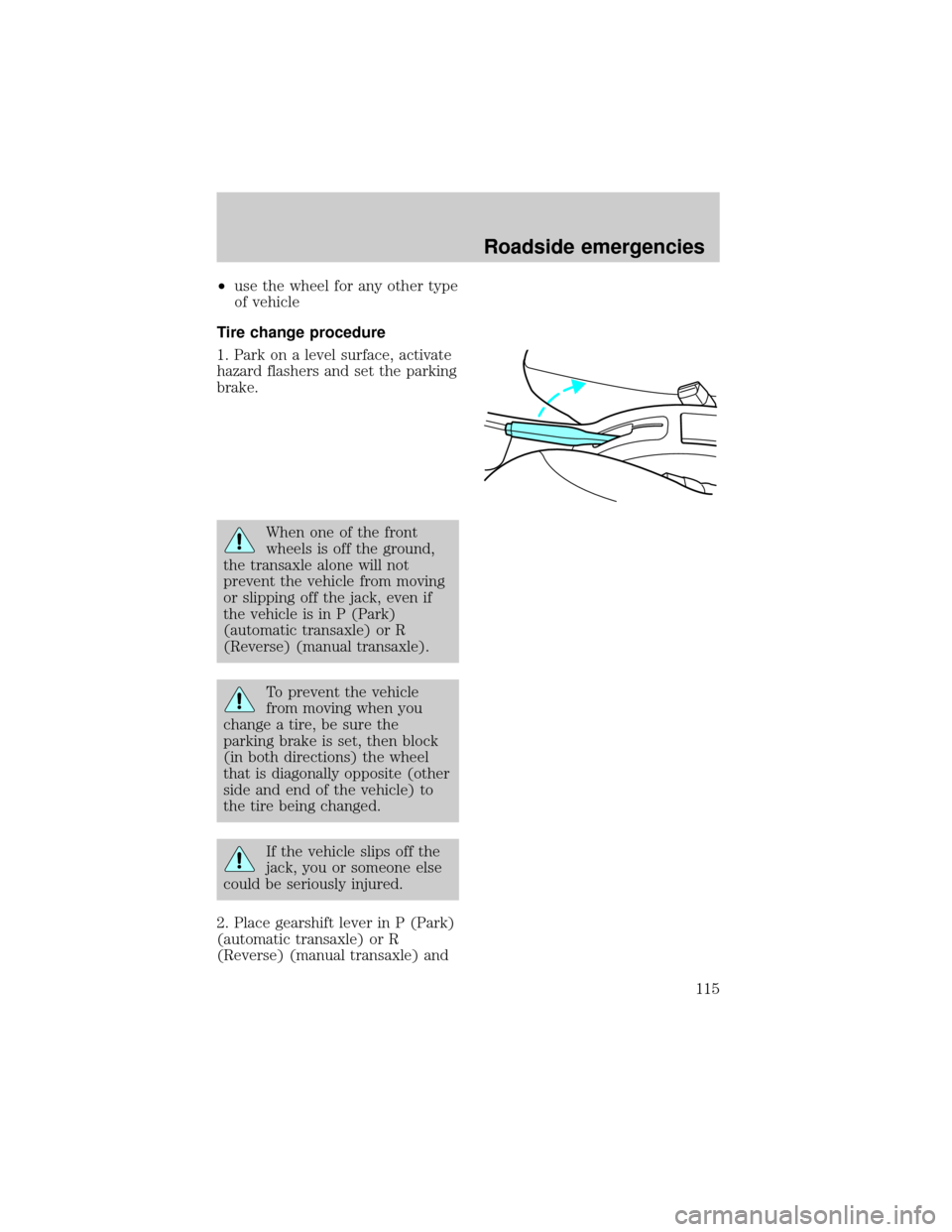
1. Park on a level surface, activate
hazard flashers and set the parking
brake.
When one of the front
wheels is off the ground,
the transaxle alone will not
prevent the vehicle from moving
or slipping off the jack, even if
the vehicle is in P (Park)
(automatic transaxle) or R
(Reverse) (manual transaxle).
To prevent the vehicle
from moving when you
change a tire, be sure the
parking brake is set, then block
(in both directions) the wheel
that is diagonally opposite (other
side and end of the vehicle) to
the tire being changed.
If the vehicle slips off the
jack, you or someone else
could be seriously injured.
2. Place gearshift lever in P (Park)
(automatic transaxle) or R
(Reverse) (manual transaxle) and
Roadside emergencies
115
Page 119 of 191
2. Do not disconnect the battery of
the disabled vehicle as this could
damage the vehicle's electrical
system.
3. Park the booster vehicle close to
the hood of the disabled vehicle
making sure theydo nottouch.
Set the parking brake on both
vehicles and stay clear of the
engine cooling fan and other
moving parts.
4. Check all battery terminals and
remove any excessive corrosion
before you attach the battery
cables.
5. Turn the heater fan on in both
vehicles to protect any electrical
surges. Turn all other accessories
off.
Connecting the jumper cables
1. Position the vehicles so that
they do not touch one another.
2. Switch off the engine. Switch off
any unnecessary electrical
equipment.
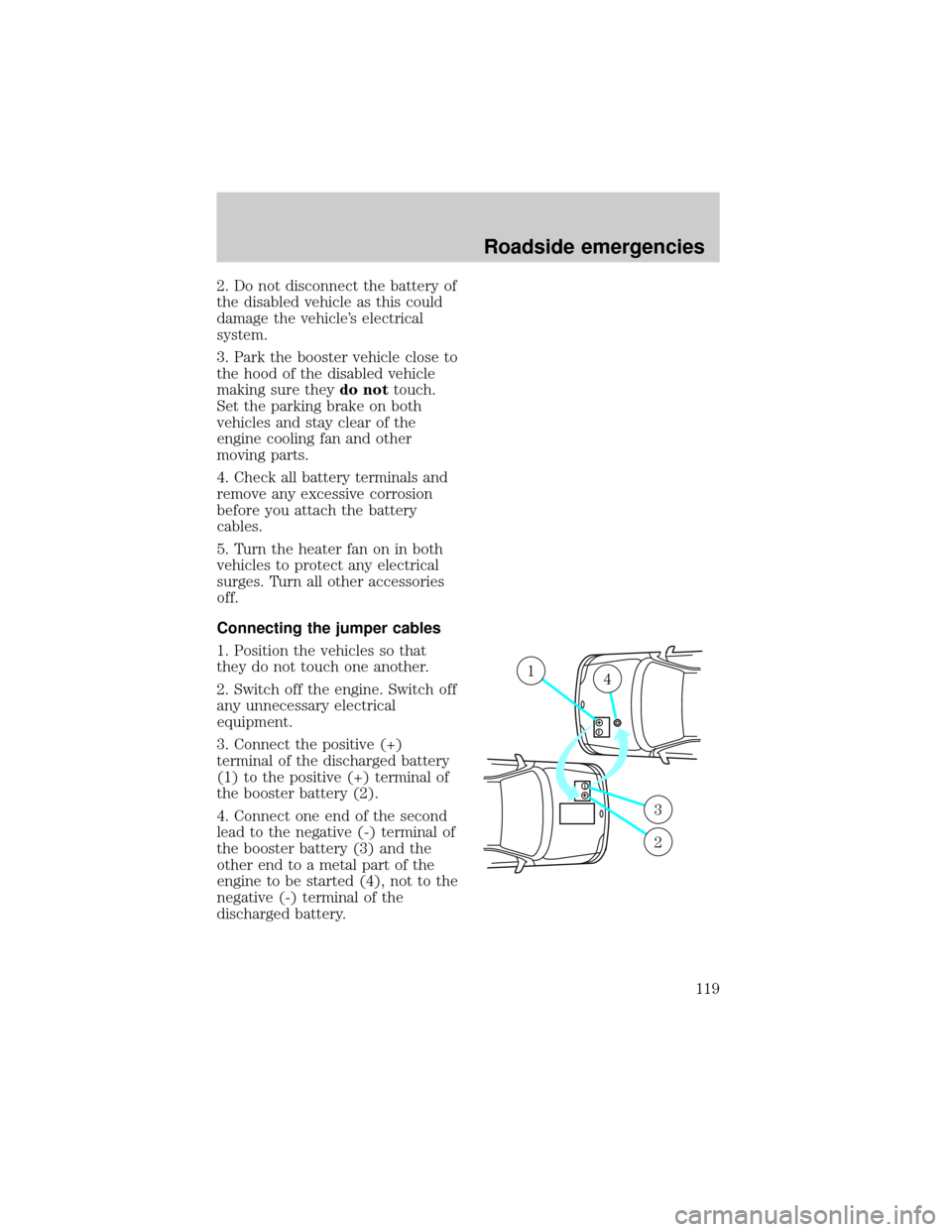
3. Connect the positive (+)
terminal of the discharged battery
(1) to the positive (+) terminal of
the booster battery (2).
4. Connect one end of the second
lead to the negative (-) terminal of
the booster battery (3) and the
other end to a metal part of the
engine to be started (4), not to the
negative (-) terminal of the
discharged battery.
+–
+–
14
3
2
Roadside emergencies
119
Page 124 of 191
²Do not work on a vehicle with
the engine running in an
enclosed space, unless you are
sure you have enough
ventilation.
²Keep all lit cigarettes, open
flames and other lit material
away from the battery and all
fuel related parts.
If you disconnect the battery, the
engine must ªrelearnº its idle
conditions before your vehicle will
drive properly, as explained in the
Batterysection in this chapter.
Working with the engine off
²Automatic transaxle:
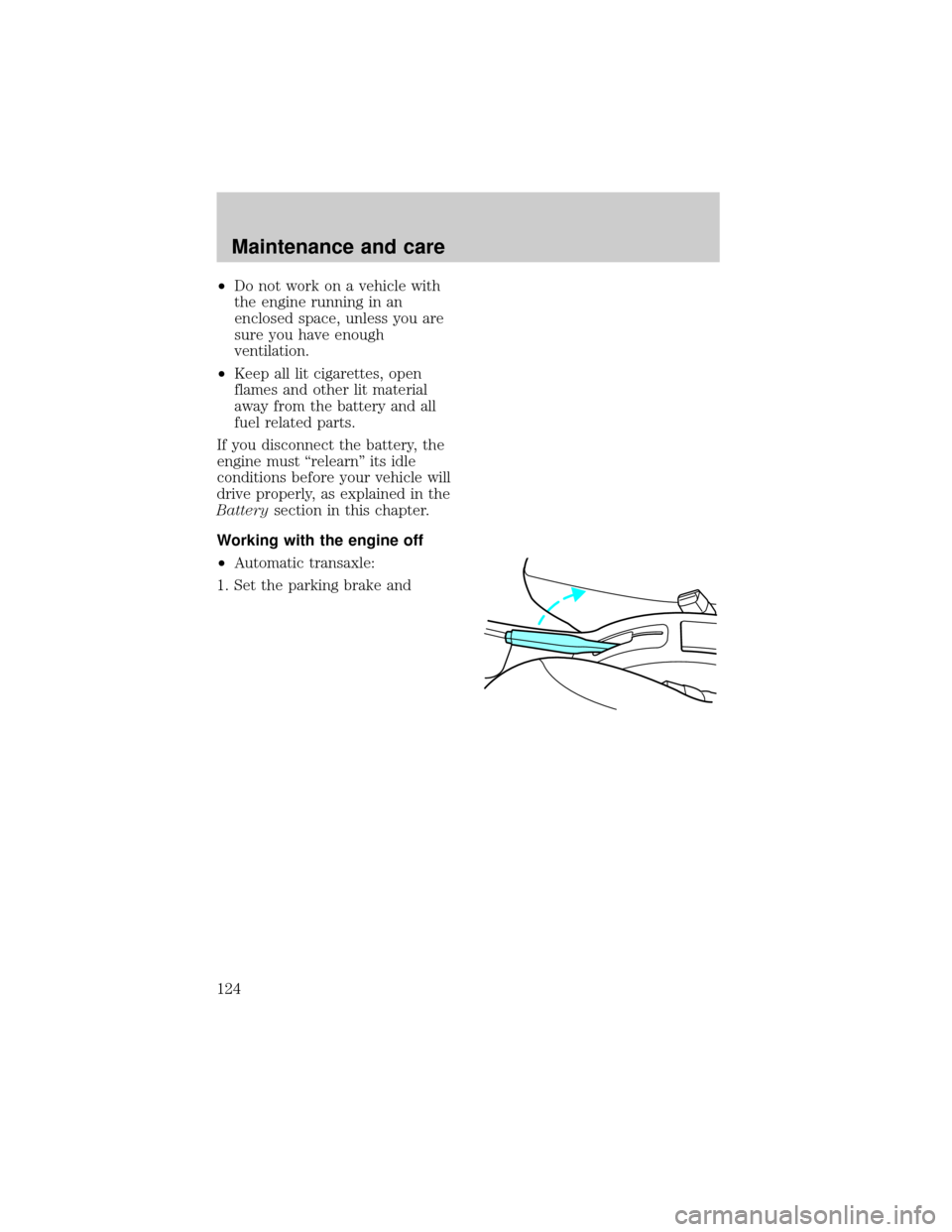
1. Set the parking brake and
Maintenance and care
124
Page 125 of 191
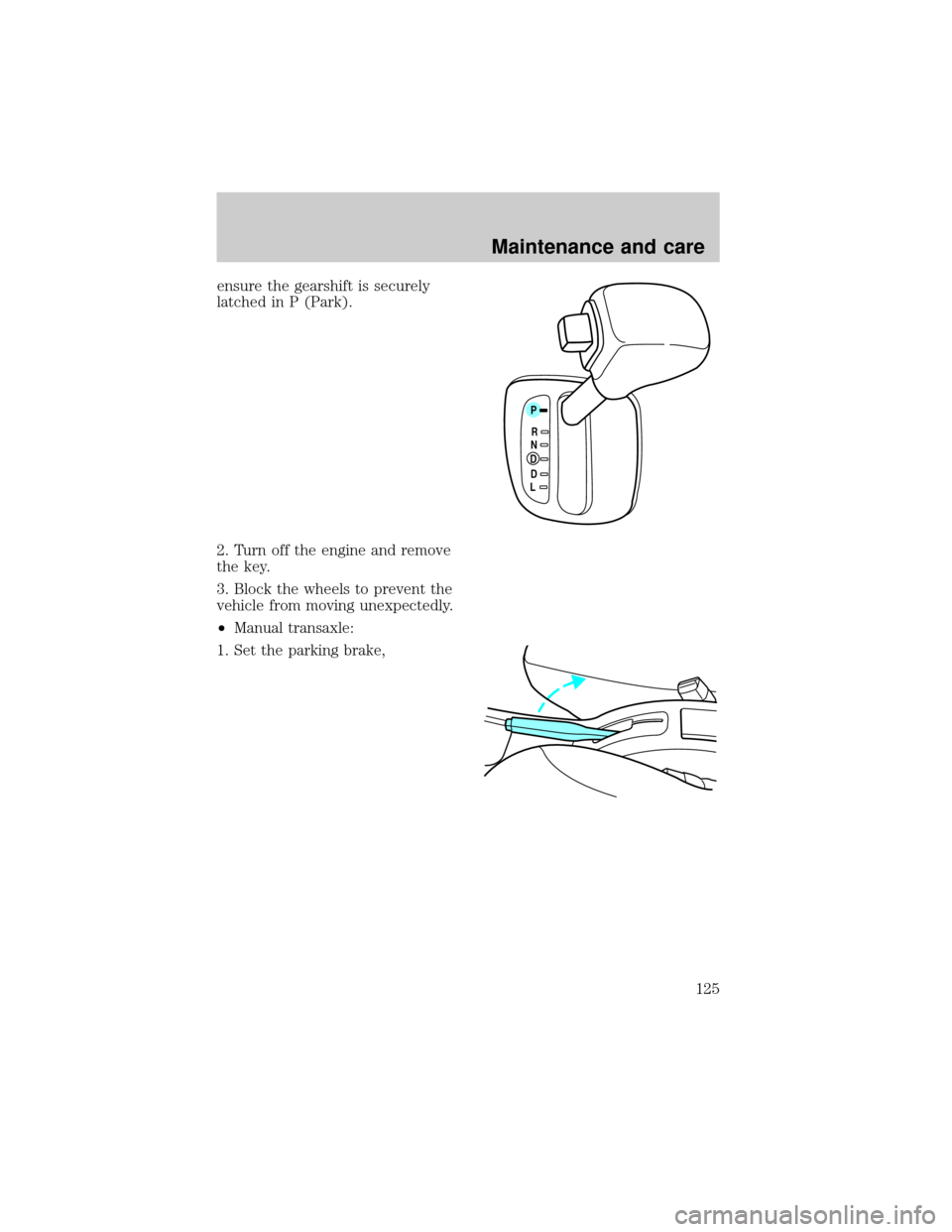
ensure the gearshift is securely
latched in P (Park).
2. Turn off the engine and remove
the key.
3. Block the wheels to prevent the
vehicle from moving unexpectedly.
²Manual transaxle:
1. Set the parking brake,
P
RNDDL
Maintenance and care
125
Page 126 of 191
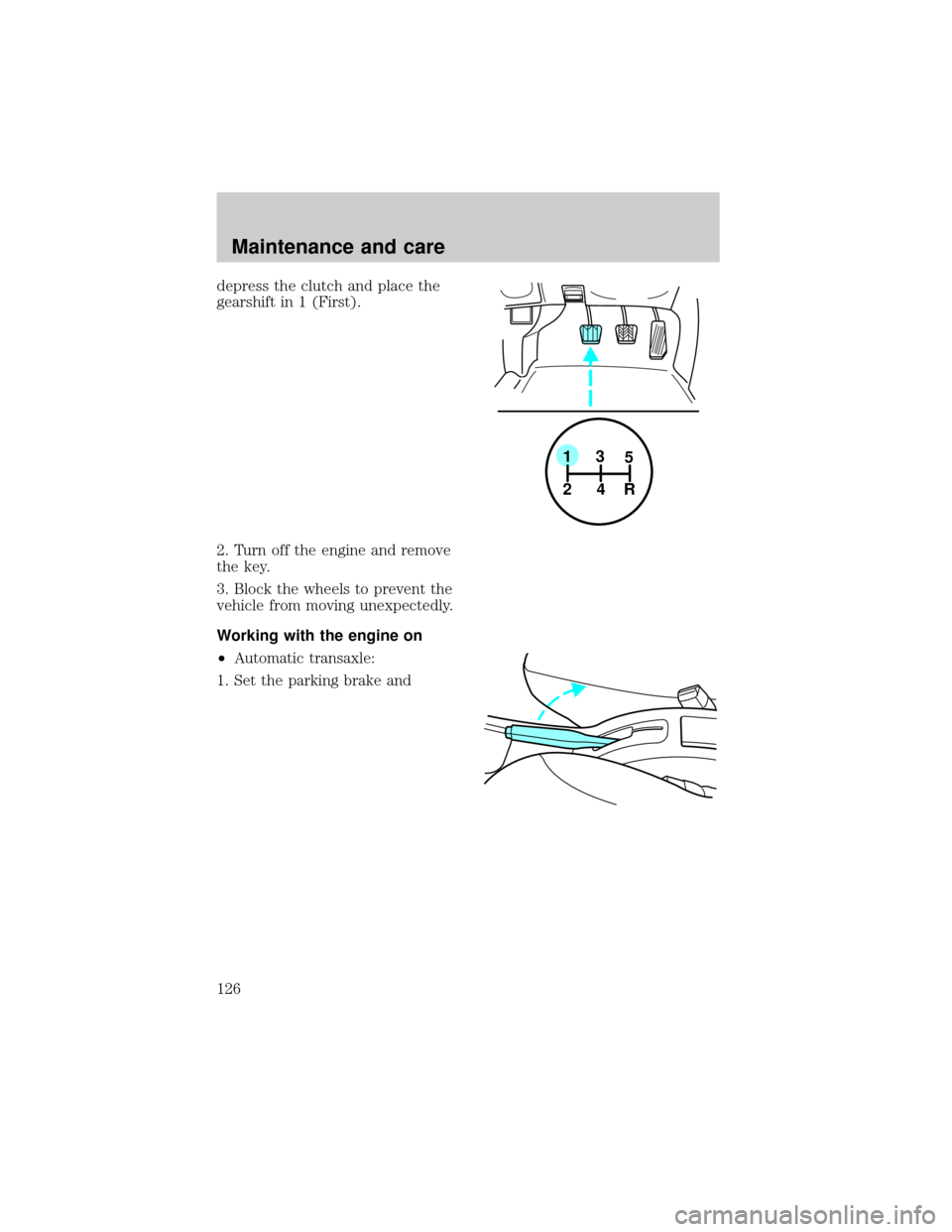
depress the clutch and place the
gearshift in 1 (First).
2. Turn off the engine and remove
the key.
3. Block the wheels to prevent the
vehicle from moving unexpectedly.
Working with the engine on
²Automatic transaxle:
1. Set the parking brake and
1
24R3
5
Maintenance and care
126