1998 DODGE RAM 1500 TcM
[x] Cancel search: TcMPage 522 of 2627
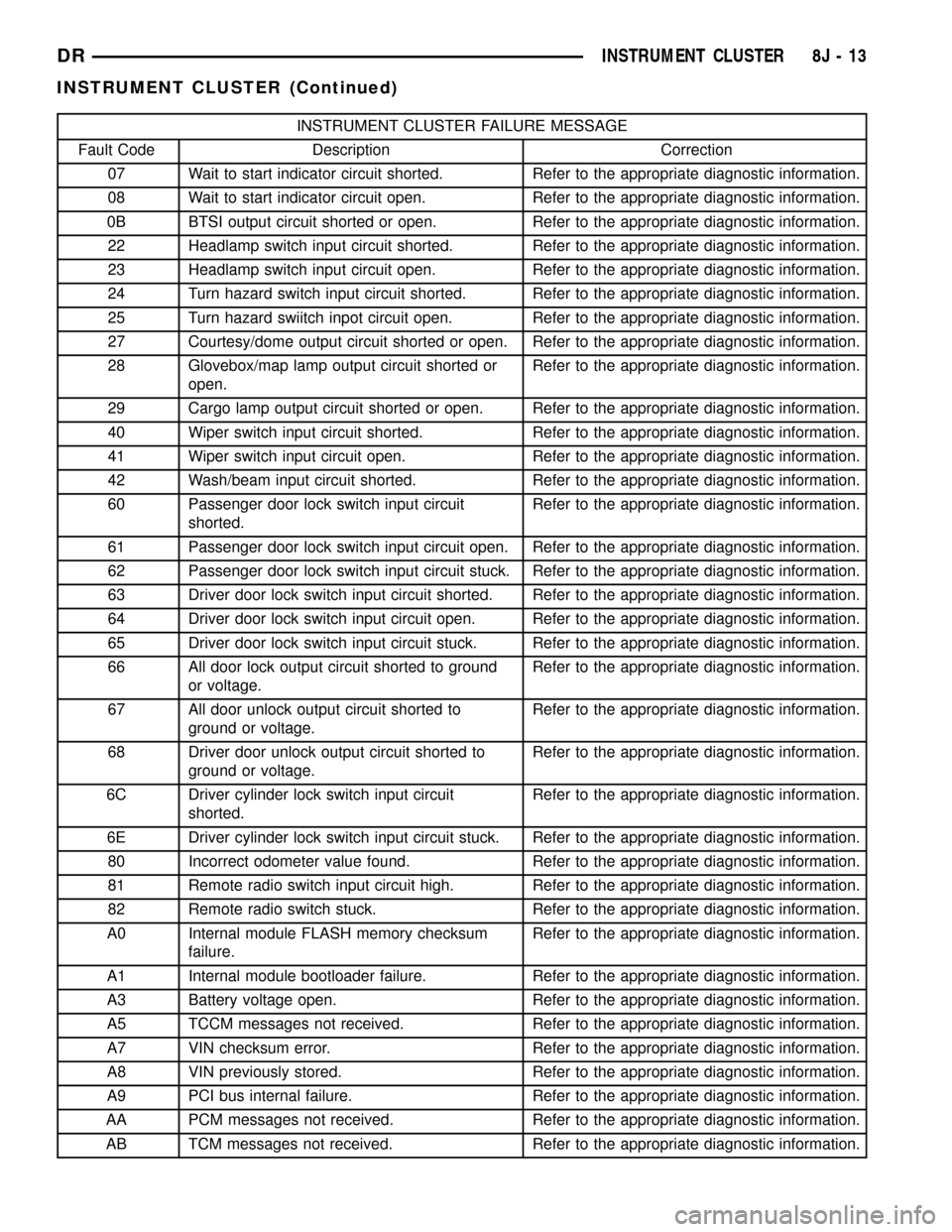
INSTRUMENT CLUSTER FAILURE MESSAGE
Fault Code Description Correction
07 Wait to start indicator circuit shorted. Refer to the appropriate diagnostic information.
08 Wait to start indicator circuit open. Refer to the appropriate diagnostic information.
0B BTSI output circuit shorted or open. Refer to the appropriate diagnostic information.
22 Headlamp switch input circuit shorted. Refer to the appropriate diagnostic information.
23 Headlamp switch input circuit open. Refer to the appropriate diagnostic information.
24 Turn hazard switch input circuit shorted. Refer to the appropriate diagnostic information.
25 Turn hazard swiitch inpot circuit open. Refer to the appropriate diagnostic information.
27 Courtesy/dome output circuit shorted or open. Refer to the appropriate diagnostic information.
28 Glovebox/map lamp output circuit shorted or
open.Refer to the appropriate diagnostic information.
29 Cargo lamp output circuit shorted or open. Refer to the appropriate diagnostic information.
40 Wiper switch input circuit shorted. Refer to the appropriate diagnostic information.
41 Wiper switch input circuit open. Refer to the appropriate diagnostic information.
42 Wash/beam input circuit shorted. Refer to the appropriate diagnostic information.
60 Passenger door lock switch input circuit
shorted.Refer to the appropriate diagnostic information.
61 Passenger door lock switch input circuit open. Refer to the appropriate diagnostic information.
62 Passenger door lock switch input circuit stuck. Refer to the appropriate diagnostic information.
63 Driver door lock switch input circuit shorted. Refer to the appropriate diagnostic information.
64 Driver door lock switch input circuit open. Refer to the appropriate diagnostic information.
65 Driver door lock switch input circuit stuck. Refer to the appropriate diagnostic information.
66 All door lock output circuit shorted to ground
or voltage.Refer to the appropriate diagnostic information.
67 All door unlock output circuit shorted to
ground or voltage.Refer to the appropriate diagnostic information.
68 Driver door unlock output circuit shorted to
ground or voltage.Refer to the appropriate diagnostic information.
6C Driver cylinder lock switch input circuit
shorted.Refer to the appropriate diagnostic information.
6E Driver cylinder lock switch input circuit stuck. Refer to the appropriate diagnostic information.
80 Incorrect odometer value found. Refer to the appropriate diagnostic information.
81 Remote radio switch input circuit high. Refer to the appropriate diagnostic information.
82 Remote radio switch stuck. Refer to the appropriate diagnostic information.
A0 Internal module FLASH memory checksum
failure.Refer to the appropriate diagnostic information.
A1 Internal module bootloader failure. Refer to the appropriate diagnostic information.
A3 Battery voltage open. Refer to the appropriate diagnostic information.
A5 TCCM messages not received. Refer to the appropriate diagnostic information.
A7 VIN checksum error. Refer to the appropriate diagnostic information.
A8 VIN previously stored. Refer to the appropriate diagnostic information.
A9 PCI bus internal failure. Refer to the appropriate diagnostic information.
AA PCM messages not received. Refer to the appropriate diagnostic information.
AB TCM messages not received. Refer to the appropriate diagnostic information.
DRINSTRUMENT CLUSTER 8J - 13
INSTRUMENT CLUSTER (Continued)
Page 537 of 2627

upon electronic messages received from the electronic
Transmission Control Module (TCM) over the Pro-
grammable Communications Interface (PCI) data
bus. If the transmission range sensor mux circuit is
open and no electronic messages are received from
the TCM within two seconds, the instrument cluster
circuitry will not display any gear selector position
until the condition is resolved or until the ignition
switch is turned to the Off position, whichever occurs
first.
²Resolved Circuit- If the transmission range
sensor mux circuit is resolved, the cluster circuitry
controls the gear selector indicator display based
upon the resistance value of the hard wired input
from the transmission range sensor. If the cluster is
configured for an automatic transmission with a
transmission range sensor input and detects a short
to ground or an open in the transmission range sen-
sor mux input, the instrument cluster circuitry will
not display any gear selector position in the VFD.
The VFD display for the short-to-ground and open
circuit conditions will continue until the condition is
resolved or until the ignition switch is turned to the
Off position, whichever occurs first.
²Actuator Test- Each time the cluster is put
through the actuator test, the gear selector indicator
VFD will display all of its characters at once during
the VFD portion of the test to confirm the function-
ality of the VFD and the cluster control circuitry.
On models with a TCM, the TCM continually mon-
itors the transmission range sensor, then sends the
proper gear selector indicator position messages to
the instrument cluster. On models without a TCM,
the instrument cluster continually monitors the hard
wired transmission range sensor multiplexed input.
For further diagnosis of the gear selector indicator or
the instrument cluster circuitry that controls this
function, (Refer to 8 - ELECTRICAL/INSTRUMENT
CLUSTER - DIAGNOSIS AND TESTING). For fur-
ther diagnosis of the transmission range sensor on
models without a TCM, (Refer to 21 - TRANSMIS-
SION/TRANSAXLE/AUTOMATIC - 42RE/TRANS-
MISSION RANGE SENSOR - DIAGNOSIS AND
TESTING) or (Refer to 21 - TRANSMISSION/
TRANSAXLE/AUTOMATIC - 46RE/TRANSMISSION
RANGE SENSOR - DIAGNOSIS AND TESTING).
On models with a TCM, for proper diagnosis of the
transmission range sensor, the TCM, the PCI data
bus, or the electronic message inputs to the instru-
ment cluster that control the gear selector indicator,
a DRBIIItscan tool is required. Refer to the appro-
priate diagnostic information.HIGH BEAM INDICATOR
DESCRIPTION
A high beam indicator is standard equipment on
all instrument clusters (Fig. 19). The high beam indi-
cator is located near the upper edge of the instru-
ment cluster, between the tachometer and the
speedometer. The high beam indicator consists of a
stencil-like cutout of the International Control and
Display Symbol icon for ªHigh Beamº in the opaque
layer of the instrument cluster overlay. The dark
outer layer of the overlay prevents the indicator from
being clearly visible when the it is not illuminated. A
blue Light Emitting Diode (LED) behind the cutout
in the opaque layer of the overlay causes the icon to
appear in blue through the translucent outer layer of
the overlay when the indicator is illuminated from
behind by the LED, which is soldered onto the
instrument cluster electronic circuit board. The high
beam indicator is serviced as a unit with the instru-
ment cluster.
OPERATION
The high beam indicator gives an indication to the
vehicle operator whenever the headlamp high beams
are illuminated. This indicator is controlled by a
transistor on the instrument cluster circuit board
based upon cluster programming and a hard wired
multiplex input received by the cluster from the
headlamp beam select switch circuitry of the multi-
function switch on the washer/beam select switch
mux circuit. The high beam indicator Light Emitting
Diode (LED) is completely controlled by the instru-
ment cluster logic circuit, and that logic will allow
this indicator to operate whenever the instrument
cluster receives a battery current input on the fused
B(+) circuit. Therefore, the LED can be illuminated
regardless of the ignition switch position. The LED
only illuminates when it is provided a path to ground
by the instrument cluster transistor. The instrument
cluster will turn on the high beam indicator for the
following reasons:
²High Beam Headlamps-On Input- Each time
the cluster detects a high beam headlamps-on input
from the headlamp beam select switch circuitry of
the multi-function switch on the washer/beam select
switch mux circuit, the headlamp high beams and
the high beam indicator will be illuminated. The
headlamp high beams and the high beam indicator
remain illuminated until the cluster receives a high
beam headlamps-off input from the multi-function
switch, or until the exterior lamp load shedding (bat-
Fig. 19 High Beam Indicator
8J - 28 INSTRUMENT CLUSTERDR
GEAR SELECTOR INDICATOR (Continued)
Page 1102 of 2627

CRANKSHAFT POSITION SENSOR (4.7L)-3WAY
CAV CIRCUIT FUNCTION
1 K24 20BR/LB CKP SIGNAL
2 K900 20DB/DG SENSOR GROUND
3 F855 20PK/YL 5 VOLT SUPPLY
CRANKSHAFT POSITION SENSOR (5.7L)-3WAY
CAV CIRCUIT FUNCTION
1 F855 20PK/YL 5 VOLT SUPPLY
2 K900 20DB/DG SENSOR GROUND
3 K24 20BR/LB CKP SIGNAL
CRANKSHAFT POSITION SENSOR (DIESEL)-3WAY
CAV CIRCUIT FUNCTION
1 K853 18DB/BR 5 VOLT SUPPLY
2 K975 18BR/BK SENSOR GROUND
2 K975 18BR/OR SENSOR GROUND
3 K24 18BR/LB CKP SIGNAL
3 K24 18LB/BR CKP SIGNAL
CYLINDER LOCK SWITCH-DRIVER (PREMIUM)-2WAY
CAV CIRCUIT FUNCTION
1 G163 20VT/LB DRIVER CYLINDER LOCK SWITCH MUX
2 Z463 20BK/LB GROUND
DATA LINK CONNECTOR - BLACK 16 WAY
CAV CIRCUIT FUNCTION
1- -
2 D25 20WT/VT PCI BUS
3- -
4 Z11 18BK/LG GROUND
5 Z111 18BK/WT GROUND
6- -
7 D21 18WT/BR SCI TRANSMIT (PCM)
8- -
9 D16 18WT/OR SCI RECEIVE (TCM)
10 - -
11 - -
DR8W-80 CONNECTOR PIN-OUTS 8W - 80 - 53
Page 1103 of 2627
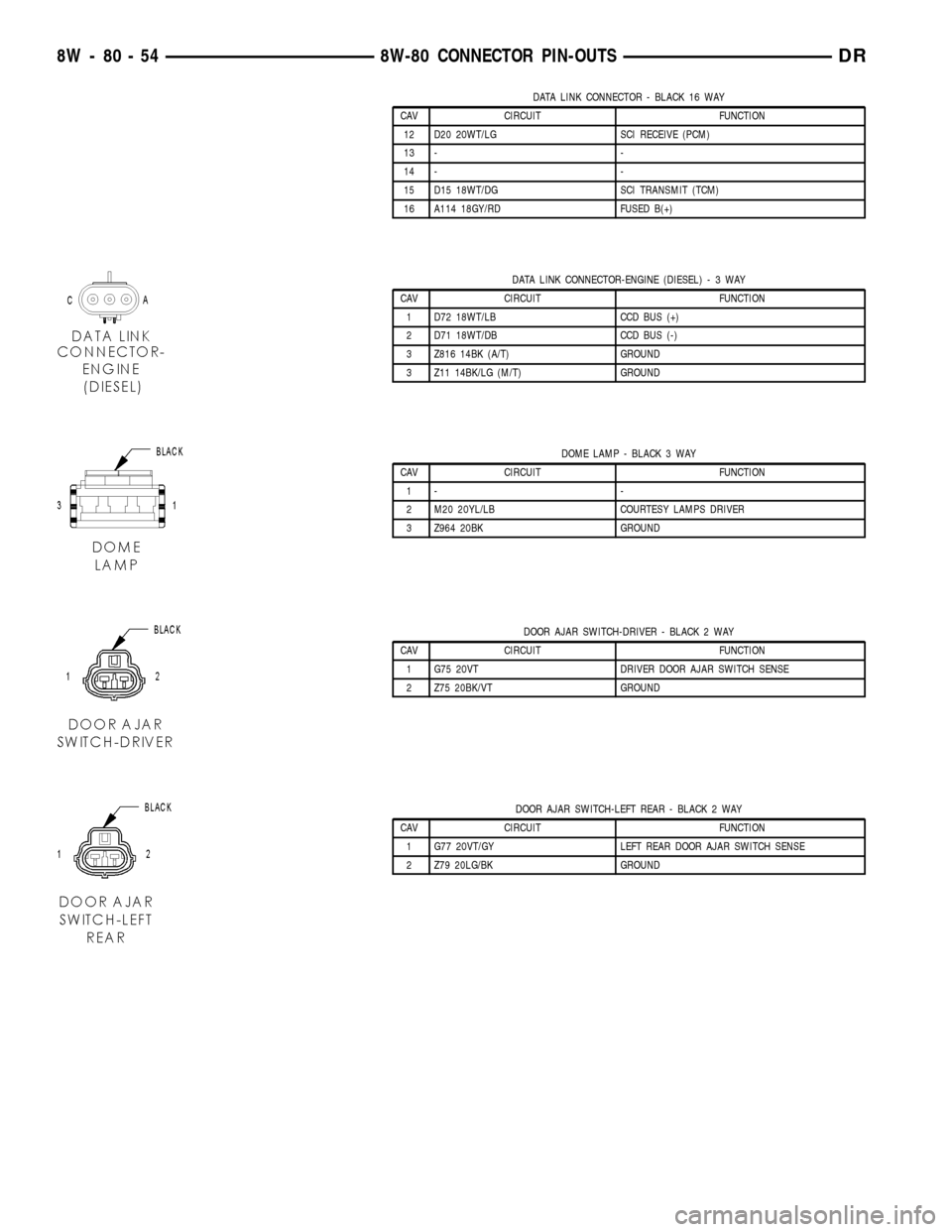
DATA LINK CONNECTOR - BLACK 16 WAY
CAV CIRCUIT FUNCTION
12 D20 20WT/LG SCI RECEIVE (PCM)
13 - -
14 - -
15 D15 18WT/DG SCI TRANSMIT (TCM)
16 A114 18GY/RD FUSED B(+)
DATA LINK CONNECTOR-ENGINE (DIESEL)-3WAY
CAV CIRCUIT FUNCTION
1 D72 18WT/LB CCD BUS (+)
2 D71 18WT/DB CCD BUS (-)
3 Z816 14BK (A/T) GROUND
3 Z11 14BK/LG (M/T) GROUND
DOME LAMP - BLACK 3 WAY
CAV CIRCUIT FUNCTION
1- -
2 M20 20YL/LB COURTESY LAMPS DRIVER
3 Z964 20BK GROUND
DOOR AJAR SWITCH-DRIVER - BLACK 2 WAY
CAV CIRCUIT FUNCTION
1 G75 20VT DRIVER DOOR AJAR SWITCH SENSE
2 Z75 20BK/VT GROUND
DOOR AJAR SWITCH-LEFT REAR - BLACK 2 WAY
CAV CIRCUIT FUNCTION
1 G77 20VT/GY LEFT REAR DOOR AJAR SWITCH SENSE
2 Z79 20LG/BK GROUND
8W - 80 - 54 8W-80 CONNECTOR PIN-OUTSDR
Page 1137 of 2627
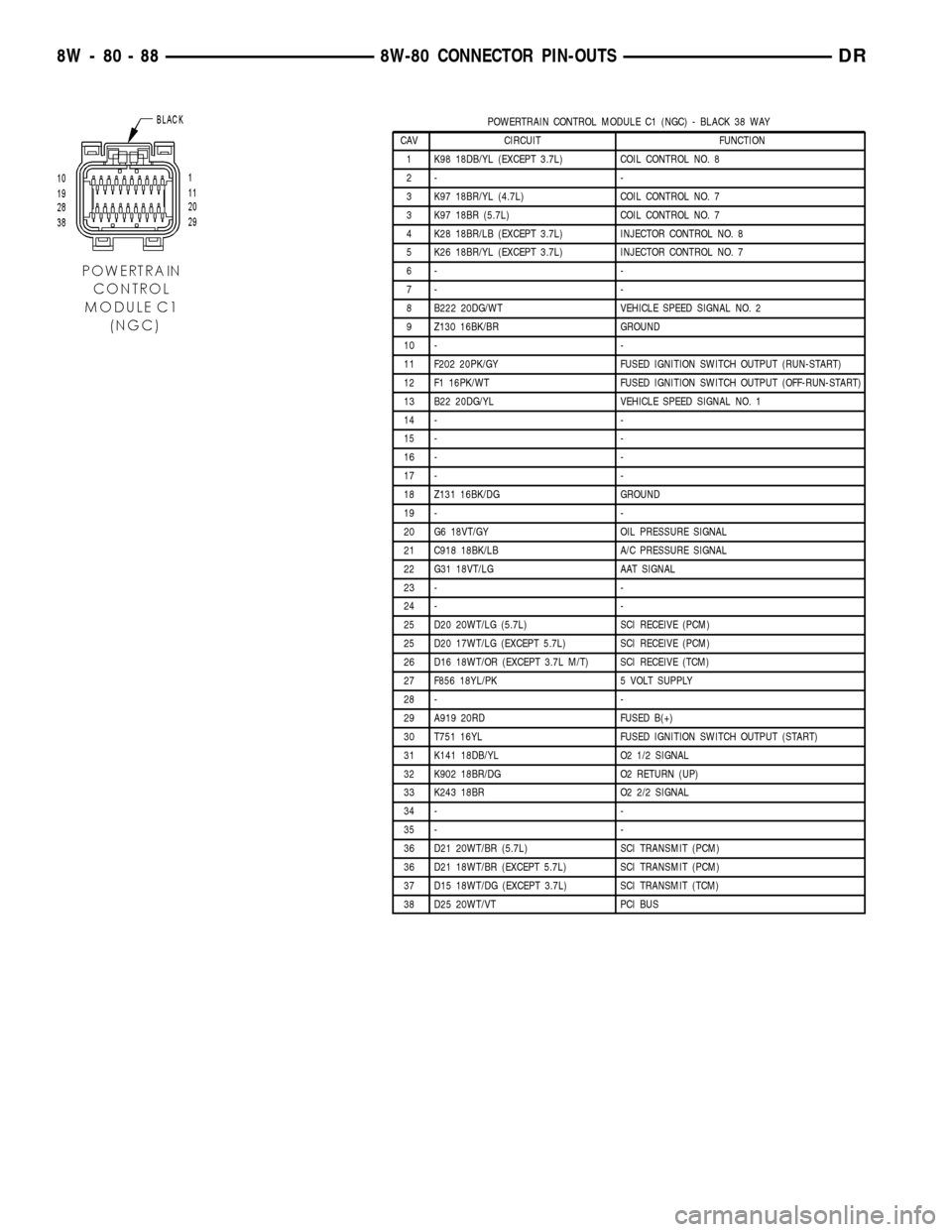
POWERTRAIN CONTROL MODULE C1 (NGC) - BLACK 38 WAY
CAV CIRCUIT FUNCTION
1 K98 18DB/YL (EXCEPT 3.7L) COIL CONTROL NO. 8
2- -
3 K97 18BR/YL (4.7L) COIL CONTROL NO. 7
3 K97 18BR (5.7L) COIL CONTROL NO. 7
4 K28 18BR/LB (EXCEPT 3.7L) INJECTOR CONTROL NO. 8
5 K26 18BR/YL (EXCEPT 3.7L) INJECTOR CONTROL NO. 7
6- -
7- -
8 B222 20DG/WT VEHICLE SPEED SIGNAL NO. 2
9 Z130 16BK/BR GROUND
10 - -
11 F202 20PK/GY FUSED IGNITION SWITCH OUTPUT (RUN-START)
12 F1 16PK/WT FUSED IGNITION SWITCH OUTPUT (OFF-RUN-START)
13 B22 20DG/YL VEHICLE SPEED SIGNAL NO. 1
14 - -
15 - -
16 - -
17 - -
18 Z131 16BK/DG GROUND
19 - -
20 G6 18VT/GY OIL PRESSURE SIGNAL
21 C918 18BK/LB A/C PRESSURE SIGNAL
22 G31 18VT/LG AAT SIGNAL
23 - -
24 - -
25 D20 20WT/LG (5.7L) SCI RECEIVE (PCM)
25 D20 17WT/LG (EXCEPT 5.7L) SCI RECEIVE (PCM)
26 D16 18WT/OR (EXCEPT 3.7L M/T) SCI RECEIVE (TCM)
27 F856 18YL/PK 5 VOLT SUPPLY
28 - -
29 A919 20RD FUSED B(+)
30 T751 16YL FUSED IGNITION SWITCH OUTPUT (START)
31 K141 18DB/YL O2 1/2 SIGNAL
32 K902 18BR/DG O2 RETURN (UP)
33 K243 18BR O2 2/2 SIGNAL
34 - -
35 - -
36 D21 20WT/BR (5.7L) SCI TRANSMIT (PCM)
36 D21 18WT/BR (EXCEPT 5.7L) SCI TRANSMIT (PCM)
37 D15 18WT/DG (EXCEPT 3.7L) SCI TRANSMIT (TCM)
38 D25 20WT/VT PCI BUS
8W - 80 - 88 8W-80 CONNECTOR PIN-OUTSDR
Page 2015 of 2627

INSTALLATION........................391
OUTPUT SPEED SENSOR
DESCRIPTION........................391
OPERATION..........................391
REMOVAL............................391
INSTALLATION........................392
TOW/HAUL OVERDRIVE SWITCH
DESCRIPTION........................392
OPERATION..........................392
REMOVAL............................392
INSTALLATION........................393
PISTONS
DESCRIPTION........................393
OPERATION..........................393
PLANETARY GEARTRAIN
DESCRIPTION........................395
OPERATION..........................396
DISASSEMBLY........................396
CLEANING...........................396
INSPECTION.........................397
ASSEMBLY...........................397
SHIFT MECHANISM
DESCRIPTION........................398
OPERATION..........................398
SOLENOID SWITCH VALVE
DESCRIPTION........................398
OPERATION..........................398
SOLENOIDS
DESCRIPTION........................398OPERATION..........................399
TORQUE CONVERTER
DESCRIPTION........................399
OPERATION..........................403
REMOVAL............................404
INSTALLATION........................404
TRANSMISSION CONTROL RELAY
DESCRIPTION........................405
OPERATION..........................405
TRANSMISSION RANGE SENSOR
DESCRIPTION........................405
OPERATION..........................405
TRANSMISSION SOLENOID/TRS ASSEMBLY
DESCRIPTION........................406
OPERATION..........................406
REMOVAL............................407
INSTALLATION........................408
TRANSMISSION TEMPERATURE SENSOR
DESCRIPTION........................408
OPERATION..........................408
VALVE BODY
DESCRIPTION........................408
OPERATION..........................408
REMOVAL............................410
DISASSEMBLY........................410
CLEANING...........................412
INSPECTION.........................413
ASSEMBLY...........................414
INSTALLATION........................414
AUTOMATIC TRANSMISSION -
45RFE/545RFE
DESCRIPTION
The 45RFE/545RFE automatic transmissions is a
sophisticated, multi-range, electronically controlled
transmission which combines optimized gear ratios
for responsive performance, state of the art efficiency
features and low NVH. Other features include driver
adaptive shifting and three planetary gear sets to
provide wide ratio capability with precise ratio steps
for optimum driveability. The three planetary gear
sets also make available a unique alternate second
gear ratio. The primary 2nd gear ratio fits between
1st and 3rd gears for normal through-gear accelera-
tions. The alternate second gear ratio (2prime) allows
smoother 4-2 kickdowns at high speeds to provide
2nd gear passing performance over a wider highway
cruising range.
The hydraulic portion of the transmission consists
of the transmission fluid, fluid passages, hydraulic
valves, and various line pressure control components.The primary mechanical components of the trans-
mission consist of the following:
²Three multiple disc input clutches
²Three multiple disc holding clutches
²Five hydraulic accumulators
²Three planetary gear sets
²Dual Stage Hydraulic oil pump
²Valve body
²Solenoid pack
The TCM is the ªheartº or ªbrainº of the electronic
control system and relies on information from vari-
ous direct and indirect inputs (sensors, switches, etc.)
to determine driver demand and vehicle operating
conditions. With this information, the TCM can cal-
culate and perform timely and quality shifts through
various output or control devices (solenoid pack,
transmission control relay, etc.).
21 - 312 AUTOMATIC TRANSMISSION - 45RFE/545RFEDR
Page 2016 of 2627

TRANSMISSION IDENTIFICATION
Transmission identification numbers are stamped
on the left side of the case just above the oil pan
sealing surface (Fig. 1). Refer to this information
when ordering replacement parts. A label is attached
to the transmission case above the stamped numbers.
The label gives additional information which may
also be necessary for identification purposes.
GEAR RATIOS
The 45RFE gear ratios are:
1st .................................3.00:1
2nd.................................1.67:1
2nd Prime...........................1.50:1
3rd.................................1.00:1
4th .................................0.75:1
Reverse.............................3.00:1
GEAR RATIOS
The 545RFE gear ratios are:
1st .................................3.00:1
2nd.................................1.67:1
2nd Prime...........................1.50:1
3rd.................................1.00:1
4th .................................0.75:1
5th .................................0.67:1
Reverse.............................3.00:1
OPERATION
The 45RFE/545RFE offers full electronic control of
all automatic up and downshifts, and features real-
time adaptive closed-loop shift and pressure control.
Electronic shift and torque converter clutch controls
help protect the transmission from damage due to
high temperatures, which can occur under severe
operating conditions. By altering shift schedules, line
pressure, and converter clutch control, these controls
reduce heat generation and increase transmission
cooling.
To help reduce efficiency-robbing parasitic losses,
the transmissions includes a dual-stage transmission
fluid pump with electronic output pressure control.
Under most driving conditions, pump output pres-
sure greatly exceeds that which is needed to keep the
clutches applied. The 45RFE/545RFE pump-pressure
control system monitors input torque and adjusts the
pump pressure accordingly. The primary stage of the
pump works continuously; the second stage is
bypassed when demand is low. The control system
also monitors input and output speed and, if incipi-
ent clutch slip is observed, the pressure control sole-
noid duty cycle is varied, increasing pressure in
proportion to demand.
A high-travel torque converter damper assembly
allows earlier torque converter clutch engagement to
reduce slippage. Needle-type thrust bearings reduce
internal friction. The 45RFE/545RFE is packaged in
a one-piece die-cast aluminum case. To reduce NVH,
the case has high lateral, vertical and torsional stiff-
ness. It is also designed to maximize the benefit of
the structural dust cover that connects the bottom of
the bell housing to the engine bedplate, enhancing
overall power train stiffness. Dual filters protect the
pump and other components. A pump return filter is
added to the customary main sump filter. Indepen-
dent lubrication and cooler circuits assure ample
pressure for normal transmission operation even if
the cooler is obstructed or the fluid cannot flow due
to extremely low temperatures.
The hydraulic control system design (without elec-
tronic assist) provides the transmission with PARK,
REVERSE, NEUTRAL, SECOND, and THIRD gears,
based solely on driver shift lever selection. This
design allows the vehicle to be driven (in ªlimp-inº
mode) in the event of a electronic control system fail-
ure, or a situation that the Transmission Control
Module (TCM) recognizes as potentially damaging to
the transmission.
The TCM also performs certain self-diagnostic
functions and provides comprehensive information
(sensor data, DTC's, etc.) which is helpful in proper
diagnosis and repair. This information can be viewed
with the DRBtscan tool.
Fig. 1 Transmission Part And Serial Number
Location
1 - IDENTIFICATION NUMBERS (STAMPED)
DRAUTOMATIC TRANSMISSION - 45RFE/545RFE 21 - 313
AUTOMATIC TRANSMISSION - 45RFE/545RFE (Continued)
Page 2085 of 2627

(28) Install the number 2 bearing onto the under-
drive hub with outer race against the hub with petro-
leum jelly.
(29) Install the underdrive hub into the input
clutch retainer.
(30) Install the number 3 bearing into the over-
drive hub with the outer race against the hub with
petroleum jelly.
(31) Install the overdrive hub into the input clutch
retainer.
(32) Install the number 4 bearing into the reverse
hub with outer race against the hub with petroleum
jelly.
(33) Install the reverse hub into the input clutch
retainer.
(34) Install the complete reverse clutch pack.
(35) Install the reverse reaction plate and snap-
ring.
(36) Push up on reaction plate to allow reverse
clutch to move freely.
INPUT SPEED SENSOR
DESCRIPTION
The Input and Output Speed Sensors are two-wire
magnetic pickup devices that generate AC signals as
rotation occurs. They are mounted in the left side of
the transmission case and are considered primary
inputs to the Transmission Control Module (TCM).
OPERATION
The Input Speed Sensor provides information on
how fast the input shaft is rotating. As the teeth of
the input clutch hub pass by the sensor coil, an AC
voltage is generated and sent to the TCM. The TCM
interprets this information as input shaft rpm.
The Output Speed Sensor generates an AC signal
in a similar fashion, though its coil is excited by rota-
tion of the rear planetary carrier lugs. The TCM
interprets this information as output shaft rpm.
The TCM compares the input and output speed
signals to determine the following:
²Transmission gear ratio
²Speed ratio error detection
²CVI calculation
The TCM also compares the input speed signal and
the engine speed signal to determine the following:
²Torque converter clutch slippage
²Torque converter element speed ratio
REMOVAL
(1) Raise vehicle.
(2) Place a suitable fluid catch pan under the
transmission.(3) Remove the wiring connector from the input
speed sensor (Fig. 91).
(4) Remove the bolt holding the input speed sensor
to the transmission case.
(5) Remove the input speed sensor from the trans-
mission case.
INSTALLATION
(1) Install the input speed sensor into the trans-
mission case.
(2) Install the bolt to hold the input speed sensor
into the transmission case. Tighten the bolt to 11.9
N´m (105 in.lbs.).
(3) Install the wiring connector onto the input
speed sensor
(4) Verify the transmission fluid level. Add fluid as
necessary.
(5) Lower vehicle.
LINE PRESSURE (LP) SENSOR
DESCRIPTION
The TCM utilizes a closed-loop system to control
transmission line pressure. The system contains a
variable force style solenoid, the Pressure Control
Solenoid, mounted on the side of the solenoid and
pressure switch assembly. The solenoid is duty cycle
controlled by the TCM to vent the unnecessary line
pressure supplied by the oil pump back to the sump.
The system also contains a variable pressure style
sensor, the Line Pressure Sensor, which is a direct
input to the TCM. The line pressure solenoid moni-
tors the transmission line pressure and completes the
Fig. 91 Input Speed Sensor
1 - OUTPUT SPEED SENSOR
2 - LINE PRESSURE SENSOR
3 - INPUT SPEED SENSOR
21 - 382 AUTOMATIC TRANSMISSION - 45RFE/545RFEDR
INPUT CLUTCH ASSEMBLY (Continued)