1998 CHEVROLET VENTURE suspension
[x] Cancel search: suspensionPage 285 of 474
Things you put inside your vehicle can strike
and injure people in a sudden stop or turn, or in
a crash.
0 Put things in the cargo area of your vehicle.
0 Never stack heavier things, like suitcases,
Try to spread the
weight evenly.
inside the vehicle
so that some of them are
above the tops
of the seats.
Don’t leave an unsecured child restraint in
your vehicle.
0 When you carry something inside the
vehicle, secure
it whenever you can.
0 Don’t leave a seat folded down unless you
need to.
Payload (Cargo Van Only)
The payload capacity is shown on the Certificatioflire
label. This is the maximum load capacity that your
vehicle can carry. Be sure to include the weight of the people inside as part
of your load.
If you added any
accessories or equipment after your vehicle left the
factory, remember to subtract the weight
of these things
from the payload. You should never exceed the
GVWR
or the GAWR. Your dealer can help you determine
your payload.
Electronic Level Control (Option)
On vehicles equipped with the optional electronic level
control, the rear of the vehicle is automatically kept
level as you load or unload your vehicle. However, you
should still not exceed the
GVWR or the GAM.
You may hear the compressor operating when you load
or unload your vehicle, and periodically as the system
self-adjusts.
This is normal.
The compressor should operate for brief periods of time.
If the sound continues for an extended period of time,
your vehicle needs service. To keep your battery from
being drained, you may want to remove the ELC fuse in
the fuse control panel until you can get your vehicle
serviced (see “Fuses and Circuit Breakers” in the Index)\
.
Using heavier suspension components to get added
durability might not change your weight ratings. Ask
your dealer to help you load your vehicle the right way.
4-32
ProCarManuals.com
Page 306 of 474
A vehicle can fall from a car carrier if it isn’t
adequately secured. This can cause a collision,
serious personal injury and vehicle damage. The
vehicle should be tightly secured with chains or
steel cables before it is transported.
Don’t use substitutes (ropes, leather straps,
canvas webbing, etc.) that can be cut
by sharp
edges underneath the towed vehicle. Always use
T-hooks inserted in the T-hook slots. Never use
J-hooks. They will damage drivetrain and
suspension components.
~~
NOTICE:
If you are using car-carrier equipment, you must
pull the Electronic Level Control (ELC) fuse, in
the instrument panel fuse block, before securing
the vehicle.
Damage to the shocks or leveling system may
occur if the Electronic Level Control (ELC) fuse
is not disabled.
When your vehicle is being towed, have the ignition key
in
OFF. The steering wheel should be clamped in a
straight-ahead position, with a clamping device
designed for towing service.
Do not use the vehicle’s
steering column lock for this. For front towing, the
transaxle should be in
PARK (P) and the parking brake
released. For rear towing, the transaxle should be in
NEUTRAL (N) and the parking brake engaged.
5-9
ProCarManuals.com
Page 410 of 474
Short Trip/City Maintenance Schedule
The services shown in this schedule up to 100,000 miles
(166 000 km) should be performed after 100,000 miles
(166 000 km) at the same intervals. The services shown
at
150,000 miles (240 000 km) should be performed at
the same interval after
150,000 miles (240 000 km).
See “Owner Checks and Services” and “Periodic
Maintenance Inspections” following.
Footnotes
The U.S. Environmental Protection Agency or the
California Air Resources Board has determined that the
failure to perform this maintenance item will not nullify
the emission warranty or limit recall liability prior to the
completion of the vehicle’s useful life. We, however,
urge that all recommended maintenance services be
performed at the indicated intervals and the maintenance
be recorded.
# Lubricate the suspension, steering linkage, transaxle
shift linkage, parking brake cable guides and the
underbody contact points and linkage.
+ A good time to check your brakes is during tire
rotation. See “Brake System Inspection” under “Periodic
Maintenance Inspections’’ in Part C of this schedule.
7-7
ProCarManuals.com
Page 424 of 474
Long Tripmighway Maintenance Schedule
The services shown in this schedule up to 100,000 miles
(166 000 km) should be performed after 100,000 miles
(166 000 lun) at the same intervals. The services shown
at
150,000 miles (240 000 km) should be performed at
the same interval after
150,000 miles (240 000 km).
See “Owner Checks and Services” and “Periodic
Maintenance Inspections” following.
Footnotes
? The U.S. Environmental Protection Agency or the
California Air Resources Board has determined that the
failure to perform this maintenance item will not nullify
the emission warranty or limit recall liability prior to the
completion
of the vehicle’s useful life. We, however,
urge that all recommended maintenance services be
performed at the indicated intervals and the maintenance
be recorded.
# Lubricate the suspension, steering linkage, transaxle
shift linkage, parking brake cable guides and the
underbody contact points and linkage.
+ A good time to check your brakes is during tire
rotation. See “Brake System Inspection” under “Periodic
Maintenance Inspections” in Part C of this schedule.
7-21
ProCarManuals.com
Page 436 of 474
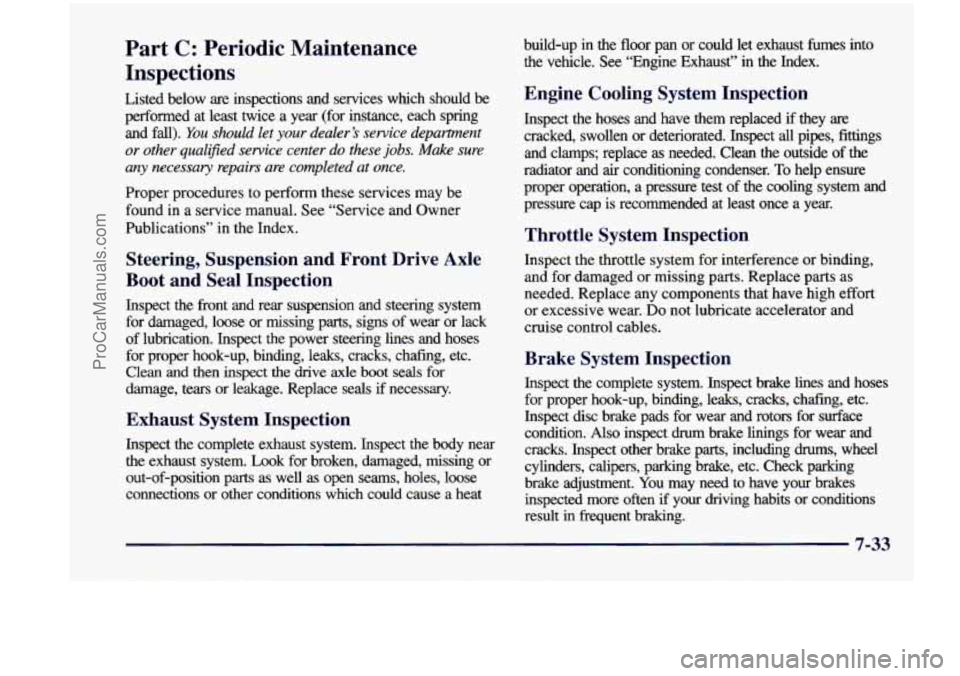
Part C: Periodic Maintenance
Inspections
Listed below are inspections and services which should be
performed at least twice a year (for instance, each spring
and fall).
You should let your dealer’s service department
or other qualijied service center do these jobs. Make sure
any necessary repairs are completed at once.
Proper procedures to perform these services may be
found in a service manual. See “Service and Owner
Publications” in the Index.
Steering, Suspension and Front Drive A: 3
Boot and Seal Inspection
Inspect the front and rear suspension and steering system
for damaged, loose or missing parts, signs
of wear or lack
of lubrication. Inspect the power steering lines and hoses
for proper hook-up, binding, leaks, cracks, chafing, etc.
Clean and then inspect the drive axle boot seals for
damage, tears or leakage. Replace seals if necessary.
Exhaust System Inspection
Inspect the complete exhaust system. Inspect the body near
the exhaust system.
Look for broken, damaged, missing or
out-of-position parts as well as
open seams, holes, loose
connections
or other conditions which could cause a heat build-up in the floor pan or could let exhaust fumes into
the vehicle. See “Engine Exhaust”
in the Index.
Engine Cooling System Inspection
Inspect the hoses and have them replaced if they are
cracked, swollen or deteriorated. Inspect
all pipes, fittings
and clamps; replace
as needed. Clean the outside of the
radiator and air conditioning condenser. To help ensure
proper operation, a pressure test
of the cooling system and
pressure cap is recommended at least once a year.
Throttle System Inspection
Inspect the throttle system for interference or binding,
and for damaged or missing parts. Replace parts as
needed. Replace
any components that have high effort
or excessive wear.
Do not lubricate accelerator and
cruise control cables.
Brake System Inspection
Inspect the complete system. Inspect brake lines and hoses
for proper hook-up, binding, leaks, cracks, chafing, etc.
Inspect disc brake pads for wear and rotors for surface
condition.
Also inspect drum brake linings for wear and
cracks. Inspect other brake parts, including
drums, wheel
cylinders, calipers, parking brake, etc. Check parking
brake adjustment. You may need to have your brakes
inspected more often if your driving habits or conditions
result in frequent braking.
- mm 7-53
ProCarManuals.com
Page 455 of 474

1998 CHEVROLET SERVICE PUBLICATIONS ORDERING INFORMATION
The following publications covering the operation and servicing of your vehicle can be purchased by filling out
the Service Publication Order Form in this book and mailing it in with your check, money order,
or credit card information to Helm, Incorporated (address below\
.)
CURRENT PUBLICATIONS FOR 1998 CHEVROLET
SERVICE MANUALS
Service Manuals have the diagnosis and repair information
on engines, transmission, axle, suspension, brakes, electrical, steering, body, etc. RETAIL SELL PRICE:
$90.00
TRANSMISSION, TRANSAXLE, TRANSFER CASE
UNIT REPAIR MANUAL
This manual provides information on unit repair service procedures, adjustments and specifications for the
1998 GM transmissions, transaxles and transfer cases.
RETAIL SELL PRICE:
$40.00
SERVICE BULLETINS
Service Bulletins give technical service information needed
to knowledgeably service General Motors cars and trucks.
Each bulletin contains instructions
to assist in the
diagnosis and service of your vehicle.
PLEASE COMPLETE THE ORDER FORM SHOWN-ON
THE FOLLOWING PAGE AND MAIL TO:
Helm, Incorporated
P.O. Box 07130 Detroit, MI 48207
OWNER’S INFORMATION
Owner publications are written directly for Owners and
intended to provide basic operational information about the
vehicle. The owner’s manual will include the Maintenance
Schedule for all models.
In-Portfolio: Includes a Portfolio, Owner’s Manual and
Warranty Booklet. RETAIL SELL PRICE:
$15.00
Without Portfolio: Owner’s Manual only.
RETAIL SELL PRICE:
$1 0.00
CURRENT & PAST MODEL ORDER FORMS
Service Publications are available for current and past
model GM vehicles.
To request an order form, please
specify year and model name of the vehicle.
OR ORDER TOLL FREE: 1-800-782-4356
Monday-Friday 8:oO AM - 6:OO PM Eastern Time
For Credit Card Orders Only (VISA-MasterCard-Discr)
ProCarManuals.com
Page 462 of 474

Front Seat Storage Net ........................... 2-71
Front Sidemarker Lamp Bulb Replacement
........... 6-36
Front Towing
.................................. 5-10
Fuel
.......................................... 6-3
Filling Your Tank
.............................. 6-5
Gage
....................................... 2-97
In Foreign Countries ........................... 6-5
Fuses and Circuit Breakers ....................... 6-58
Gages Engine Coolant Temperature
.................... 2-9 1
Fuel ....................................... 2-97
Speedometer
................................. 2-85
Garage Door Opener Compartment
................. 2-67
Gear Positions. Automatic Transaxle
................ 2-30
GloveBox
.................................... 2-66
Gross Axle Weight Rating
........................ 4-31
Gross Vehicle Weight Rating
...................... 4-30
Guide en Franpis
11
GAWR ....................................... 4-31
.. .................................
GVWR ....................................... 4-30
Halogen Bulbs
................................ 6-31
Hazard Warning Flashers
.......................... 5-2
Head Restraints
................................. 1-6
Headlamps
.................................... 2-60
Bulb Replacement ............................ 6-3 1
OnReminder ................................ 2-60
Wiring
..................................... 6-57
HighLow Beam Changer ...................... 2-54
Hearing Impaired. Customer Assistance
.............. 8-4 Heating
........................................ 3-4
High-BeamHeadlamps
.......................... 2-54
Highway Hypnosis
.............................. 4-24
Hill and Mountain Roads
......................... 4-24
Hitches. Trailer
................................. 4-36
Hood
Checking Things Under ......................... 6-8
Prop ........................................ 6-9
Release ...................................... 6-8
Horn ......................................... 2-52
Hydroplaning .................................. 4-20
Ignition Positions
.............................. 2-26
Ignition Transaxle Lock Check
.................... 7-32
Illuminated Entry
............................... 2-62
Inflation. Tire
.................................. 6-41
Inflator. Air
................................... 2-78
Inside Daymight Rearview Mirror
................. 2-65
Inspections
Brake System
................................ 7-33
Exhaust Systems
............................. 7-33
Front Drive Axle Boot ......................... 7-33
Front Drive Axle Seal
......................... 7-33
Radiator and Heater Hose
...................... 7-33
Steering
.................................... 7-33
Suspension
.................................. 7-33
Throttle
System .............................. 7-33
InstrumentPanel
............................... 2-82
Cleaning
.................................... 6-50
Cluster ..................................... 2-84
FuseBlock
.................................. 6-58
Light Intensity Control ......................... 2-61
ProCarManuals.com