1998 CHEVROLET VENTURE fuel
[x] Cancel search: fuelPage 10 of 474
60’s automotive excitement
included Chevrolet landmarks
like the Corvette Sting Ray,
the sporty Camaro, and
powerplants like the
legendary
327 V8.
I
I
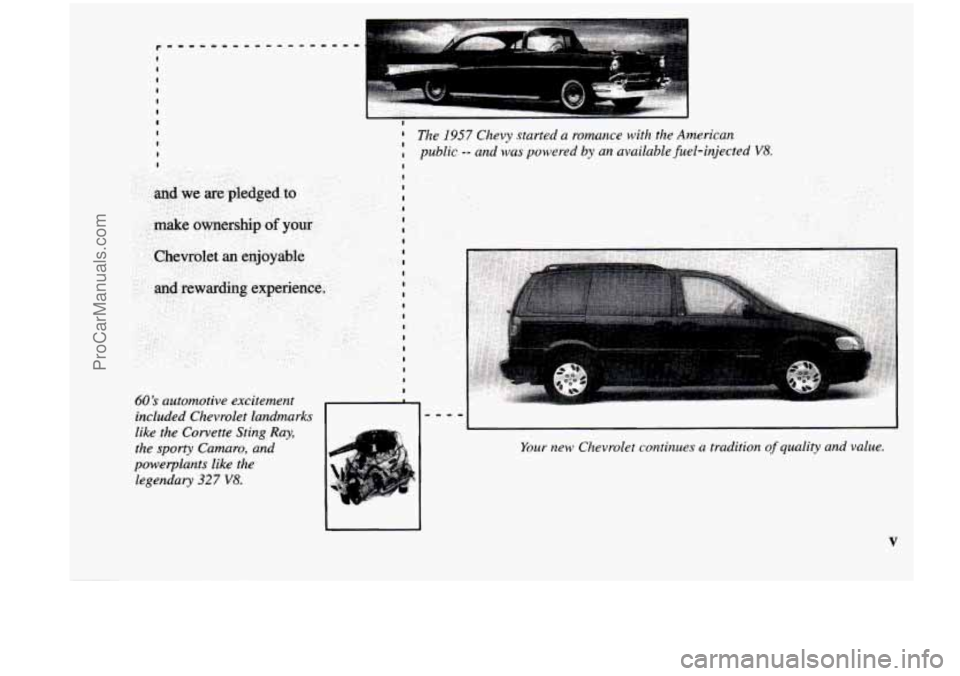
The 1957 Chevy started a romance with the American
public
-- and was powered by an available fuel-injected V8.
I
Your new Chevrolet continues a tradition of quality and value.
V
ProCarManuals.com
Page 13 of 474
Vehicle Symbols
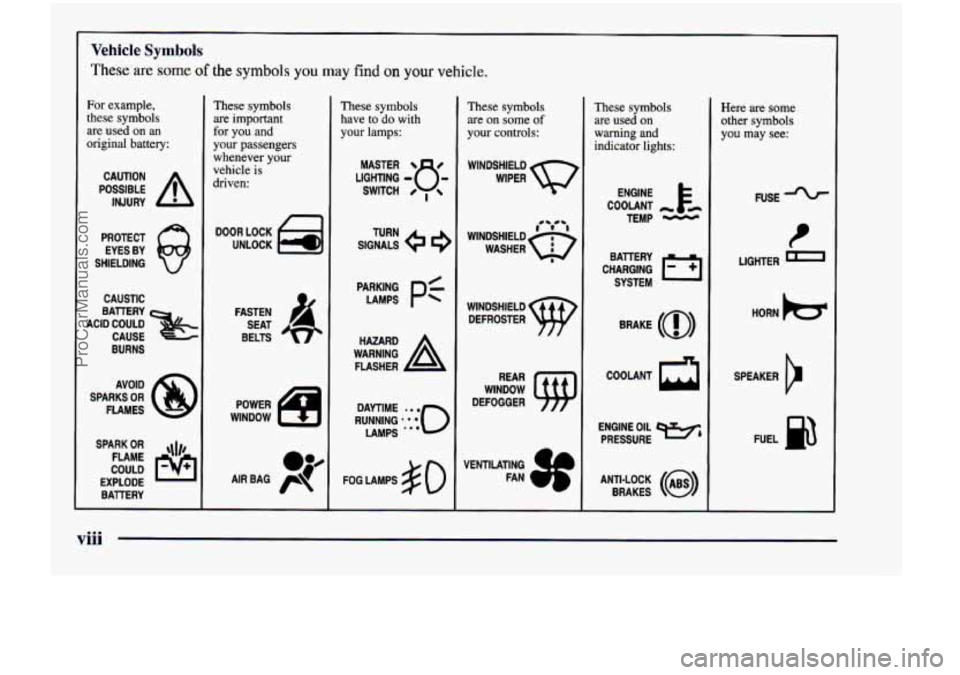
These are some of the symbols you may find on your vehicle.
For example,
these symbols
are used on an
original battery:
POSSIBLE A
CAUTION
INJURY
PROTECT EYES BY
SHIELDING
Q
CAUSTIC
BURNS AVOID
SPARKS
OR
FLAMES
SPARK
OR ,\I/,
COULD FLAME
EXPLODE BA'ITERY
These symbols
are important
for you and
your passengers
whenever your
vehicle is
driven:
DOOR LOCK
UNLOCK
FASTEN SEAT
BELTS
POWER
WlNDOW
These symbols
have to do with
your lamps:
SIGNALS e
TURN
FOG LAMPS
& 0
These symbols
are on some of
your controls:
WINDSHIELD WIPER
WINDSHIELD DEFROSTER
WINDOW
DEFOGGER
VENTILATING FAN
These symbols
are used on
warning and
indicator lights:
COOLANT -
TEMP -
CHARGING I-1
BAllERY
SYSTEM
BRAKE
(0)
COOLANT
a
ENGINE OIL e,
PRESSURE
ANTI-LOCK
(@)
BRAKES
Here are some
other symbols
you may see:
FUSE
LIGHTER m
HORN b
SPEAKER
cr
FUEL B
viii
ProCarManuals.com
Page 130 of 474
Instrument Panel Switchbank Sliding Door
IF, L
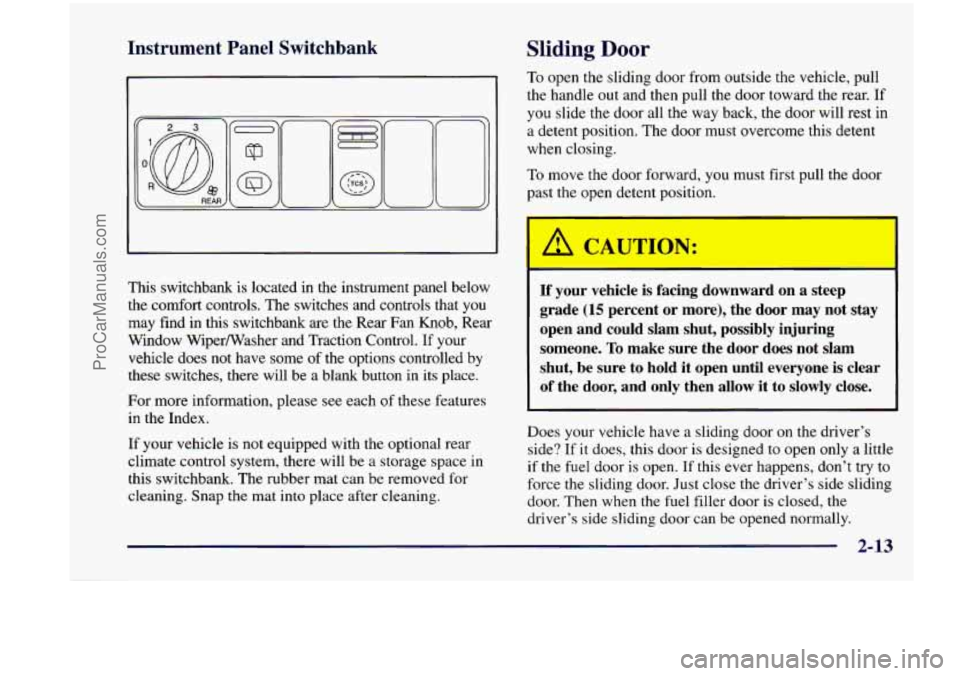
This switchbank is located in the instrument panel below the comfort controls. The switches and controls that you
may find
in this switchbank are the Rear Fan Knob, Rear
Window WiperNasher and Traction Control.
If your
vehicle does not have some
of the options controlled by
these switches, there will be a blank button in its place.
For more information, please
see each of these features
in the Index.
If your vehicle is not equipped with the optional rear
climate control system, there will be
a storage space in
this switchbank. The rubber mat can be removed for
cleaning. Snap the mat into place after cleaning.
To open the sliding door from outside the vehicle, pull
the handle out and then pull the door toward the rear.
If
you slide the door all the way back, the door will rest in
a detent position. The door must overcome this detent
when closing.
To move the door forward, you must first pull the door
past the open detent position.
I I CAUTION:
If your vehicle is facing downward on a steep
grade
(15 percent or more), the door may not stay
open and could slam shut, possibly injuring someone.
To make sure the door does not slam
shut, be sure to hold it open until everyone is clear
of the door, and only then allow it to slowly close.
Does your vehicle have a sliding door on the driver’s
side?
If it does, this door is designed to open only a little
if the fuel door
is open. If this ever happens, don’t try to
force the sliding door, Just close the driver’s side sliding
door. Then when the
fuel filler door is closed, the
driver’s side sliding door can be opened normally.
2-13
ProCarManuals.com
Page 140 of 474
Content Theft-Deterrent (Option)
If your vehicle has this option, it has a theft-deterrent
alarm system.
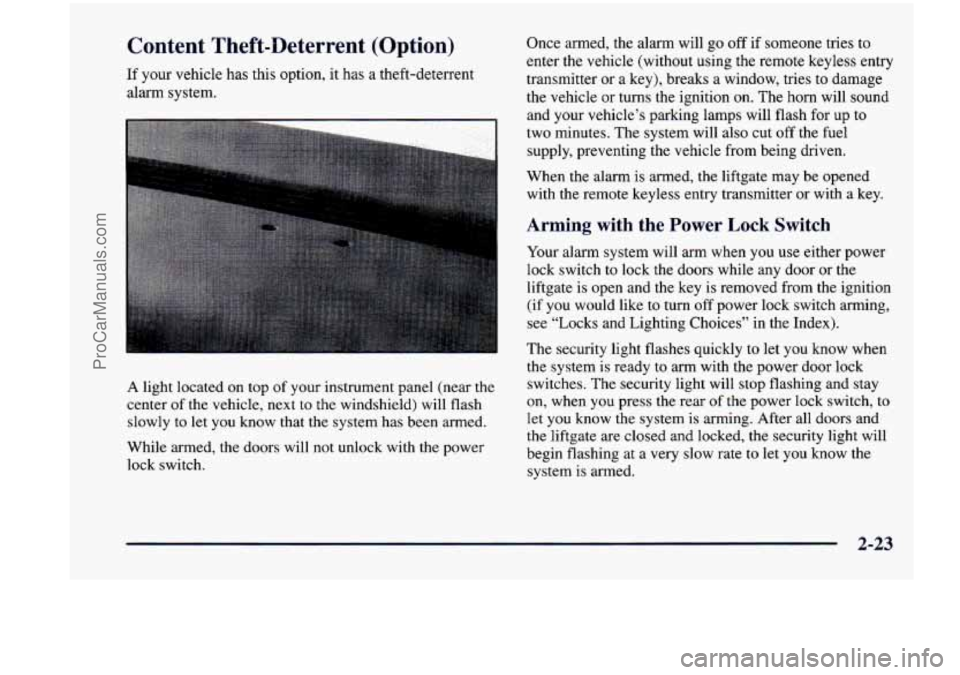
A light located on top of your instrument panel (near the
center of the vehicle, next to the windshield) will flash
slowly to let you know that the system has been armed.
While armed, the doors will not unlock with the power
lock switch. Once
armed, the alarm will go off if someone tries to
enter the vehicle (without using
the remote keyless entry
transmitter or a key), breaks a window, tries to damage
the vehicle or turns the ignition on. The
horn will sound
and your vehicle’s parking lamps will flash for up
to
two minutes. The system will also cut off the fuel
supply, preventing the vehicle from being driven.
When the alarm is armed, the liftgate may be opened
with the remote keyless entry transmitter or with a key.
Arming with the Power Lock Switch
Your alarm system will arm when you use either power
lock switch to lock the doors while any door
or the
liftgate is open and the key is removed from the ignition
(if you would like to turn off power lock switch arming,
see “Locks and Lighting Choices” in the Index).
The security light flashes quickly to let you know when
the system is ready to arm with the power door lock
switches. The security light will stop flashing and stay
on, when you press the rear of the power lock switch, to
let
you know the system is arming. After all doors and
the liftgate are closed and locked, the security light will
begin flashing at a very slow rate
to let you know the
system
is armed.
2-23
ProCarManuals.com
Page 146 of 474
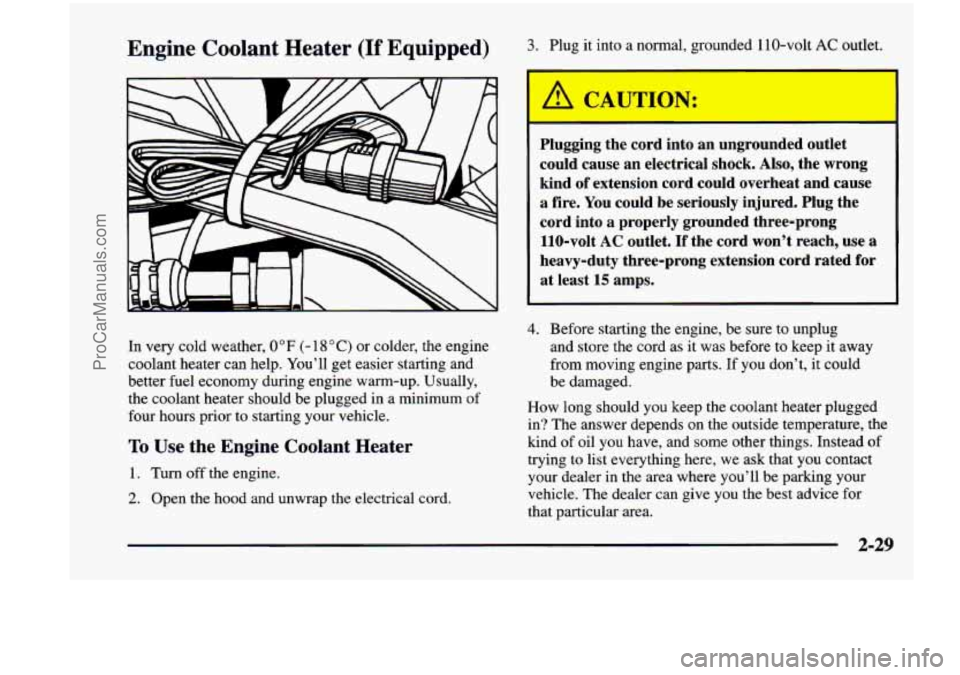
Engine Coolant Heater (If Equipped)
In very cold weather, 0” F (- 18 O C) or colder, the engine
coolant heater can help. You’ll get easier starting and
better fuel economy during engine warm-up. Usually,
the coolant heater should be plugged in a minimum of
four hours prior to starting your vehicle.
To Use the Engine Coolant Heater
1. Turn off the engine.
2. Open the hood and unwrap the electrical cord.
3. Plug it into a normal, grounded 110-volt AC outlet.
A C. [JTIO :
Plugging the cord into an ungrounded outlet
could cause an electrical shock.
Also, the wrong
kind
of extension cord could overheat and cause
a fire. You could be seriously injured. Plug the
cord into
a properly grounded three-prong
110-volt
AC outlet. If the cord won’t reach, use a
heavy-duty three-pro: extension cord rated for at least 15 amps.
_____~
4. Before starting the engine, be sure to unplug and store the cord as it was before to keep it away
from moving engine parts.
If you don’t, it could
be damaged.
How long should you keep the coolant heater plugged
in? The answer depends on the outside temperature, the
kind of oil you have, and some other things. Instead of
trying to list everything here, we ask that you contact your dealer in the area where you’ll be parking your
vehicle. The dealer can give you the best advice for
that particular area.
2-29
ProCarManuals.com
Page 149 of 474
I
AUTOMATIC OVERDRIW (D): This position is
for normal driving. If you need more power for passing,
and you’re:
Going less than 35 mph (55 km/h), push your
Going about 35 mph (55 km/h) or more, push the
You’ll shift down to the next gear and have more power.
THIRD (3): This position is also used for normal
driving, but
it offers more power and lower fuel
economy than AUTOMATIC OVERDRIVE
(D).
Here are some times you might choose THIRD (3)
instead
of AUTOMATIC OVERDRIVE (D):
When driving on hilly, winding roads.
When towing a trailer (so there is less shifting
When going down a steep hill. accelerator pedal
about halfway down.
accelerator all the way down.
between gears).
SECOND (2): This position gives you more power, but
lower fuel economy.
You can use SECOND (2) on hills.
It can help control your speed as you go down steep
mountain roads, but then you would also want to use
your brakes
off and on.
I NOTICE:
Don’t drive in SECOND (2) for more than 25 miles
(40 km), or at speeds over 55 mph (90 km/h), or
you can damage your transaxle. Use THIRD (3) or
AUTOMATIC OVERDRIVE (D) as much as
possible. Don’t shift into SECOND (2) unless you
are going slower than 65 mph (105 km/h) or you
can damage your engine.
2-32
ProCarManuals.com
Page 150 of 474

NOTICE:
If your vehicle seems to start up rather slowly,
or
if it seems not to shift gears as you go faster,
something may be wrong with a transaxle system
sensor.
If you drive very far that way, your
vehicle can be damaged.
So, if this happens,
have your vehicle serviced right away. Until then,
you can use
SECOND (2) when you are driving
less than
35 mph (55 km/h) and THIRD (3) for
higher speeds. FIRST
(1): This position gives
you even more power
(but lower fuel economy) than
SECOND (2). You can
use it on very steep hills, or in deep snow or mud.
If
the selector lever is put in FIRST (l), the transaxle
won’t downshift into fist gear until the vehicle
is
going slow enough.
NOTICE:
If your front wheels can’t rotate, don’t try to
drive. This might happen
if you were stuck in
very deep sand or mud or were up against
a
solid object. You could damage your transaxle.
Also, if you stop when going uphill, don’t hold
your vehicle there with only the accelerator
pedal. This could overheat and damage the
transaxle. Use your brakes or shift into
PARK (P)
to hold your vehicle in position on a hill.
2-33
ProCarManuals.com
Page 200 of 474

Your instrument panel is designed to let you know at a glance how your vehicle is running. You’ll know how fast
you’re going, how much fuel you’re using, and many other things you’ll need
to drive safely and economically.
Refer to the accompanying diagram
of your instrument panel to locate the components listed below.
A. Side Vents L. Ignition Switch
B. Front Vent
M. Climate Controls
C. Turn Signalhlultifunction Lever N. Rear Fan Controls (Option)
D. Hazard Warning Flashers Switch 0. Accessory Power Outlet
E. Instrument Cluster P. Storage Bin
E Center Vents Q. Remote CD Player (Option)
G. Audio System R. Instrument Panel Switchbank
H. Side Vents
S. LightedAshtray
I. Lamps Switch T. Glove Box
J. Hood Release U. Front Vents
K. Horn V. Fuse Panel
2-83
ProCarManuals.com