1998 CHEVROLET VENTURE engine
[x] Cancel search: enginePage 315 of 474
NOTICE:
Engine damage from running your engine
without coolant isn’t covered by your warranty.
If there seems to be no leak, with the engine on, check to
see if the electric engine cooling fans are running. If the
engine is overheating, both fans should be running. If
they aren’t, your vehicle needs service.
How to Add Coolant to the Coolant
Recovery Tank
If you haven’t found a problem yet, but the coolant
level isn’t
at or above the FULL COLD mark, add a
50/50 mixture of clean water (preferably distilled) and
DEX-COOL’ engine coolant at the coolant recovery
tank. (See “Engine Coolant” in the Index for
more information.)
A CAUTION:
Adding only plain water to your cooling system
can be dangerous. Plain water,
or some other
liquid like alcohol, can boil before the proper
coolant mixture will. Your vehicle’s coolant
warning system is set for the proper coolant
mixture. With plain water or the wrong mixture,
your engine could get
too hot but you wouldn’t
get the overheat warning.
Your engine could
catch fire and you or others could be burned.
Use a
50/50 mixture of clean water and
DEX-COOL@ coolant.
5-18
ProCarManuals.com
Page 316 of 474
I NOTICE:
In cold weather, water can freeze and crack the
engine, radiator, heater core and other parts.
Use the recommended coolant and the proper
coolant mixture.
a
I ,A CAU I ION:
You can be burned if you spill coolant on hot
engine parts. Coolant contains ethylene glycol
and it
will burn if the engine parts are hot
enough. Don’t spill coolant on
a hot engine.
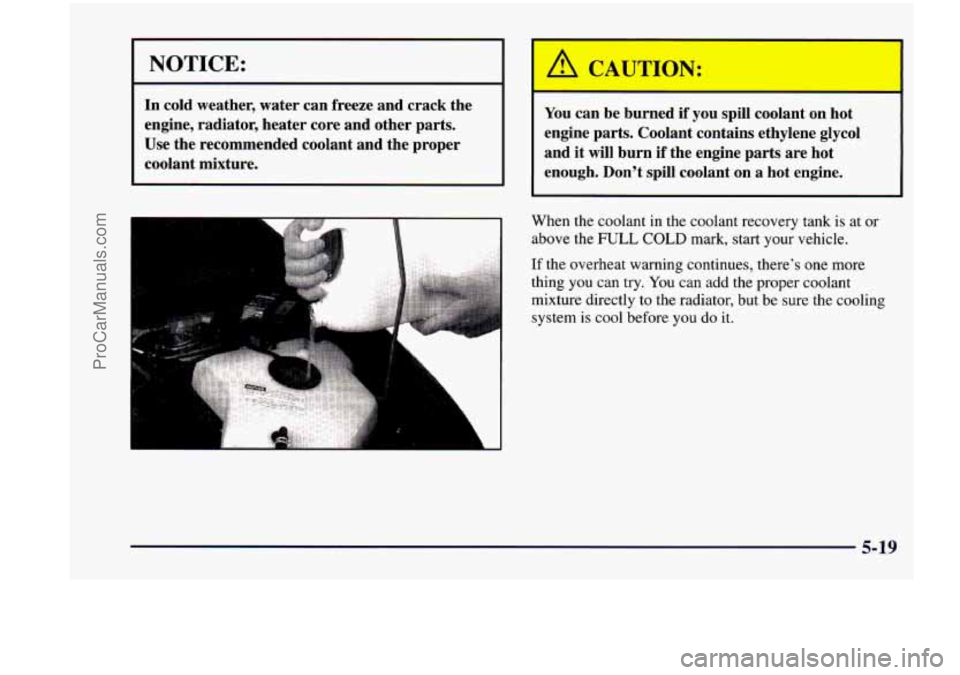
When the coolant in the coolant recovery tank
is at or
above the
FULL COLD mark, start your vehicle.
If the overheat warning continues, there’s one more
thing you can try.
You can add the proper coolant
mixture directly to the radiator, but
be sure the cooling
system is cool before you do it.
5-19
ProCarManuals.com
Page 319 of 474
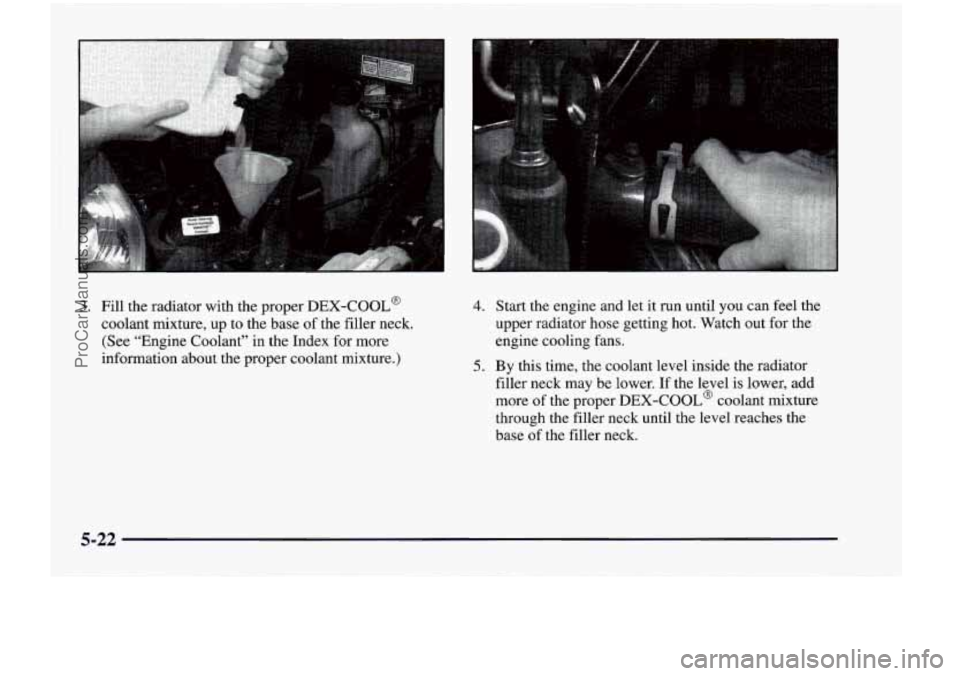
3. Fill the radiator with the proper DEX-COOL@
coolant mixture, up to the base
of the filler neck.
(See “Engine Coolant”
in the Index for more
information about the proper coolant mixture.)
L
4. Start the engine and let it run until you can feel the
upper radiator hose getting hot. Watch out for the
engine cooling fans.
5. By this time, the coolant level inside the radiator
filler neck may be lower.
If the level is lower, add
more of the proper DEX-COOL@ coolant mixture
through the filler neck until the level reaches the
base of the filler neck.
5-22
ProCarManuals.com
Page 321 of 474
If a Tire Goes Flat
It’s unusual for a tire to “blow out” while you’re driving,
especially if you maintain your tires properly. If
air goes
out of a tire, it’s much more likely to leak out slowly.
But
if you should ever have a “blowout,” here are a few
tips about what to expect and what to do:
If a front tire fails, the flat tire
will create a drag that
pulls the vehicle toward that side. Take your foot
off the
accelerator pedal and grip the steering wheel fiiy.
Steer to maintain lane position, and then gently brake to
a stop well out of the
traffic lane.
A rear blowout, particularly on a curve, acts much like a
skid and may require the same correction you’d use in a
skid. In any rear blowout, remove your foot from the
accelerator pedal. Get the vehicle under control by
steering the way you want the vehicle to go. It may be
very bumpy and noisy, but you can still steer. Gently
brake to a stop
-- well off the road if possible.
If a tire goes flat, the next part shows how to use your
jacking equipment to change a flat tire safely.
Air Inflator (Option)
Your vehicle may have an air inflator used to bring tires
up to the proper pressure. See “Accessory Inflator
System” in the Index for more details.
Changing a Flat Tire
If a tire goes flat, avoid further tire and wheel damage
by driving slowly to a level place. Turn on your hazard
warning flashers.
- 1
’ A CAUTION:
--
Changing a tire can cause an injury. The vehicle
can slip
off the jack and roll over you or other
people. You and they could be badly injured.
Find
a level place to change your tire. To help
prevent the vehicle from moving:
1. Set the parking brake firmly.
2. Put the shift lever in PARK (P).
3. I’urn off the engine.
To be even more certain the vehicle won’t move,
you can put blocks
at the front and rear of the
tire farthest
away from the one being changed.
That would be the tire on the other side of the
vehicle, at the opposite end.
i-24
ProCarManuals.com
Page 332 of 474
NOTICE:
When the compact spare is installed, don’t take
your vehicle through an automatic car wash with
guide rails. The compact spare can get caught on
the rails. That can damage the tire and wheel,
and maybe other parts
of your vehicle.
Don’t
use your compact spare on other vehicles.
And don’t
mix your compact spare tire or wheel with
other wheels or tires. They won’t fit. Keep your spare
tire and its wheel together.
NOTICE:
Tire chains won’t fit your compact spare. Using
them can damage your vehicle and can damage
the chains too. Don’t use tire chains on your
compact spare.
If You’re Stuck: In Sand, Mud,
Ice
or Snow
What you don’t want to do when your vehicle is stuck is
to spin your wheels
too fast. The method known as
“rocking” can help you get out when you’re stuck, but
you must use caution.
I
If you let your tires spin at high speed, they can
explode, and you or others could be injured. And,
the transaxle or other parts
of the vehicle can
overheat. That could cause an engine
compartment fire
or other damage. When you’re
stuck, spin the wheels as little as possible. Don’t
spin the wheels above
35 mph (55 km/h) as shown
on the speedometer.
5-35
ProCarManuals.com
Page 336 of 474

Section 6 Service and Appearance Care
Here you will find information about the care of your vehicle. This section begins with service and fuel information,
and then it shows how to check important fluid and lubricant levels. There is also technical information about your
vehicle, and
a part devoted to its appearance care.
6- 18
6-2 1
6-24
6-25
6-26
6-30
6-3
1
6-39 6-2
Service
6-3 Fuel
6-7 Filling a Portable Fuel Container
6-
8 Checking Things Under the Hood
6-11 Engine Oil
6-15 Air Cleaner
6-16 Passenger Compartment Air Filter
Replacement
Automatic Transaxle Fluid
Engine Coolant
Radiator Pressure Cap
Windshield Washer Fluid
Brakes
Battery
Bulb Replacement
Windshield Wiper Blade Replacement 6-40
6-48
6-48
6-52
6-54
6-54
6-55
6-56
6-57
6-64
6-65
6-65
6-66
6-66
6-66 Tires
Appearance
Care
Cleaning the Inside of Your Vehicle
Cleaning the Outside of Your Vehicle
Underbody Maintenance Chemical Paint Spotting
Appearance Care Materials Chart
Vehicle Identification Number (VIN)
Electrical System
Replacement Bulbs
Capacities and Specifications
Engine Specifications
Vehicle Dimensions
Normal Maintenance Replacement Parts
Air Conditioning Refrigerants
ProCarManuals.com
Page 338 of 474
Fuel
L
You can be injured and your ve :le could be
damaged if you try to do service work on a
vehicle without knowing enough about
it.
Be sure you have sufficient knowledge,
experience, the proper replacement parts
and tools before you attempt any vehicle
maintenance task.
Be sure to use the proper nuts, bolts and
other fasteners, “English” and “metric”
fasteners can be easily confused.
If you use
the wrong fasteners, parts can later break
or fall
off. You could be hurt.
Adding Equipment to the - hide of
Your Vehicle
Things you might add to the outside of your vehicIe can
affect the airflow around
it. This may cause wind noise
and affect windshield washer performance. Check with
your dealer before adding equipment to the outside
of
your vehicle. Use regular unleaded gasoline rated at
87 octane
or
higher. At
a minimum, it should meet specifications
ASTM
D4814 in the United States and CGSB 3.5-M93
in Canada. Improved gasoline specifications have been
developed by the American Automobile Manufacturers
Association (AAMA) for better vehicle performance
and engine protection. Gasolines meeting the
AAMA
specification could provide improved driveability
and emission control system protection compared to
other gasolines.
Be sure the posted octane is at least 87. If the octane is
less than 87,
you may get a heavy knocking noise when
you drive. If it’s bad enough, it can damage your engine.
If you’re using fuel rated at
87 octane or higher and you
hear heavy knocking, your engine needs service. But
don’t worry if you hear a little pinging noise when
you’re accelerating or driving up
a hill. That’s normal,
and you don’t have
to buy a higher octane fuel to get rid
of pinging. It’s the heavy, constant knock that means
you have
a problem.
ProCarManuals.com
Page 339 of 474
If your vehicle is certified to meet California Emission
Standards (indicated on the underhood emission control
label),
it is designed to operate on fuels that meet
California specifications. If such fuels are not available
in states adopting California emissions standards, your
vehicle will operate satisfactorily on fuels meeting
federal specifications, but emission control system
performance may be affected. The malfunction indicator
lamp on your instrument panel may turn on and/or your
vehicle may fail a smog-check test. If
this occurs, return
to your authorized Chevrolet dealer for diagnosis to
determine the cause of failure. In the event it is
determined that the cause of the condition is the type
of
fuels used, repairs may not be covered by your warranty.
Some gasolines that are not reformulated for low
emissions contain an octane-enhancing additive called
methylcyclopentadienyl manganese tricarbonyl
(MMT);
ask your service station operator whether or not his fuel
contains MMT. General Motors does not recommend the
use of such gasolines. If fuels containing
MMT are used,
spark plug life may be reduced and your emission
control system performance may be affected. The
malfunction indicator lamp on your instrument panel
may turn on.
If this occurs, return to your authorized
Chevrolet dealer for service.
To provide cleaner air, all gasolines in the United States
are now required to contain additives that will help
prevent deposits from forming in your engine and fuel
system, allowing your emission control system to
function properly. Therefore, you should not have to
add anything to the fuel. In addition, gasolines
containing oxygenates, such as ethers and ethanol, and
reformulated gasolines may be available in your area to
help clean the air. General Motors recommends that you
use these gasolines
if they comply with the
specifications described earlier.
NOTICE:
Your vehicle was not designed for fuel that
contains methanol. Don’t use it. It can corrode
metal parts in your fuel system and also damage
plastic and rubber parts. That damage wouldn’t
be covered under your warranty.
6-4
ProCarManuals.com