1998 CHEVROLET PRIZM window
[x] Cancel search: windowPage 14 of 364

Downloaded from www.Manualslib.com manuals search engine Vehicle Symbols
These are some of the symbols you may find on your vehicle.
For example,
these symbols
are used
on an
original battery:
POSSIBLE A
CAUTION
INJURY
PROTECT EYES BY
SHIELDING
Q
CAUSTIC
ACID COULD BATTERY
CAUSE
BURNS
AVOID
SPARKS
OR
FLAMES
SPARK
OR ,111,
COULD FLAME
EXPLODE BATTERY
These symbols are important
for you and
your passengers whenever your
vehicle
is
driven:
DOOR LOCK
UNLOCK
FASTEN SEAT
BELTS
These symbols
have to do with
your lamps:
SIGNALS e e
TURN
FOG LAMPS
$0
These symbols are
on some of
your controls:
WINDSHIELD
WIPER
WINDSHIELD DEFROSTER
WINDOW
DEFOGGER
VENTILATING FAN
These symbols are used on
warning and
indicator lights:
ENGINE t
COOLANT t- TEMP -
CHARGING I-1
BATTERY
SYSTEM
BRAKE
(0)
COOLANT a
ENGINE OIL w,
PRESSURE
ANTI-LOCK
(8)
BRAKES
Here are some
other symbols
you may see:
FUSE
LIGHTER
a
HORN )tr
SPEAKER
b
FUEL p3
viii
Page 41 of 364

Downloaded from www.Manualslib.com manuals search engine How does an air bag restrain?
In moderate to severe frontal or near frontal collisions,
even belted occupants can contact the steering wheel or
the instrument panel. In moderate to severe side
collisions, even belted occupants can contact the inside
of the vehicle. The air bag supplements the protection
provided by safety belts. Air bags distribute the force of
the impact more evenly over the occupant’s upper body,
stopping the occupant more gradually. But the frontal air
bags would not help you in many types of collisions,
including rollovers, rear impacts, and side impacts,
primarily because an occupant’s motion is not toward
the air bag. Side impact air bags would not help you in
many types of collisions, including frontal or near
frontal collisions, rollovers, and rear impacts, primarily
because an occupant’s motion is not toward those air
bags. Air bags should never be regarded as anything
more than a supplement to safety belts, and then only in
moderate to severe frontal or near-frontal collisions for
the driver’s and right front passenger’s frontal air bags,
and only in moderate to severe side collisions for the
driver’s and right front passenger’s side impact air bags.
What will you see after an air bag inflates?
After an air bag inflates, it quickly deflates, so quickly
that some people may not even realize
the air bag inflated. Some components
of the
air bag module -- the
steering wheel hub for the driver’s air bag, the instrument
panel for
the right front passenger’s bag, the side of the
seatback closest to the door for the driver and right front
passenger’s side impact air bags
-- will be hot for a short
time. The parts of the bag that come into contact with you
may be warm, but not too hot to touch. There will be
some smoke and dust coming from the vents in the
deflated air bags. Air bag inflation doesn’t prevent the
driver from seeing or being able to steer the vehicle, nor
does it stop people from leaving the vehicle.
A CAUTION:
When an air bag inflates, there is dust in the air.
This dust could cause breathing problems for
people with a history of asthma or other breathing trouble.
To avoid this, everyone in the
vehicle should get out as soon
as it is safe to do so.
If you have breathing problems but can’t get out
of the vehicle after an air bag inflates, then get
fresh air by opening a window or
a door.
1-27
Page 66 of 364
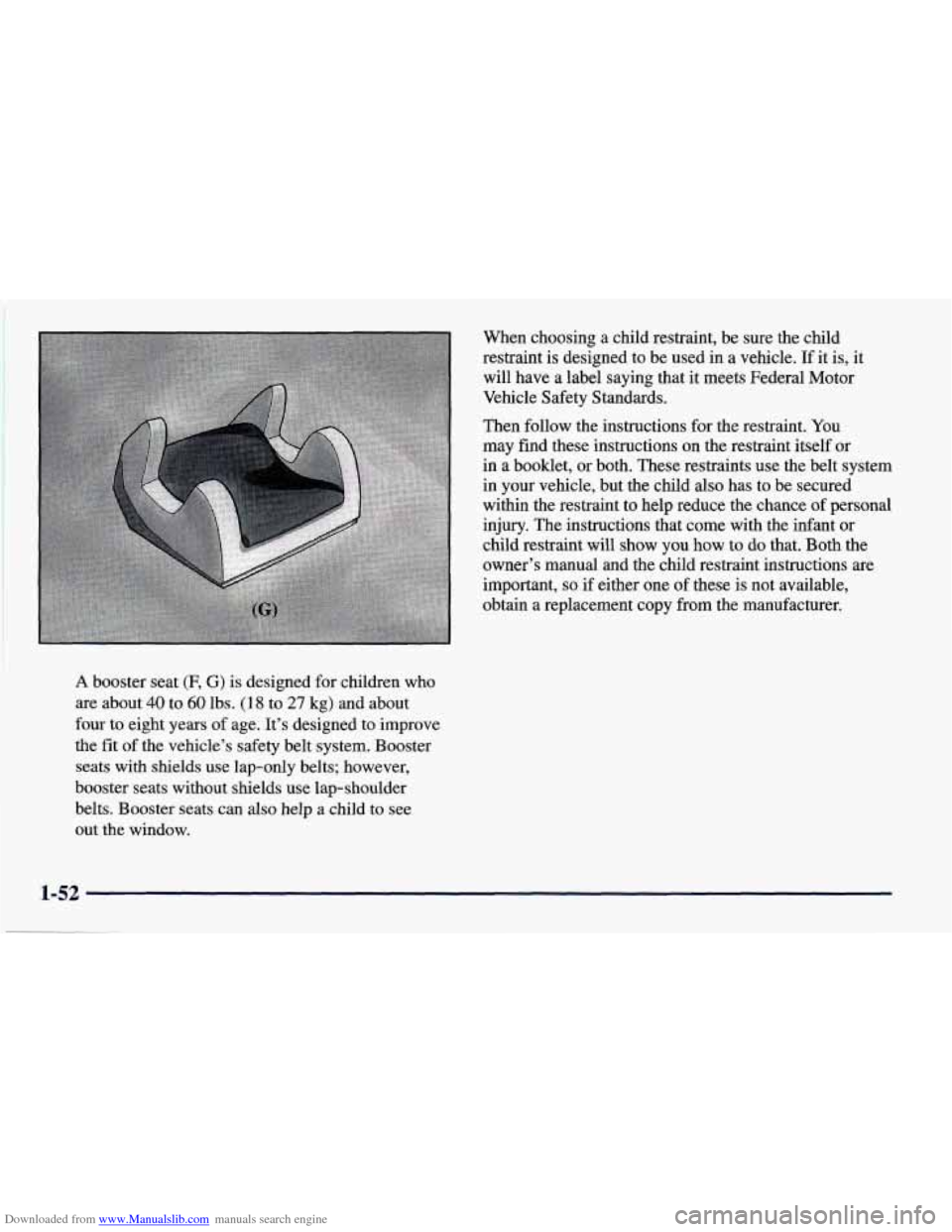
Downloaded from www.Manualslib.com manuals search engine A booster seat (F, G) is designed for children who
are about
40 to 60 lbs. (18 to 27 kg) and about
four to eight years of age. It’s designed to improve
the
fit of the vehicle’s safety belt system. Booster
seats with shields use lap-only belts; however,
booster seats without shields
use lap-shoulder
belts. Booster seats can also help a child to see
out the window. When choosing
a child restraint, be sure the child
restraint is designed to be used in
a vehicle. If it is, it
will have
a label saying that it meets Federal Motor
Vehicle Safety Standards.
Then follow the instructions for the restraint.
You
may find these instructions on the restraint itself or
in a booklet, or both. These restraints use the belt system
in your vehicle, but the child also has to be secured
within the restraint to help reduce the chance of personal
injury. The instructions that come with the infant or
child restraint will show you how
to do that. Both the
owner’s manual and the child restraint instructions are
important,
so if either one of these is not available,
obtain a replacement copy from the manufacturer.
1-52 ~
Page 73 of 364
Downloaded from www.Manualslib.com manuals search engine Accident statistics show that children are safer if they
are restrained in the rear seat. But they need to use the
safety belts properly.
Children who aren’t buckled up can be thrown out
0 Children who aren’t buckled up can strike other
in
a crash.
people who are.
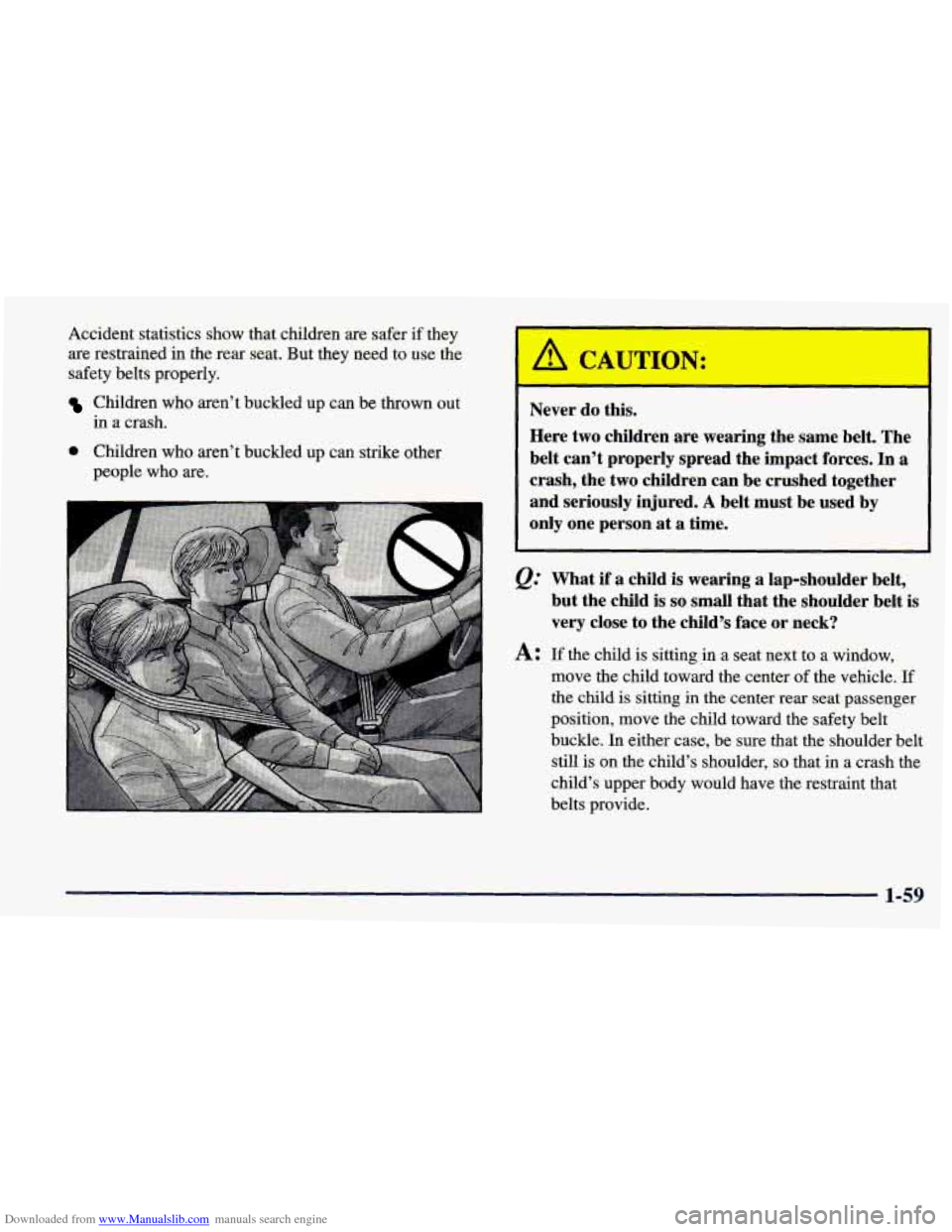
Never do this.
Here two children
are wearing the same belt. The
belt can’t properly spread the impact forces. In a
crash, the two children can be crushed together
and seriously injured.
A belt must be used by
only one person at a time.
What
if a child is wearing a lap-shoulder belt,
but the child is
so small that the shoulder belt is
very close to the child’s face or neck?
A: If the child is sitting in a seat next to a window,
move the child toward
the center of the vehicle. If
the child is sitting in the center rear seat passenger
position, move the child toward the safety belt
buckle. In either case, be sure that the shoulder belt
still is on the child’s shoulder,
so that in a crash the
child’s upper body would have the restraint that
belts provide.
1-59
Page 79 of 364

Downloaded from www.Manualslib.com manuals search engine a Section 2 Features and Controls
Here you can learn about the many standard and optional features on your vehicle, and information on starting,
shifting and braking. Also explained are the instrument panel and the warning systems that tell
you if everything is
working properly -- and what to do if you have a problem.
2-2 2-4
2-6
2-9
2-10 2-1
1
2-1 1
2-13 2- 14
2-18
2-20
2-2 1
2-23
2-24 Keys
Door Locks
Keyless Entry System (If Equipped)
Trunk
Theft
New Vehicle “Break-In”
Ignition Switch
Starting Your Engine
Automatic Transaxle Operation
Manual Transaxle Operation
Parking Brake
Shifting Into Park (P) (Automatic
Transaxle Only) Parking Over Things That Burn
Engine Exhaust 2-24
2-25
2-26
2-26
2-27
2-32
2-34
2-3
5
2-37
2-38
2-3
8
2-39
2-40
2-45 Running
Your Engine While You’re Parked
(Automatic Transaxle)
Windows
Horn
Tilt Column (Option)
Turn Signalhlultifunction Lever
Exterior Lamps
Interior Lamps
Mirrors Storage Compartments
Ashtrays and Lighter
Sun Visors
Sunroof (Option)
Instrument Panel
Warning Lights, Gages and Indicators
2-1
Page 80 of 364
Downloaded from www.Manualslib.com manuals search engine Keys
1-
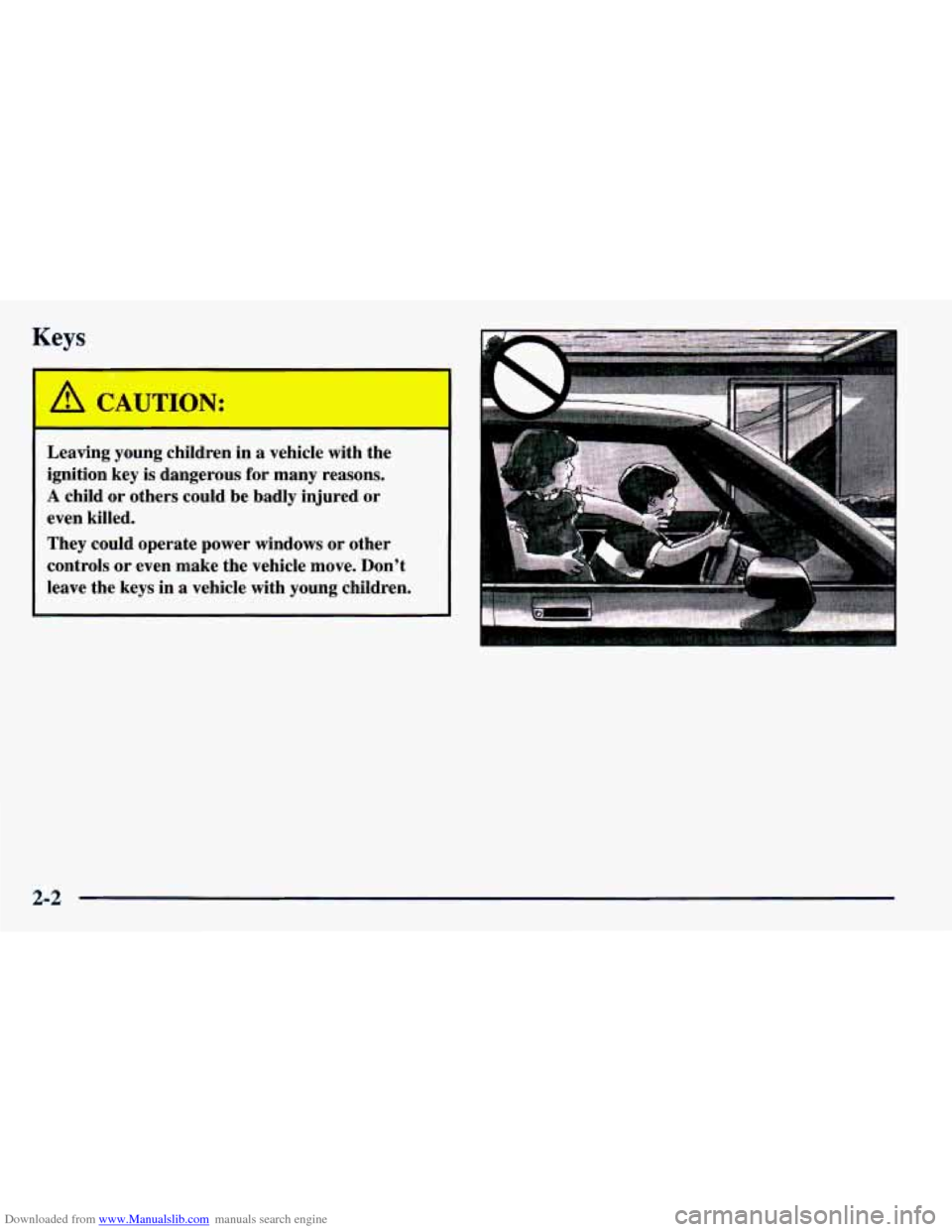
A CAUTION:
I
Leaving young children in a vehicle with the
ignition key is dangerous for many reasons.
A child or others could be badly injured or
even killed.
They could operate power windows or other
controls
or even make the vehicle move. Don't
leave the keys in a vehicle with young children.
T, :,. .,. ,* ..'! ,, '
2-2
Page 87 of 364
Downloaded from www.Manualslib.com manuals search engine To replace the battery: Trunk
1. Insert a coin into the notch near the keyring. Turn
the coin to the left to separate the two halves
of
the transmitter.
2. Once the transmitter is separated, use a pencil eraser
to remove the old battery.
Do not use a metal object.
3. Replace the battery with the positive (+) side
facing upward.
4. Snap the transmitter back together tightly to be
sure
no moisture can enter.
It can be dangerous to drive with the trunk open
because carbon monoxide
(CO) gas can come into
your vehicle. You can’t see or smell
CO. It can
cause unconsciousness and even death.
If you must drive with the trunk open or if
electrical wiring or other cable connections
must pass through the seal between the body
and the trunk:
Make sure all windows are shut.
Thrn the fan on your heating or cooling
system
to its highest speed with the setting
on
VENT. That will force outside air into
your vehicle. See “Comfort Controls” in
the Index.
instrument panel, open them all the way.
If you have air outlets on or under the
See “Engine Exhaust” in the Index.
2-9
Page 88 of 364

Downloaded from www.Manualslib.com manuals search engine Trunk Lock Release Theft
To open the trunk lid, use your key and turn it to
the right.
To close the lid, lower and press down on it. After
closing the lid, try pulling it up to make sure it is closed.
Remote Trunk Lock Release
nw Pull the lever on the floor
near the driver’s door to
open the trunk lid from
inside your vehicle. Vehicle
theft
is big business, especially in some cities.
Although your vehicle has a number
of theft-deterrent
features, we know that nothing we put
on it can make
it impossible to steal. However, there are ways you
can help.
Key in the Ignition
If you leave your vehicle with the keys inside, it’s an
easy target for joy riders or professional thieves
-- so
don’t do it.
When
you park your vehicle and open the driver’s door,
you’ll hear a tone reminding you to remove your key
from the ignition and take
it with you. Always do this.
Your steering wheel will be locked, and
so will your
ignition. If you have an automatic transaxle, taking your
key out also locks your transaxle. And remember to
lock the doors.
Parking at Night
Park in a lighted spot, close all windows and lock your
vehicle. Remember to keep your valuables out
of sight.
Put them in a storage area, or take them with you.
2-10