1998 CHEVROLET PRIZM clock
[x] Cancel search: clockPage 10 of 364

Downloaded from www.Manualslib.com manuals search engine iv
In I932 Chevrolet
introduced the
Synchro-Mesh
transmission and
offered a host
of
accessories -- including
such niceties as a
clock!
white Corvettes
launched the I
first use of a I 1
Page 135 of 364
Downloaded from www.Manualslib.com manuals search engine 0 Section 3 Comfort Controls and Audio Systems
In this section, you’ll find out how to operate the comfort control and audio systems offered with your vehicle. Be
sure to read about the particular systems supplied with your vehicle.
3-2
3-3
3-3 3-4
3-5
3-6
3-6
3-6 3-8 Comfort Controls
Air Conditioner Controls (Option)
Heating
Ventilation System
Defogging and Defrosting
Audio Systems Setting the Clock
AM-FM Stereo (If Equipped)
AM-FM Stereo with Cassette Tape Player and
Automatic Tone Control (If Equipped) 3-1 1
3- 14
3- 14
3-15
3- 17
3- 17
3- 17
i
I
AM-FM Stereo with Compact Disc Player and
Automatic Tone Control
(If Equipped)
Understanding Radio Reception
Tips About Your Audio System
Care of Your Cassette Tape Player
Care of Your Compact Discs
Care of Your Compact Disc Player
Fixed Mast Antenna
3-1
Page 140 of 364
Downloaded from www.Manualslib.com manuals search engine NOTICE:
Don't use a razor blade or something else sharp
on the inside
of the rear window. If you do, you
could cut or damage the warming grid, and the repairs wouldn't be covered by your warranty.
Audio Systems
Your Delco Electronics audio system has been designed
to operate easily and give years of listening pleasure.
You
will get the most enjoyment out of it if you
acquaint yourself with it first. Find out what your Delco
Electronics system can
do and how to operate all its
controls, to be sure you're getting the most out of the
advanced engineering that went into it.
Setting the Clock
Press and hold RECALL (TIME SET) to set the correct
hour. At the same time, press and hold the
TUNE left
arrow (H) until the correct hour appears.
Press and hold RECALL
(TIME SET) to set the correct
minute. At the same time, press and hold the
TUNE
right arrow (M) until the correct minute appears.
AM-FM Stereo (If Equipped)
.. l.,-..._l *c ""'.'--- - ..- ........ ;,. .
. ., ........ ..........___..... .. .. .............................. belco Electronics 4 5 6 .,-. .. ........ ... .x ... " .............. ~ ..... 1. ... .......... .~ ..-" ................... ...... 1 ...... I
Playing the Radio
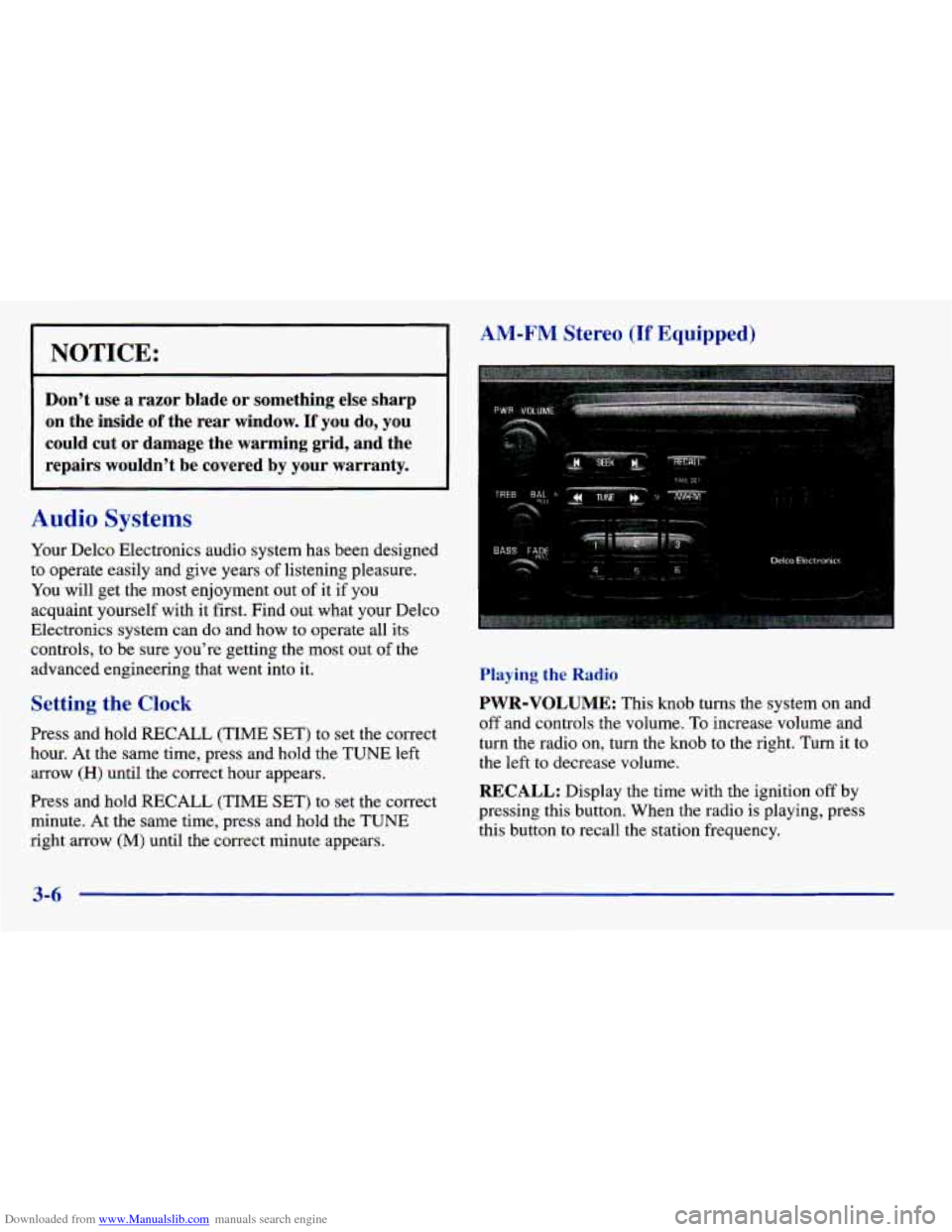
PWR-VOLUME: This knob turns the system on and
off and controls the volume. To increase volume and
turn the radio on, turn the knob to the right. Turn it to
the left to decrease volume.
RECALL: Display the time with the ignition off by
pressing this button. When the radio
is playing, press
this button to recall the station frequency.
3-6
Page 163 of 364
Downloaded from www.Manualslib.com manuals search engine Steering in Emergencies
There are times when steering can be more effective
than braking. For example, you come over a hill and
find a truck stopped in your lane, or a car suddenly pulls
out from nowhere, or a child darts out from between
parked cars and stops right in front
of you. You can
avoid these problems by braking
-- if you can stop in
time. But sometimes you can’t; there isn’t room.
That’s the time for evasive action
-- steering around
the problem.
Your vehicle can perform very well in emergencies like
these. First apply your brakes
-- but, unless you have
anti-lock, not enough to lock your wheels. (See
“Braking in Emergencies” earlier in this section.) It is
better to remove as much speed as you can from a
possible collision. Then steer around the problem,
to
the left or right depending on the space available. An emergency
like this requires close attention and a
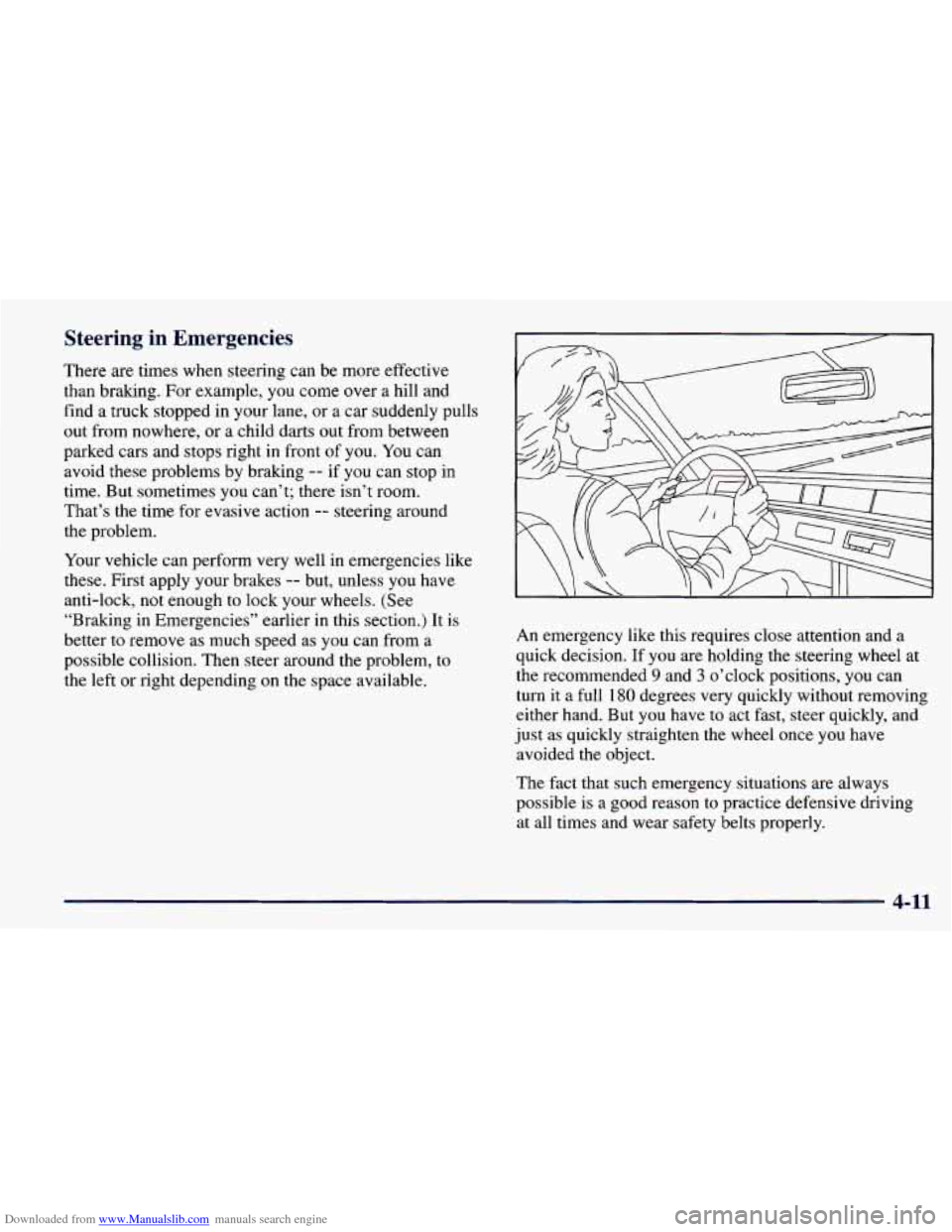
quick decision. If you are holding the steering wheel at
the recommended 9 and 3 o’clock positions, you can
turn it a full
180 degrees very quickly without removing
either hand. But you have to act fast, steer quickly, and
just as quickly straighten the wheel once you have
avoided the object.
The fact that such emergency situations are always
possible is a good reason to practice defensive driving
at all times and wear safety belts properly.
4-11
Page 210 of 364
Downloaded from www.Manualslib.com manuals search engine How to Add Coolant to the Radiator
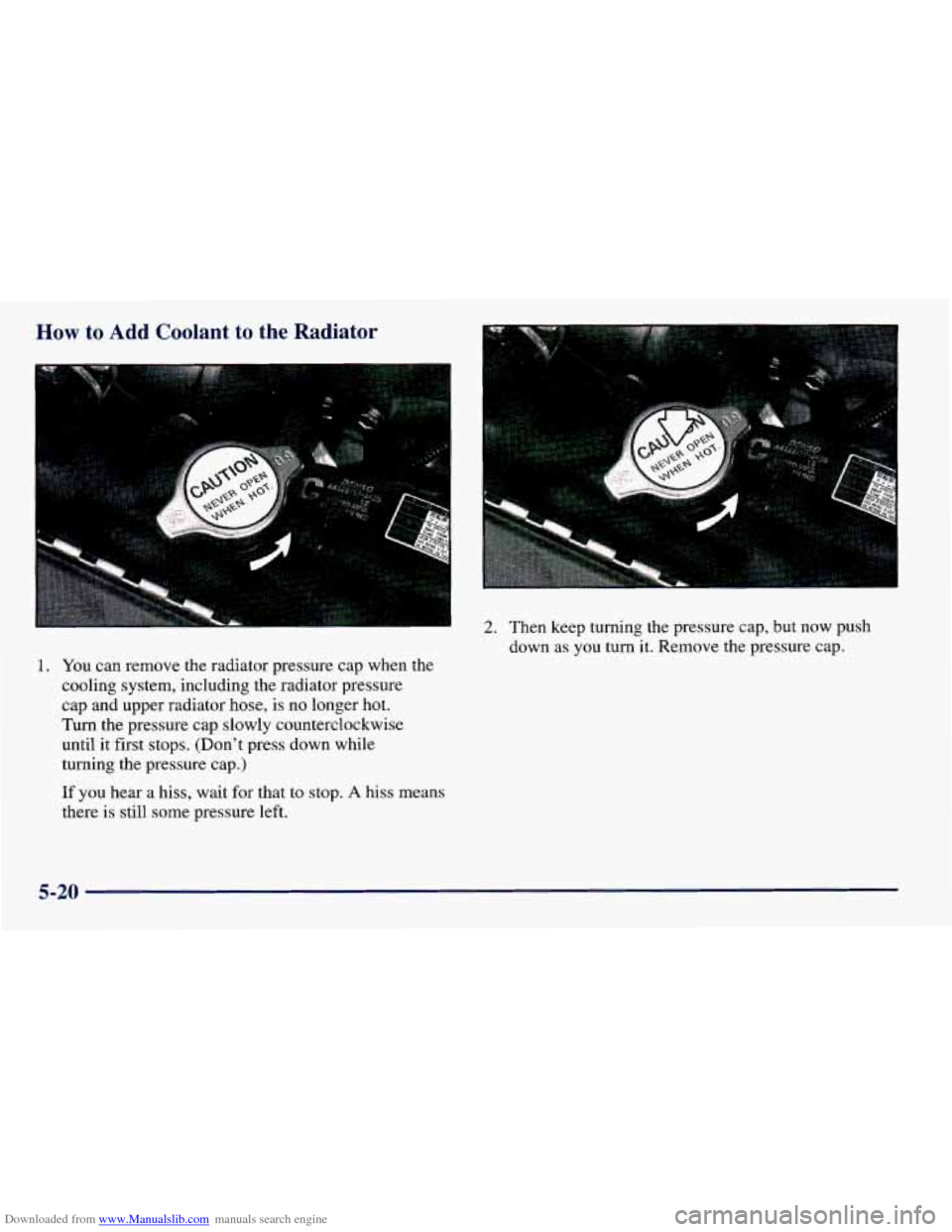
1. You can remove the radiator pressure cap when the
cooling system, including the radiator pressure
cap and upper radiator hose, is no longer
hot.
Turn the pressure cap slowly counterclockwise
until it first stops. (Don’t press down while
turning the pressure cap.)
If you hear a hiss, wait for that to stop. A hiss means
there
is still some pressure left.
2. Then keep turning the pressure cap, but now push
down as you
turn it. Remove the pressure cap.
5-20
Page 233 of 364
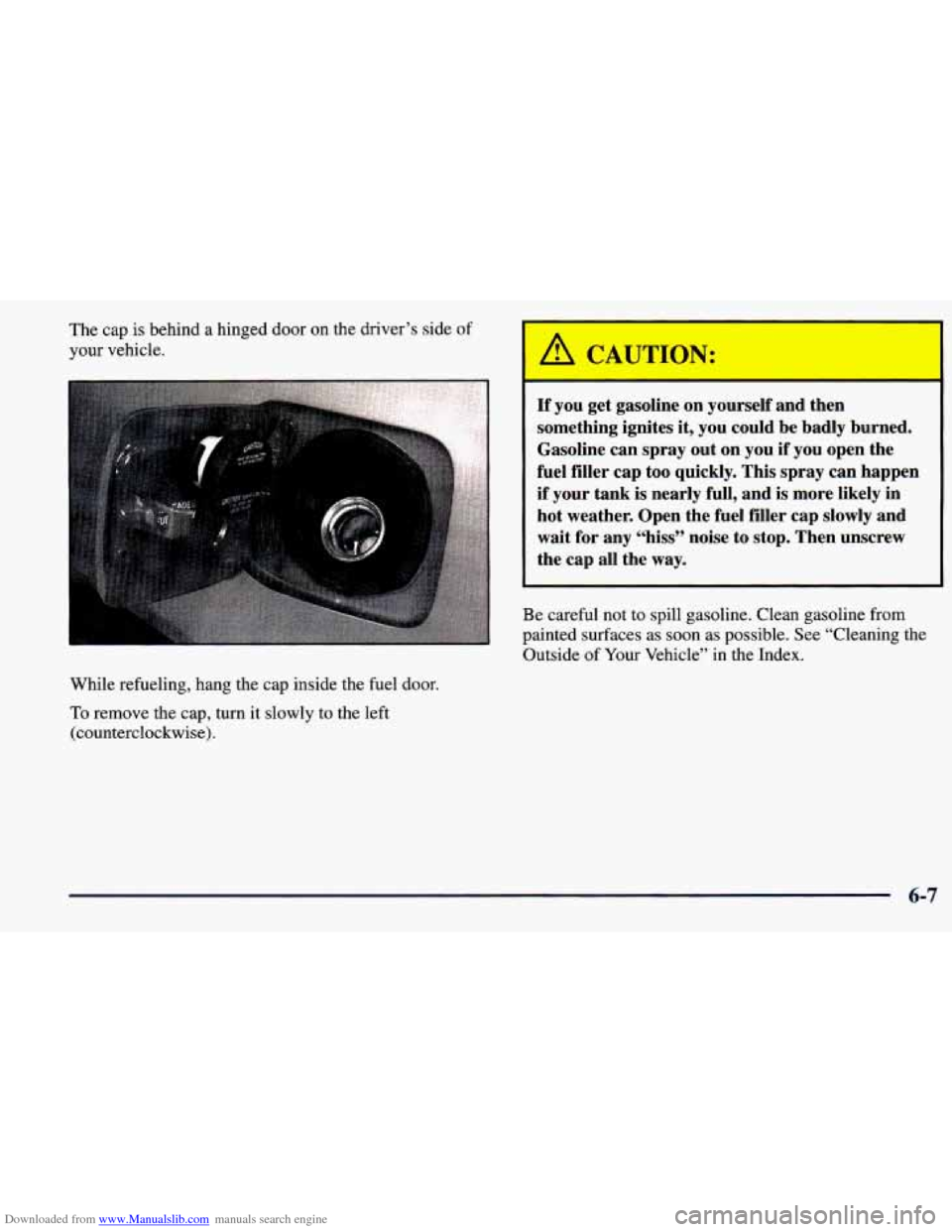
Downloaded from www.Manualslib.com manuals search engine The cap is behind a hinged door on the driver’s side of
your vehicle.
While refueling, hang the cap inside the fuel door.
To remove the cap, turn it slowly to the left
(counterclockwise).
A ,CAUTION
If you get gasoline on yourself and then
something ignites it, you could be badly burned.
Gasoline can spray out on you if you open the
fuel filler cap too quickly. This spray can happen
if your tank is nearly full, and is more likely in
hot weather. Open the fuel filler cap slowly and
wait for any “hiss” noise to stop. Then unscrew
the cap all the way.
Be careful not to spill gasoline. Clean gasoline from
painted surfaces as soon as possible.
See “Cleaning the
Outside of Your Vehicle” in the Index.
6-7
Page 234 of 364
Downloaded from www.Manualslib.com manuals search engine When you put the cap back on, turn it to the right
(clockwise) until you hear a clicking sound. Make
sure you fully install the cap. The diagnostic system
can determine
if the fuel cap has been left off or
improperly installed. This would allow fuel to
evaporate into the atmosphere. See “Malfunction
Indicator Lamp” in the Index.
NOTICE:
If you need a new cap, be sure to get the right
type. Your dealer can get one for you.
If you get
the wrong type, it may not fit properly. This may
cause your malfunction indicator lamp to light
and your fuel tank and emissions system may be
damaged. See “Malfunction Indicator Lamp” in
the Index.
Filling a Portable Fuel Container
Never fill a portable fuel container while it is in
your vehicle. Static electricity discharge from the
container can ignite the gasoline vapor.
You can
be badly burned and your vehicle damaged if this
occurs. To help avoid injury to you and others:
Dispense gasoline only into approved
containers.
Do not fill a container while it is inside a
vehicle, in a vehicle’s trunk, pickup bed or
on any surface other than the ground.
inside
of the fill opening before operating
the nozzle. Contact should be maintained
until the filling
is complete.
0 Bring the fill nozzle in contact with the
Don’t smoke while pumping gasoline.
Page 350 of 364

Downloaded from www.Manualslib.com manuals search engine Brakes. Anti-Lock ............................... 4-7
Braking in Emergencies
........................... 4-9
Break-In. New Vehicle
.......................... 2-11
Built-In Child Restraint
.......................... 1-36
Cleaning
.................................... 6-47
Removing the Child
........................... 1-44
Securing a Child
.............................. 1-37
Bulb Replacement
.............................. 6-33
........................................ Brdcing 4-6
BTSI
.................................... 2-22. 7-40
BTSICheck
................................... 7-40
..................................... Storing 1-45
Canadian Roadside Assistance
.................... 8-7
Capacities and Specifications
...................... 6-59
Carbon Monoxide
................ 2.9.2.24.4.27. 4.33
Cassette Deck Service
........................... 7-37
Cassette Tape Player
............................. 3-8
Cassette Tape Player Care ........................ 3- 15
Certification Label
.............................. 4-29
Chains. Tire
................................... 6-44
Changing a Hat Tire
............................. 5-23
Charging System Light
.......................... 2-46
Check Engine Light
............................. 2-49
Checking
Your Restraint Systems .................. 1-61
Chemical Paint Spotting
.......................... 6-51
Child Restraints
............ 1.33.1.36.1.48.1.54. 1.56
Securing in the Rear Seat
Position ................ 1-54
Securing
in the Right Front Seat Position .......... 1-56
Top Strap .................................. , . 1-53
Cigarette Lighter
............................... 2-38
Built-In
....,............................... l-36
Wheretoput ................................ l-53
Circuit Breakers and Fuses ....................... 6-54
Cleaning Cleaner. Air .............................. 6.16. 6.60
Aluminum Wheels
............................ 6-49
Built-in Child Restraint
........................ 6-47
Exterior LampsLenses
........................ 6-48
Glass Surfaces
............................... 6-47
Inside
of Your Vehicle ......................... 6-45
Instrument Panel
............................. 6-46
Interior Plastic Components
..................... 6-47
Outside
of Your Vehicle ........................ 6-48 .
Special Problems ............................. 6-46
Windshield and Wiper Blades
................... 6-48
Climate Control System
........................... 3-2
Clock, Setting the
................................ 3-6
Clutch Adjustment
.............................. 6-22
Clutch, Hydraulic
............................... 6-22
Column, Tilt
................................... 2-26
Comfort Controls
................................ 3-2
Fabric
...................................... 6-45
...................................... Stains 6-46
Tires
....................................... 6-50
Vinyl 6-46 .......................................
Compact Disc
Care
....................................... 3-17
Player 3-11 ......................................
Player Care .................................. 3-17
Compact Spare Tire
............................. 5-33
Console Storage Area
........................... 2-37
Control
of a Vehicle .............................. 4-6
Convex Outside Mirror
.......................... 2-36
Recovery
Tank .......................... 5-16, 5-17
Coolant ....................................... 6-23
9-2