1998 CHEVROLET PRIZM trailer
[x] Cancel search: trailerPage 89 of 364

Downloaded from www.Manualslib.com manuals search engine New Vehicle “Break-In”
NOTICE:
Your vehicle doesn’t need an elaborate
“break-in.” But it will perform better in the long
run
if you follow these guidelines:
Don’t drive at any one speed -- fast or
slow
-- for the first 500 miles (805 km).
Don’t make full-throttle starts.
200 miles (322 km) or so. During this time
your new brake linings aren’t yet broken
in. Hard stops with new linings can mean
premature wear and earlier replacement.
Follow this breaking-in guideline every
time you get new brake linings.
Don’t tow a trailer during break-in. See
“Towing a Trailer” in the Index for
more information.
Avoid making hard stops for the first
Ignition Switch
With the key in the ignition switch, you can turn the
switch to
four positions.
W
LOCK (A): This is the only position from which you
can remove the key. This locks your steering wheel,
ignition and automatic transaxle.
Push in the ignition
switch as you
turn the it toward you.
If you have an automatic transaxle, the ignition switch
can’t be turned to
LOCK unless the shift lever is in
the
PARK (P).
Page 93 of 364
Downloaded from www.Manualslib.com manuals search engine It is dangc- JUS to get out of your vehicle if the
shift lever
is not fully in PARK (P) with the
parking brake firmly set. Your vehicle can roll.
Don’t leave your vehicle when the engine is
running unless you have to.
If you have left the
engine running, the vehicle can move suddenly.
You or others could be injured.
To be sure your
vehicle won’t move, even when you’re
on fairly
level ground, always set your parking brake and
move the shift lever to
PARK (P).
you’re pulling a trailer, see “Towing a Trailer’’
~ See “Shifting Into PARK (P)” in the Index. If
~ in the Index.
Ensure the shift lever is fully in PARK (P) range
before starting the engine. Your vehicle has
a
brake-transaxle shift interlock. You have to fully apply
your regular brakes before you can shift from
PARK (P)
when the ignition key is in ON. If you cannot shift out
of PARK (P), ease pressure on the shift lever -- push the
shift lever all the way into PARK
(P) and release the
shift lever button as you maintain brake application.
Then press the shift lever button and move the shift
lever into the gear you wish. See “Shifting Out of
PARK (P)” in the index.
REVERSE (R): Use this gear to back up.
NOTICE:
Shifting to REVERSE (R) while your vehicle is
moving forward could damage your transaxle.
Shift to
REVERSE (R) only after your vehicle
is stopped.
To rock your vehicle back and forth to get out of snow,
ice or sand without damaging your transaxle, see
“Stuck: In Sand,
Mud, Ice or Snow” in the Index.
2-15
Page 99 of 364
Downloaded from www.Manualslib.com manuals search engine NOTICE:
Driving with the parking brake on can cause
your rear brakes to overheat. You may have to
replace them, and you could also damage other
parts of your vehicle.
If you are towing a trailer, see “Towing a Trailer” in
the Index.
Shifting Into PARK (P)
A
It can be dangerous to get out of your vehicle if
the shift lever is not fully in
PARK (P) with the
parking brake firmly set. Your vehicle can roll.
If
you have left the engine running, the vehicle can
move suddenly. You or others could be injured.
To be sure your vehicle won’t move, even when
you’re on fairly level ground, use the steps that
follow.
If you’re pulling a trailer, see “Towing a
Trailer” in the Index.
1. Hold the brake pedal down with your right foot and
set the parking brake by pulling up on the parking
brake lever.
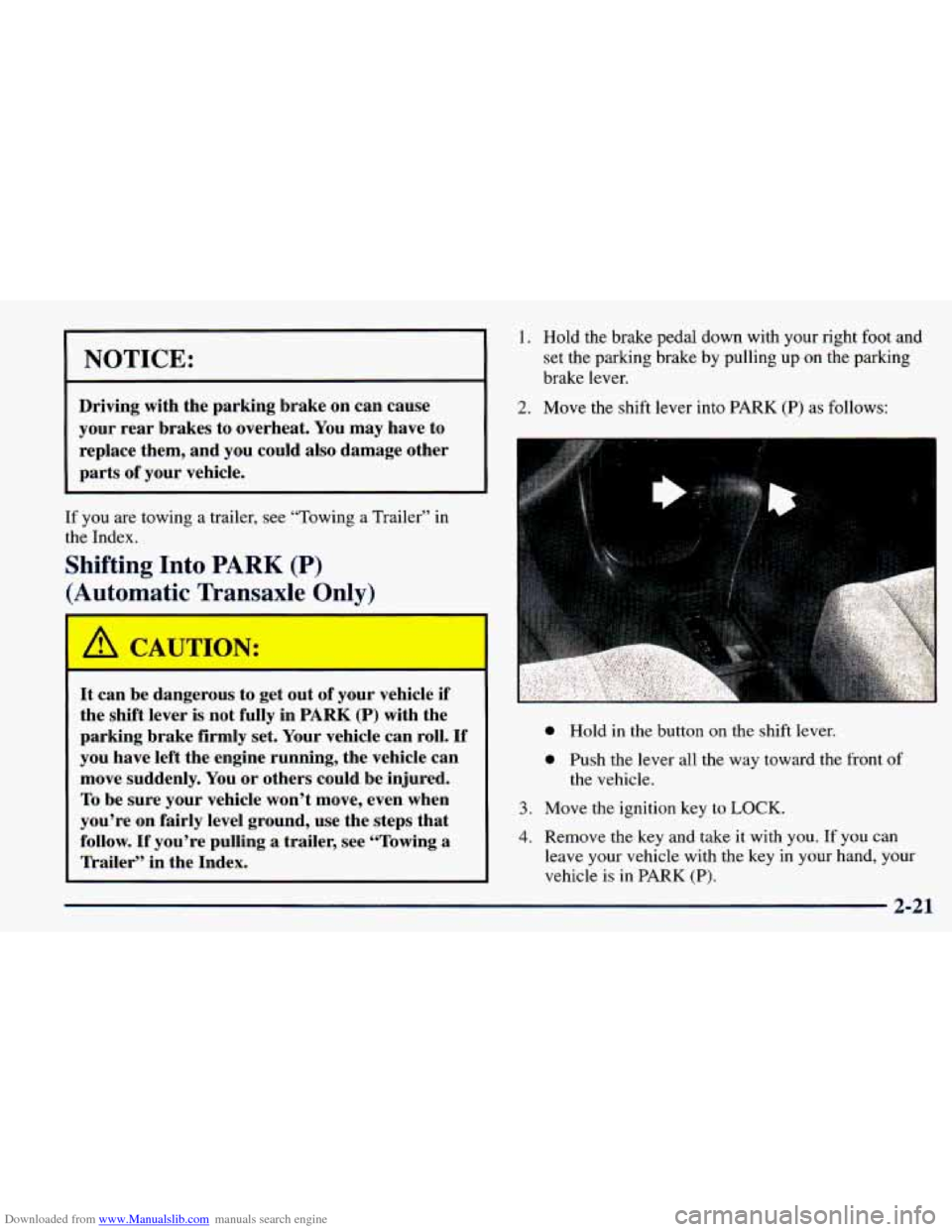
2. Move the shift lever into PARK (P) as follows:
I
0 Hold in the button on the shift lever.
0 Push the lever all the way toward the front of
the vehicle.
3. Move the ignition key to LOCK.
4.
Remove the key and take it with you. If you can
leave your vehicle with
the key in your hand, your
vehicle is
in PARK (P).
2-21
Page 101 of 364
Downloaded from www.Manualslib.com manuals search engine If you cannot shift out of PARK (P), ease pressure on
the shift lever
-- push the shift lever all the way into
PARK (P) and release the shift lever button as you
maintain brake application. Then press the shift lever
button and move the shift lever into the gear you wish.
If you ever hold the brake pedal down but still can’t
shift out of PARK (P), try this:
1. Carefully pry the shift lock override cover from the
floor shift console using a fiat-bladed tool.
2. Insert the end of the flat-bladed tool into the
rectangular slot and press down firmly.
3. While maintaining brake application, move the shift lever into the drive gear you want.
4. Have the vehicle fixed as soon as possible.
Parking Your Vehicle (Manual Transaxle)
Before you get out of your vehicle, put your manual
transaxle in
REVERSE (R) (if your vehicle is parked on
a level surface or facing downhill), or put your manual
transaxle in FIRST
(1) (if your vehicle is parked facing
uphill) and firmly apply the parking brake.
If you are towing
a trailer, see “Towing a Trailer” in
the Index.
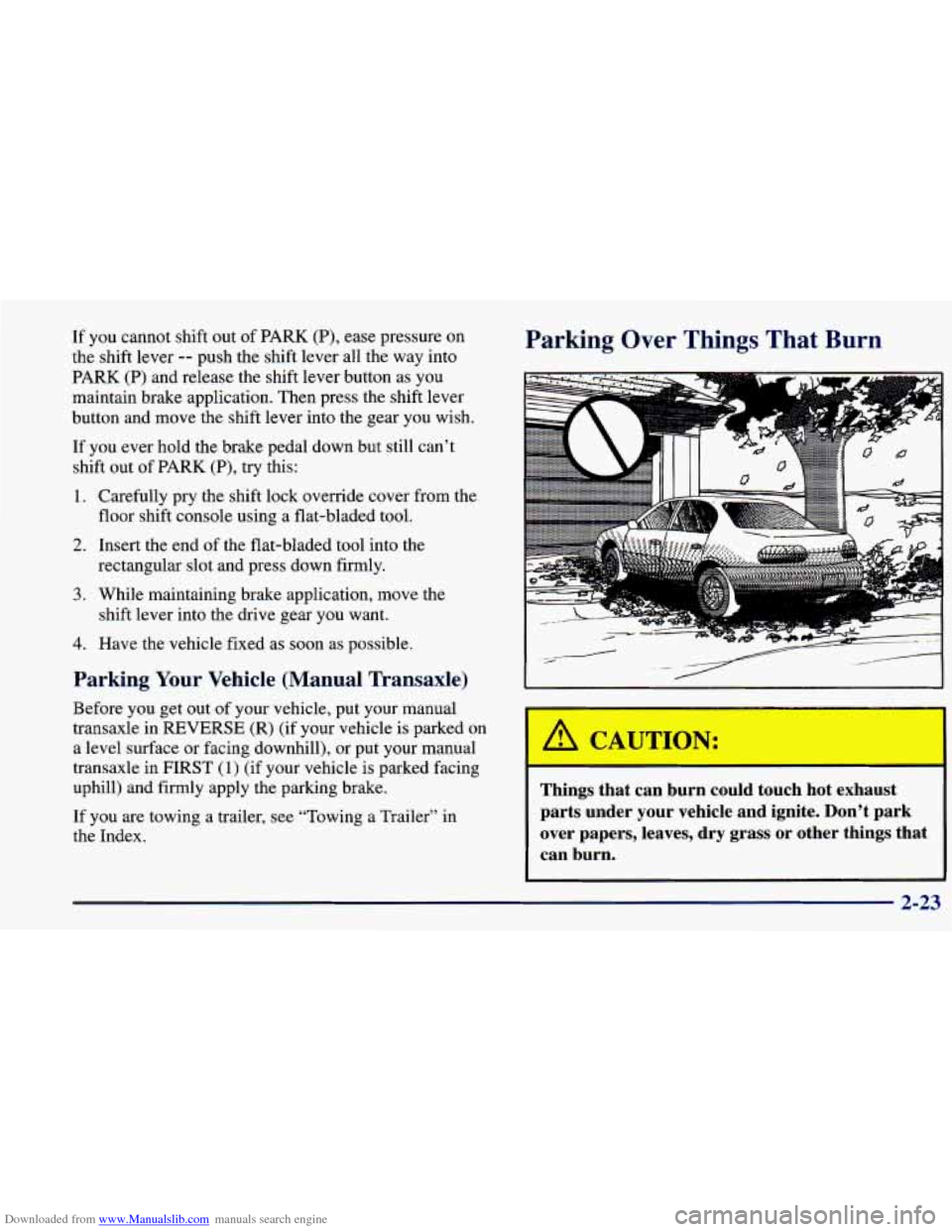
Parking Over Things That Burn
Things that can burn cudd touw hot exhaust
parts under your vehicle and ignite. Don’t park
over papers, leaves, dry grass or other things that
can burn.
2-23
Page 103 of 364

Downloaded from www.Manualslib.com manuals search engine Power Windows (Option)
It can be dangerous to get out of your vehicle if
the shift lever is not fully in PARK (P) with the
parking brake firmly
set. Your vehicle can roll.
Don’t leave your vehicle when the engine is
running unless you have to.
If you’ve left the
engine running, the vehicle can move suddenly.
You or others could be injured.
To be sure your
vehicle won’t move, even when you’re on fairly
level ground, always set your parking brake and
move the shift lever to
PARK (P).
Follow the proper steps to be sure your vehicle won’t
move. See “Shifting Into
PARK (P)” in the Index.
If you are parking on a hill and
if you’re pulling a
trailer, also see “Towing a Trailer” in the Index.
Windows
Manual Windows
Use the window crank to open and close each window. With power
windows, switches on the driver’s door
control each window when the ignition is on.
Push down
the front of the switch to lower a window and lift the
front of the switch to raise
a window.
The AUTO switch for the driver’s window has an
express-down feature. To use express-down, push the
switch down all the way. Release the switch and the
window will lower completely. Pull
up on the switch
lightly and release it to stop
the window partway.
2-25
Page 128 of 364

Downloaded from www.Manualslib.com manuals search engine NOTICE:
If you keep driving your vehicle with this light
on, after
a while, your emission controls may not
~ work as well, your fuel economy may not be as
good and your engine may not run as smoothly.
This could lead to costly repairs that may not be
covered
by your warranty.
This light should come on, as a check to show you it is
working, when the ignition is on and the engine
is not
running. If the light doesn’t come on, have it repaired.
This light will also come on during a malfunction in
one of two ways:
Light Flashing -- A misfire condition has been
detected.
A misfire increases vehicle emissions and
may damage the emission control system on your
vehicle. Dealer or qualified service center diagnosis
and service may be required.
@ Light On Steady -- An emission control system
malfunction has been detected on your vehicle.
Dealer or qualified service center diagnosis and
service may be required.
If the Light Is Flashing
The following may prevent more serious damage to
your vehicle:
0 Reducing vehicle speed.
Avoiding hard accelerations.
0 Avoiding steep uphill grades.
0 If you are towing a trailer, reduce the amount of
cargo being hauled as soon as it is possible.
If the light stops flashing and remains on steady, see “If
the Light Is
On Steady” following.
If the light continues to flash, when it is
safe to do so,
stop the vehicle. Find a safe place to park your vehicle.
Turn the key off, wait at least
10 seconds and restart the
engine. If the light remains on steady, see “If the Light
Is On Steady” following. If the light is still flashing,
follow the previous steps, and drive the vehicle to your
dealer or qualified service center for service.
2-50
Page 153 of 364
Downloaded from www.Manualslib.com manuals search engine 0 Section 4 Your Driving and the Road
Here you’ll find information about driving on different kinds of roads and in varying weather conditions. We’ve also
included many other useful tips
on driving.
4-2 4-3
4-6
4-6 4-
10
4-12
4-12
4-13
4- 15 Defensive Driving
Drunken Driving Control of a Vehicle
Braking Steering
Off-Road Recovery
Passing
Loss of Control
Driving
a Night Driving
in Rain and on Wet Roads
City Driving
Freeway Driving Before Leaving on a Long Trip
Highway Hypnosis
Hill and Mountain Roads
Winter Driving Loading Your Vehicle
Towing a Trailer
4- 16
4- 19
4-20
4-2
1
4-2 1
4-22
4-24
4-2 8
4-30
4-1
Page 182 of 364
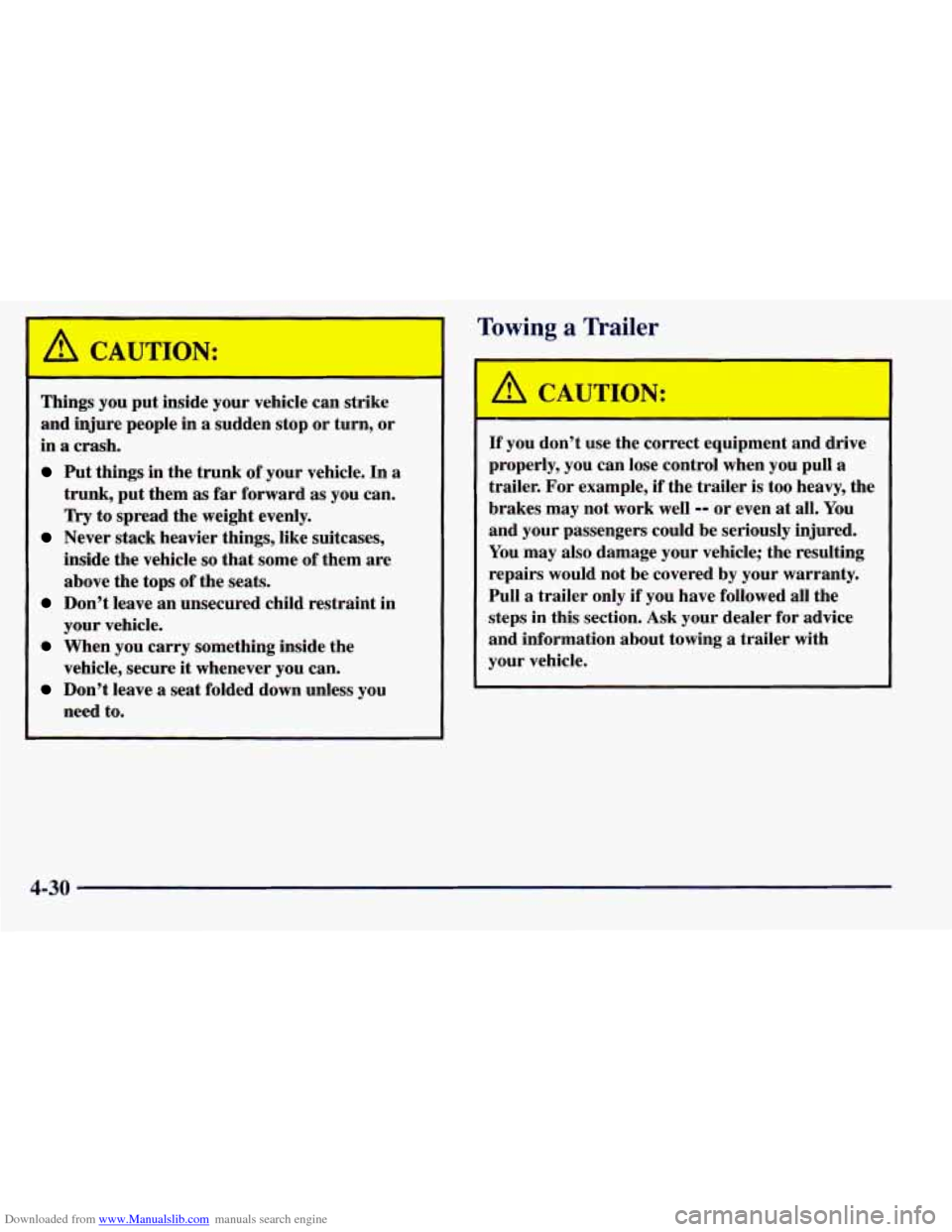
Downloaded from www.Manualslib.com manuals search engine A CAUTION:
Things you put inside your vehicle can strike
and injure people in a sudden stop or turn, or
in
a crash.
Put things in the trunk of your vehicle. In a
trunk, put them as far forward as you can.
Try to spread the weight evenly.
Never stack heavier things, like suitcases,
inside the vehicle
so that some of them are
above the tops of the seats.
Don’t leave an unsecured child restraint in
your vehicle.
When you carry something inside the
vehicle, secure it whenever you can.
Don’t leave a seat folded down unless you
need to.
Towing a Trailer
I A CAUTION:
If you don’t use the correct equipment and drive
properly, you can lose control when you pull a
trailer. For example, if the trailer is too heavy, the
brakes may not work well
-- or even at all. You
and your passengers could be seriously injured.
You may also damage your vehicle; the resulting
repairs would not be covered by your warranty.
Pull
a trailer only if you have followed all the
steps
in this section. Ask your dealer for advice
and information about towing
a trailer with
your vehicle.
4-30