1998 CHEVROLET MALIBU trunk release
[x] Cancel search: trunk releasePage 72 of 362
Downloaded from www.Manualslib.com manuals search engine This device complies with RSS-210 of Industry Canada.
Operation is subject to the following two conditions:
(1) this device may not cause interference, and (2) this
device must accept any interference received, including
interference that may cause undesired operation of
the device.
Changes or modifications to this system by other than an
authorized service facility could void authorization to
use this equipment.
This system has a range of about
3 feet (1 m) up to
30 feet (9 m). At times you may notice a decrease in
range. This is normal for any remote keyless entry
system. If the transmitter does not work or if you have
to stand closer to your vehicle for the transmitter to
work, try this:
Check to determine if battery replacement or
resynchronization is necessary. See the instructions
that follow.
Check the distance. You may be too far from your
vehicle. You may need to stand closer during rainy
or snowy weather.
Check the location. Other vehicles or objects may be
blocking the signal. Take a few steps to the left or
right, hold the transmitter higher, and try again.
If you’re still having trouble, see your dealer or a
qualified technician for service.
Operation
The following functions are available with the keyless
entry system:
LOCK: All doors will automatically lock when the
LOCK button on the transmitter is pressed. Press the
button a second time and you will hear a “chirp” to
indicate that the doors have been locked.
UNLOCK: The driver’s door will unlock automatically
when the UNLOCK button on the transmitter is pressed.
If the UNLOCK button is pressed again within five
seconds, all remaining doors will unlock.
Trunk Release: The trunk will unlock anytime
the
vehicle symbol on the transmitter is pressed, the trunk
lockout is not engaged and the gear selector is in
PARK
(P) or NEUTRAL (N) .
Page 75 of 362
Downloaded from www.Manualslib.com manuals search engine I’runk Remote Trunk Release
To unlock the trunk from the outside, insert the key and
turn the trunk lock cylinder.
It can be dangerous to drive with the trunk lid
open because carbon monoxide
(CO) gas can
come into your vehicle. You can’t see or smell
CO. It can cause unconsciousness and even death.
If you must drive with the trunk lid open or if
electrical wiring or other cable connections must
pass through the seal between the body and the
trunk lid:
Make sure all windows are shut.
%hrn the fan on your heating or cooling
system to
its highest speed with the setting on
VENT. That will force outside air into your
vehicle.
See ‘6Comfort Controls” in the Index.
instrument panel, open them all the way.
If you have air outlets on or under the
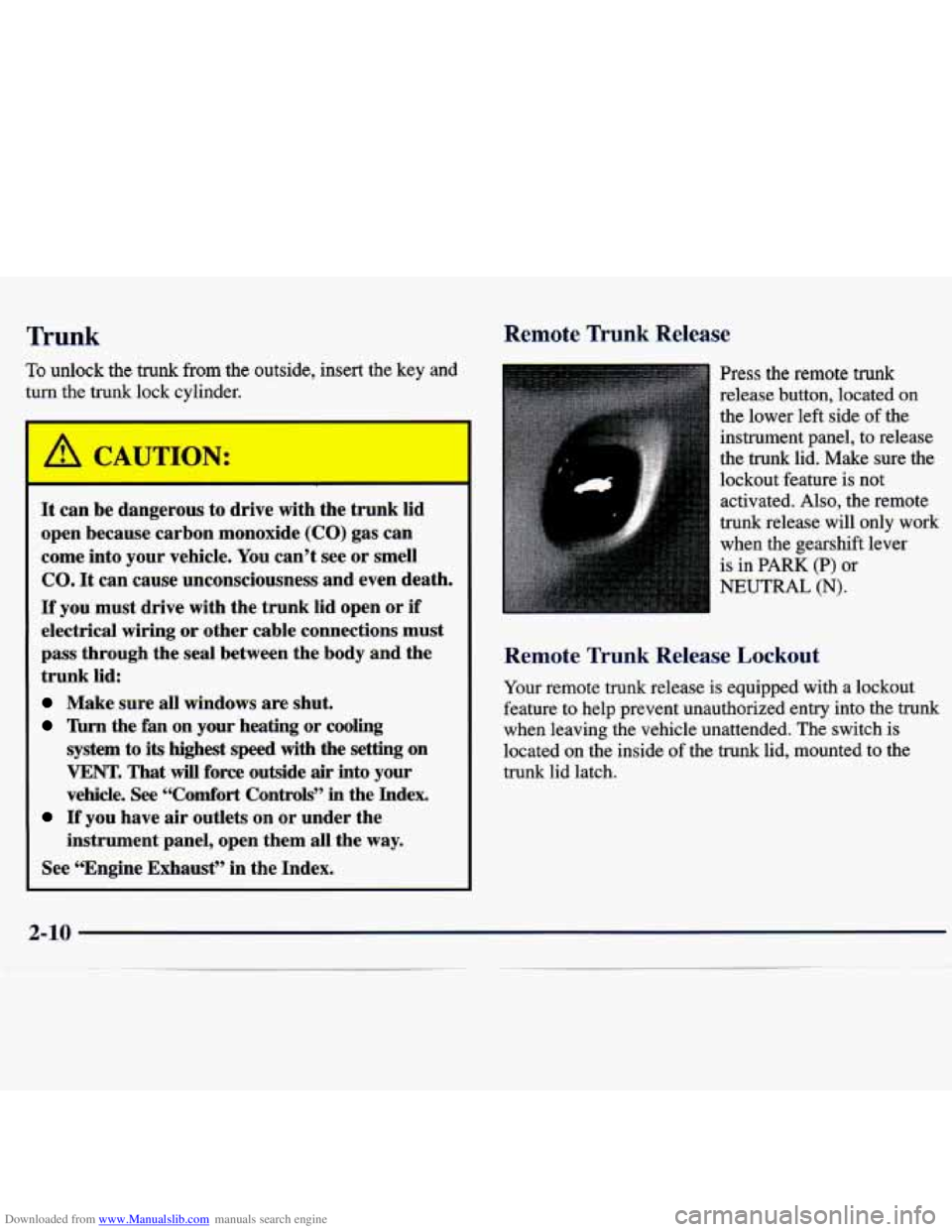
See “Engine Exhaust” in the Index. Press the remote trunk
release button, located on
the lower left side of the
instrument panel, to release
the trunk lid. Make sure the
lockout feature is not
activated. Also, the remote
trunk release will only work
when the gearshift lever
is in PARK (P)
or
NEUTRAL (N).
Remote Trunk Release Lockout
Your remote trunk release is equipped with a lockout
feature to help prevent unauthorized entry into the trunk when leaving the vehicle unattended. The switch is
located on the inside of the trunk lid, mounted to the
trunk lid latch.
2-10
Page 76 of 362
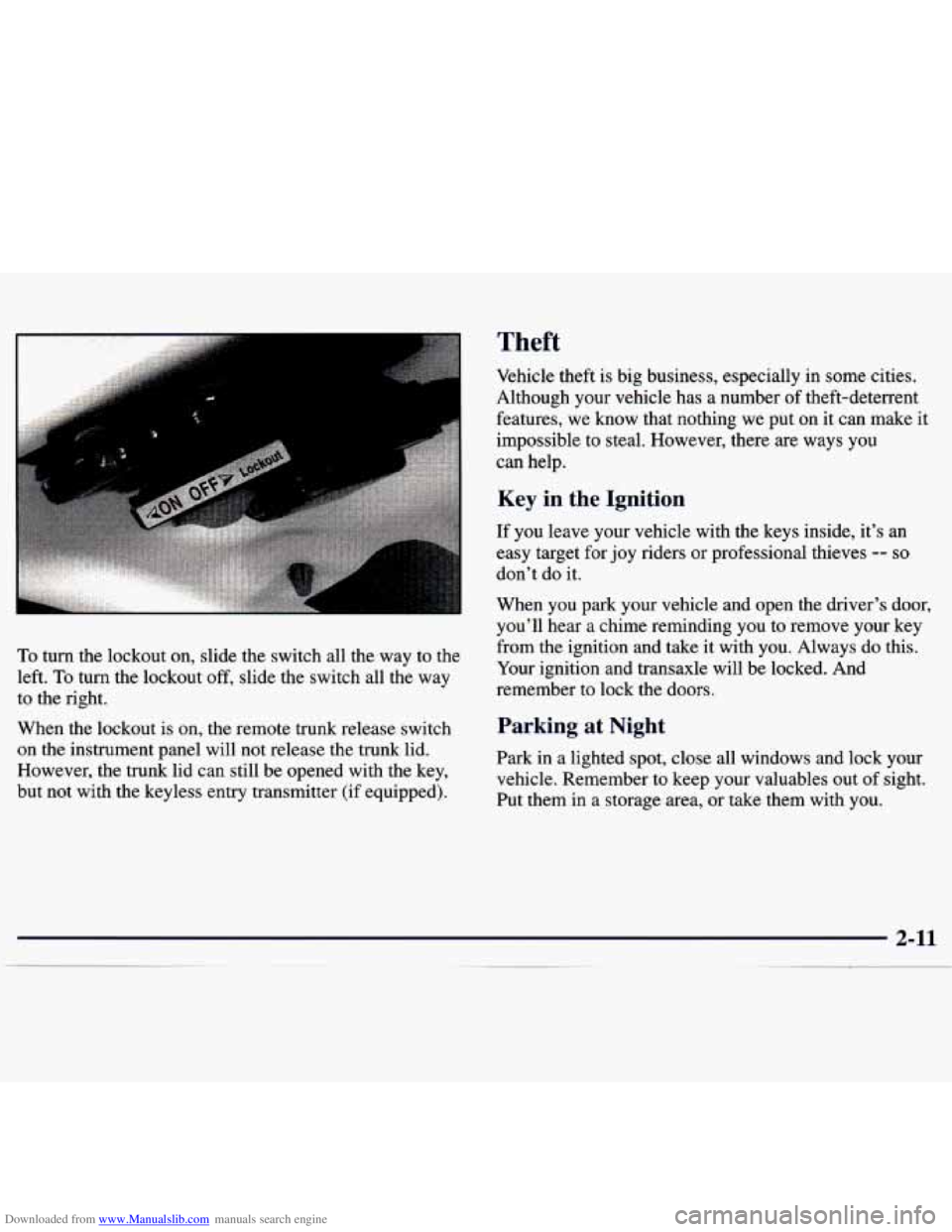
Downloaded from www.Manualslib.com manuals search engine To turn the lockout on, slide the switch all the way to the
left.
To turn the lockout off, slide the switch all the way
to the right.
When the lockout is on,
the remote trunk release switch
on the instrument panel will not release the trunk lid.
However, the trunk lid can still be opened with the key,
but not with the keyless entry transmitter (if equipped).
Theft
Vehicle theft is big business, especially in some cities.
Although your vehicle has a number of theft-deterrent
features,
we know that nothing we put on it can make it
impossible to steal. However, there are ways you
can help.
Key in the Ignition
If you leave your vehicle with the keys inside, it's an
easy target for joy riders or professional thieves
-- so
don't do it.
When you park your vehicle and open the driver's door,
you'll hear a chime reminding you to remove your key
from the ignition and take it with you. Always do this.
Your ignition and transaxle will be locked. And
remember to lock the doors.
Parking at Night
Park in a lighted spot, close all windows and lock your
vehicle. Remember to keep your valuables out of sight.
Put them in a storage area, or take them with you.
Page 77 of 362
Downloaded from www.Manualslib.com manuals search engine Parking Lots Passlock@
If you park in a lot where someone will be watching
your vehicle, it’s best to lock it up and take your keys.
But what
if you have to leave your key?
0
0
0
0
0
0
If possible, park in a busy, well lit area.
Put your valuables in a storage area, like your
trunk or glove box. Be sure to close and lock
the
storage area.
Close all windows. Slide the remote trunk release lockout switch all the
way to the
OFF.
Lock the glove box.
Lock all the doors except the driver’s. Your
vehicle
is equipped with the Passlock
theft-deterrent system.
Passlock is a passive theft-deterrent system. The system
is armed once the key is removed from the ignition.
Passlock enables fuel if the ignition lock cylinder is
turned with
a valid key. If a correct key is not used, fuel
is disabled.
During normal operation, the THEFT SYSTEM light will go
off after the engine is started.
If the THEFT SYSTEM light flashes, wait until the light
stops flashing before starting the engine.
If the THEFT
SYSTEM light comes on while the engine
is running, a problem has been detected and the system
may need service. See your dealer for service.
In an emergency, call the Chevrolet Roadside Assistance
Center at 1-800-CHEV-USA
(1-800-243-8872). (In
Canada, call
1-800-268-6800.)
Page 112 of 362
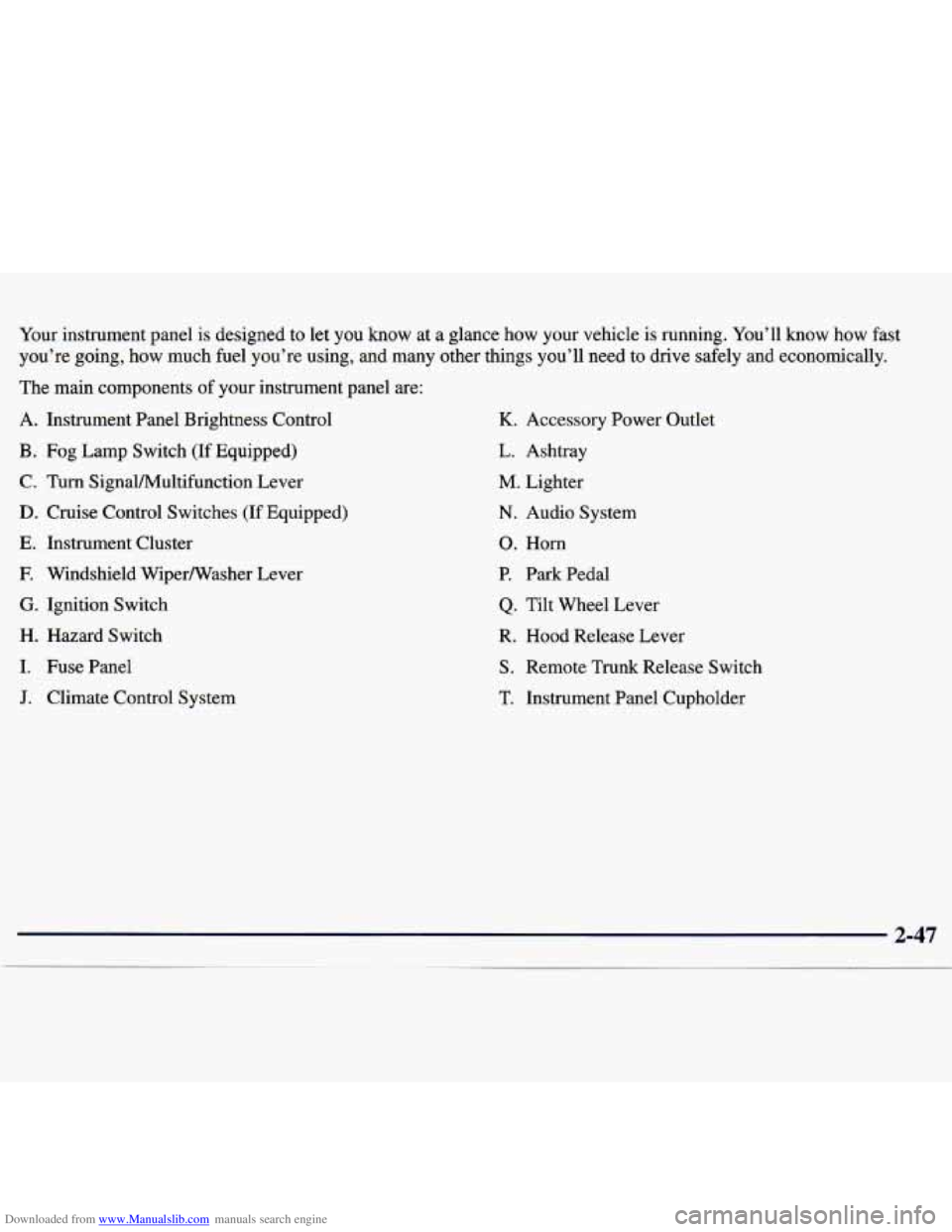
Downloaded from www.Manualslib.com manuals search engine Your instrument panel is designed to let you know at a glance how your vehicle is running. You’ll know how fast
you’re going, how much fuel you’re using, and many other things you’ll need to drive \
safely and economically.
The main components
of your instrument panel are:
A. Instrument Panel Brightness Control
B. Fog Lamp Switch (If Equipped)
C. Turn SignaVMultifunction Lever
D. Cruise Control Switches (If Equipped)
E. Instrument Cluster
F. Windshield Wipermasher Lever
G. Ignition Switch
H. Hazard Switch
I. Fuse Panel
J. Climate Control System
K. Accessory Power Outlet
L. Ashtray
M. Lighter
N. Audio System
0. Horn
P. Park Pedal
Q. Tilt Wheel Lever
R. Hood Release Lever
S. Remote Trunk Release Switch
T. Instrument Panel Cupholder
Page 282 of 362
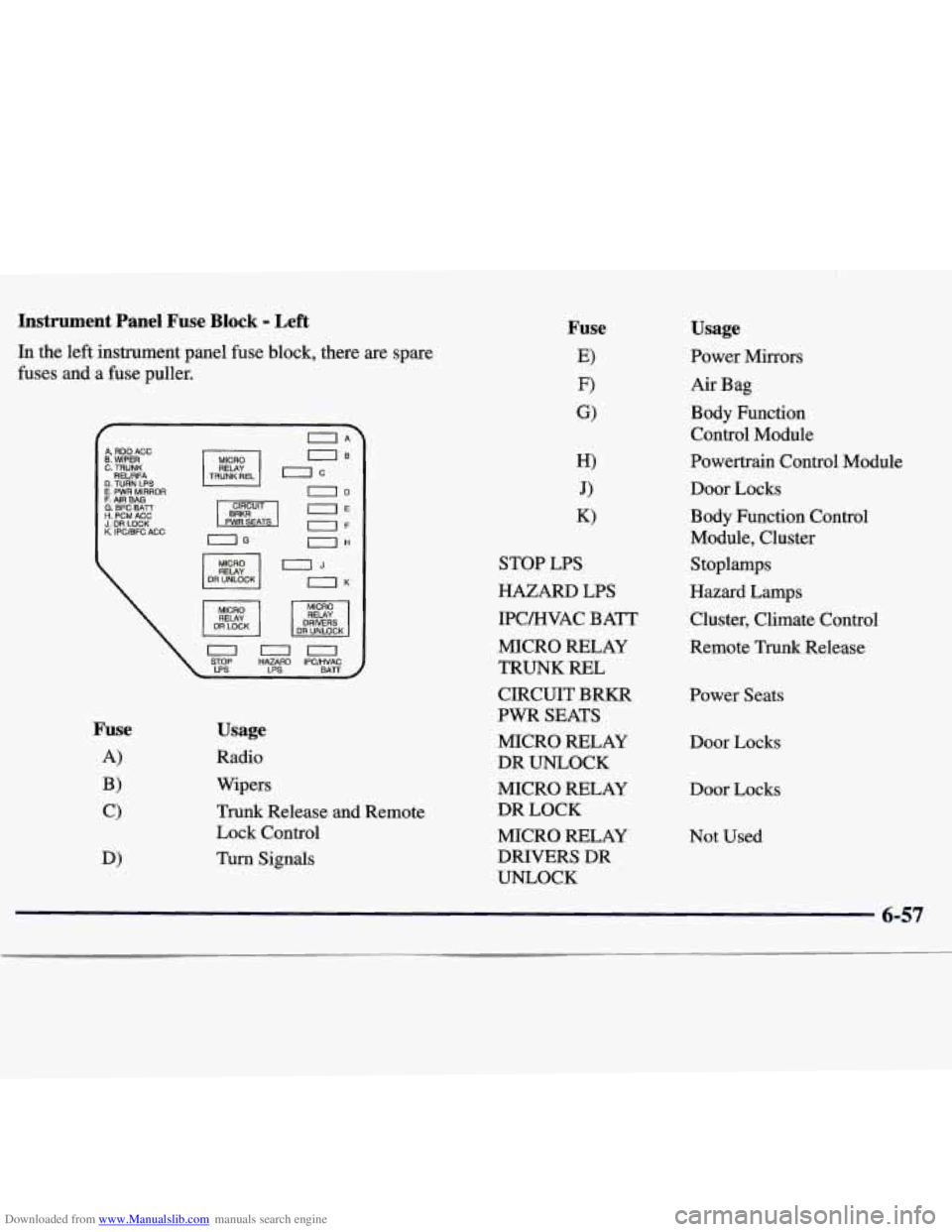
Downloaded from www.Manualslib.com manuals search engine Instrument Panel Fuse Block - Left
In the left instrument panel fuse block, there are spare
fuses and a fuse puller.
A RDO ACC B. WIPER C. TRUNK
D. TURN LPS REURFA
E. PWR MIRROR F. AIR BAG G. BFC BATT H. PCM ACC J. DR LOCK
K. IPC/BFC ACC
- . - - -. . . .
MICRO
TRUNK REL
MICRO
OR LOCK
Usage
Radio
Wipers Trunk Release and Remote
Lock Control
Turn Signals STOP
LPS
HAZARD LPS
IPCIHVAC BATT
MICRO RELAY
TRUNK REL
CIRCUIT BRKR
PWR SEATS
MICRO RELAY
DR UNLOCK
MICRO RELAY
DR LOCK
MICRO RELAY
DRIVERS DR
UNLOCK
Usage
Power Mirrors
Air Bag
Body Function
Control Module
Powertrain Control Module
Door Locks
Body Function Control
Module, Cluster
Stoplamps
Hazard Lamps
Cluster, Climate Control
Remote Trunk Release
Power Seats
Door Locks
Door Locks
Not Used
6-57
Page 284 of 362
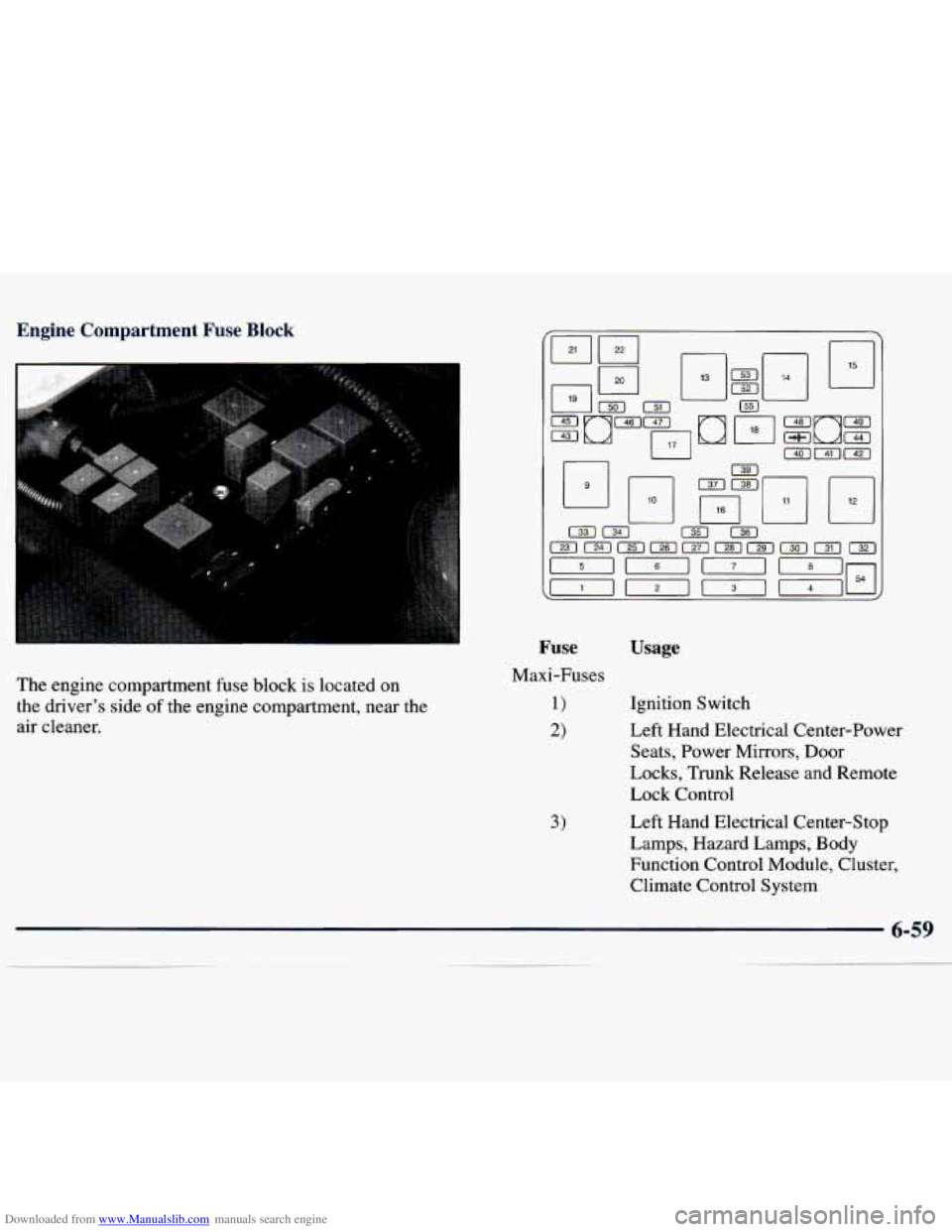
Downloaded from www.Manualslib.com manuals search engine Engine Comnartment Fuse Block
The engine compartment fuse block is located on
the driver’s side of the engine compartment, near the
air cleaner.
Fuse Usage
Maxi-Fuses
1)
2)
3)
Ignition Switch
Left Hand Electrical Center-Power Seats, Power Mirrors, Door
Locks, Trunk Release and Remote
Lock Control
Left Hand Electrical Center-Stop
Lamps, Hazard Lamps, Body
Function Control Module, Cluster,
Climate Control System
Page 353 of 362
Downloaded from www.Manualslib.com manuals search engine Power Accessory Outlet
............................. 2-44
DoorLocks
................................... 2-5
Option Fuses
................................ 6-55
Remote Control Mirror
........................ 2-40
Seat
......................................... 1-3
Steering
..................................... 4-9
Steering Fluid
................................ 6-24
Windows
................................... 2-27
Pregnancy. Use of Safety Belts
.................... 1 - 19
Problems on the Road
............................ 5-2
Publications. Service and Owner
................... 8-12
Radiator
..................................... 5 . 17
Radio Reception
................................ 3-21
Rain. Driving
In ................................ 4- 16
Door Security Locks
........................... 2-5
Outside Seat Position
.......................... 1-27
Safety Belt Comfort Guides
..................... 1-30
Seatpassengers
.............................. 1-27
Radios
........................................ 3-6
Rear
Towing
..................................... 5-11
Window Defogger
............................. 3-5
Rearview Mirror
................................ 2-39
Reclining Front Seatbacks
......................... 1-4
Recommended Fluids and Lubricants
............... 7-35
Recreational Vehicle Towing
...................... 4-28
Inside
Daymight
............................. 2-39 Refrigerants. Air Conditioning
.................... 6-62
Remote Cassette Tape Player
...................... 3-18
Remote Trunk Release
................................ 2-10
Trunk Release Lockout ........................ 2-10
Bulbs
...................................... 6-61
Parts ....................................... 6-63
Wheel ...................................... 6-43
Replacement
Replacing Safety Belts
........................... 1-52
Reporting Safety Defects
......................... 8-10
Restraints Checking
................................... 1-52
Child
....................................... 1-37
Head
........................................ 1-5
Replacing Parts After a Crash
................... 1-52
Systemcheck
................................ 7-30
Reverse. Automatic Transaxle
..................... 2-19
Right Front Passenger Position
.................... 1-20
Roadside Assistance
.............................. 8-5
Roadside Assistance. Canadian
..................... 8-7
Rocking Your Vehicle
........................... 5-34
Rotation. Tires
................................. 6-39
Safety Belt Extender
............................ 1-52
Safety Belt Reminder Light
................... 2.51. 1-7
Safety Belts
.................................... 1-6
Adults ...................................... 1-11
Care ....................................... 6-48