Page 150 of 362
Downloaded from www.Manualslib.com manuals search engine When using a scrubbing action, non-abrasive cleaning
cassette, it is normal for the cassette to eject because
your unit
is equipped with a cut tape detection feature
and a cleaning cassette may appear as a broken tape. To
prevent the cleaning cassette from being ejected, use the
following steps.
1. Turn the ignition to ON or ACC.
2. Turn the radio off.
3. Press and hold the TAPE AUX button for five
seconds. The tape symbol
on the display will flash
for two seconds.
4. Insert the scrubbing action cleaning cassette.
5. Eject the cleaning cassette after the manufacturer’s
When the cleaning cassette has been ejected, the cut tape
detection feature is active again. recommended cleaning time.
You may
also choose a non-scrubbing action, wet-type
cleaner which uses a cassette with a fabric belt to clean
the tape head. This type
of cleaning cassette will not
eject on its own. A non-scrubbing action cleaner may
not clean as thoroughly as the scrubbing type cleaner.
The
use of a non-scrubbing action, dry-type cleaning
cassette is not recommended.
After you clean the player, press and hold EJECT for
five seconds to reset the
CLN indicator. The radio will
display
-- to show the indicator was reset.
Cassettes are subject to wear and the sound quality
may degrade over time. Always make sure the cassette
tape is in good condition before
you have your tape
player serviced.
Page 174 of 362
Downloaded from www.Manualslib.com manuals search engine If you drive regularly in steep country, or if you’re
planning to visit there, here are some tips that can make
your trips safer and more enjoyable.
0 Keep your vehicle in good shape. Check all fluid
levels and also the brakes, tires, cooling system
and transaxle. These parts can work hard on
mountain roads.
0 Know how to go down hills. The most important
thing to know
is this: let your engine do some of the
slowing down. Shift to a lower gear when you
go
down a steep or long hill.
i If you don’t shift down, your brakes could
~ get so hot that they wouldn’t work well. You
would then have poor braking or even none going
down
a hill. You could crash. Shift down to let
your engine assist your brakes on
a steep
downhill slope. Coasting
dow
in NEUTRAL (N) or with the
ignition
off is dangerous. Your brakes will have to
do all the work of slowing down. They could get so
hot that they wouldn’t work well. You would then
have poor braking or even none going down
a hill.
You could crash. Always have your engine running
and your vehicle in gear when you go downhill.
0
0
0
a
Know how to go uphill. Drive in the highest
gear possible.
Stay in your own lane when driving on two-lane
roads in hills or mountains. Don’t swing wide or cut
across the center
of the road. Drive at speeds that let
you stay in your own lane.
As you go over the top of a hill, be alert. There could
be something in your lane, like a stalled car
or an
accident.
You may see highway signs on mountains that warn of
special problems. Examples are long grades, passing or
no-passing zones, a
falling rocks area or winding
roads. Be alert to these and take appropriate action.
Page 180 of 362
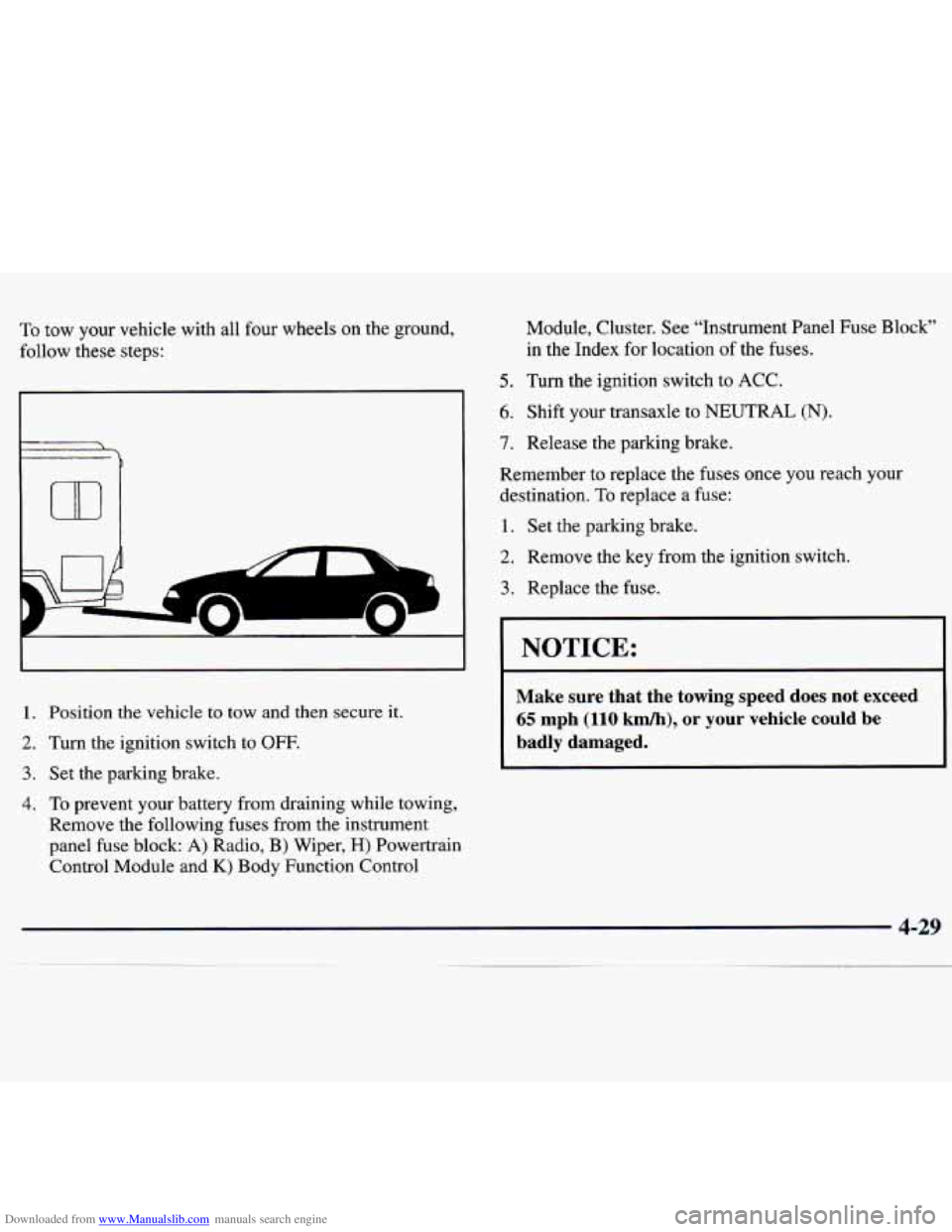
Downloaded from www.Manualslib.com manuals search engine To tow your vehicle with all four wheels on the ground,
follow these steps: Module,
Cluster. See “Instrument Panel Fuse Block”
in the Index for location of the fuses.
5. Turn the ignition switch to ACC.
6. Shift your transaxle to NEUTRAL (N).
7. Release the parking brake.
Remember to replace the fuses once you reach your
destination.
To replace a fuse:
1. Set the parking brake.
2. Remove the key from the ignition switch.
3. Replace the fuse.
I NOTICE:
1. Position the vehicle to tow and then secure it.
2. Turn the ignition switch to OFF.
3. Set the parking brake.
4. To prevent your battery from draining while towing,
Remove the following fuses from the instrument
panel fuse block: A) Radio,
B) Wiper, H) Powertrain
Control Module and
K) Body Function Control
Make sure that the towing speed does not exceed
65 mph (110 km/h), or your vehicle could be
badly damaged.
Page 195 of 362
Downloaded from www.Manualslib.com manuals search engine 2. Get the vehicles close enough so the jumper cables
can reach, but be sure the vehicles aren’t touching
each other.
If they are, it could cause a ground
connection you don’t want.
You wouldn’t be able to
start your vehicle, and the bad grounding could
damage the electrical systems.
You could be injured if the vehicles roll. Set the
parking brake firmly on each vehicle. Put the
transaxle in
PARK (P).
unnecessary accessories plugged into the cigarette
lighter or
the accessory power outlet. Turn off all
lamps that aren’t needed, as well as radios. This will
avoid
sparks and help save both batteries. In
addition, it could save your radio.
3. Turn off the ignition on both vehicles. Unplug
I NOTICE:
If you leave your radio on, it could be badly
damaged. The repairs wouldn’t be covered by
your warranty.
4. Open the hoods and locate the batteries.
I
I A CAUTION:
An electric fan can start up even when the engine
is not running and can injure you. Keep hands,
clothing and tools away from any underhood
electric fan.
5-4
Page 200 of 362
Downloaded from www.Manualslib.com manuals search engine To help avoid inpry to you or others:
0 Never let passengers ride in a vehicle that is
Never tow faster than safe or posted speeds.
Never tow with damaged parts not
fully secured.
0 Never get under your vehicle after it has
been lifted by the tow truck.
0 Always secure the vehicle on each side with
separate safety chains when towing it.
Never use J-hooks. Use T-hooks instead.
being towed.
A CA TION:
A vehicle can fall from a
car carrier if it isn’t
adequately secured. This can cause a collision,
serious personal injury and vehicle damage. The
vehicle should be tightly secured with chains or
steel cables before it is transported.
Don’t use substitutes (ropes, leather straps,
canvas webbing, etc.) that can be cut by sharp
edges underneath the towed vehicle. Always use
T-hooks inserted in the T-hook slots. Never use
J-hooks. They will damage drivetrain and
suspension components.
When your vehicle is being towed, turn the ignition key
to ACC. The steering wheel should be clamped in a
straight-ahead position, with
a clamping device
designed for towing service. The transaxle should be in
NEUTRAL (N) and the parking brake released.
Page 284 of 362
Downloaded from www.Manualslib.com manuals search engine Engine Comnartment Fuse Block
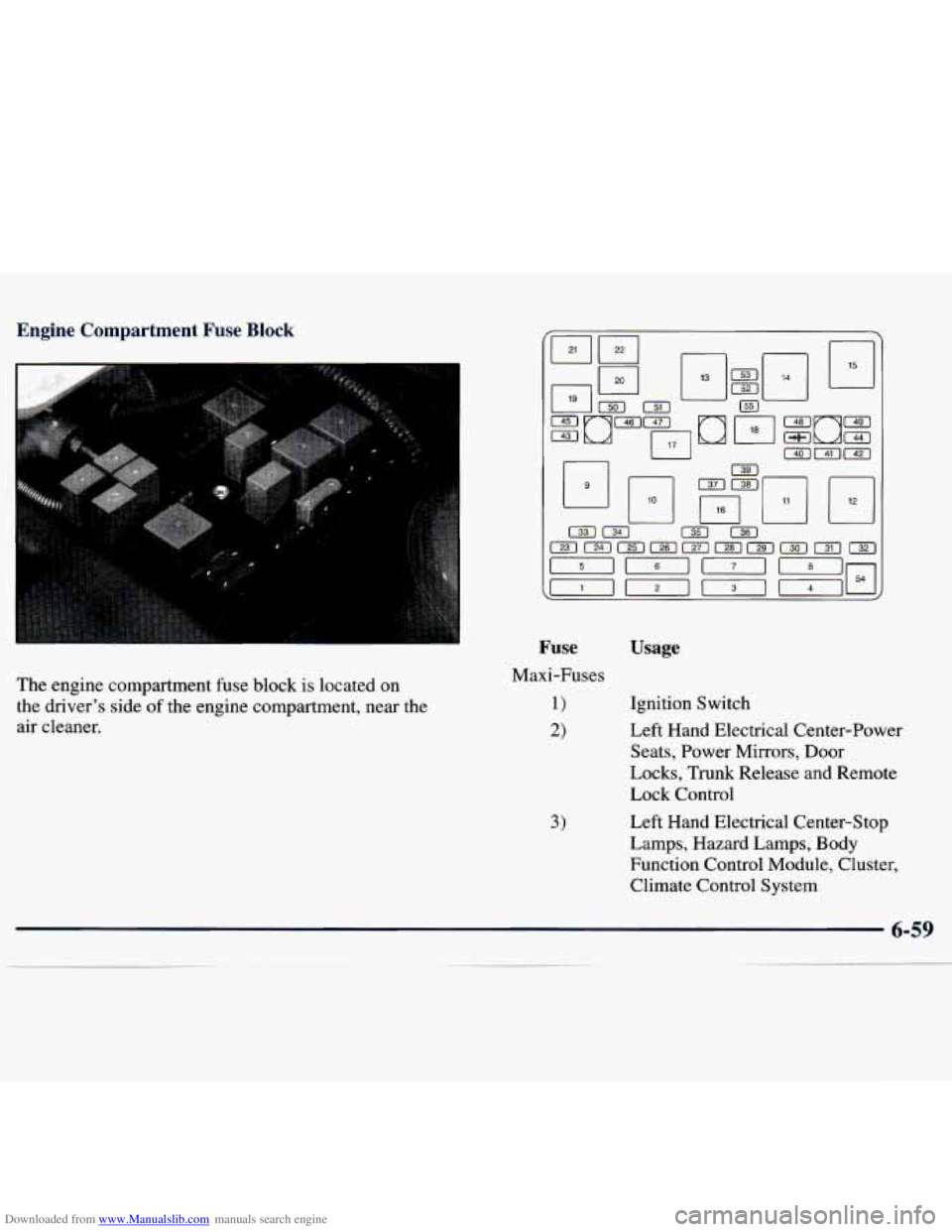
The engine compartment fuse block is located on
the driver’s side of the engine compartment, near the
air cleaner.
Fuse Usage
Maxi-Fuses
1)
2)
3)
Ignition Switch
Left Hand Electrical Center-Power Seats, Power Mirrors, Door
Locks, Trunk Release and Remote
Lock Control
Left Hand Electrical Center-Stop
Lamps, Hazard Lamps, Body
Function Control Module, Cluster,
Climate Control System
Page 285 of 362
Downloaded from www.Manualslib.com manuals search engine Fuse
4)
Usage
Right Hand Electrical Center-Fog
Lamps, Radio, Body Function Control
Module, Interior Lamps
Ignition Switch
Not Used
Anti-Lock Brakes
Cooling Fans
Mini-Relays
9) Rear Defog
10) Not Used
11) Anti-Lock Brakes
12) Cooling Fan
13) HVAC Blower (Climate Control)
14) Cooling Fans
15) Cooling Fans
16) Air Conditioning Compressor
17) Not Used
1% Fuel Pump
19) Automatic Light Control
Micro-Relays
Fuse
20)
21)
22)
Mini-Fuses
23
- 32)
33)
34)
35)
36)
37)
43)
44)
Usage
Automatic Light Control
Horn
Daytime Running
Lamps
Spare Fuse Holder
Rear Defog
Accessory Power Outlets, Cigar
Lighter
Anti-Lock Brakes
Anti-Lock Brakes
Air Conditioning Compressor, Body
Function Control Module
Automatic Transaxle
Powertrain Control Module, Ignition Anti-Lock Brakes
Ignition System Back-up Lamps, Brake Transaxle
Shift Interlock
Horn
Powertrain Control Module
Page 323 of 362
Downloaded from www.Manualslib.com manuals search engine Ignition Transaxle Lock Check
While parked, and with the parking brake set,
try to tum
the ignition key to OFF in each shift lever position. The
key should
turn to OFF only when the shift lever is in
PARK (P).
On all vehicles, the key should come out only in OFF.
Parking Brake and Automatic Transaxle PARK (P)
T - lanism Check
II
When you are doing this check, your vehicle
could begin to move. You
or others could be
injured and property could be damaged. Make
sure there
is room in front of your vehicle in case
it begins to roll. Be ready to apply the regular
brake
at once should the vehicle begin to move. Park
on a fairly steep
hill, with the vehicle facing
downhill. Keeping your foot on the regular brake, set the
parking brake.
To check the parking brake’s holding ability: With
the engine running and transaxle in
NEUTRAL (N),
slowly remove foot pressure from the regular brake
pedal.
Do this until the vehicle is held by the parking
brake only.
0 To check the PARK (P) mechanism’s holding ability:
With the engine running, shift to PARK
(P). Then
release
all brakes.
Underbody Flushing Service
At least
every spring, use plain water to flush any
corrosive materials from the underbody. Take care to
clean thoroughly any areas where mud and other debris
can collect.
7-32