1998 CHEVROLET MALIBU lights
[x] Cancel search: lightsPage 113 of 362
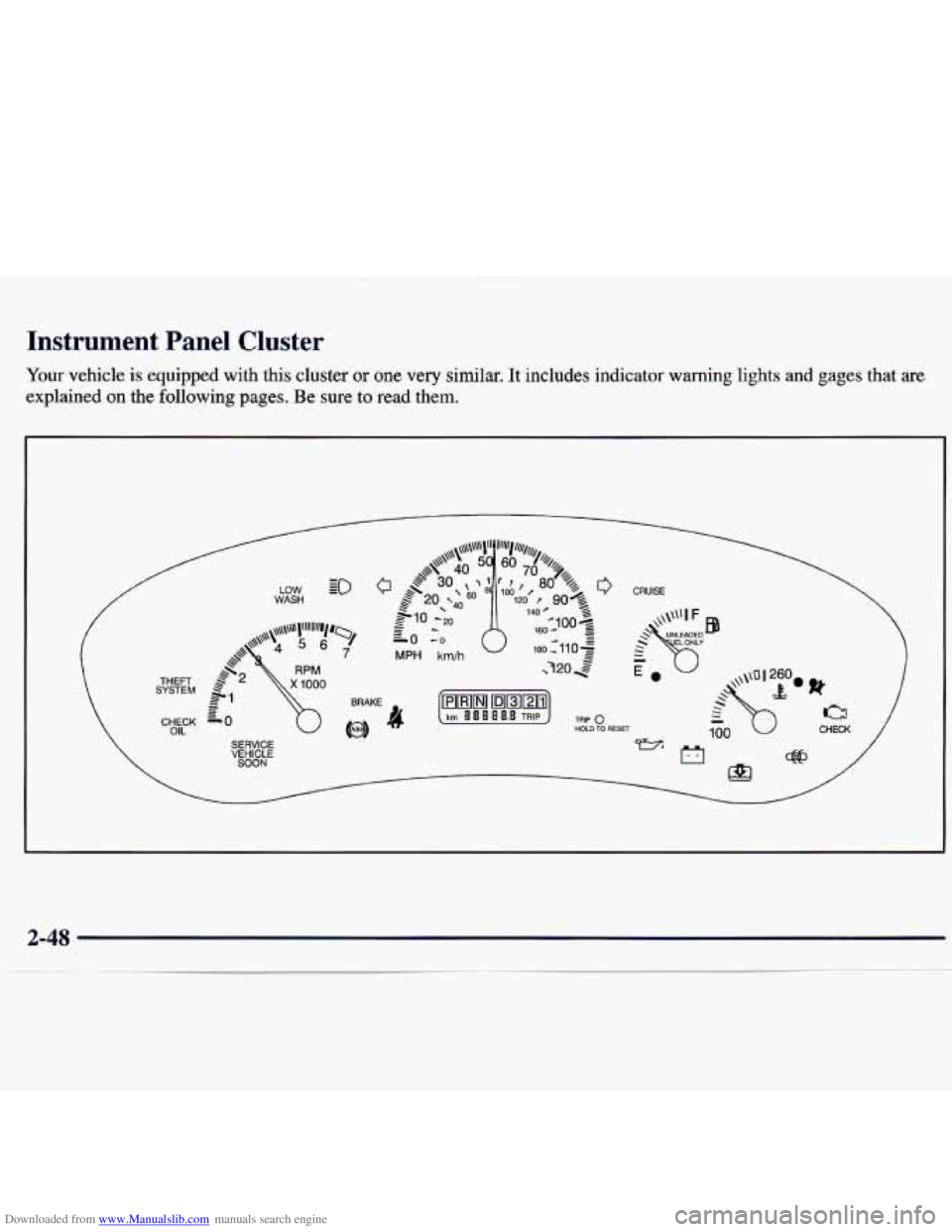
Downloaded from www.Manualslib.com manuals search engine Instrument Panel Cluster
Your vehicle is equipped with this cluster or one very similar. It includes indicator warning lights and gages that are
explained on the following pages. Be sure to read them.
WASH LOW
SYSTEM THEFT
CHECK
OIL
I- +I
IWU - Bu
2-48
--- - ._
Page 115 of 362
Downloaded from www.Manualslib.com manuals search engine Tachon- T I I_-
I
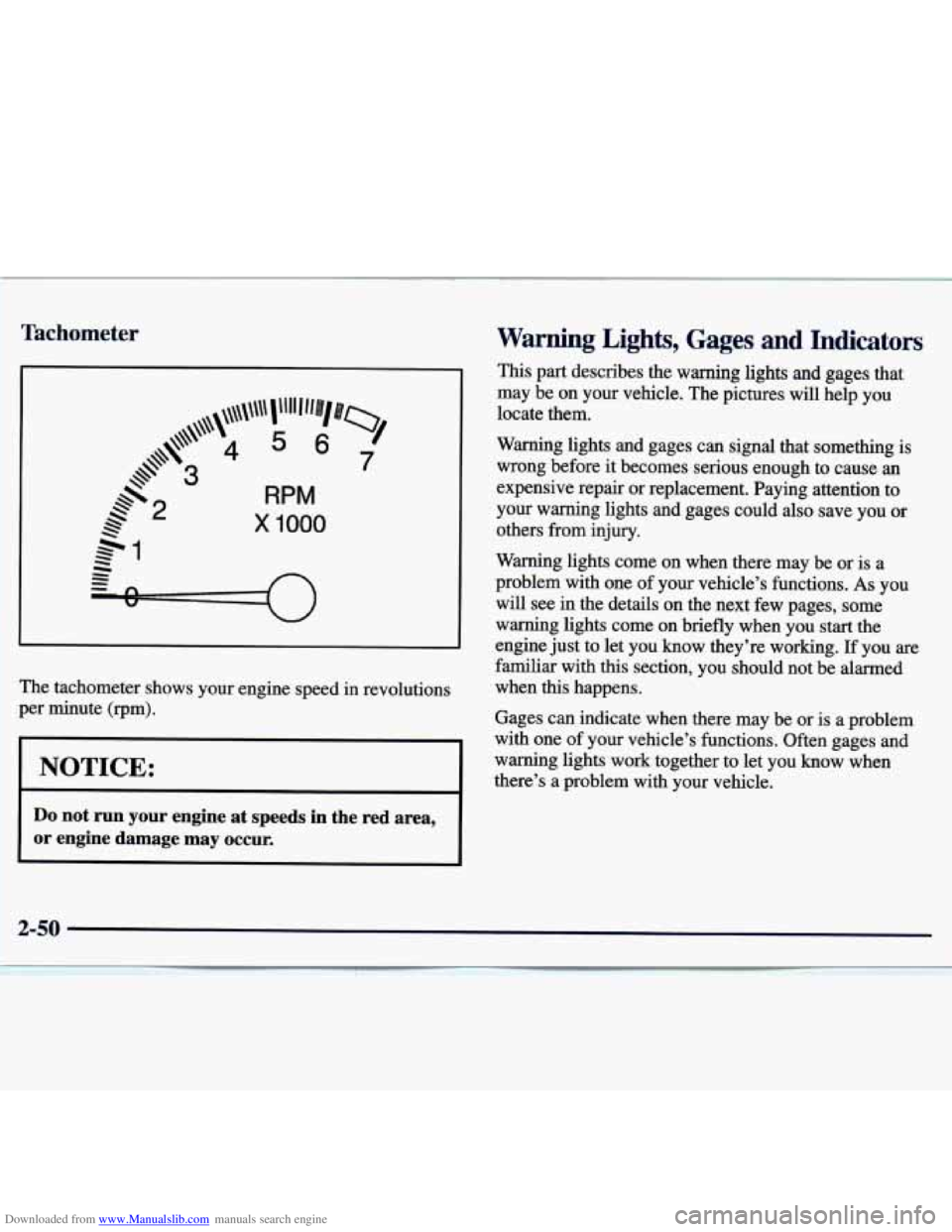
The tachometer shows your engine speed in revolutions
per minute
(rpm).
NOTICE:
Do not run your engine at speeds in the red area,
or engine damage may occur.
Warning Lights, Gages and Indicators
This part describes the warning lights and gages that
may be on your vehicle. The pictures will help you
locate them.
Warning lights and gages can signal that something is
wrong before it becomes serious enough to cause an
expensive repair or replacement. Paying attention to
your warning lights and gages could also save you or
others from injury.
Warning lights come on when there may be or is a
problem with one of your vehicle’s functions. As you
will see in the details on the next few pages, some
warning lights come on briefly when you
start the
engine just to let you know they’re working.
If you are
familiar with
this section, you should not be alarmed
when
this happens.
Gages can indicate when there may be or is a problem
with one
of your vehicle’s functions. Often gages and
warning lights work together to let you know when
there’s a problem with your vehicle.
Page 116 of 362
Downloaded from www.Manualslib.com manuals search engine When one of the warning lights comes on and stays on
when you are driving, or when one of the gages shows
there may be a problem, check
the section that tells you
what to do about it. Please follow this manual’s advice.
Waiting to do repairs can be costly
-- and even
dangerous.
So please get to know your warning lights
and gages. They’re a big help.
Safety Belt Reminder Light
When the key is turned to ON or START, a chime will
come
on for about eight seconds to remind people to
fasten their safety belts, unless the driver’s safety belt is
already buckled.
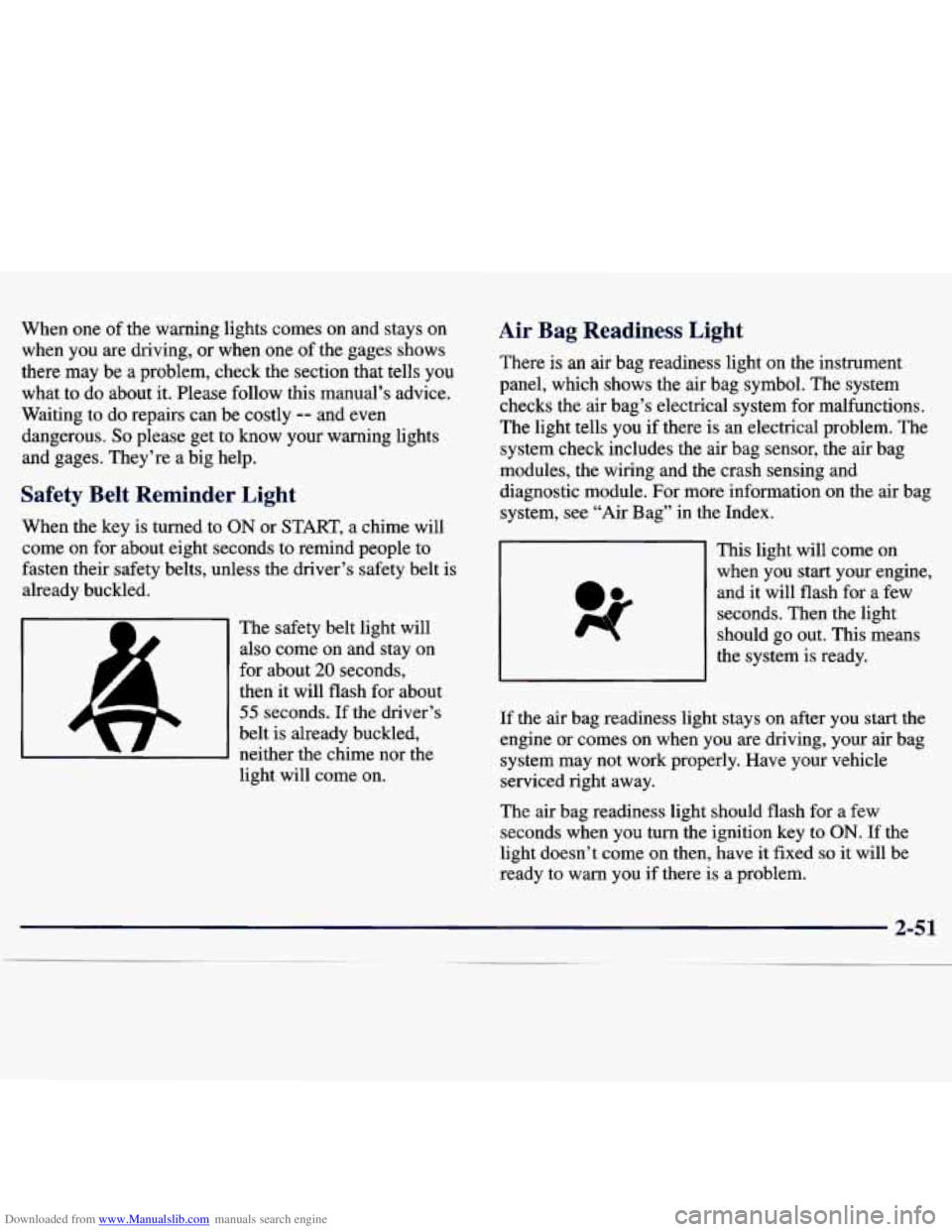
The safety belt light will
also come on and stay on
for about
20 seconds,
then it will flash for about
55 seconds. If the driver’s
belt is already buckled,
neither the chime nor the
light will come on.
Air Bag Readiness Light
There is an air bag readiness light on the instrument
panel, which shows the air bag symbol. The system
checks the air bag’s electrical system for malfunctions.
The light tells you
if there is an electrical problem. The
system check includes the air bag sensor, the air bag
modules, the wiring and the crash sensing and
diagnostic module. For more information on the air bag
system, see “Air Bag’’ in the Index.
This light will come on
when you start your engine,
and it will flash for a few
seconds. Then the light
should
go out. This means
the system is ready.
If the air bag readiness light stays on after you start the
engine or comes on when you are driving, your air bag
system may not work properly. Have your vehicle
serviced right away.
The air bag readiness light should flash for a few
seconds when you turn the ignition key to
ON. If the
light doesn’t come on then, have it fixed
so it will be
ready to warn you if there is a problem.
Page 166 of 362
Downloaded from www.Manualslib.com manuals search engine Here are some tips on night driving.
0
0
0
0
0
0
0
Drive defensively.
Don’t drink and drive.
Adjust your inside rearview mirror to reduce the
glare from headlamps behind you.
Since you can’t see as well, you may need to
slow down and keep more space between you and
other vehicles.
Slow down, especially on higher speed roads. Your
headlamps can light up only
so much road ahead.
In remote areas, watch for animals.
If you’re tired, pull off the road in a safe place
and rest.
Night Vision
No one can see as well at night as in the daytime. But as
we get older these differences increase. A 50-year-old
driver may require at least twice as much light to see the
same thing at night as a 20-year-old.
What you do in the daytime can also affect your night
vision. For example, if you spend the day in bright
sunshine
you are wise to wear sunglasses. Your eyes will
have less trouble adjusting to night. But if you’re
driving, don’t wear sunglasses at night. They may cut down on glare
from headlamps, but they also make a lot
of things invisible.
You can be temporarily blinded by approaching
headlamps. It can take a second or two, or even several
seconds, for your eyes to readjust to the dark. When you
are faced with severe glare (as from a driver who
doesn’t lower the high beams, or a vehicle with
misaimed headlamps), slow down a little. Avoid staring
directly into the approaching headlamps.
Keep your windshield and all the glass on your vehicle
clean
-- inside and out. Glare at night is made much
worse by dirt on the glass. Even the inside
of the glass
can build up a film caused by dust. Dirty glass makes
lights dazzle and flash more than clean glass would,
making the pupils
of your eyes contract repeatedly.
Remember that your headlamps light up far less
of a
roadway when you are in a turn or curve. Keep your
eyes moving; that way, it’s easier
to pick out dimly
lighted objects. Just as your headlamps should be
checked regularly for proper aim,
so should your eyes
be examined regularly. Some drivers suffer from night
blindness
-- the inability to see in dim light -- and aren’t
even aware of it.
4-15
--
Page 245 of 362
Downloaded from www.Manualslib.com manuals search engine NOTICE:
-
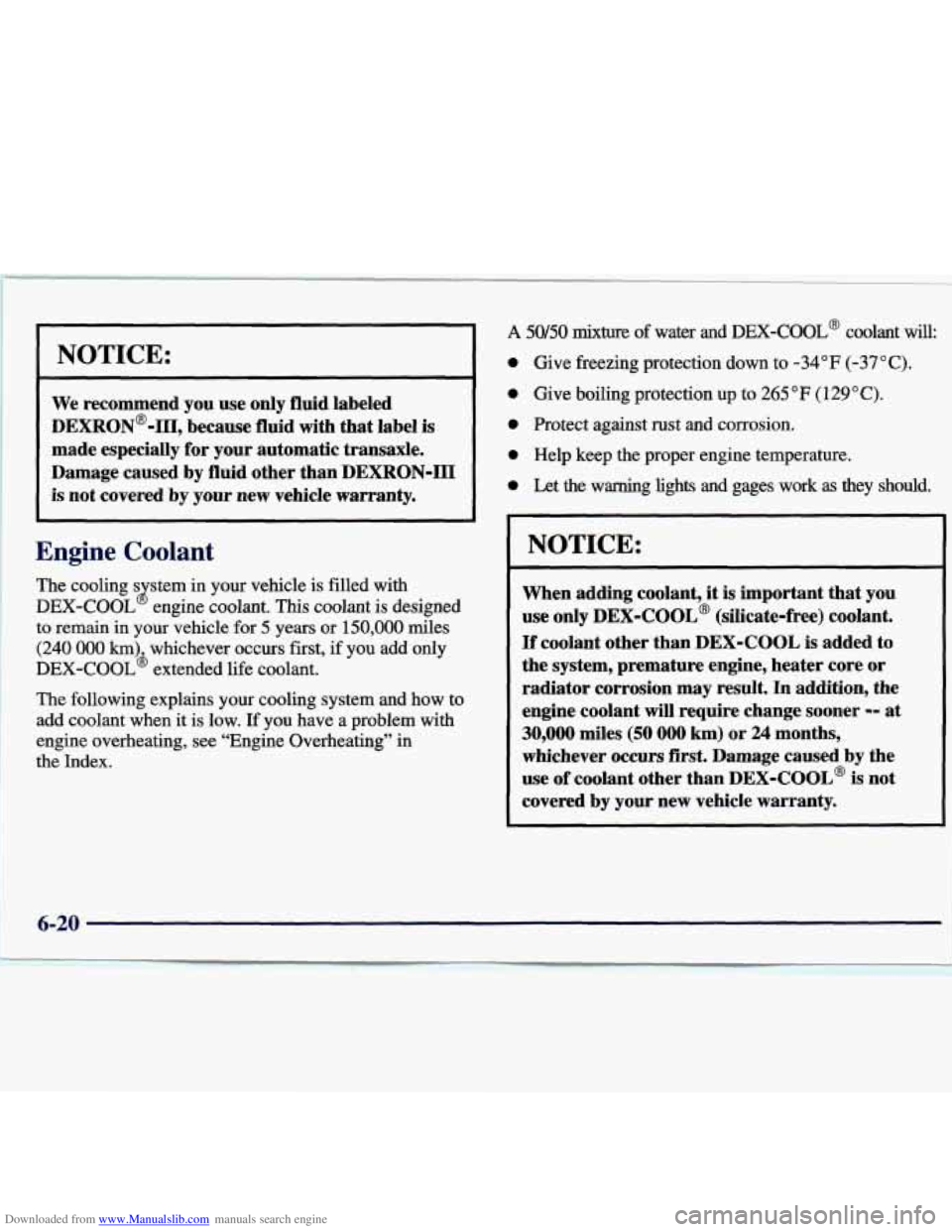
We recommend you use only fluid labeled
DEXRON@-III, because
fluid with that label is
made especially for your automatic transaxle.
Damage caused by fluid other than DEXRON-III
is not covered by your new vehicle warranty.
Engine Coolant
The cooling s stem in your vehicle is filled with
DEX-COOL engine coolant.
This coolant is designed
to remain in your vehicle for 5 years or 150,000 miles
(240 000 km) whichever occurs first, if you add only
DEX-COOL’ extended life coolant.
The following explains your cooling system and how to
add coolant when it is low.
If you have a problem with
engine overheating, see “Engine Overheating” in
the Index.
8
A 50/50 mixture of water and DEX-COOL@ coolant wilk
0 Give freezing protection down to -34°F (-37’C).
0 Give boiling protection up to 265 OF ( 129 O C).
0 Protect against rust and corrosion.
0 Help keep the proper engine temperature.
0 Let the warning lights and gages work as they should.
~~
NOTICE:
When adding coolant, it is important that you
use only DEX-COOL@ (silicate-free) coolant.
If coolant other than DEX-COOL is added. to
the system, premature engine, heater core or
radiator corrosion may result.
In addition, the
engine coolant will require change sooner
-- at
30,000 miles (50 000 km) or 24 months,
whichever
occurs first. Damage caused by the
use of coolant other than DEX-COOL@ is not
covered by
your new vehicle warranty.
6-20 I
Page 283 of 362
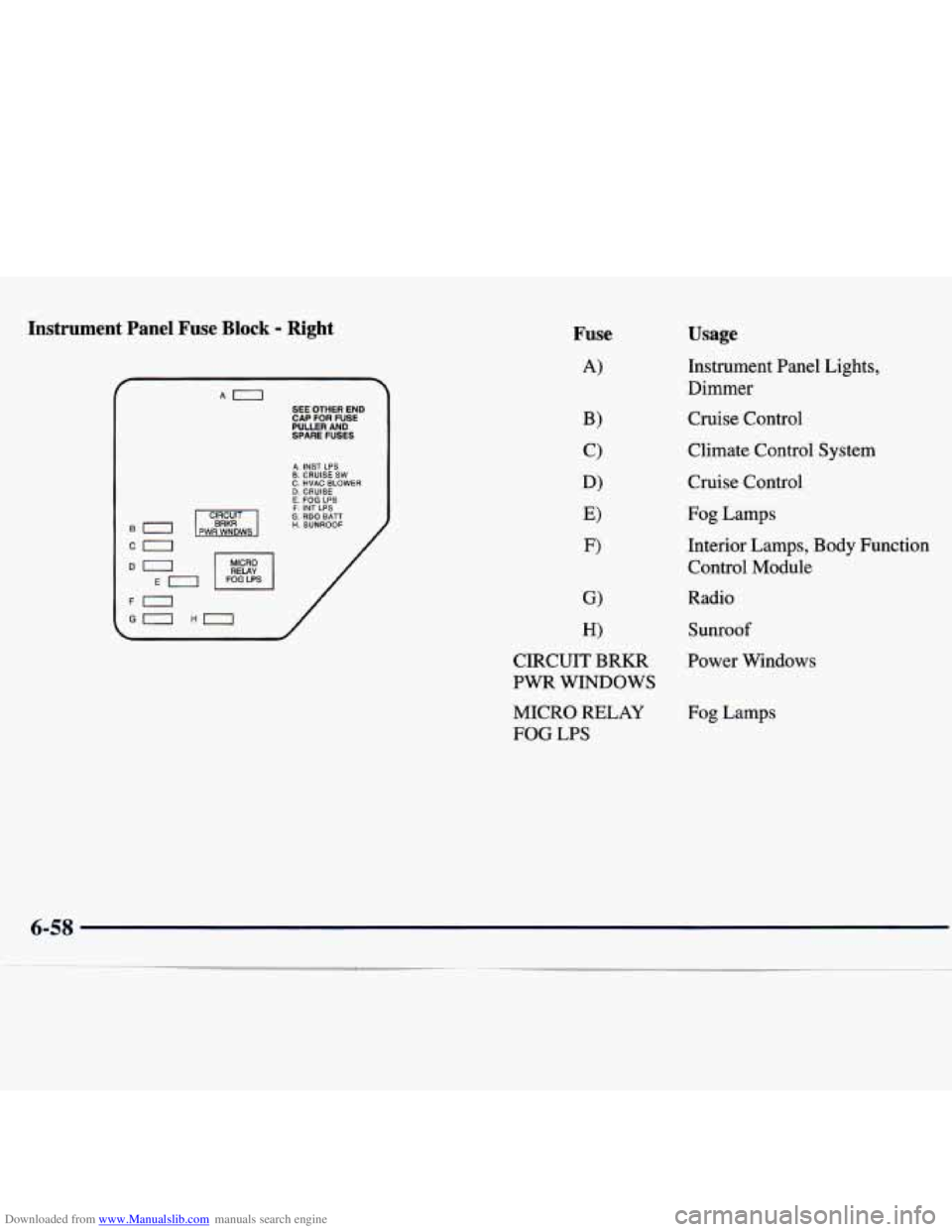
Downloaded from www.Manualslib.com manuals search engine Instrument Panel Fuse Block - Right
SEE OTHER END
CAP FOR FUSE PUUER AND
SPARE FUSES
A. INST LPS B. CRUISE SW C. HVAC BLOWER D. CRUISE E. FOG LPS F. INT LPS G. RDO BATT H. SUNROOF
/
/
Fuse
A)
Usage
Instrument Panel Lights,
Dimmer
Cruise Control
Climate Control
System
Cruise Control
Fog Lamps
Interior Lamps, Body Function Control Module
Radio
Sunroof
CIRCUIT BRKR Power Windows
PWR WINDOWS
MICRO RELAY
FOG
LPS
Fog Lamps
6-58
Page 357 of 362
Downloaded from www.Manualslib.com manuals search engine warning Devices ............................... 5-2
Warning Lights. Gages and Indicators 2-50
Washer Fluid. Windshield ........................ 6-25
Washing Your Vehicle ........................... 6-49
Weatherstrips .................................. 6-49
Wheel
Alignment
.................................. 6-43
Nut Torque ............................. 5.29. 6.62
Replacement ................................. 6-43
Used Replacement ............................ 6-44
Wrench ..................................... 5-23
Windows ..................................... 2-27
Auto-Down ................................. 2-28
Lock Out Switch ............................. 2-28
Power ...................................... 2-27
I
...............
Windshield Washer ............................. 2-32
Fluid .................................. 2.32. 6.25
Fluid Level Check ............................ 7-29
Windshield Wipers .............................. 6-55
Winter Driving ................................. 4-24
Wiper Blade Check ............................. 7-30
Wiper Blade. Cleaning ........................... 6-48
Wiring. Headlamp
.............................. 6-55
WreckerTowing ................................. 5-8
Wrench. Wheel ................................. 5-23
Windshield Wiper .............................. 2-30
Blade Replacement ........................... 6-37