1998 CHEVROLET MALIBU wiring
[x] Cancel search: wiringPage 75 of 362
Downloaded from www.Manualslib.com manuals search engine I’runk Remote Trunk Release
To unlock the trunk from the outside, insert the key and
turn the trunk lock cylinder.
It can be dangerous to drive with the trunk lid
open because carbon monoxide
(CO) gas can
come into your vehicle. You can’t see or smell
CO. It can cause unconsciousness and even death.
If you must drive with the trunk lid open or if
electrical wiring or other cable connections must
pass through the seal between the body and the
trunk lid:
Make sure all windows are shut.
%hrn the fan on your heating or cooling
system to
its highest speed with the setting on
VENT. That will force outside air into your
vehicle.
See ‘6Comfort Controls” in the Index.
instrument panel, open them all the way.
If you have air outlets on or under the
See “Engine Exhaust” in the Index. Press the remote trunk
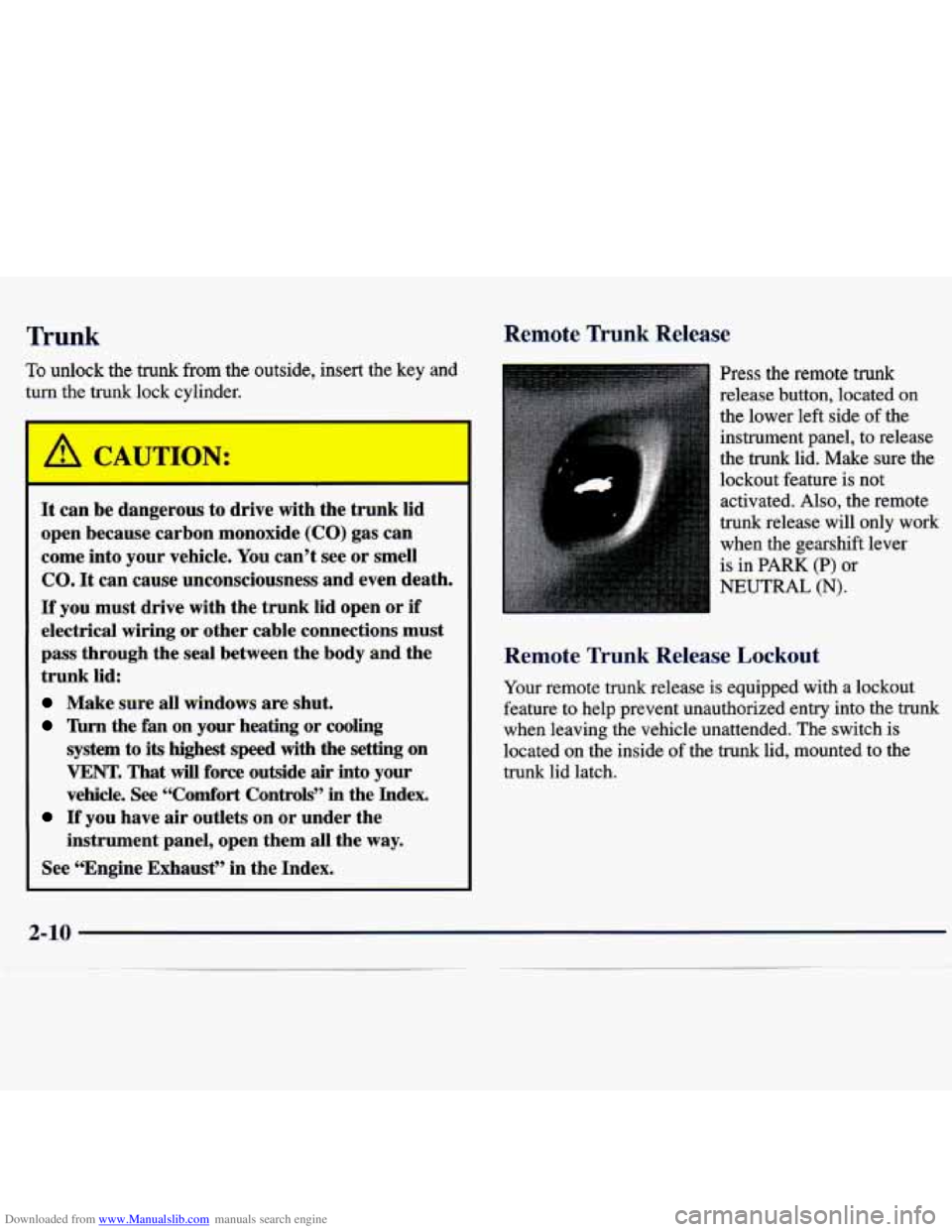
release button, located on
the lower left side of the
instrument panel, to release
the trunk lid. Make sure the
lockout feature is not
activated. Also, the remote
trunk release will only work
when the gearshift lever
is in PARK (P)
or
NEUTRAL (N).
Remote Trunk Release Lockout
Your remote trunk release is equipped with a lockout
feature to help prevent unauthorized entry into the trunk when leaving the vehicle unattended. The switch is
located on the inside of the trunk lid, mounted to the
trunk lid latch.
2-10
Page 116 of 362
Downloaded from www.Manualslib.com manuals search engine When one of the warning lights comes on and stays on
when you are driving, or when one of the gages shows
there may be a problem, check
the section that tells you
what to do about it. Please follow this manual’s advice.
Waiting to do repairs can be costly
-- and even
dangerous.
So please get to know your warning lights
and gages. They’re a big help.
Safety Belt Reminder Light
When the key is turned to ON or START, a chime will
come
on for about eight seconds to remind people to
fasten their safety belts, unless the driver’s safety belt is
already buckled.
The safety belt light will
also come on and stay on
for about
20 seconds,
then it will flash for about
55 seconds. If the driver’s
belt is already buckled,
neither the chime nor the
light will come on.
Air Bag Readiness Light
There is an air bag readiness light on the instrument
panel, which shows the air bag symbol. The system
checks the air bag’s electrical system for malfunctions.
The light tells you
if there is an electrical problem. The
system check includes the air bag sensor, the air bag
modules, the wiring and the crash sensing and
diagnostic module. For more information on the air bag
system, see “Air Bag’’ in the Index.
This light will come on
when you start your engine,
and it will flash for a few
seconds. Then the light
should
go out. This means
the system is ready.
If the air bag readiness light stays on after you start the
engine or comes on when you are driving, your air bag
system may not work properly. Have your vehicle
serviced right away.
The air bag readiness light should flash for a few
seconds when you turn the ignition key to
ON. If the
light doesn’t come on then, have it fixed
so it will be
ready to warn you if there is a problem.
Page 189 of 362
Downloaded from www.Manualslib.com manuals search engine Turn Signals When Towing a Trailer
When you tow a trailer, your vehicle may need
additional wiring. Check with your dealer. The green
arrows on
your instrument panel will flash whenever
you signal a turn or lane change. Properly hooked up,
the trailer lamps will also flash, telling other drivers
you’re about to turn, change lanes
or stop.
When towing a trailer, the green arrows on your
instrument panel will flash for turns even
if the bulbs on
the trailer are burned out. Thus, you may think drivers
behind you are seeing your signal when they are not. It’s
important to check occasionally to be sure the trailer
bulbs are still working.
Driving On Grades
NOTICE:
Do not tow on steep continuous grades exceeding
6 miles (9.6 km). Extended, higher than normal
engine and transaxle temperatures may result and damage your vehicle. Frequent stops are
very important
to allow the engine and transaxle
to
cool.
Reduce speed and shift to a lower gear before you start
down a long
or steep downgrade. If you don’t shift
down, you might have to
use your brakes so much that
they would get hot and no longer work well.
On a long uphill grade, shift down and reduce your
speed to around
45 mph (70 km/h) to reduce the
possibility
of engine and transaxle overheating.
Pay attention to the engine coolant gage.
If the indicator
is in the red area, turn
off the air conditioning to reduce
engine load (see “Engine Overheating” in the Index).
Page 257 of 362
Downloaded from www.Manualslib.com manuals search engine Headlamp and Front nrn Signal Lamp
Bulb Replacement
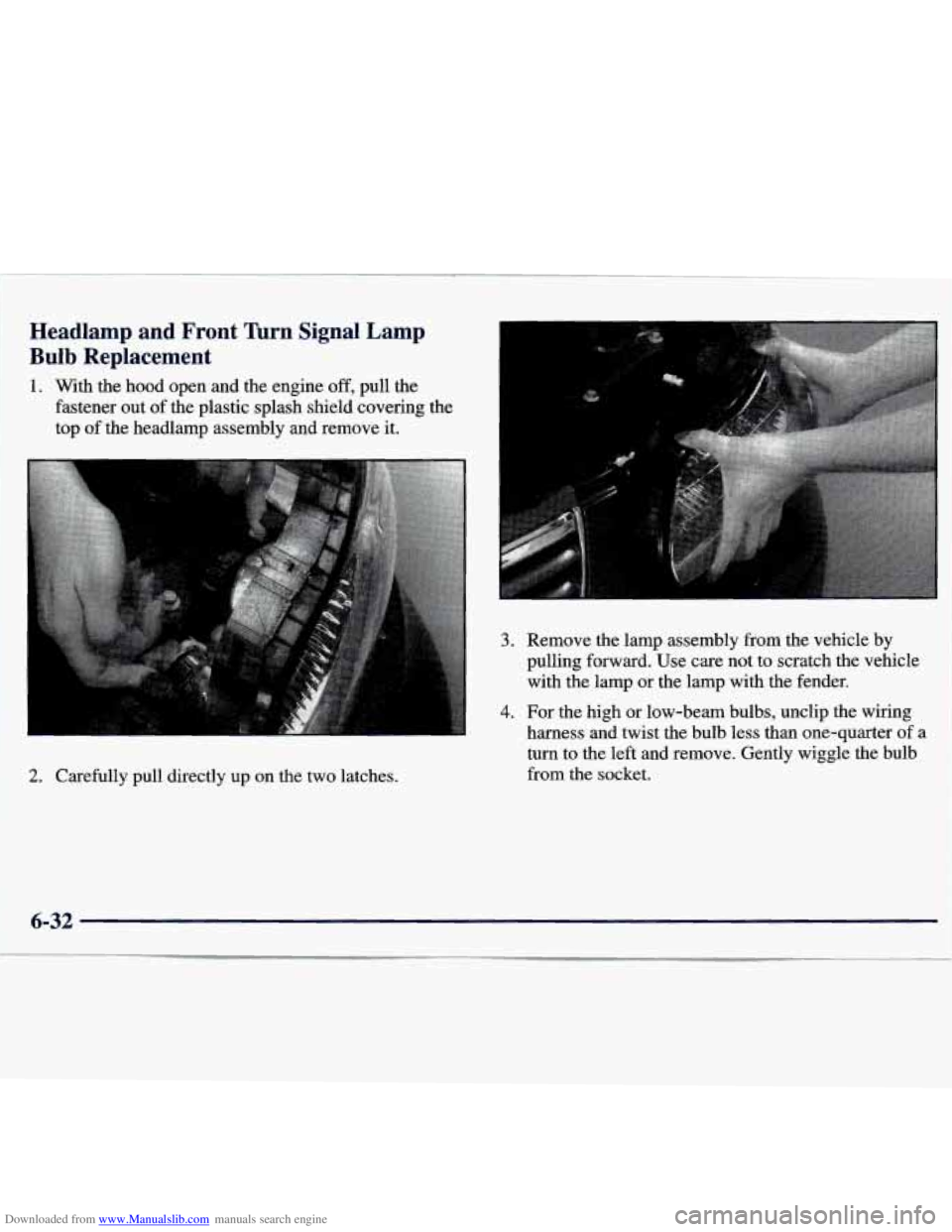
1. With the hood open and the engine off, pull the
fastener out of the plastic splash shield covering the
top of the headlamp assembly and remove it.
2. Carefully pull directly up on the two latches.
3. Remove the lamp assembly from the vehicle by
pulling forward. Use care not to scratch the vehicle
with the lamp or the lamp with the fender.
4. For the high or low-beam bulbs, unclip the wiring
harness
and twist the bulb less than one-quarter of a
turn to the left and remove. Gently wiggle the bulb
from the socket.
6-32
Page 258 of 362
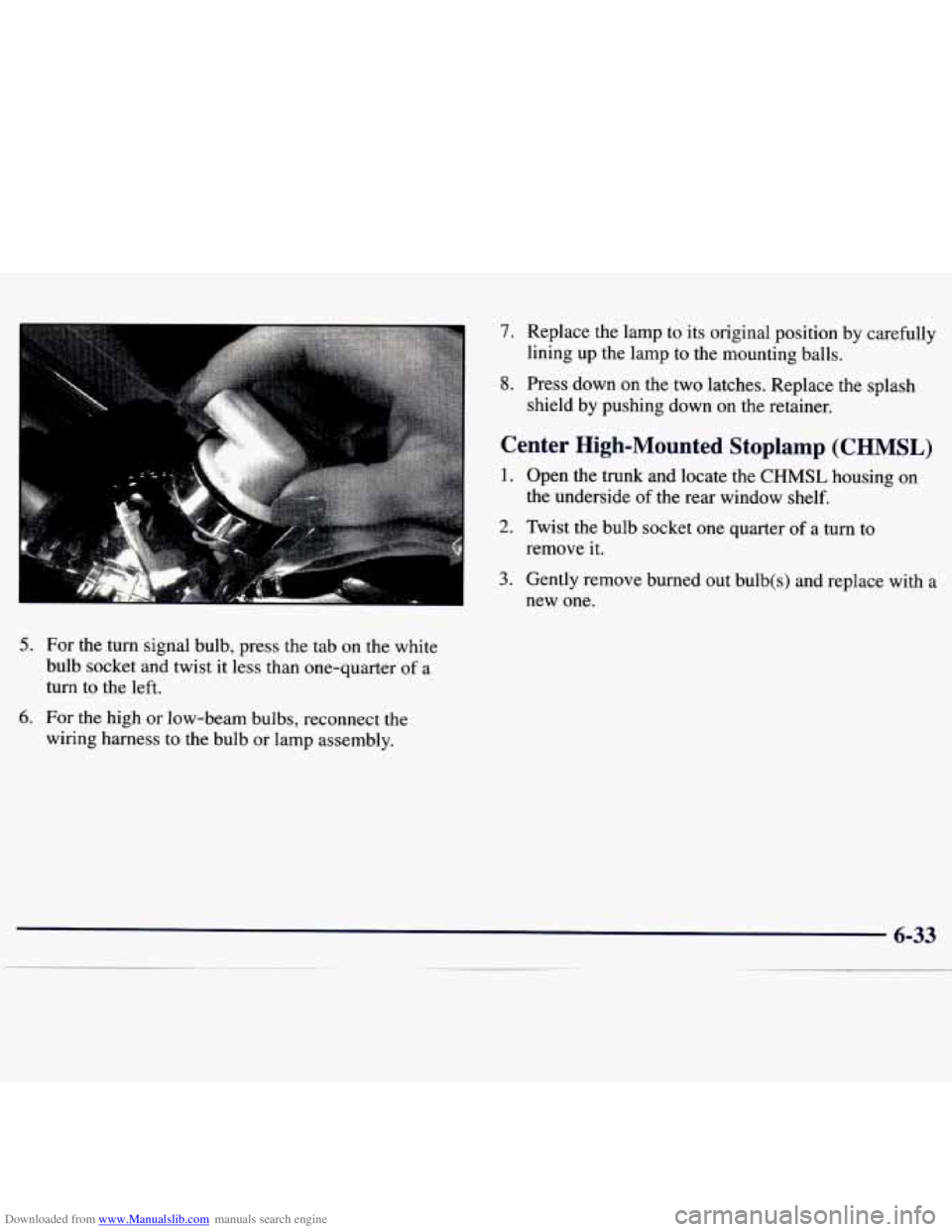
Downloaded from www.Manualslib.com manuals search engine 5. For the turn signal bulb, press the tab on the white
bulb socket and twist it less than one-quarter
of a
turn to the left.
6. For the high or low-beam bulbs, reconnect the
wiring harness to the bulb or lamp assembly.
7. Replace the lamp to its original position by carefully
lining up the lamp to the mounting balls.
8. Press down on the two latches. Replace the splash
shield by pushing down on the retainer.
Center High-Mounted Stoplamp (CHMSL)
1. Open the trunk and locate the CHMSL housing on
the underside of the rear window shelf.
2. Twist the bulb socket one quarter of a turn to
remove it.
3. Gently remove burned out bulb(s) and replace with a
new one.
Page 280 of 362
Downloaded from www.Manualslib.com manuals search engine Electrical System
Add-on Electrical Equipment
I NOTICE:
Don’t add anything electrical to your vehicle
unless you check with your dealer first. Some
electrical equipment can damage your vehicle
and the damage wouldn’t be covered by your warranty. Some add-on electrical equipment
can keep other components from working as
they should.
Your vehicle has an air bag system. Before attempting to
add anything electrical to your vehicle, see “Servicing
Your Air Bag-Equipped Vehicle” in
the Index.
Headlamp Wiring
The headlamp wiring is protected by fuses, one for each
headlamp, in the fuse block. An electrical overload will
cause the lamps to turn
off. If this happens, have your
headlamp wiring checked right away.
Windshield Wipers
The windshield wiper motor is protected by an internal
circuit breaker and a fuse. If the motor overheats due to
heavy snow, etc., the wiper will stop until the motor
cools.
If the overload is caused by some electrical
problem and not snow, etc., be sure
to get it fixed.
Power Windows and Other Power Options
Circuit breakers in the fuse block protect the power
windows and other power accessories. When the current
load is too heavy, the circuit breaker opens and closes,
protecting the circuit until
the problem is fixed or
goes away.
Page 281 of 362
Downloaded from www.Manualslib.com manuals search engine Fuses and Circuit Breakers
The wiring circuits in your vehicle are protected from
short circuits by a combination of fuses, circuit breakers
and fusible thermal links in the wiring itself.
Look at
the silver-colored band inside the fuse. If the
band is broken or melted, replace the fuse. Be sure you
replace a bad fuse with a new one of the identical size
and rating.
If you ever have a problem on the road and don’t have a
spare fuse, you can borrow one that has the same
amperage. Just pick a feature of your vehicle that you
can get along without
-- like the radio or cigarette
lighter
-- and use its fuse, if it is the correct amperage.
Replace it as soon as you can. Also, there are spare fuses
in the left side instrument panel door.
There are three fuse blocks in your vehicle: two
instrument panel fuse blocks and the engine
compartment fuse block.
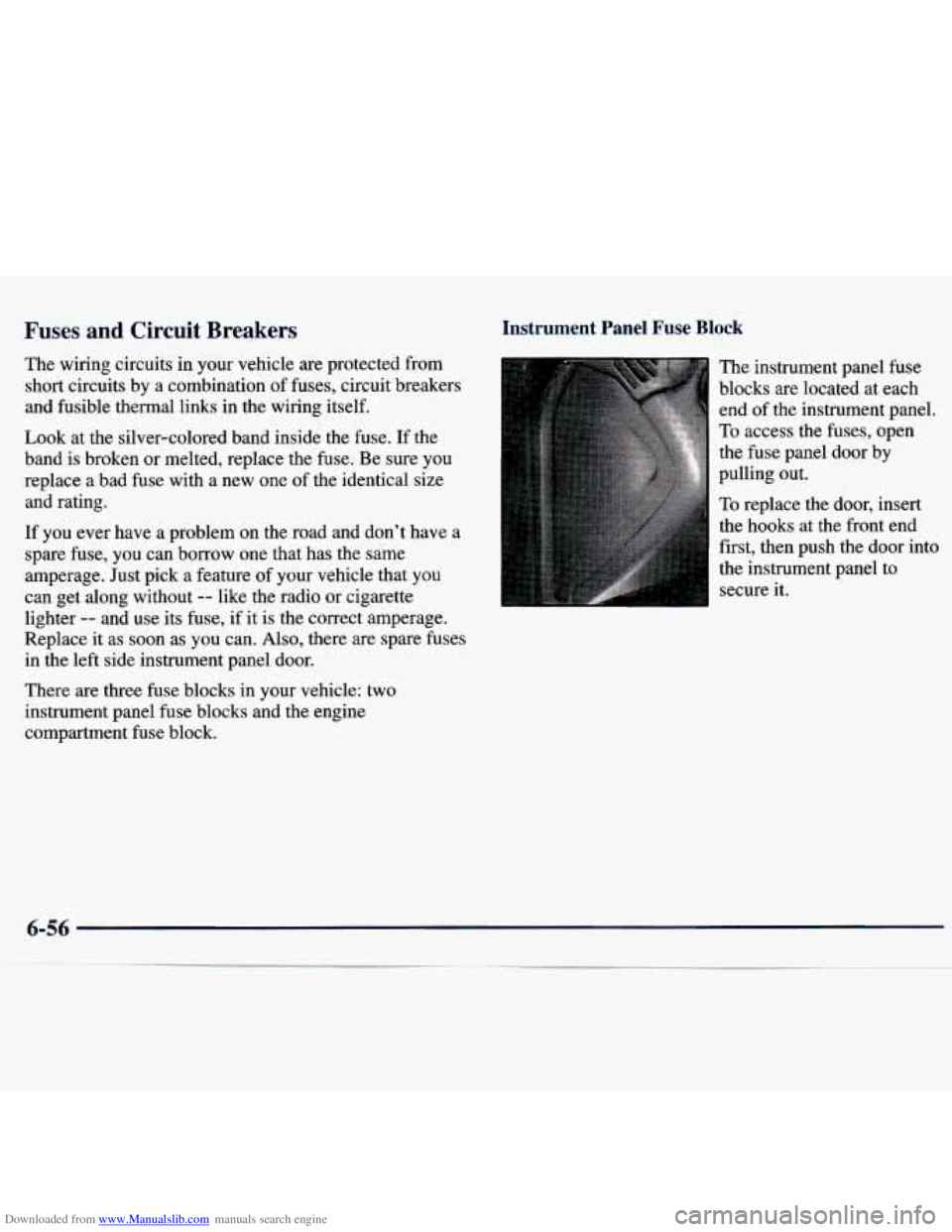
Instrument Panel Fuse Block
The instrument panel fuse
blocks are located at each end of the instrument panel.
To access the fuses, open
the fuse panel door by
pulling out.
To replace the door, insert
the hooks at the front end
first, then push the door into
the instrument panel to
secure it.
6-56
Page 350 of 362
Downloaded from www.Manualslib.com manuals search engine Fuel .......................................... 6-3
FillingYourTank
.............................. 6-5
Gage
....................................... 2-60
In Foreign Countries ........................... 6-5
Fuses and Circuit Breakers
....................... 6-56
Gages Engine Coolant Temperature
.................... 2-54
Fuel
....................................... 2-60
GarmentHook
................................. 2-45
GAM
....................................... 4-31
Gear Positions. Automatic Transaxle
................ 2- 18
GloveBox
.................................... 2-41
Gross Axle Weight Rating
........................ 4-31
Gross Vehicle Weight Rating
...................... 4-31
Guide en Francais
u
GVWR ....................................... 4-31
.. .................................
Halogen Bulbs ................................ 6-31
Hazard Warning Flashers
.......................... 5-2
Head Restraints
................................. 1-5
Headlamps .................................... 2-36
Bulb Replacement
............................ 6-32
High/Low Beam Changer
...................... 2-30
OnReminder
................................ 2-36
Wiring
..................................... 6-55
Hearing Impaired. Customer Assistance
.............. 8-4
Heating
........................................ 3-4
High-BeamHeadlamps
.......................... 2-30
Highway Hypnosis
.............................. 4-22 HillandMountainRoads
......................... 4-22
Hitches. Trailer
................................. 4-35
Hood Checking Things Under
......................... 6-8
Release
...................................... 6-8
Horn
......................................... 2-28
Hydroplaning
.................................. 4-18
Ignition Positions
..............
Ignition Transaxle Lock Check ....
Illuminated Entryfixit ...........
Inflation. Tire ..................
Inside Daymight Rearview Mirror .
Inspections ....................
Brake System ................
Exhaust Systems .............
Front-Wheel-Drive Axle Boot . .
Front-Wheel-Drive Axle Seal ...
Radiator and Heater Hose ......
Steering ....................
Suspension ..................
Throttle System ..............
Inspections. Engine Cooling System
Instrument Panel
...............
Cleaning ....................
Cluster .....................
Fuse Block ..................
Intensity Control .............
Interior Lamps .................
................ 2-13
................ 7-32
................ 2-38
................ 6-38
................ 2-39
................ 7-33
................ 7-34
................ 7-33
................ 7-33
................ 7-33
................ 7-33
................ 7-33
................ 7-33
................ 7-34
................ 7-33
................ 2-46
................ 6-48
................ 2-48
................ 6-56
................ 2-38
................ 2-38