1998 CHEVROLET MALIBU battery
[x] Cancel search: batteryPage 117 of 362
Downloaded from www.Manualslib.com manuals search engine Charging System Indicator Light
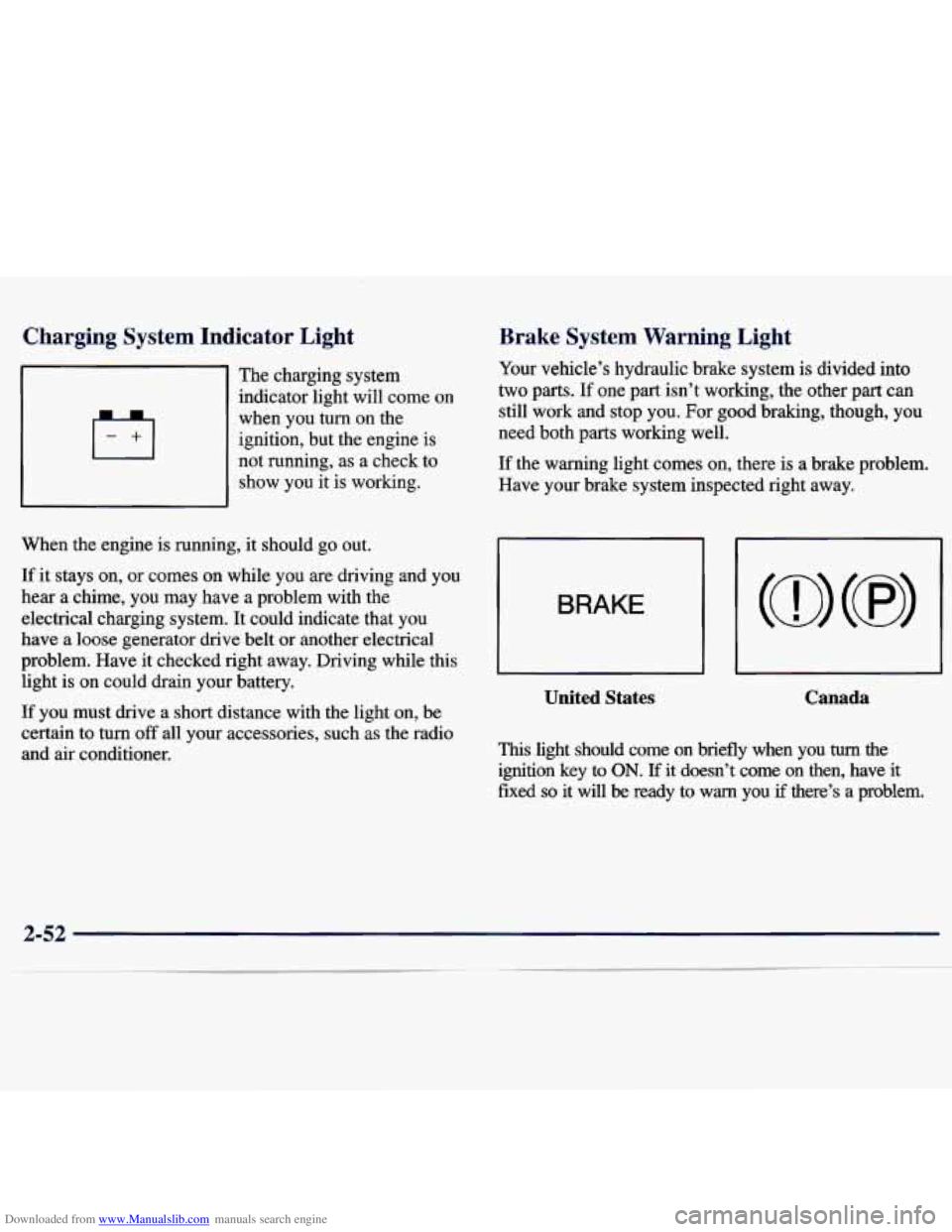
The charging system
~ indicator light will come on
when you turn on the
ignition, but the engine is
not running, as
a check to
show you
it is working.
When the engine is running, it should
go out.
If it stays on, or comes on while you are driving and you
hear a chime, you may have a problem with the
electrical charging system. It could indicate that you
have a loose generator drive belt
or another electrical
problem. Have it checked right away. Driving while this
light is on could drain your battery.
If you must drive a short distance with the light on, be
certain to turn
off all your accessories, such as the radio
and air conditioner.
Brake System Warning Light
Your vehcle’s hydraulic brake system is divided into
two parts. If one part isn’t working, the other part can
still work and stop you. For good braking, though, you
need both parts working well.
If the warning light comes on, there is a brake problem.
Have your brake system inspected right away.
BRAKE
~
United States Canada
This light should come on briefly when you turn the
ignition key to ON. If it doesn’t come on then, have it
fixed so it will be ready to warn you if there’s a problem.
Page 146 of 362
Downloaded from www.Manualslib.com manuals search engine PROG: Press this button on the remote cassette player
to
go from one side of the tape to the other.
CDPLAY: After a cassette tape and a CD have been
inserted, press the CDPLAY button to switch between
the CD player and
the cassette tape player. Both features
cannot be played at the same time.
EJECT Press this button on the remote cassette player
to remove the tape. EJECT can be used with either the
ignition or radio off. Also, you must press EJECT before
loading a cassette with the radio off to allow loading.
If
you leave a cassette tape in the player while listening to
the radio, it may become warm.
CLN: If this message appears on the display, the
cassette tape player needs to be cleaned. It will still play
tapes, but you should clean it as soon as possible to
prevent damage to the tapes and player. See “Care of
Your Cassette Tape Player”
in the Index. After you clean
the player, press and hold RECALL on the radio and the
EJECT button on the remote cassette at the same time
for five seconds to reset the CLN indicator. The radio
will display
--- to show the indicator was reset.
Theft-Deterrent Feature
THEFTLOCK@ is designed to discourage theft of your
radio. It works by using a secret code to disable all radio
functions whenever battery power is removed. The THEFTLOCK feature
for the radio may be used or
ignored. If ignored, the system plays normally and the
radio is not protected by the feature. If THEFTLOCK
is activated, your radio
will not operate if stolen.
When THEFTLOCK is activated, the radio will display
LOC to indicate a locked condition anytime battery
power has been interrupted.
If your battery loses power
for any reason, you must unlock the radio with the
secret code before
it will operate.
Activating the Theft-Deterrent Feature
The instructions which follow explain how to enter your
secret code to activate the THEFTLOCK system. It is
recommended that you read through all nine steps
before starting the procedure.
NOTE:
If you allow more than 15 seconds to elapse
between any steps, the radio automatically reverts to
time and you must start the procedure over at Step 4.
1. Write down any three or four-digit number from
000 to 1999 and keep it in a safe place separate
from the vehicle.
2. Turn the ignition to ACC or ON.
Page 148 of 362
Downloaded from www.Manualslib.com manuals search engine Disabling the Theft-Deterrent Feature
Enter your secret code as follows; pause no more than
15 seconds between steps:
1. Turn the ignition to ACC or ON.
2. Turn the radio off.
3. Press the 1 and 4 buttons together. Hold them down
until
SEC shows on the display.
4. Press MN and 000 will appear on the display.
5. Press MN again to make the last two digits agree
6. Press HR to make the first one or two digits agree
with your code.
with your code.
7. Press AM-FM after you have confirmed that the
code matches the secret code you have written down.
The display will show
---, indicating that the radio is
no longer secured.
If the code entered is incorrect,
SEC will appear on the
display. The radio will remain secured until the correct
code is entered.
When battery power is removed and later applied to a
secured radio, the radio won’t turn on and
LOC will
appear on the display. To
unlock a secured radio, see “Unlocking the
Theft-Deterrent Feature After a Power
Loss”
earlier in this section.
Understanding Radio Reception
AM
The range for most AM stations is greater than for FM,
especially at night. The longer range, however, can
cause stations to interfere with each other.
AM can pick
up noise from things like storms and power lines. Try
reducing the treble to reduce this noise if you ever get it.
FM Stereo
FM stereo will give you the best sound, but FM signals
will reach only about
10 to 40 miles (16 to 65 km). Tall
buildings or hills can interfere with FM signals, causing
the sound to come and go.
Tips About Your Audio System
Hearing damage from loud noise is almost undetectable
until it is too late. Your hearing can adapt to higher
volumes of sound. Sound that seems normal can be
loud and harmful to your hearing. Take precautions
by
adjusting the volume control on your radio to a safe
sound level before your hearing adapts to it.
Page 179 of 362
Downloaded from www.Manualslib.com manuals search engine Run your engine only as long as you must. This saves
fuel. When you
run the engine, make it go a little faster
than just idle. That
is, push the accelerator slightly. This
uses less fuel for the heat that you get and it keeps the
battery charged. You will need a well-charged battery to
restart the vehicle, and possibly for signaling later on
with your headlamps. Let the heater run for a while.
Then, shut the engine
off and close the window almost
all the way to preserve the heat. Start the engine again
and repeat this only when you feel really uncomfortable
from the cold. But do it as little as possible. Preserve the
fuel
as long as you can. To help keep warm, you can get
out of the vehicle and do some fairly vigorous exercises
every half hour or
so until help comes.
Recreational Vehicle Towing
You can tow your vehicle behind another vehicle for use
at your destination. Be sure to use the proper towing
equipment designed for recreational towing. Follow the
instructions for the towing equipment.
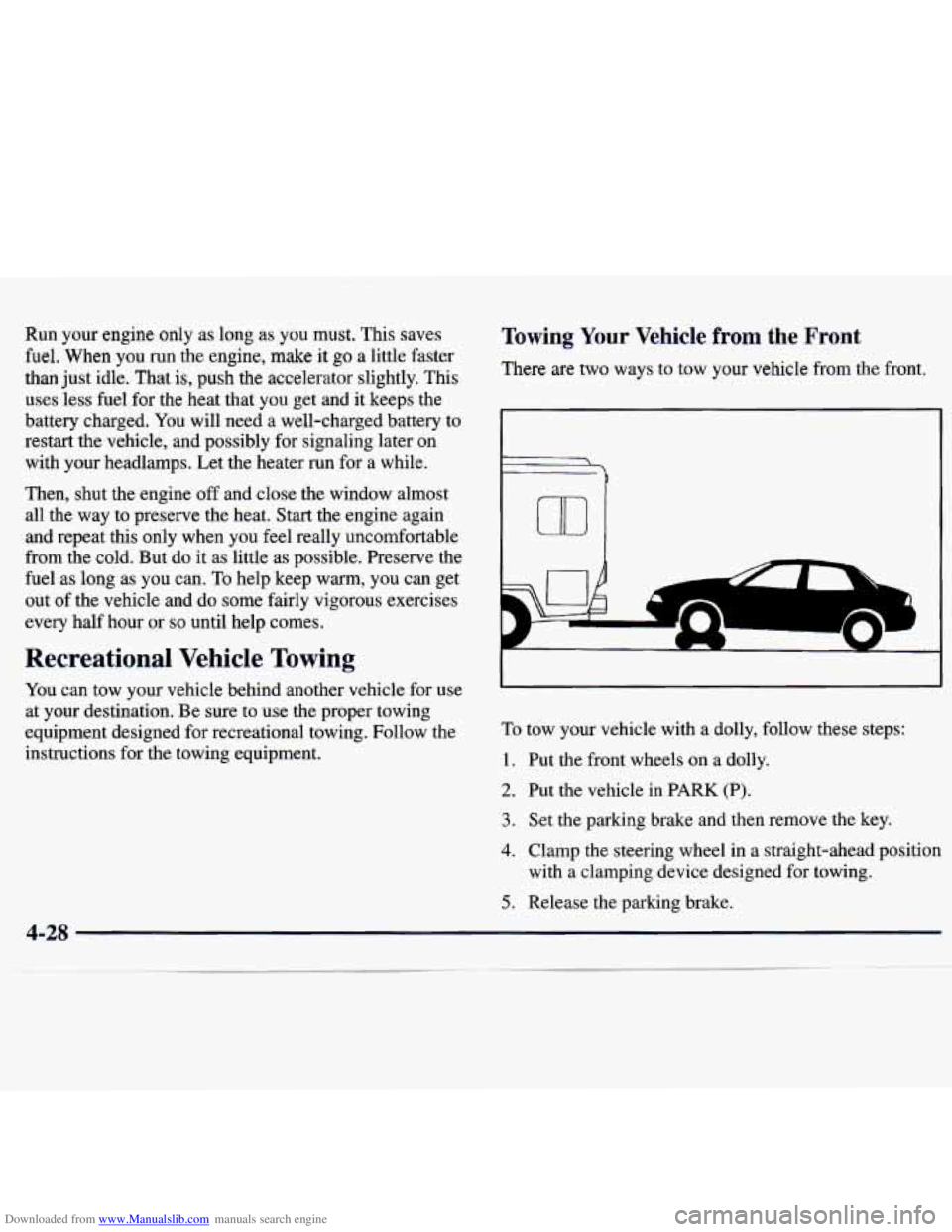
Towing Your Vehicle from the Front
There are two ways to tow your vehicle from the front,
To tow your vehicle with a dolly, follow these steps:
1. Put the front wheels on a dolly.
2. Put the vehicle in PARK (P).
3. Set the parking brake and then remove the key.
4. Clamp the steering wheel in a straight-ahead position
with
a clamping device designed for towing.
5. Release the parking brake.
Page 180 of 362
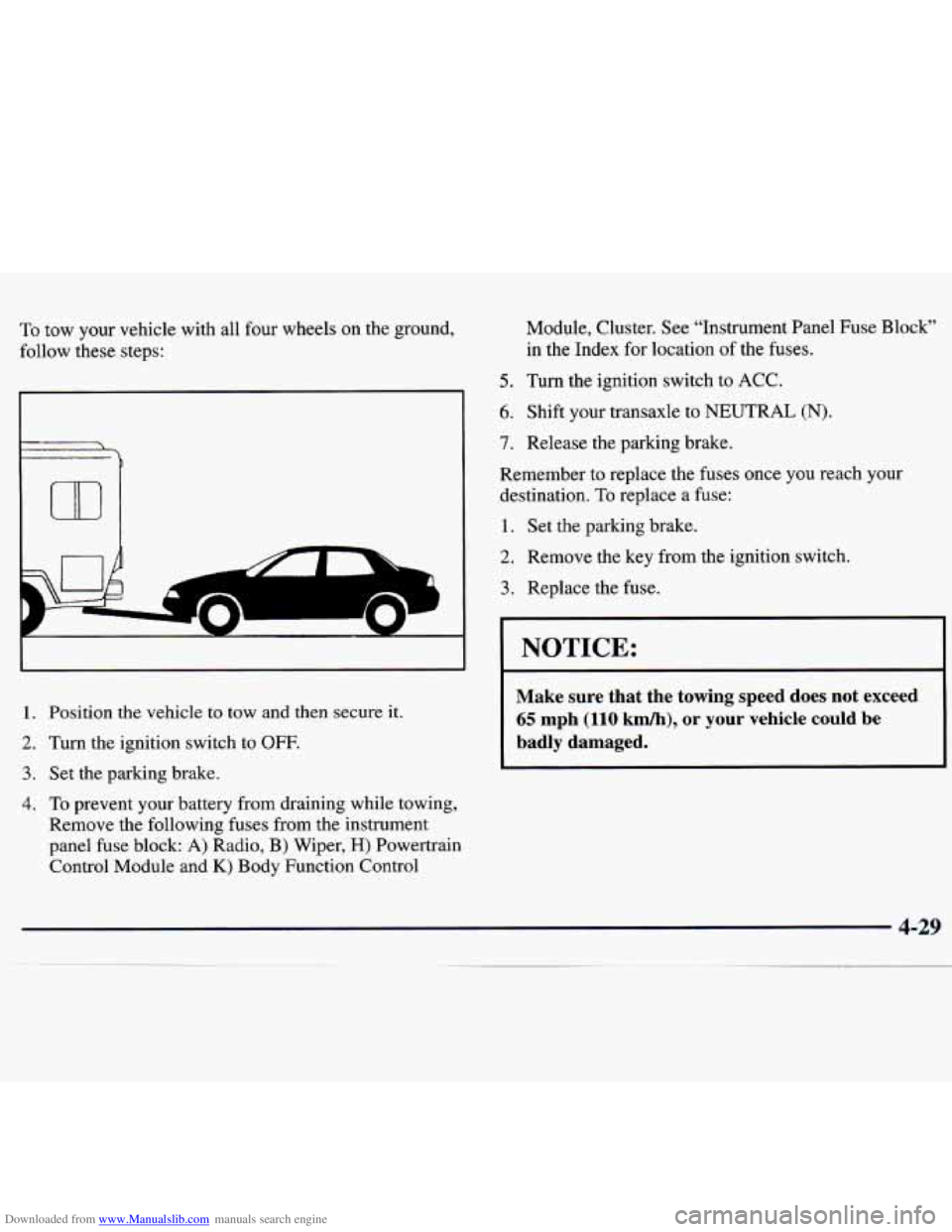
Downloaded from www.Manualslib.com manuals search engine To tow your vehicle with all four wheels on the ground,
follow these steps: Module,
Cluster. See “Instrument Panel Fuse Block”
in the Index for location of the fuses.
5. Turn the ignition switch to ACC.
6. Shift your transaxle to NEUTRAL (N).
7. Release the parking brake.
Remember to replace the fuses once you reach your
destination.
To replace a fuse:
1. Set the parking brake.
2. Remove the key from the ignition switch.
3. Replace the fuse.
I NOTICE:
1. Position the vehicle to tow and then secure it.
2. Turn the ignition switch to OFF.
3. Set the parking brake.
4. To prevent your battery from draining while towing,
Remove the following fuses from the instrument
panel fuse block: A) Radio,
B) Wiper, H) Powertrain
Control Module and
K) Body Function Control
Make sure that the towing speed does not exceed
65 mph (110 km/h), or your vehicle could be
badly damaged.
Page 194 of 362
Downloaded from www.Manualslib.com manuals search engine Jump Starting
If your battery has run down, you may want to use
another vehicle and some jumper cables to start your
vvehicle. But please follow the steps here
to do
it safely.
I
Batteries can hurt you. They can be dangerous
because:
0 They contain acid that can burn you.
0 They contain gas that can explode or ignite.
0 They contain enough electricity to
If you don’t follow these steps exactly, some or all
of these things can hurt you.
burn
you.
NOTICE:
Ignoring these steps could result in costly damage
to your vehicle that wouldn’t be covered by
your warranty.
Trying to
start your vehicle by pushing or pulling
it won’t work, and
it could damage your vehicle.
1. Check the other vehicle. It must have a 12-volt
battery with a negative ground system.
I NOTICE:
If the other system isn’t a 12-volt system with a
negative ground, both vehicles can be damaged.
Page 196 of 362
Downloaded from www.Manualslib.com manuals search engine 5. Find the positive (+) and negative (-) terminals on
each battery.
Using
a match near a battery can cause battery
gas to explode. People have been hurt doing this,
and some have been blinded. Use
a flashlight if
you need more light.
Be
sure the battery has enough water. You don’t
need to add water to the
AC Delco Freedom@
battery installed in every new
GM vehicle. But
if a battery has fiier caps, be sure the right
amount of fluid is there.
If it is low, add water to
take
care of that first. If you don’t, explosive gas
could be present.
Battery fluid contains acid that can burn you.
Don’t get
it on you. If you accidentally get it in
your eyes or on your skin, flush the place with
water and get medical help immediately.
6. Check that the jumper cables don’t have loose or
missing insulation.
If they do, you could get a shock.
The vehicles could be damaged, too. Before you
connect the cables, here are some things
you should
know. .Positive (+) will go to positive (+) and
negative
(-) will go to negative (-) or a metal engine
part. Don’t connect positive
(+) to negative (-) or
you’ll get
a short that would damage the battery and
maybe other parts, too.
Fans
or other moving engine parts can injure you
badly. Keep your hands away from moving parts
once the engine is running.
5-5
Page 197 of 362
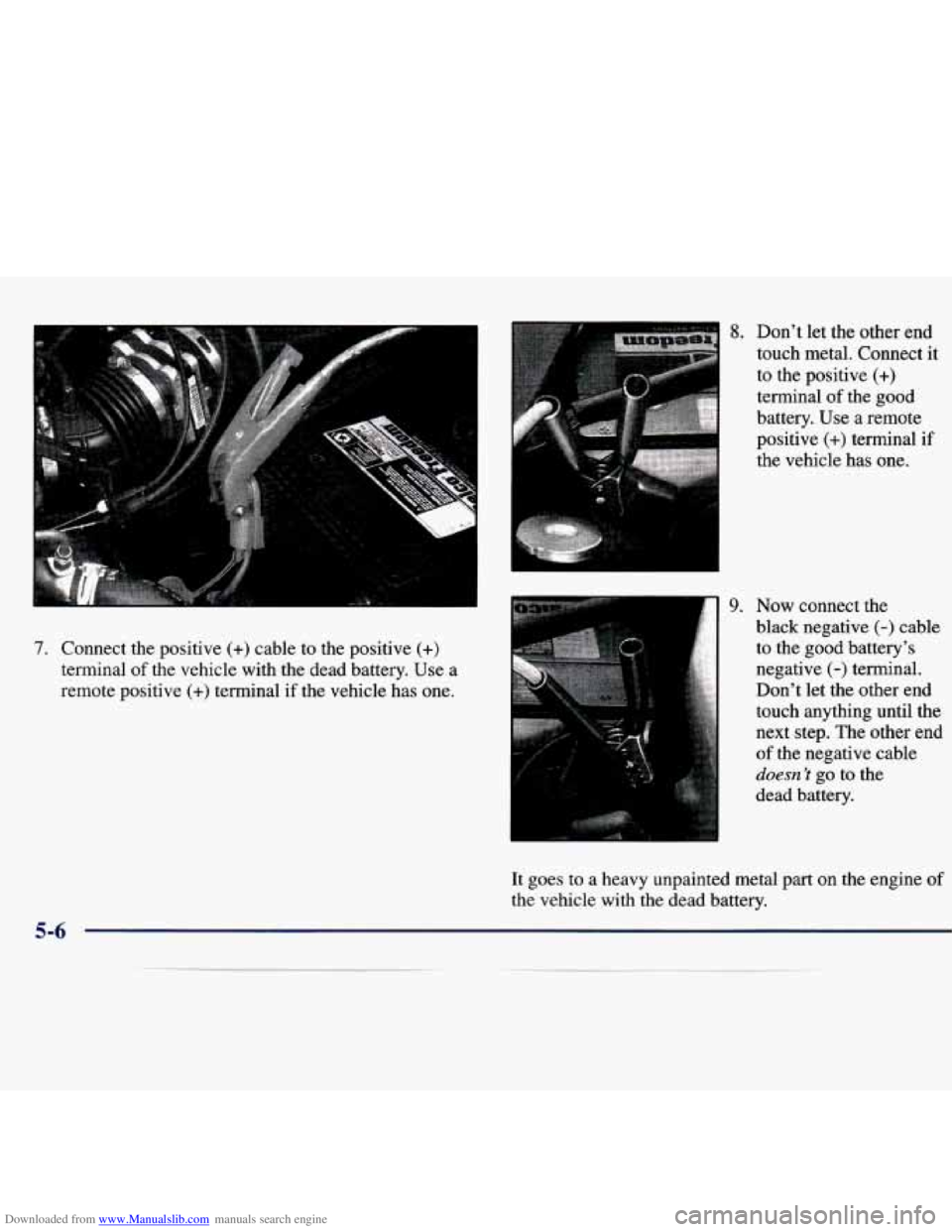
Downloaded from www.Manualslib.com manuals search engine 7. Connect the positive (+) cable to the positive (+)
terminal of the vehicle with the dead battery. Use a
remote positive (+) terminal if the vehicle has one.
8. Don’t let the other end
touch metal. Connect
it
to the positive (+)
terminal of the good
battery. Use a remote
positive
(+) terminal if
the vehicle
has one.
9. Now connect the
black negative
(-) cable
to the good battery’s
negative
(-) terminal.
Don’t let the other end
touch anything until the
next step. The other end
of the negative cable
duesn 2 go to the
dead battery.
It goes to a heavy unpainted metal part on the engine
of
the vehicle with the dead battery.
5-6