Page 269 of 378
Downloaded from www.Manualslib.com manuals search engine NOTICE:
If you use an improper coolant mixture, your
engine could overheat and be badly damaged.
The repair cost wouldn’t be covered by your
warranty. Too much water in the mixture can
freeze and crack the engine, radiator, heater core
and other parts.
If you have to add coolant more than four times a year,
have your dealer check your cooling system.
NOTICE:
If you use the proper coolant, you don’t have to
add extra inhibitors or additives which claim to
improve the system. These can be harmful.
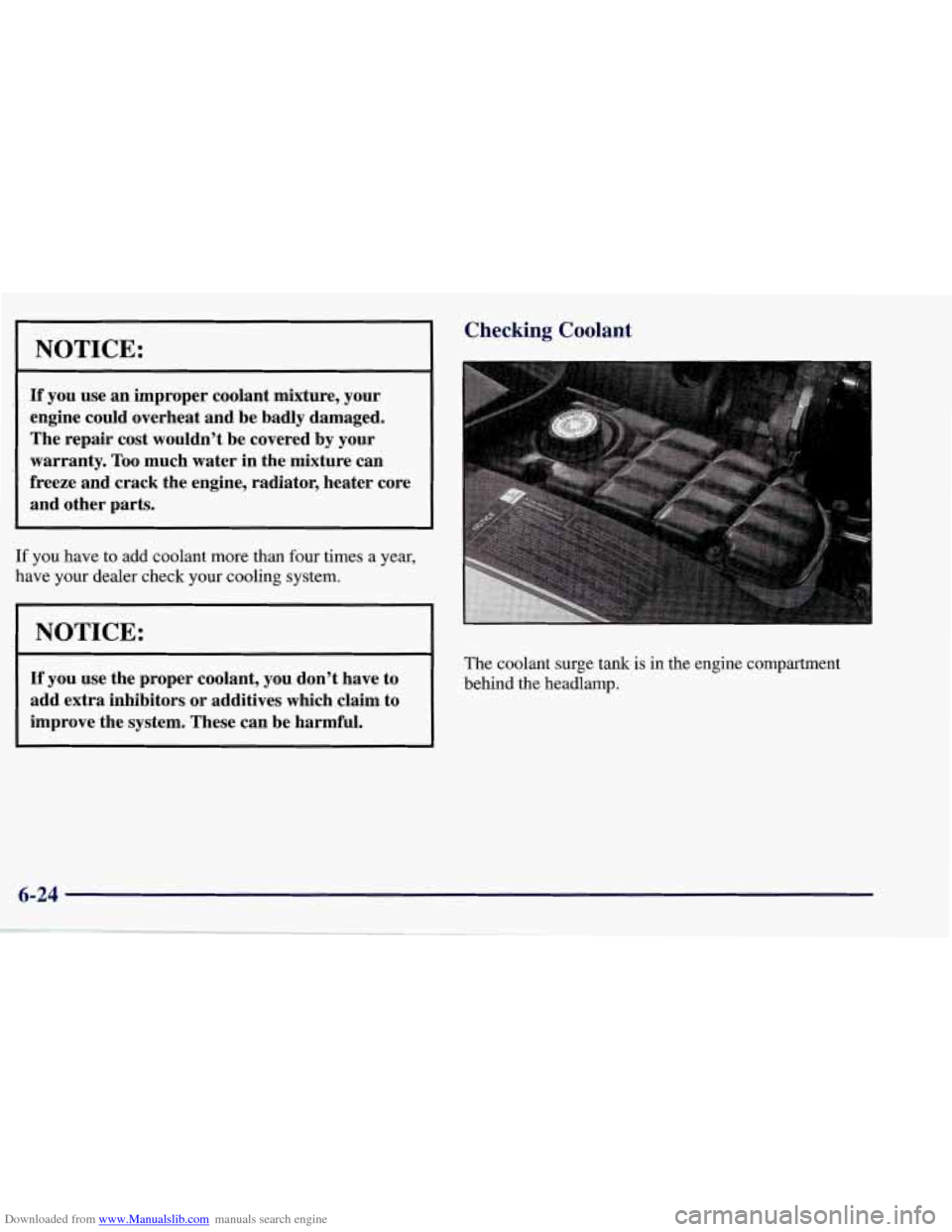
Checking Coolant
The coolant surge tank is in the engine compartment
behind the headlamp.
Page 270 of 378
Downloaded from www.Manualslib.com manuals search engine Turning the surge tank pressure cap when the
engine and radiator are hot can allow steam and
i
scalding liquids to blow out and burn you badly.
Never turn the surge tank pressure cap
-- even a
little
-- when the engine and radiator are hot.
I
When your engine is cold, the coolant level should be at
the
FULL COLD mark. Don’t overfill the surge tank.
Too much coolant can result in an ovefflow when the
fluid is hot.
If the LOW COOLANT message comes on, it means
you’re low
on engine coolant.
Adding Coolant
If you need more coolant, add the proper DEX-COOL@
coolant mixture
at the surge tank, but only when the
engine is cool.
A CAUTION:
r
You can be burned if you spill coolant on hot
engine parts. Coolant contains ethylene glycol,
and
it will burn if the engine parts are hot
enough. Don’t spill coolant on a hot engine.
When replacing the pressure cap, make sure it is tight.
6-25
Page 271 of 378
Downloaded from www.Manualslib.com manuals search engine Surge Tank Pressure Cap
NOTICE:
The surge tank pressure cap is a 15 psi (105 kPa)
pressure-type cap and must be tightly installed to prevent coolant
loss and possible engine damage
from overheating.
When you replace the surge tank pressure cap, a GM cap
is recommended.
Thermostat
Engine coolant temperature is controlled by a thermostat
in the engine coolant system. The thermostat stops the
flow of coolant through the radiator until the coolant
reaches a pre-set temperature.
When you replace the thermostat, a GM thermostat
is recommended.
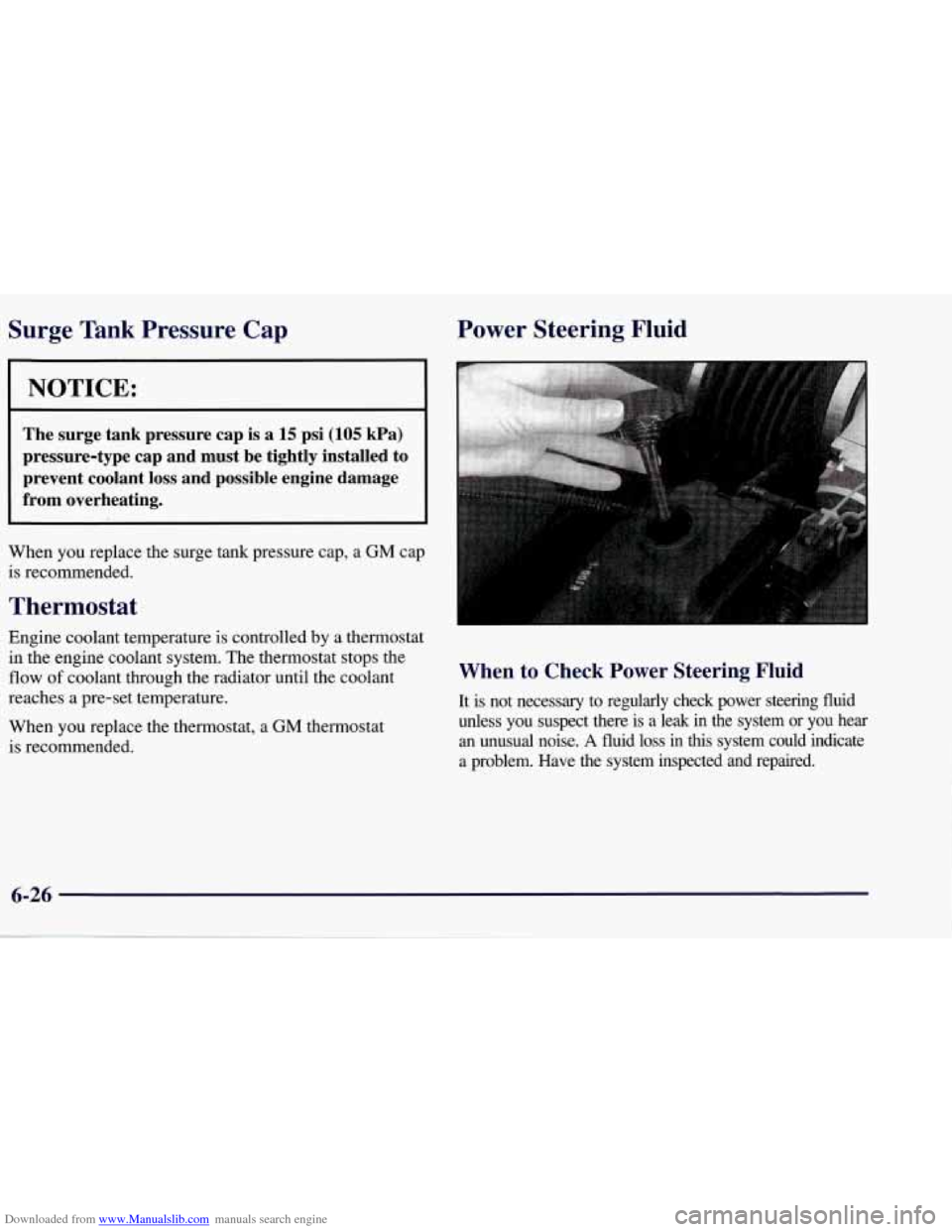
Power Steering Fluid
When to Check Power Steering Fluid
It is not necessary to regularly check power steering fluid
unless you suspect there is a leak
in the system or you hear
an unusual noise. A fluid loss in this system could indicate
a problem. Have the system inspected
and repaired.
Page 273 of 378
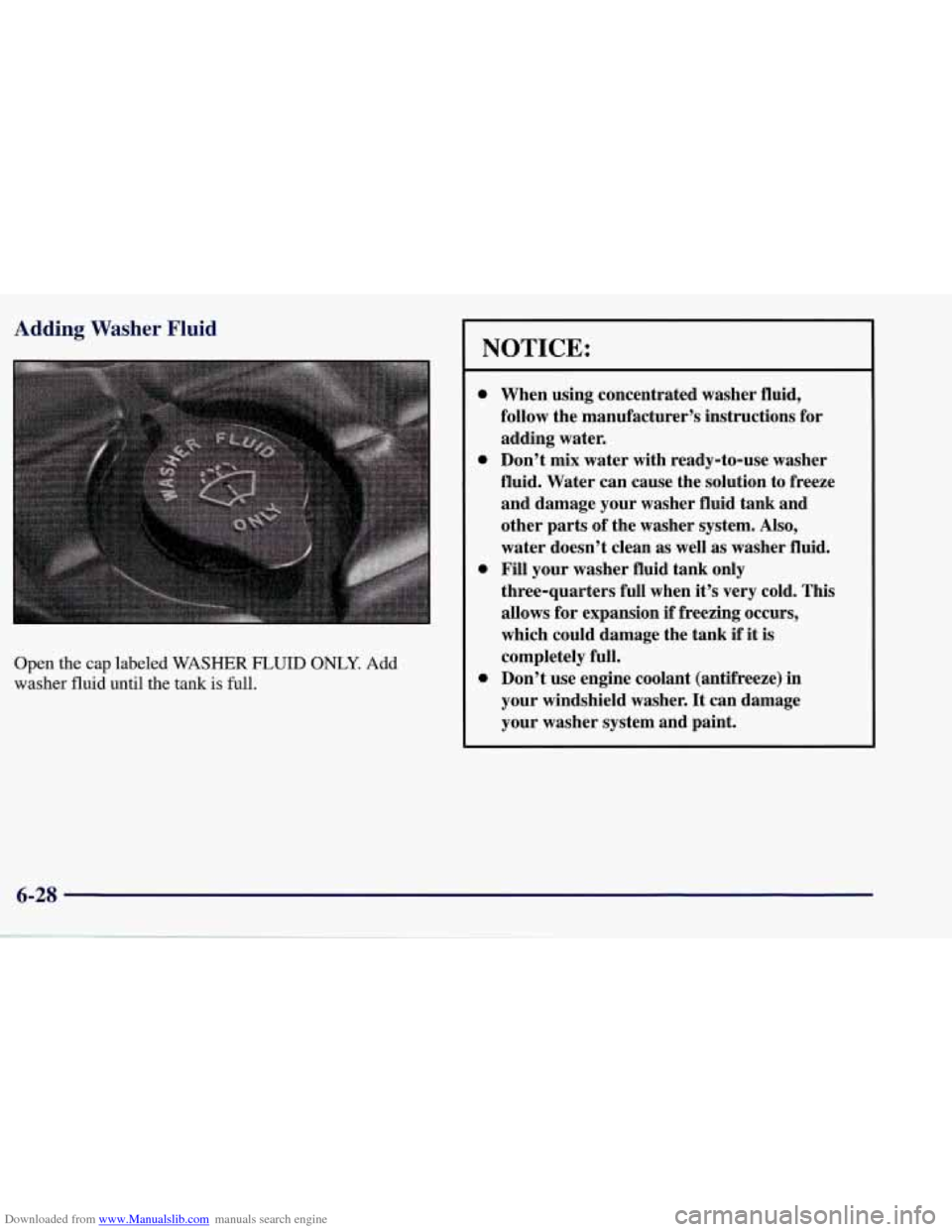
Downloaded from www.Manualslib.com manuals search engine Adding Washer Fluid
Open the cap labeled WASHER FL,UID ONLY. Add
washer
fluid until the tank is full.
NOTICE:
e
0
e
e
When using concentrated washer fluid,
follow the manufacturer’s instructions for
adding water.
Don’t mix water with ready-to-use washer
fluid. Water can cause the solution to freeze
and damage your washer fluid tank and
other parts of the washer system. Also,
water doesn’t clean as well as washer fluid.
Fill your washer fluid tank only
three-quarters full when it’s very cold. This
allows for expansion if freezing occurs,
which could damage the tank if it is
completely full.
Don’t use engine coolant (antifreeze) in
your windshield washer. It can damage
your washer system and paint.
6-28
Page 315 of 378

Downloaded from www.Manualslib.com manuals search engine Capacities and Specifications
Engine
vpe .................................... V8
VIN Engine Code
LSl ...................................... G
Fuel Delivery ............ Sequential Multi-Port
Fuel Injection (SFI)
Valve Arrangement ............. Overhead Valve
Piston Displacement ...................... 5.7L
Bore ...................... 3.90 inches (9.9 cm)
Stroke .................... 3.62 inches (9.2 cm)
Compression Ratio
LSl ................................ 10.1:l
Horsepower
LS1 .................................. 345
Firing Order .................. 1-8-7-2-6-5-4-3
Thermostat Temperature
Specification
................... 187°F (86°C)
Replacement Parts
Air Cleaner Filter ...................... A917C
Battery ............................. 78A-72H
Coolant Surge Tank Cap ... GM Part No. 10296465
15 psi (105 kPa)
Engine Oil Filter ........................ PF44
PCV Valve ............................. 799C
Serpentine Belt
AC Compressor
......... GM Part No. 12556609
or equivalent
Water Pump, Generator, Power Steering Pump
... GM Part No. 12555225
Spark Plug ............. 41-93 1 (0.60 inch Gap) or equivalent
Thermostat ............. GM Part No. 12555717
or equivalent
Windshield Wiper Blade
Length ................... .22 inches (55.9 cm)
Type
............ 9 mm x 3 mm Shephard’s Hook
6-70
Page 316 of 378
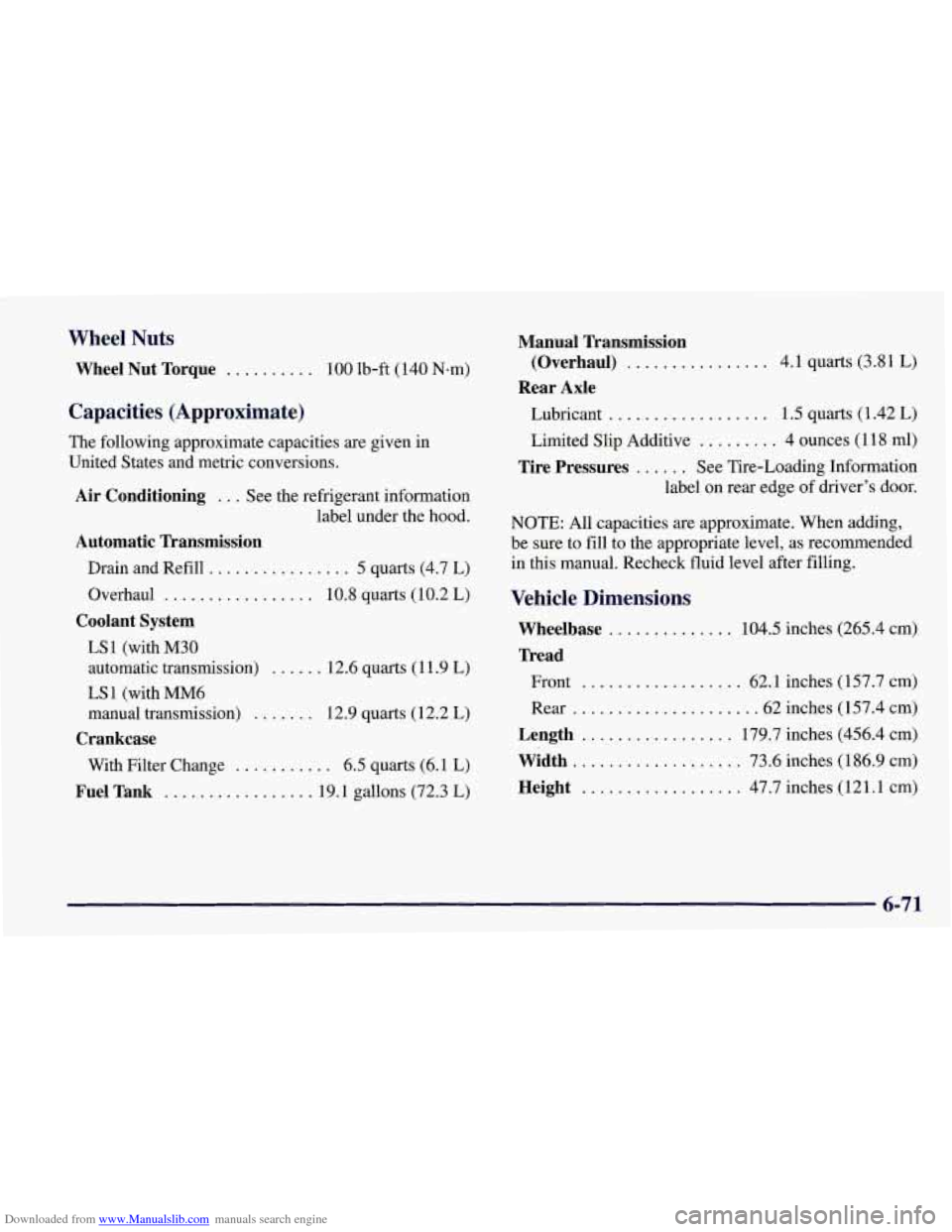
Downloaded from www.Manualslib.com manuals search engine Wheel Nuts
Wheel Nut Torque .......... 100 lb-ft (140 N-m)
Capacities (Approximate)
The following approximate capacities are given in
United States and metric conversions.
Air Conditioning ... See the refrigerant information
label under the hood.
Automatic Transmission
Drain and Refill ................ 5 quarts (4.7 L)
Overhaul
................. 10.8 quarts (10.2 L)
Coolant System
LS 1 (with M30
automatic transmission)
...... 12.6 quarts (1 1.9 L)
LS 1 (with "6
manual transmission)
....... 12.9 quarts ( 12.2 L)
Crankcase
With Filter Change ........... 6.5 quarts (6.1 L)
Fuel Tank ................. 19.1 gallons (72.3 L)
Manual Transmission
Rear Axle (Overhaul)
................ 4.1
quarts (3.8 1 L)
Lubricant
.................. 1.5 quarts (1 -42 L)
Limited Slip Additive ......... 4 ounces (1 18 ml)
Tire Pressures ...... See Tire-Loading Information
label on rear edge of driver's door.
NOTE: All capacities are approximate. When adding,
be sure to fill to the appropriate level, as recommended
in this manual. Recheck fluid level after filling.
Vehicle Dimensions
Wheelbase .............. 104.5 inches (265.4 cm)
Tread
Front .................. 62.1 inches (157.7 cm)
Rear
.................... .62 inches (157.4 cm)
Length ................. 179.7 inches (456.4 cm)
Width ................... 73.6 inches (1 86.9 cm)
Height .................. 47.7 inches (1 21.1 cm)
6-71
Page 329 of 378
Downloaded from www.Manualslib.com manuals search engine Maintenance Schedule
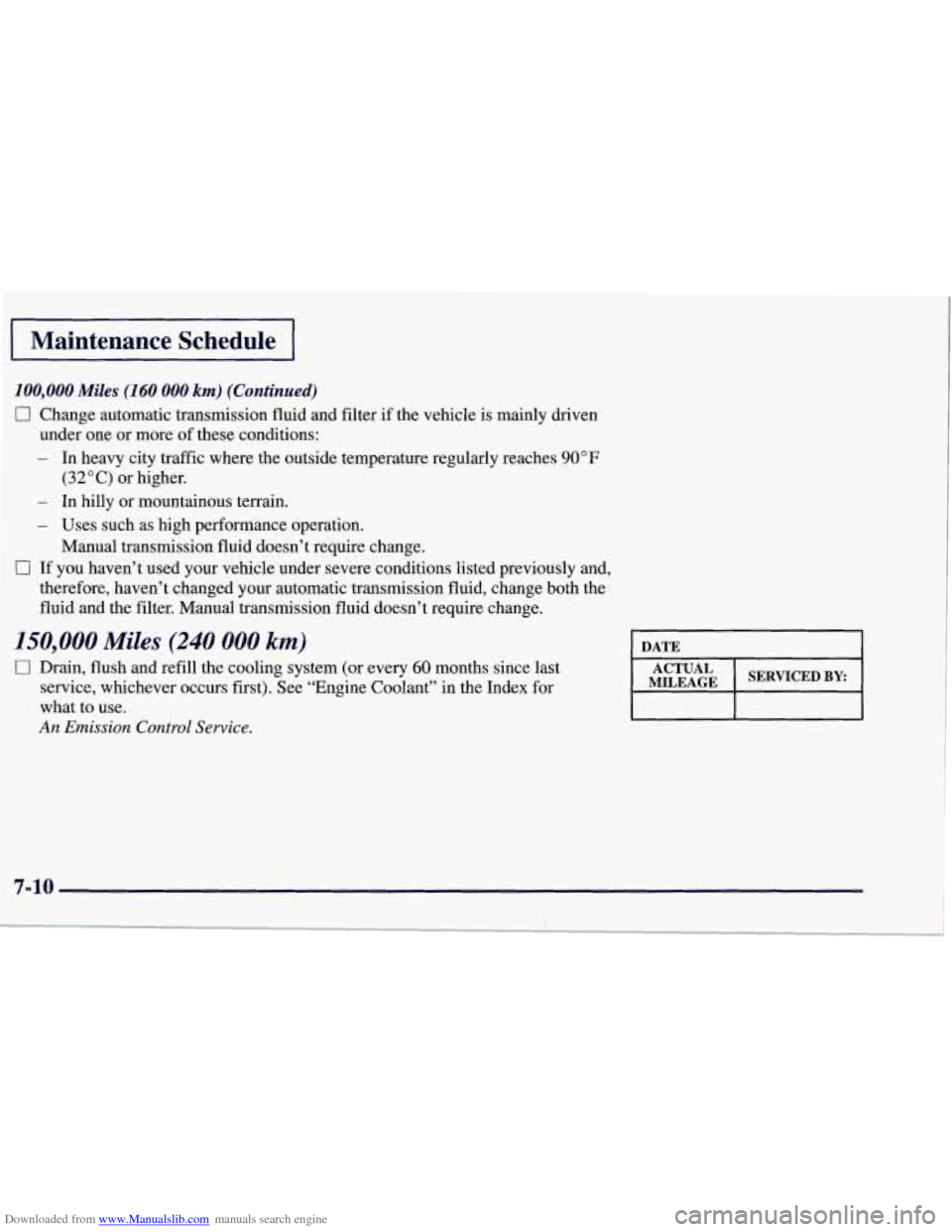
100,000 Miles (160 000 km) (Continued)
0 Change automatic transmission fluid and filter if the vehicle is mainly driven
under one or more of these conditions:
- In heavy city traffic where the outside temperature regularly reaches 90°F
(32 O C) or higher.
- In hilly or mountainous terrain.
- Uses such as high performance operation.
Manual transmission fluid doesn’t require change.
0 If you haven’t used your vehicle under severe conditions listed previously and,
therefore, haven’t changed your automatic transmission fluid, change
both the
fluid and the filter. Manual transmission fluid doesn’t require change.
150,000 Miles (240 000 km)
0 Drain, flush and refill the cooling system (or every 60 months since last
service, whichever occurs first). See “Engine Coolant” in the Index for
what to use.
An Emission Control Sewice.
DATE I
MILEAGE
7-10
I
Page 330 of 378
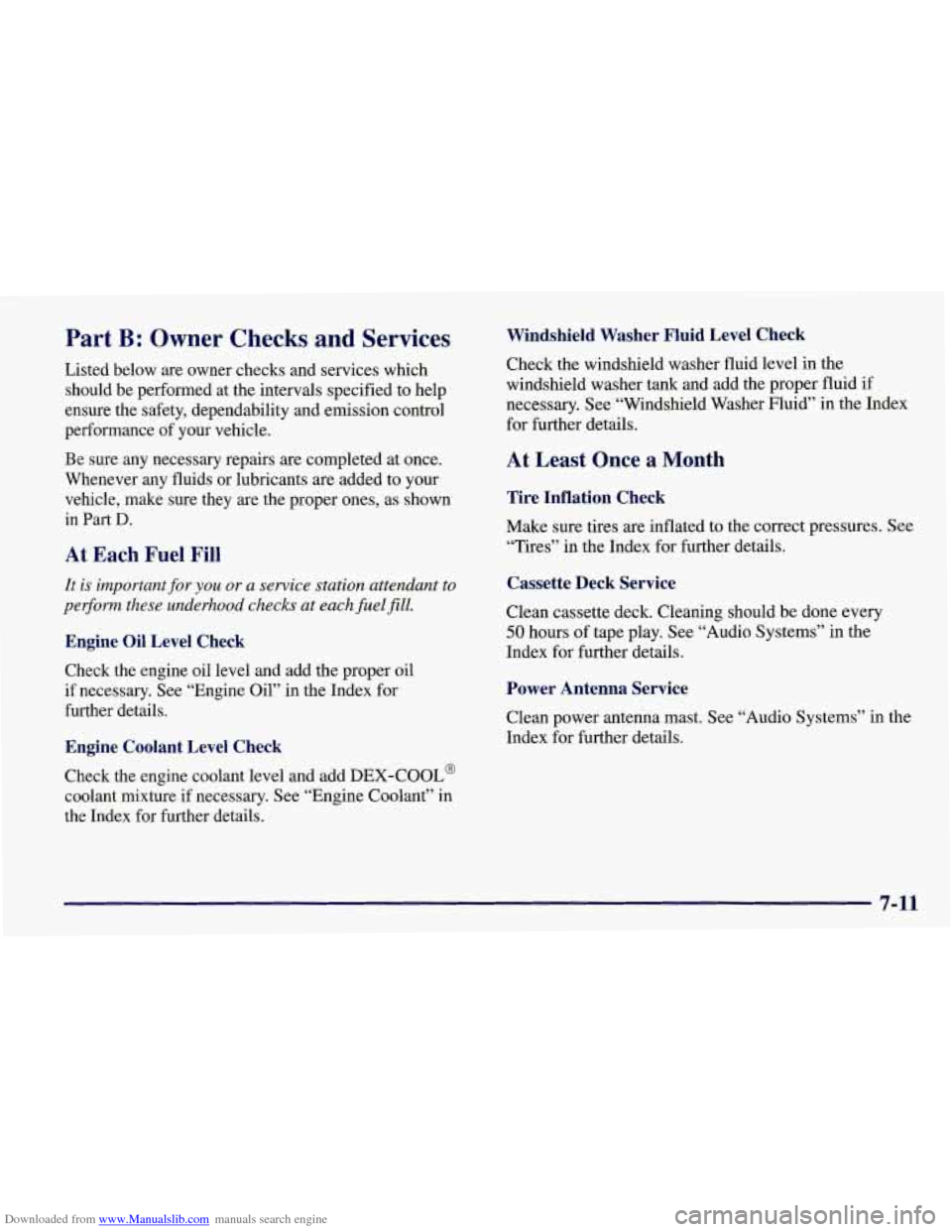
Downloaded from www.Manualslib.com manuals search engine Part B: Owner Checks and Services
Listed below are owner checks and services which
should be performed at the intervals specified to help
ensure the safety, dependability and emission control
performance of your vehicle.
Be sure any necessary repairs are completed at once.
Whenever any fluids or lubricants are added to your
vehicle, make sure they
are the proper ones, as shown
in
Part D.
At Each Fuel Fill
It is important for you or a service station attendant to
pe$om these underhood checks at each fuel
fill.
Engine Oil Level Check
Check the engine oil level and add the proper oil
if necessary. See “Engine Oil” in the Index for
further details.
Engine Coolant Level Check
Check the engine coolant level and add DEX-COOL@
coolant mixture
if necessary. See “Engine Coolant” in
the Index for further details.
Windshield Washer Fluid Level Check
Check the windshield washer fluid level in the
windshield washer tank and add the proper fluid if
necessary.
See “Windshield Washer Fluid” in the Index
for further details.
At Least Once a Month
Tire Inflation Check
Make sure tires are inflated to the correct pressures. See
“Tires” in the Index for further details.
Cassette Deck Service
Clean cassette deck. Cleaning should be done every
50 hours of tape play. See “Audio Systems” in the
Index for further details.
Power Antenna Service
Clean power antenna mast. See “Audio Systems” in the
Index for further details.
7-11