Page 229 of 378
Downloaded from www.Manualslib.com manuals search engine Towing Your Vehicle
Try to have a GM dealer or a professional towing service
tow your vehicle. They can provide the right equipment
and know-how to tow your vehicle without damage.
If your vehicle has been changed or modified since it
was factory new by adding aftermarket items like
fog
lamps, aero skirting, or special tires and wheels, these
instructions and illustrations may not be correct.
Before you
do anything, turn on the hazard
warning flashers.
When you call, tell the towing service:
That your vehicle cannot be towed with sling-type equipment.
0 That your vehicle has rear-wheel drive.
The make, model and year of your vehicle.
0 Whether you can still move the shift lever.
If there was an accident, what was damaged.
0 If the vehicle is to be towed from the rear with a
wheel-lift truck, a front dolly will be required.
When the towing service arrives; let the tow operator
know that this manual contains detailed towing
instructions and illustrations. The operator may want
to
see them.
Page 230 of 378
Downloaded from www.Manualslib.com manuals search engine To help avoid injury to you or others:
Never let passengers ride in a vehicle that is
Never tow faster than safe or posted speeds.
Never tow with damaged parts not
0 Never get under your vehicle after it has
Always secure the vehicle on each side with
0 Use only R-hooks. being towed.
fully secured.
been lifted by the tow truck.
separate safety chains when towing it.
A vehicle can fall from a car carrier if it isn’t
adequately secured. This can cause a collision,
serious personal injury and vehicle damage. The
vehicle should be tightly secured with chains or
steel cables before
it is transported.
Don’t use substitutes (ropes, leather straps,
canvas webbing, etc.) that can be cut by sharp
edges underneath the towed vehicle. Always use
R-hooks inserted in the front and rear R-hook
slots. Never use J-hooks. They will damage
drivetrain and suspension components.
When your vehicle is being towed, have the ignition
key in the
OFF position. The steering wheel should
be clamped in a straight-ahead position, with a
clamping device designed for towing service.
Do not
use the vehicle’s steering column lock for this. The
transmission should be in
NEUTRAL (N) and the
parking brake released.
5-9
Page 231 of 378
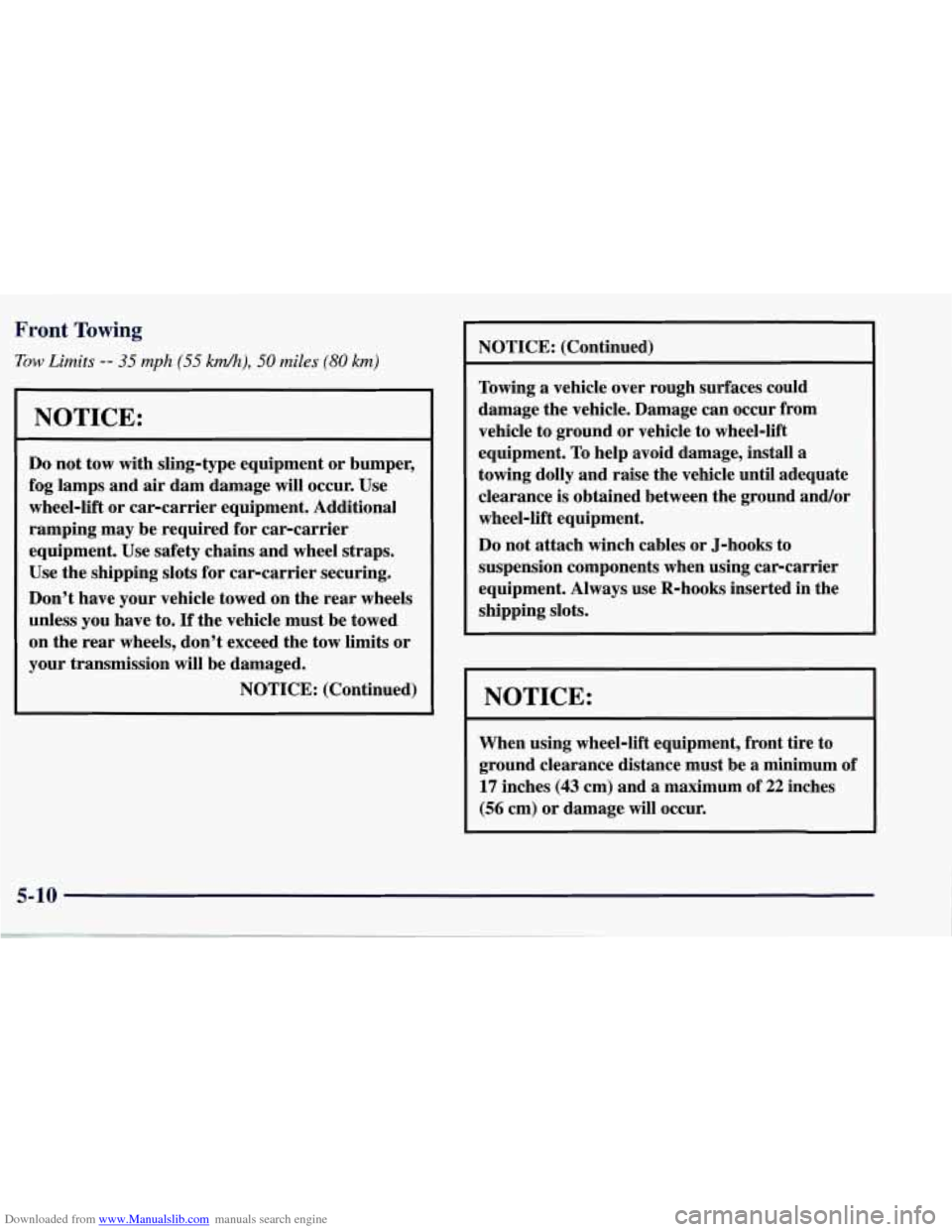
Downloaded from www.Manualslib.com manuals search engine Front Towing
Tow Limits -- 35 mph (55 kh), 50 miles (80 km)
I NOTICE:
Do not tow with sling-type equipment or bumper,
fog lamps and air dam damage will occur. Use
wheel-lift or car-carrier equipment. Additional
ramping may be required for car-carrier
equipment. Use safety chains and wheel straps.
Use the shipping slots for car-carrier securing.
Don’t have your vehicle towed on the rear wheels
unless you have to.
If the vehicle must be towed
on the rear wheels, don’t exceed the tow limits or
your transmission will be damaged.
NOTICE: (Continued) NOTICE: (Continued)
Towing
a vehicle over rough surfaces could
damage the vehicle. Damage can occur from
vehicle to ground or vehicle to wheel-lift
equipment.
To help avoid damage, install a
towing dolly and raise the vehicle until adequate
clearance is obtained between the ground and/or
wheel-lift equipment.
Do not attach winch cables or
J-hooks to
suspension components when using car-carrier
equipment. Always use R-hooks inserted in the
shipping slots.
I NOTICE:
When using wheel-lift equipment, front tire to
ground clearance distance must be a minimum of
17 inches (43 cm) and a maximum of 22 inches
(56 cm) or damage will occur.
Page 232 of 378
Downloaded from www.Manualslib.com manuals search engine Rear Towing
NOTICE:
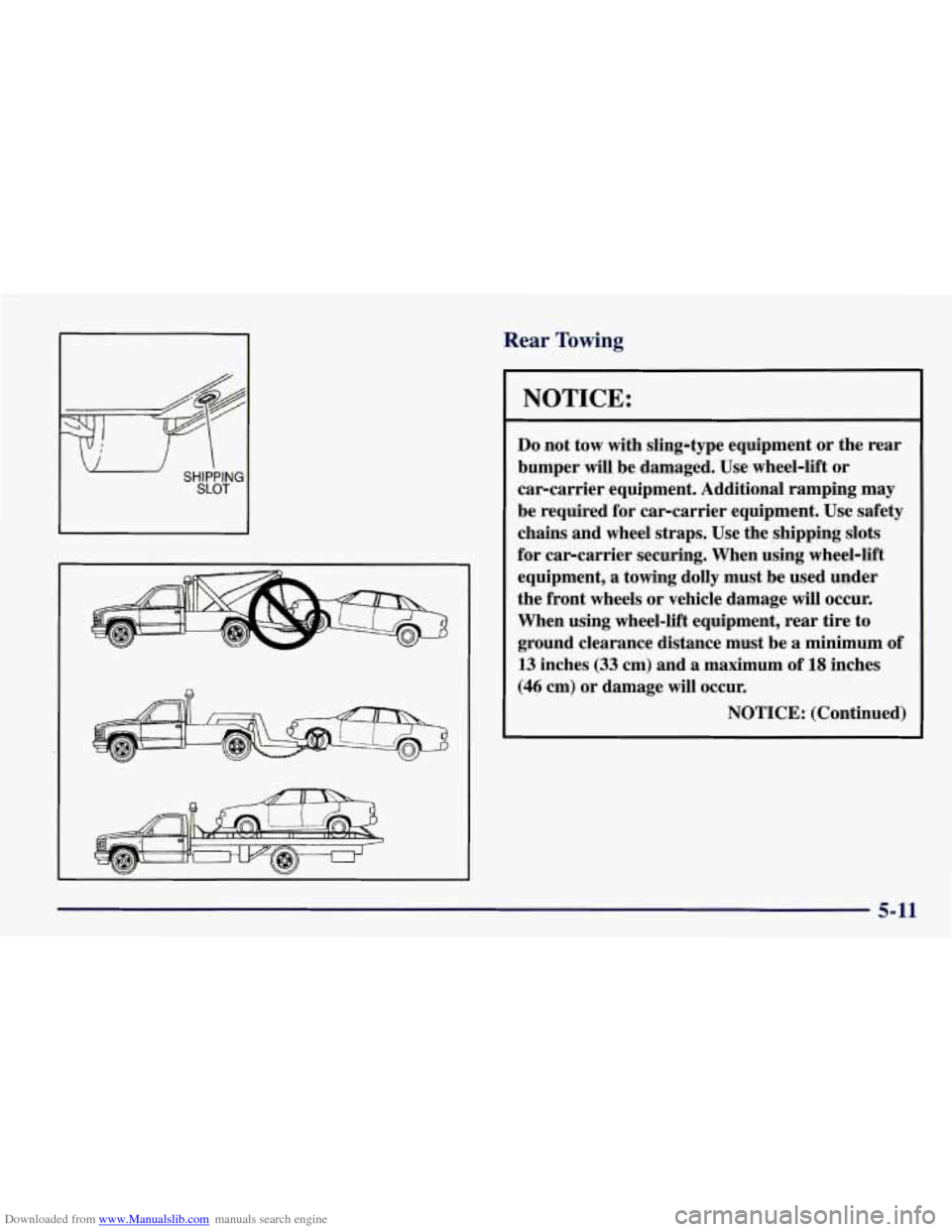
Do not tow with sling-type equipment or the rear
bumper will be damaged. Use wheel-lift or
car-carrier equipment. Additional ramping may
be required for car-carrier equipment. Use safety
chains and wheel straps. Use the shipping slots
for car-carrier securing. When using wheel-lift
equipment, a towing dolly must be used under
the front wheels or vehicle damage will occur.
When using wheel-lift equipment, rear tire to
ground clearance distance must be
a minimum of
13 inches (33 cm) and a maximum of 18 inches
(46 cm) or damage will occur.
NOTICE: (Continued)
5-11
Page 233 of 378
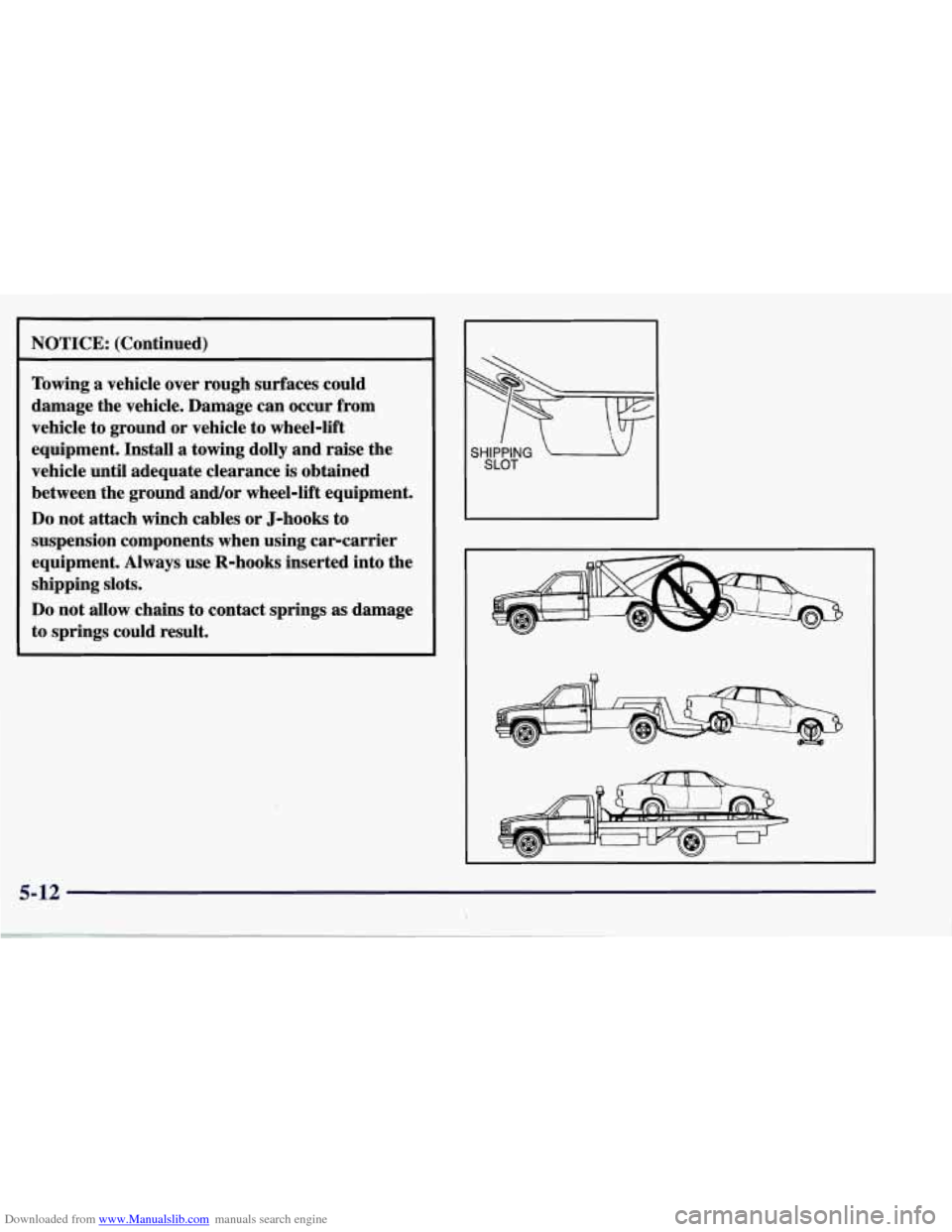
Downloaded from www.Manualslib.com manuals search engine NOTICE: (Continued)
Towing a vehicle over rough surfaces could
damage the vehicle. Damage can occur from
vehicle to ground or vehicle to wheel-lift
equipment. Install a towing dolly and raise the
vehicle until adequate clearance
is obtained
between the ground and/or wheel-lift equipment.
Do not attach winch cables or J-hooks to
suspension components when using car-carrier
equipment. Always use R-hooks inserted into the
shipping slots.
Do not allow chains to contact springs as damage
to springs could result.
SHIPPING SLOT
"
5-12 ~
Page 244 of 378
Downloaded from www.Manualslib.com manuals search engine I NOTICE:
Spinning your wheels can destroy parts of your
vehicle as well as the tires.
If you spin the wheels
too fast while shifting your transmission back
and forth, you can destroy your transmission.
For information about using tire chains on your vehicle, see “Tire Chains’’ in the Index.
Rocking Your Vehicle To Get It Out
First, turn your steering wheel left and right. That will
clear the area around your front wheels. You should turn
your TCS System
off. (See “Traction Control System’’
in the Index.) Then shift back and forth between
REVERSE (R) and a forward gear, spinning the wheels
as little as possible. For a manual transmission, shift
slowly between either FIRST
(1) or SECOND (2) and
REVERSE (R), allowing the wheels to stop before
shifting into gear. Release the accelerator pedal while
you shift, and press lightly on the accelerator pedal
when the transmission is in gear. If that doesn’t get you
out after a few tries, you may need to be towed out.
If
you do need to be towed out, see “Towing Your Vehicle”
in the Index.
5-23
Page 257 of 378
Downloaded from www.Manualslib.com manuals search engine Engine Oil
If the LOW OIL LEVEL message on the Driver
Information Center comes on, it means you need to
check your engine oil level right away. For more
information, see “Driver Information Center” in the
Index. You should check your engine oil level regularly;
this is an added reminder.
It’s
a good idea to check your engine oil level every time
you get fuel. In order to get an accurate reading, the oil
must be warm and the vehicle must be on level ground.
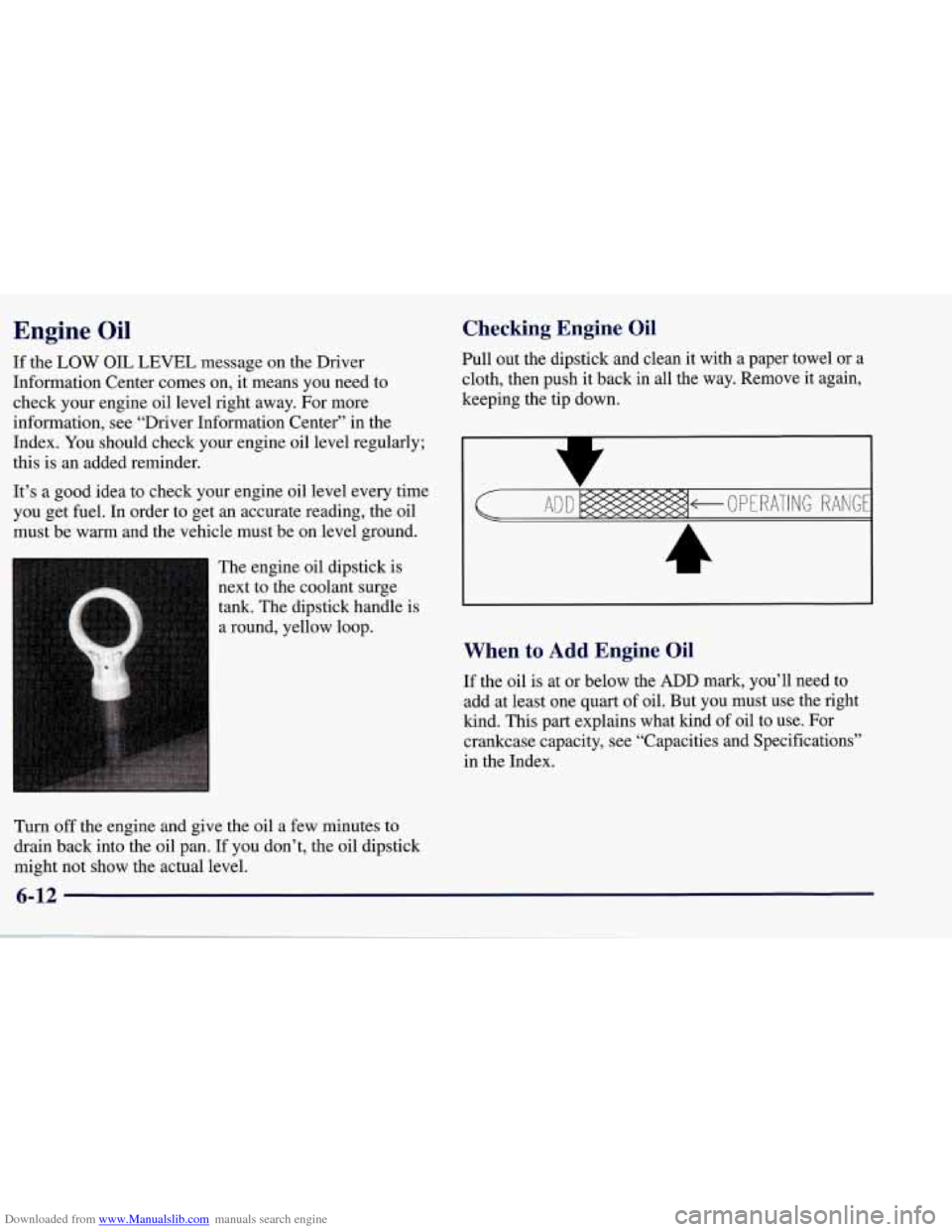
The engine oil dipstick is
next to the coolant surge
tank. The dipstick handle is
a round, yellow loop.
Turn off the engine and give the oil a few minutes to
drain back into the oil pan. If you don’t, the oil dipstick
might not show the actual level.
Checking Engine Oil
Pull out the dipstick and clean it with a paper towel or a
cloth, then push it back in all the way. Remove it again,
keeping the tip down.
When to Add Engine Oil
If the oil is at or below the ADD mark, you’ll need to
add at least one quart of oil. But you must use the right
kind. This part explains what kind of oil to use. For
crankcase capacity, see “Capacities and Specifications”
in the Index.
6-12
Page 294 of 378
Downloaded from www.Manualslib.com manuals search engine A CAUTION:
Using the wrong replacement wheels, wheel bolts
or wheel nuts on your vehicle can be dangerous.
It could affect the braking and handling of your
vehicle, make your tires lose air and make you
lose control. You could have a collision in which
you or others could be injured. Always use the
correct wheel, wheel bolts and wheel nuts
for replacement.
I NOTICE:
The wrong wheel can also cause problems with
bearing life, brake cooling, speedometer or
odometer calibration, headlamp aim, bumper
height, vehicle ground clearance and tire
clearance to the body and chassis.
A CAUTION:
Rust or dirt on the wheel, or on the parts to
which
it is fastened, can make the wheel nuts
become loose after a time. The wheel could come
off and cause an accident. When you change a
wheel, remove any rust or dirt from the places
where the wheel attaches to the vehicle. In an
emergency, you can use a cloth or paper towel to
do this; but be sure to use a scraper or wire brush
later,
if you need to, to get all the rust or dirt off.
I A CAUTION:
I
Never use oil or grease on studs or nuts. If you
do, the nuts might come loose. Your wheel could
fall off, causing a serious accident.
6-49