Page 257 of 414
Downloaded from www.Manualslib.com manuals search engine 3. Put the flat end of the extension on an angle through
the hole in the rear door frame, above the bumper.
Turn the ratchet toward the right until the tire is
against the underside of the vehicle.
Keep turning the ratchet until you feel at least two
“clicks” when the tire is up all the way. Try to move
the tire with your hands to make sure it is securely
in place.
The compact spare is for temporary use only. Replace
the compact spare tire with a full-size tire as soon as
you can. See “Compact Spare Tire” in the Index. See
the storage instructions label to restore your compact
spare properly.
Return the jacking equipment to its proper location.
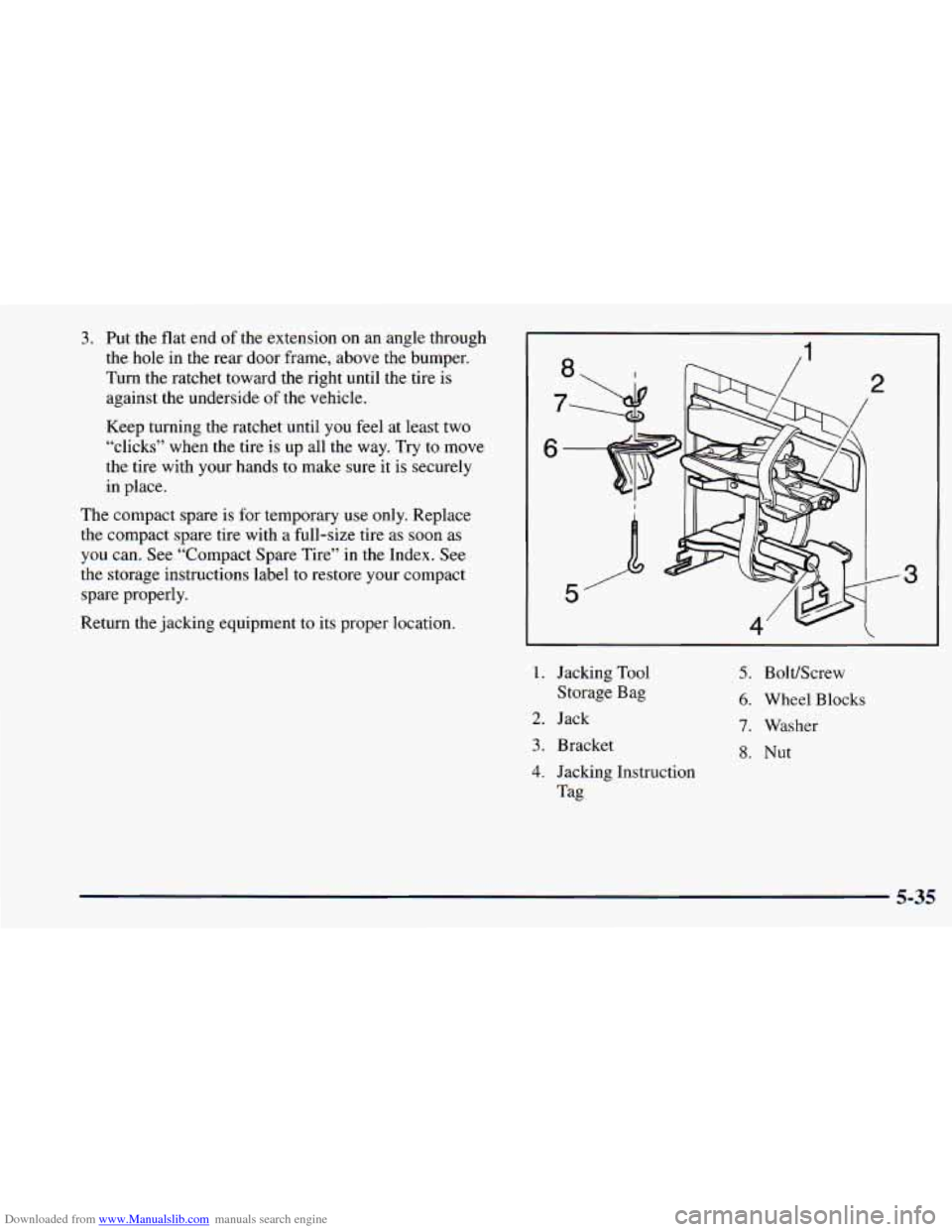
1. Jacking Tool
Storage Bag
2. Jack
3. Bracket
3
5. Bolt/Screw
6. Wheel Blocks
7. Washer
8. Nut
4. Jacking Instruction
Tag
5-35
Page 268 of 414
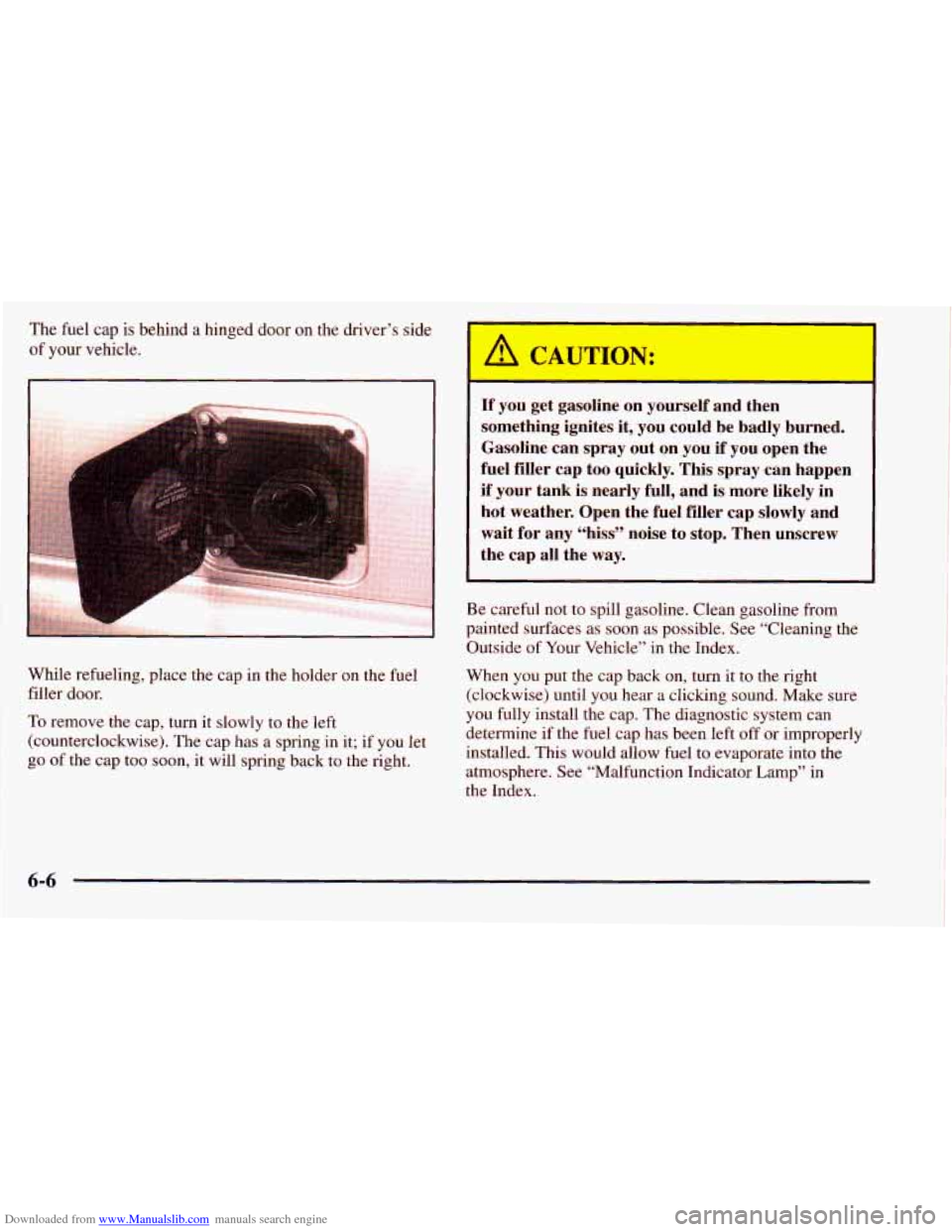
Downloaded from www.Manualslib.com manuals search engine The fuel cap is behind a hinged door on the driver’s side
of your vehicle.
While refueling, place the cap in the holder on the fuel
filler door.
To remove the cap, turn it slowly to the left
(counterclockwise). The cap has a spring in it;
if you let
go of the cap too soon,
it will spring back to the right.
1
A CAUTION:
If you get gasoline on yourself and then
something ignites it, you could be badly burned.
Gasoline can spray out on you if you open the
fuel filler cap too quickly. This spray can happen
if your tank is nearly full, and is more likely in
hot weather. Open the fuel filler cap slowly and
wait for any (‘hiss” noise to stop. Then unscrew
the cap all the way.
Be careful not to spill gasoline. Clean gasoline from
painted surfaces as soon as possible. See “Cleaning the
Outside of Your Vehicle” in the Index.
When you put the cap back on, turn it to the right
(clockwise) until you hear a clicking sound. Make sure
you fully install the cap. The diagnostic system can
determine
if the fuel cap has been left off or improperly
installed. This would allow fuel to evaporate into the
atmosphere. See “Malfunction Indicator Lamp” in
the Index.
Page 284 of 414
Downloaded from www.Manualslib.com manuals search engine I
Then, without shutting off the engine, follow these steps:
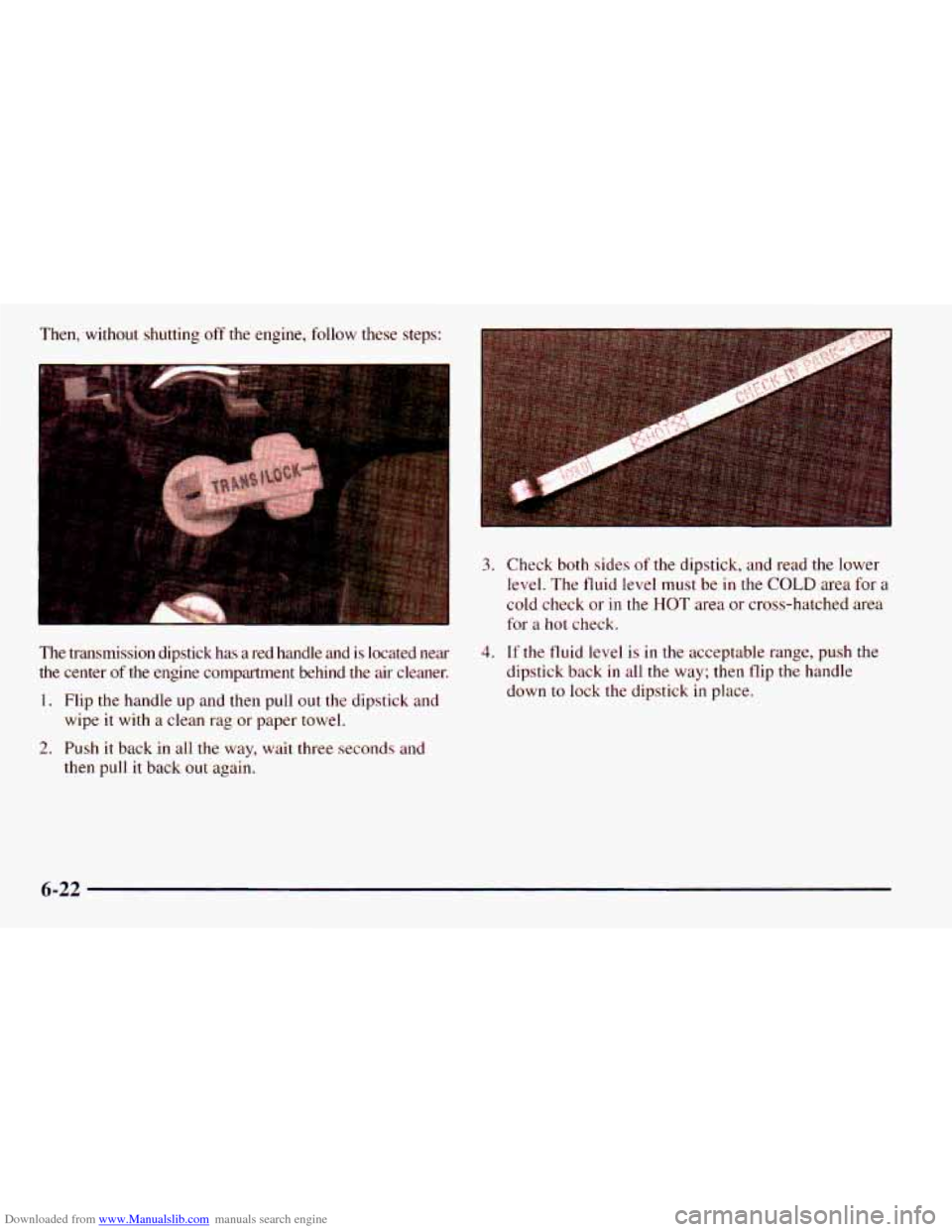
The transmission dipstick has a red handle and
is located near
the center of the engine compartment behind the air cleaner.
1. Flip the handle up and then pull out the dipstick and
wipe it with a clean rag or paper towel.
then pull it back out again.
2. Push it back in all the way, wait three seconds and
3. Check both sides of the dipstick, and read the lower
level. The fluid level must be in the
COLD area for a
cold check or in the
HOT area or cross-hatched area
for a hot check.
4. If the fluid level is in the acceptable range, push the
dipstick back
in all the way; then flip the handle
down to lock the dipstick in place.
6-22
Page 285 of 414

Downloaded from www.Manualslib.com manuals search engine How to Add Fluid
Refer to the Maintenance Schedule to determine what
kind of transmission fluid to use. See “Recommended
Fluids and Lubricants” in the Index.
Add fluid
only after checking the transmission fluid
while it is hot. (A cold check is used
only as a
reference.) If the fluid level is low, add only enough of
the proper fluid to bring the level up to the HOT area for
a hot check. It doesn’t take much fluid, generally less
than one pint
(0.5 L). Don’t overji11.
NOTICE:
We recommend you use only fluid labeled
DEXRON@-111, because fluid with that label is
made especially for your automatic transmission.
Damage caused by fluid other than DEXRON-I11
is not covered by your new vehicle warranty.
After adding fluid, recheck the fluid level as
described under “How
to Check.”
When the correct fluid level is obtained, push the
dipstick back in
all the way; then flip the handle
down to lock the dipstick in place.
All-Wheel Drive
If you have an all-wheel-drive vehicle, be sure to
perform
the lubricant checks described in this section.
However, they have two additional systems that
need lubrication.
Transfer Case
When to Check Lubricant
Refer to the Maintenance Schedule to determine how
often to check
the lubricant. See “Periodic Maintenance
Inspections” in the Index.
6-23
Page 302 of 414
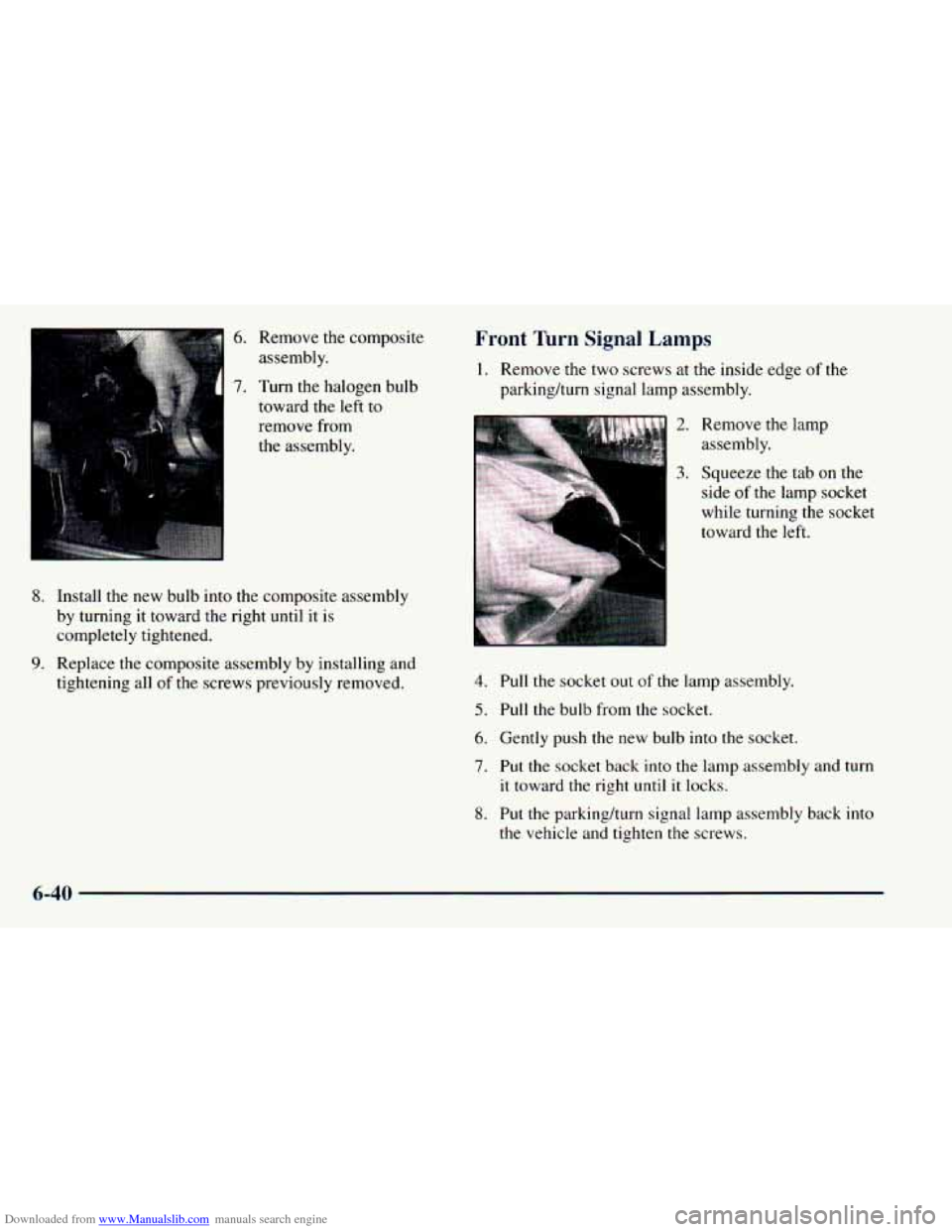
Downloaded from www.Manualslib.com manuals search engine 6. Remove the composite
assembly.
7. Turn the halogen bulb
toward the left
to
remove from
the assembly.
8. Install the new bulb into the composite assembly
by turning it toward the right until it is
completely tightened.
tightening all
of the screws previously removed.
9. Replace the composite assembly by installing and
Front Turn Signal Lamps
1. Remove the two screws at the inside edge of the
parkingkurn signal lamp assembly.
4.
5.
6.
7.
8.
.. .
2.
3.
Remove the lamp
assembly.
Squeeze the tab
on the
side of the lamp socket
while turning the socket
toward
the left.
Pull the socket out
of the lamp assembly.
Pull the bulb from the socket.
Gently push the new bulb into the socket.
Put the socket back into the lamp assembly and turn
it toward the right until it locks.
Put
the parkinghrn signal lamp assembly back into
the vehicle and tighten the screws.
6-40
Page 304 of 414
Downloaded from www.Manualslib.com manuals search engine 5. Reverse Steps 1 through 4 to reinstall the taillamp.
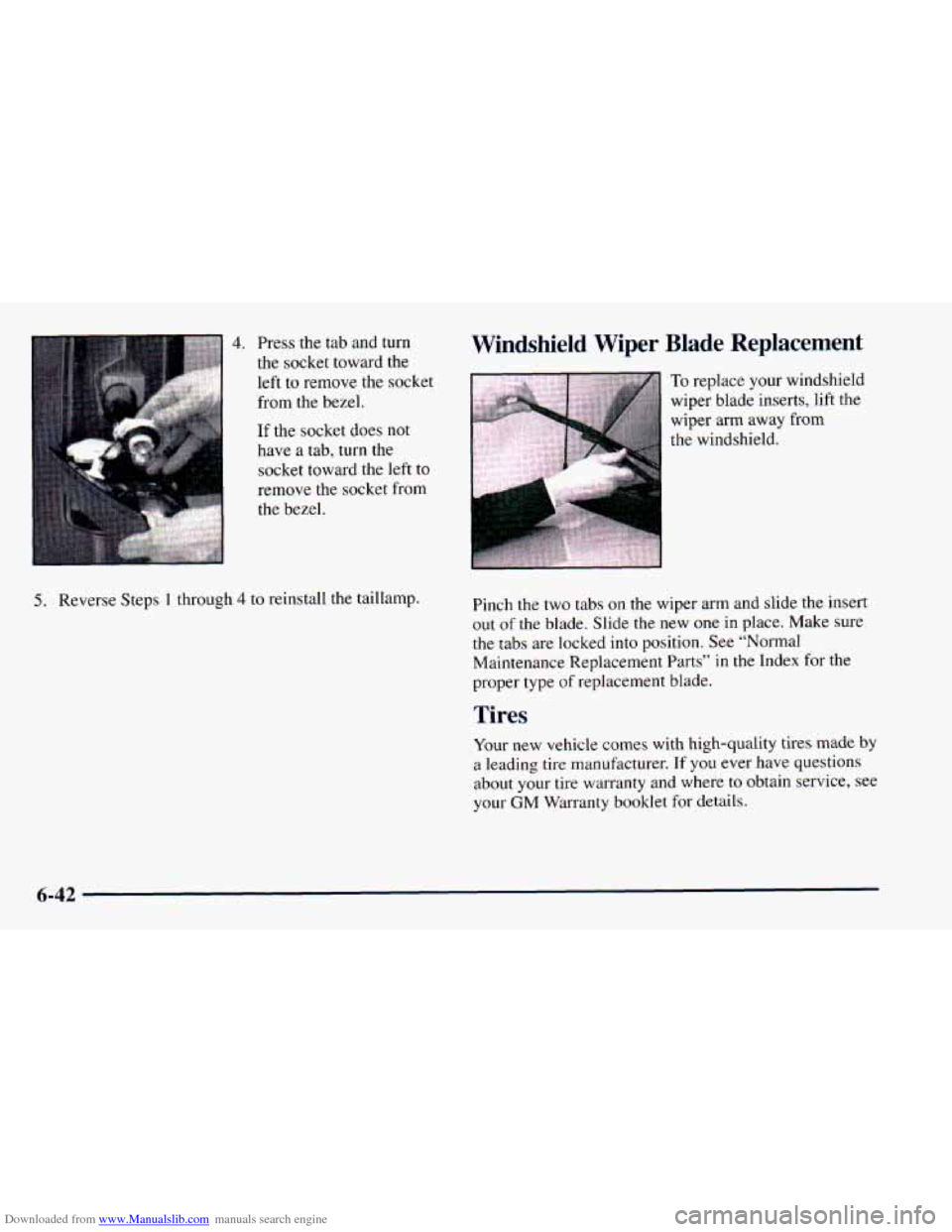
Pinch the two tabs on the wiper arm and slide the insert
out
of the blade, Slide the new one in place. Make sure
the tabs are locked into position. See “Normal
Maintenance Replacement Parts”
in the Index for the
proper type
of replacement blade.
Tires
Your new vehicle comes with high-quality tires made by
a leading tire manufacturer. If you ever have questions
about your tire warranty and where
to obtain service, see
your
GM Warranty booklet for details.
6-42
Page 323 of 414
Downloaded from www.Manualslib.com manuals search engine 11
Fuses and Circuit Breakers
The wiring circuits in your vehicle are protected from
short circuits by a combination of fuses, circuit breakers
and fusible thermal links. This greatly reduces the
chance of fires caused by electrical problems.
Look at the silver-colored band inside the fuse. If the
band is broken or melted, replace the fuse. Be sure you
replace a bad fuse with a new one of the identical size
and rating.
Spare fuses and a fuse puller are located in the
underhood electrical center.
You can remove fuses with
the fuse puller. Remember to replace any of the spare
fuses you use,
so you will have some if you ever need
them again.
If you ever have a problem on the road and don’t have a
spare fuse, you can borrow one that has the same
amperage. Just pick some feature of your vehicle that
you can get along without
-- like the radio or cigarette
lighter
-- and use its fuse, if it is the correct amperage.
Replace
it as soon as you can.
There are two fuse blocks in your vehicle: one is inside
the vehicle and one is in the engine compartment.
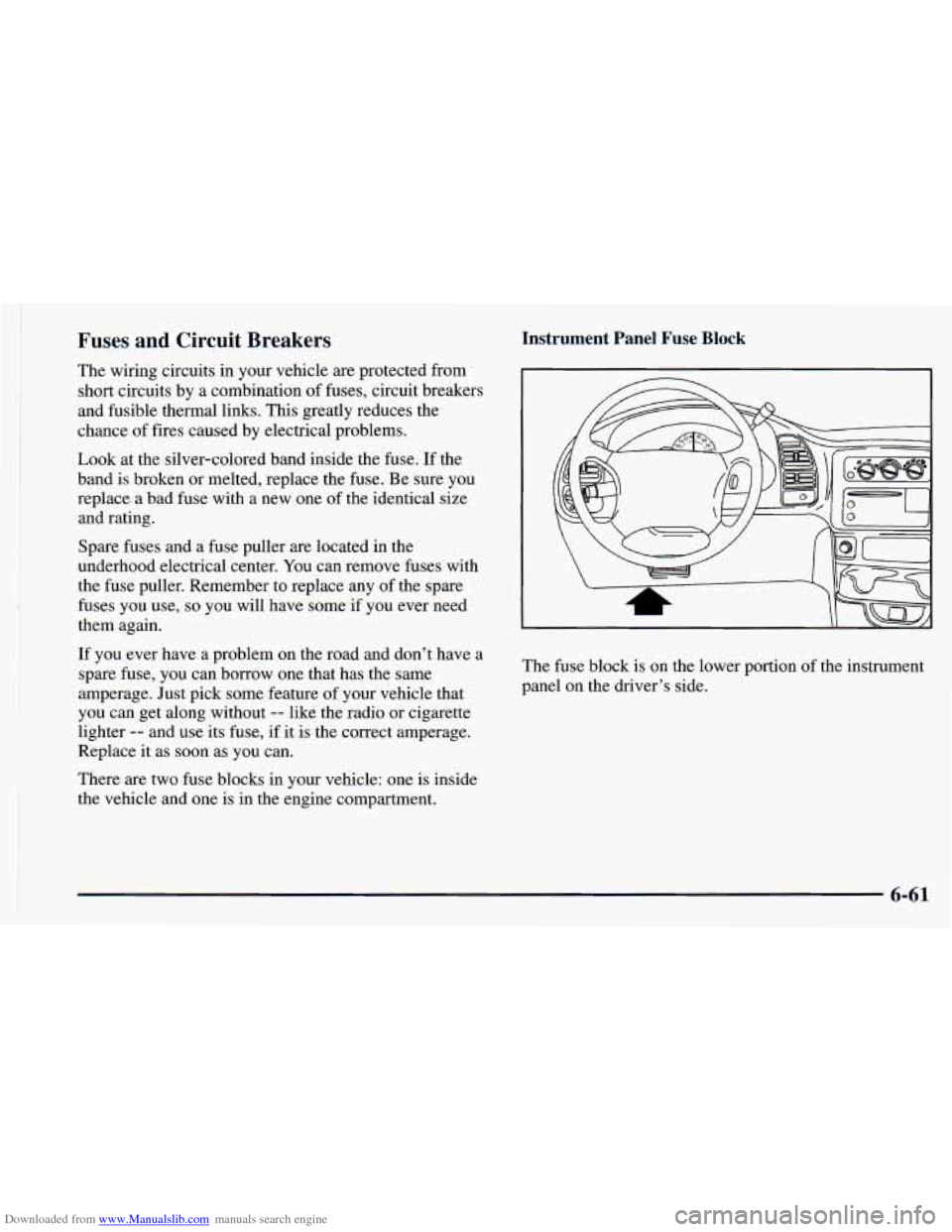
Instrument Panel Fuse Block
The fuse block is on the lower portion of the instrument
panel on the driver’s side.
6-61
Page 325 of 414

Downloaded from www.Manualslib.com manuals search engine FuseKircuit Breaker Usage
12
13
14
15
16
17
L, M 1, M2 Blower Motor, Rear A/C
Relay Coil, Front Cont. Temp. Door
Motor,
HI Blower Relay, Defogger
Timer Coil
Cigar Lighter, Door Lock Switches,
Dutch Door Release Module
Cluster Illum, HVAC Controls, Chime
Module, Radio Illumination, Rear Heat
Switch Illumination, Rear
Wiper/Washer Switch Illumination,
Rear Liftgate Switch Illumination,
Remote Cassette Illumination, O/H
Console
DRL Lamps
Front Turn Signals, Rear Turn Signals,
Trailer Turn Signals, Back-up Lamps,
BTSI Solenoid
Radio: ATC (Standby), 2000 Series
(Main Feed), Rear Seat Audio Controls 19
20
FuseKircuit
Breaker Usage
18 VCM-Ign 3, VCM-Brake, LCWAL,
Cruise Stepper Motor Signal
Radio: ATC (Main Feed),
2000 Series
(Standby)
PRNDL/ Odometer, TCC Enable and
PWM Solenoid, Shift A and Shift B
Solenoids, 3-2 Downshift Solenoid
21
22
23
24
A
B Not Used
Security/Steering Module
Rear Wiper, Rear Washer Pump
Not Used (Circuit Breaker) Power Door
Lock
Relay, 6-way Power Seat, Remote
Control Door Lock Receiver, Dutch
Door Module, Dutch Door Release
(Circuit Breaker) Power Windows
6-63