Page 228 of 414
Downloaded from www.Manualslib.com manuals search engine 9.
10.
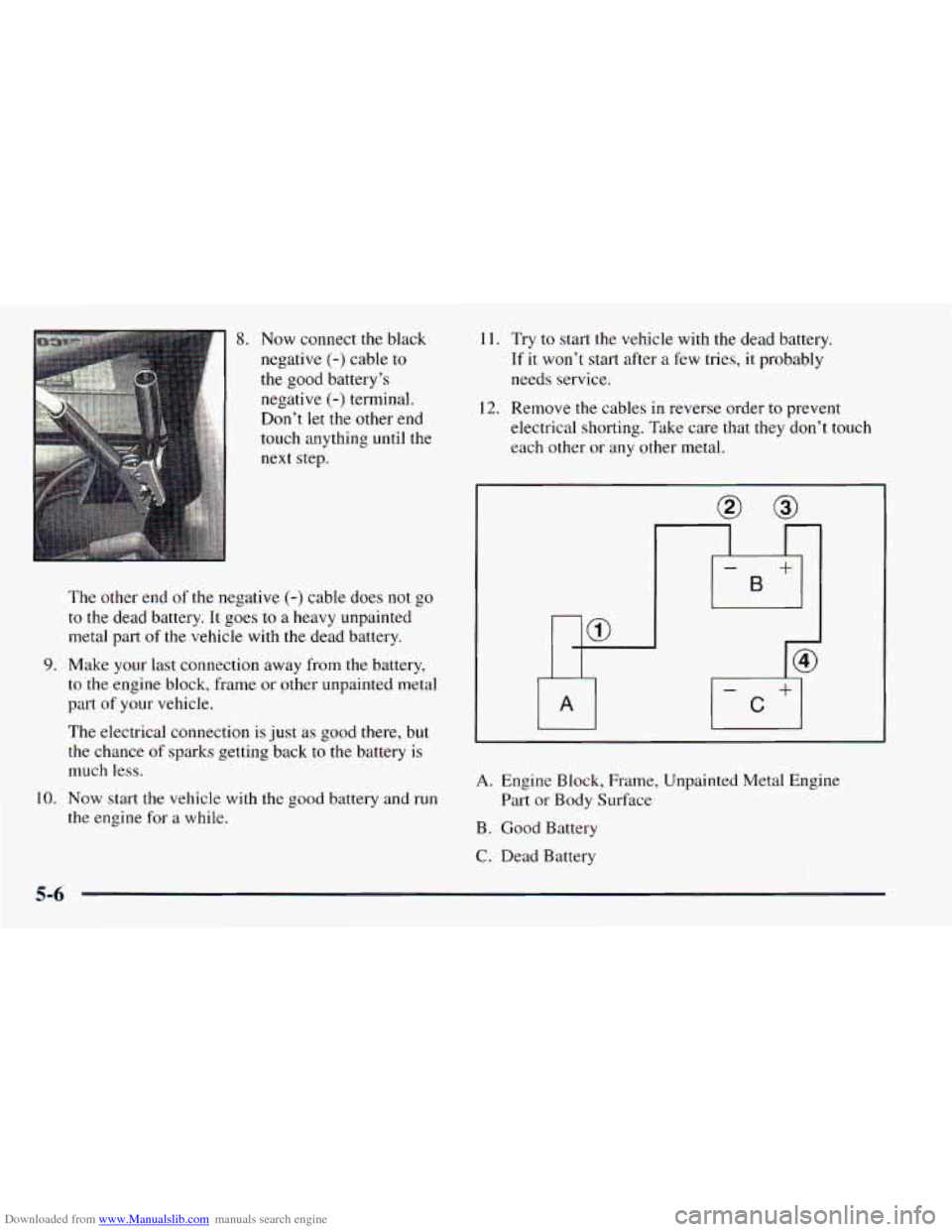
8. Now connect the black
negative
(-) cable to
the good battery’s
negative
(-) terminal.
Don’t
let the other end
touch anything until the
next step.
11. Try to start the vehicle with the dead battery.
If it won’t start after a few tries, it probably
needs service.
12. Remove the cables in reverse order to prevent
electrical shorting. Take care that they don’t touch
each other or any other metal.
The other end of the negative
(-) cable does not go
to the dead battery. It goes to a heavy unpainted
metal part
of the vehicle with the dead battery.
Make your last connection away from the battery,
to the engine block, frame or other unpainted metal
part of your vehicle.
The electrical connection is just
as good there, but
the chance
of sparks getting back to the battery is
much less.
Now start the vehicle with the good battery and run
the engine
for a while.
1Al
A. Engine Block, Frame, Unpainted Metal Engine
B. Good Battery
C. Dead Battery
Part
or Body
Surface
J
5-6
Page 230 of 414
Downloaded from www.Manualslib.com manuals search engine A CAUTION:
A vehicle can fall from a car carrier if it isn’t
adequately secured. This can cause
a collision,
serious personal injury and vehicle damage. The
vehicle should be tightly secured with chains or
steel cables before
it is transported.
Don’t use substitutes (ropes, leather straps,
canvas webbing, etc.) that can be cut by sharp
edges underneath the towed vehicle.
When your vehicle is being towed, have the ignition
key in the
OFF position. The steering wheel should
be clamped in a straight-ahead position, with a
clamping device designed for towing service. Do not
use the vehicle’s steering column lock for this. The
transmission should be in NEUTRAL
(N) and the
parking brake released.
I I
If your vehicle has the all-wheel-drive option, it can
only be towed with all four wheels
off the ground.
A dolly must be used under the unraised wheels
when towing or the vehicle must be transported on a
flat bed carrier.
Don’t have your vehicle towed with the wheels in
contact with the ground
if it has all-wheel drive. If
a vehicle with all-wheel drive must be towed with
sling-type or wheel-lift equipment, then either the
front or rear wheels must be supported on a dolly.
NOTICE:
If your vehicle has all-wheel drive, do not have
it towed with the wheels in contact with the
ground or vehicle damage may occur.
A dolly
must be used under the unraised wheels when
towing or the vehicle must be transported
on a
flat bed carrier.
5-8
Page 241 of 414
Downloaded from www.Manualslib.com manuals search engine How to Add Coolant to the Radiator
1.
I
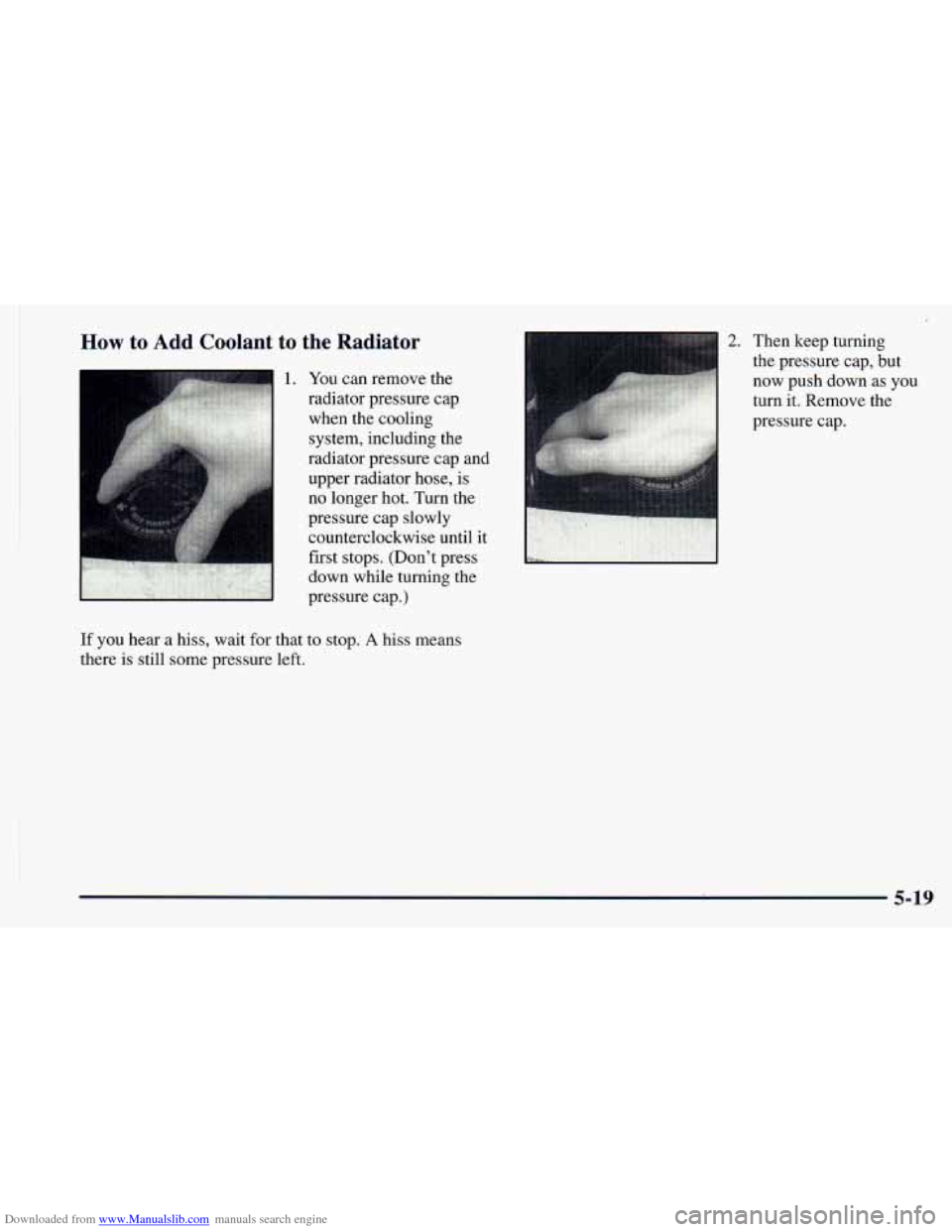
You can remove the
radiator pressure cap
when the cooling system, including the
radiator pressure cap and
upper radiator hose, is
no longer hot. Turn the
pressure cap slowly
counterclockwise until it
first stops. (Don’t press down while turning the
pressure cap.)
2.
If you hear a hiss, wait for that to stop. A hiss means
there is still some pressure left. Then keep turning
the pressure cap, but now push down as you
turn
it. Remove the
pressure cap.
1 I
I 5-19
Page 245 of 414
Downloaded from www.Manualslib.com manuals search engine Changing a Flat Tire
If a tire goes flat, avoid further tire and wheel damage
by driving slowly to a level place. Turn on your hazard
warning flashers.
/! C! UTION:
Changing a tire can cause an injury. The vehicle
can slip
off the jack and roll over you or other
people. You and they could be badly injured.
Find
a level place to change your tire. To help
prevent the vehicle from moving:
1. Set the parking brake firmly.
2. Put the shift lever in PARK (P).
3. Turn off the engine.
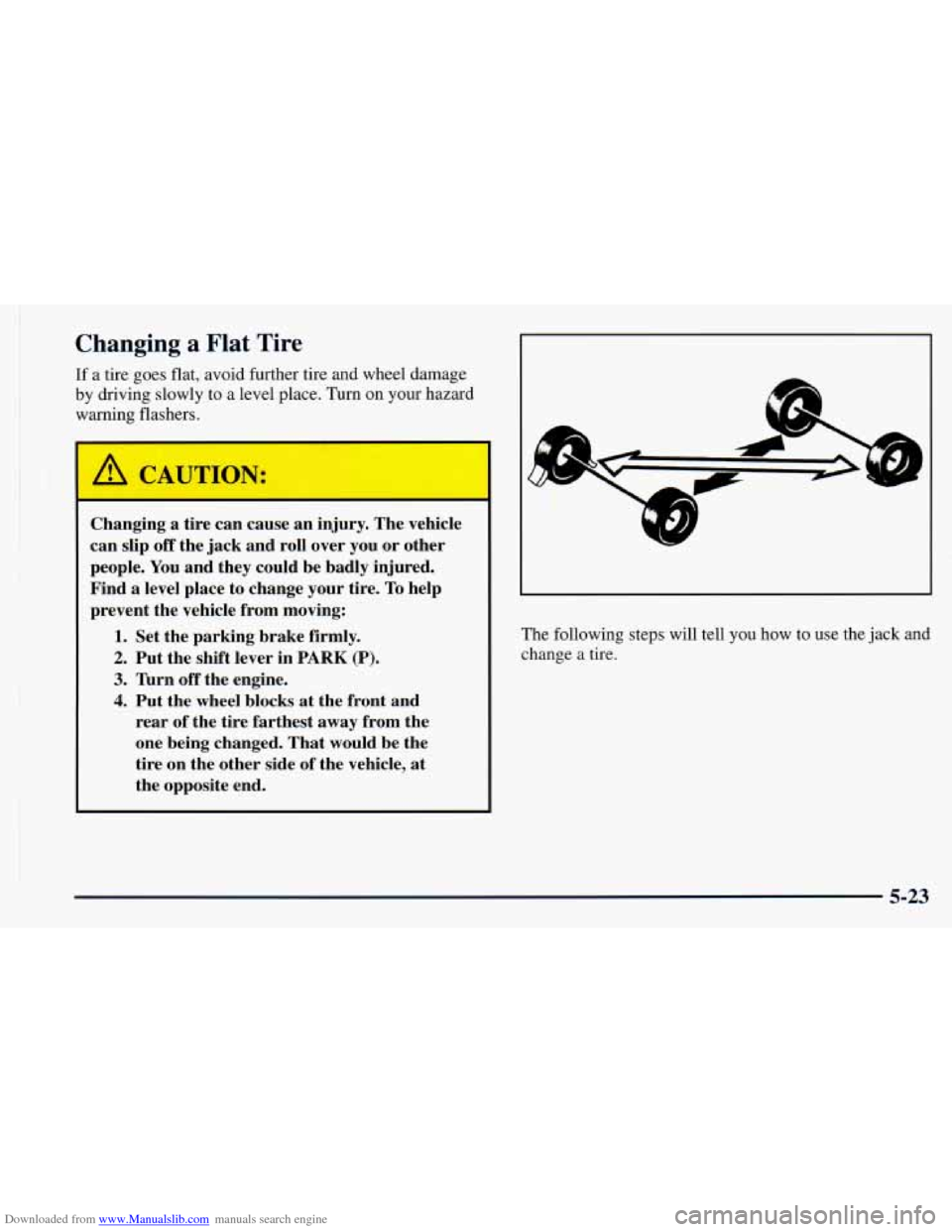
4. Put the wheel blocks at the front and
rear of the tire farthest away from the
one being changed. That would be the
tire on the other side of the vehicle, at
the opposite end. The
following steps will tell
you how to use the jack and
change a tire.
5-23
Page 246 of 414
Downloaded from www.Manualslib.com manuals search engine Removing the Spare Tire and Tools
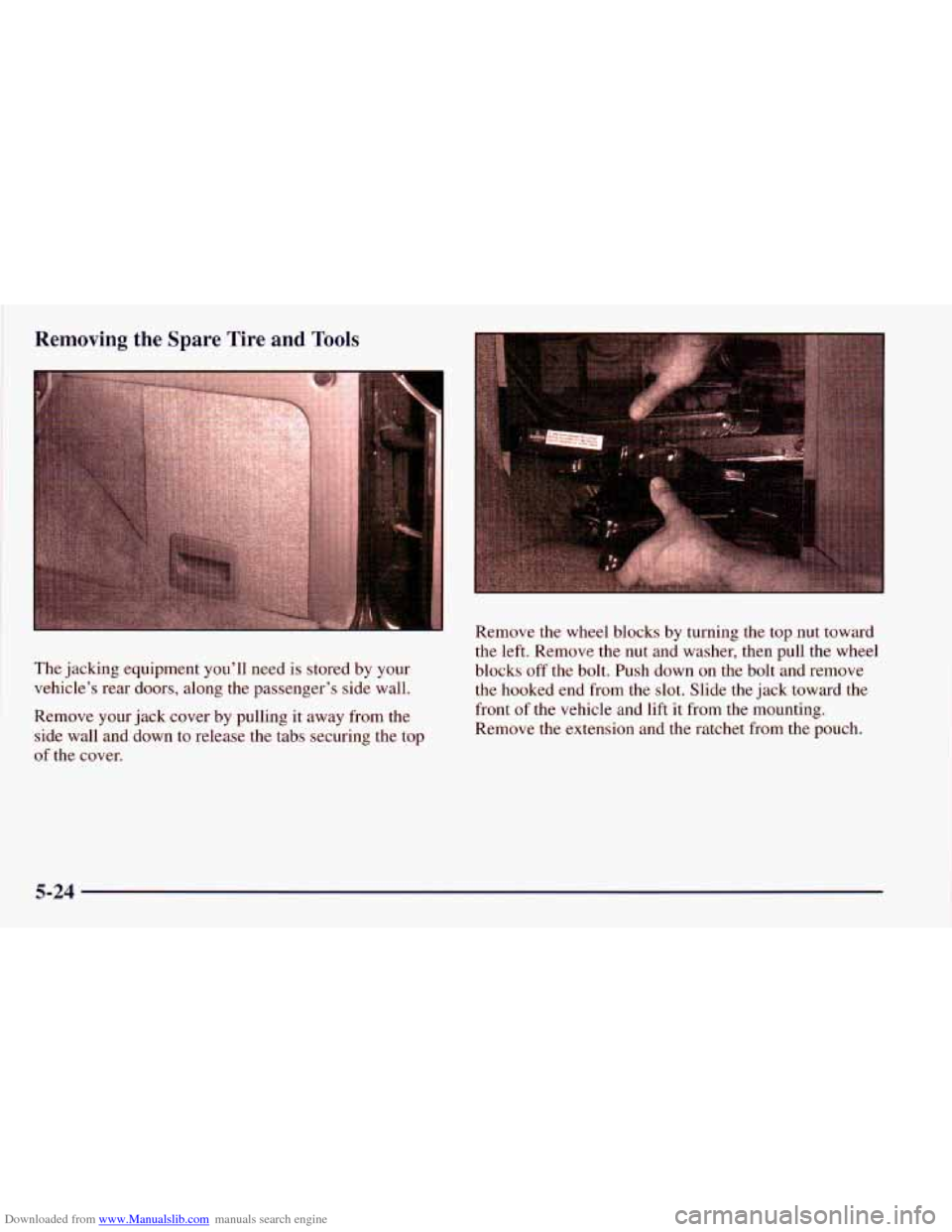
The jacking equipment you'll need is stored by your
vehicle's rear doors, along the passenger's side wall.
Remove your jack cover by pulling it away from the
side wall and down to release the tabs securing the top
of the cover. Remove
the wheel blocks by turning the top nut toward
the left. Remove the nut and washer, then pull the wheel
blocks off the bolt. Push down on the bolt and remove
the hooked end from the slot. Slide the jack toward the
front of the vehicle and lift it from the mounting.
Remove the extension and the ratchet from the pouch.
5-24
Page 249 of 414
Downloaded from www.Manualslib.com manuals search engine r-- -
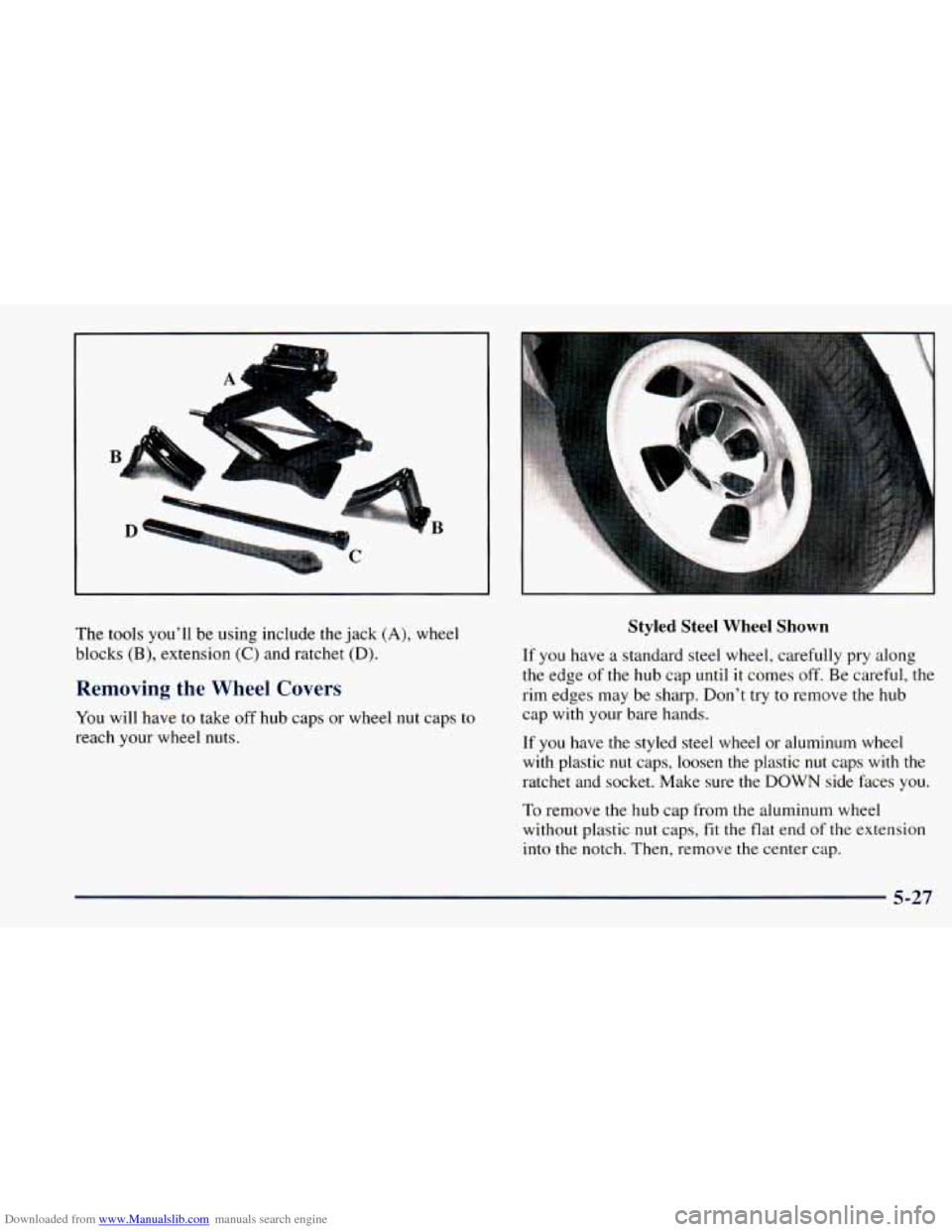
The tools you'll be using include the jack (A), wheel
blocks
(B), extension (C) and ratchet (D).
Removing the Wheel Covers
You will have to take off hub caps or wheel nut caps to
reach your wheel nuts.
I
Styled Steel Wheel Shown
If you have a standard steel wheel, carefully pry along
the edge
of the hub cap until it comes off. Be careful, the
rim edges may be sharp. Don't try to remove the hub
cap with your bare hands.
If you have the styled steel wheel or aluminum wheel
with plastic nut caps, loosen the plastic nut caps with the
ratchet and socket. Make sure the
DOWN side faces you.
To remove the hub cap from the aluminum wheel
without plastic
nut caps, fit the flat end of the extension
into the notch. Then, remove the center cap.
5-27
Page 250 of 414
Downloaded from www.Manualslib.com manuals search engine Removing the Flat Tire and Installing the
Spare Tire
. . . . . . . ..
I
1. Before you start, block the front and rear of the tire
farthest away from the one being changed. Then put
your spare tire near the flat tire.
2. With the DOWN side facing you, use the ratchet and
socket
to loosen all the wheel nuts. Don’t remove
them yet.
3. The jack has a bolt on the end. Attach the socket end
of the extension
to the jack bolt.
5-28
Page 256 of 414
Downloaded from www.Manualslib.com manuals search engine NOTICE:
Improperly tightened wheel nuts can lead to
brake pulsation and rotor damage.
To avoid
expensive brake repairs, evenly tighten the wheel
nuts in the proper sequence and to the proper
torque specification.
13. Remove the wheel blocks.
I NOTICE:
Wheel covers won’t fit on your compact spare. If
you try to put a wheel cover on your compact
spare, you could damage the cover or the spare.
Storing a Flat or Spare Tire and Tools
I
A CdJTdN:
Storing a jack, a tire or other equipment in the
passenger compartment
of the vehicle could
cause injury. In a sudden stop or collision, loose
equipment could strike someone. Store all these
in the proper place.
1. Put the flat tire on the ground at the rear of the
vehicle, with the valve stem pointed down.
2. Tilt the retainer plate downward and through the
wheel opening. Make sure it is fully seated across the
underside
of the wheel. Attach the ratchet, with the
UP side facing you, to the extension.
5-34