Page 235 of 414
Downloaded from www.Manualslib.com manuals search engine Engine Overheating
You will find an engine coolant temperature gage
on your vehicle’s instrument panel. See “Gages” in
the Index.
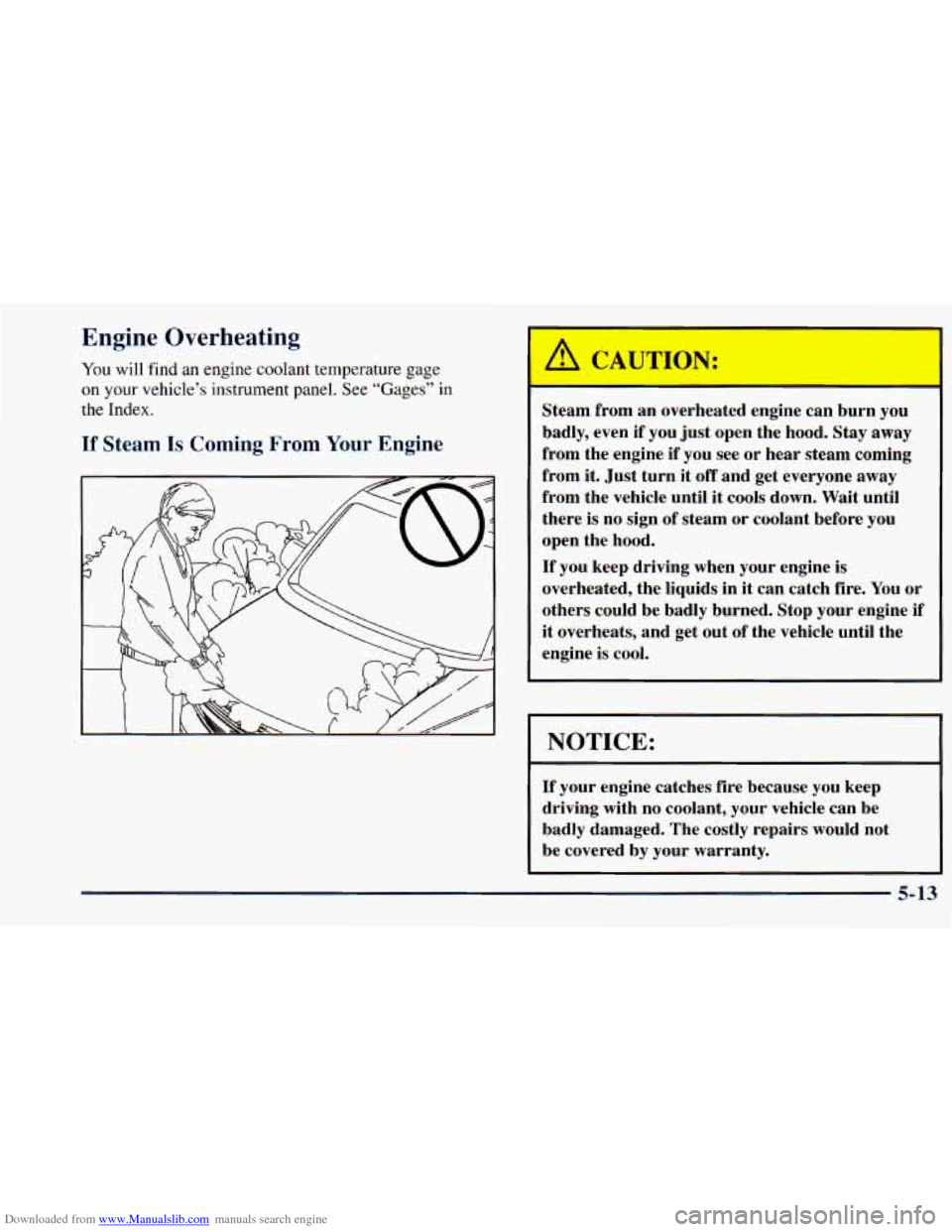
If Steam Is Coming From Your Engine
A CAUTION:
Steam from an overheated engine can burn you
badly, even if you just open the hood. Stay
away
from the engine if you see or hear steam coming
from it. Just turn it
off and get everyone away
from the vehicle until it cools down. Wait until
there is no sign of steam or coolant before you
open the hood.
If you keep driving when your engine is
overheated, the liquids in it can catch fire. You or
others could be badly burned. Stop your engine if
it overheats, and get out of the vehicle until the
engine is cool.
NOTICE:
If your engine catches fire because you keep
driving with no coolant, your vehicle can be
badly damaged. The costly repairs would not
be covered by your warranty.
5-13
Page 266 of 414
Downloaded from www.Manualslib.com manuals search engine If your vehicle is certified to meet California Emission
Standards (indicated on the underhood emission control
label), it is designed to operate on fuels that meet
California specifications.
If such fuels are not available
in states adopting California emissions standards, your
vehicle will operate satisfactorily on fuels meeting
federal specifications, but emission control system
performance may be affected. The malfunction indicator
lamp on your instrument panel may turn
on and/or your
vehicle may fail a smog-check test. If this occurs, return
to your authorized
GM dealer for diagnosis to determine
the cause of failure. In the event it
is determined that the
cause
of the condition is the type of fuels used, repairs
may not be covered by your warranty.
Some gasolines that
are not reformulated for low
emissions contain an octane-enhancing additive called
methylcyclopentadienyl manganese tricarbonyl (MMT);
ask your service station operator whether or not his fuel
contains MMT. General Motors does not recommend the
use
of such gasolines. If fuels containing MMT are used,
spark plug life may be reduced and your emission
control system performance may be affected. The
malfunction indicator lamp on your instrument panel
may turn
on. If this occurs, return to your authorized
GM dealer for service. To provide cleaner air, all
gasolines in the United States
are now required to contain additives that will help
prevent deposits from forming in your engine and fuel
system, allowing your emission control system
to
function properly. Therefore, you should not have to add
anything
to the fuel. In addition, gasolines containing
oxygenates, such as ethers and ethanol, and
reformulated gasolines may be available
in your area to
help clean the air. General Motors recommends that
you
use these gasolines if they comply with the
specifications described earlier.
NOTICE:
Your vehicle was not designed for fuel that
contains methanol. Don’t use it. It can corrode
metal parts in your fuel system and also damage
plastic and rubber parts. That damage wouldn’t
be covered under your warranty.
6-4
Page 277 of 414
Downloaded from www.Manualslib.com manuals search engine Engine Cover
Removing the Engine Cover
1. Move both front seats as far back as they will go.
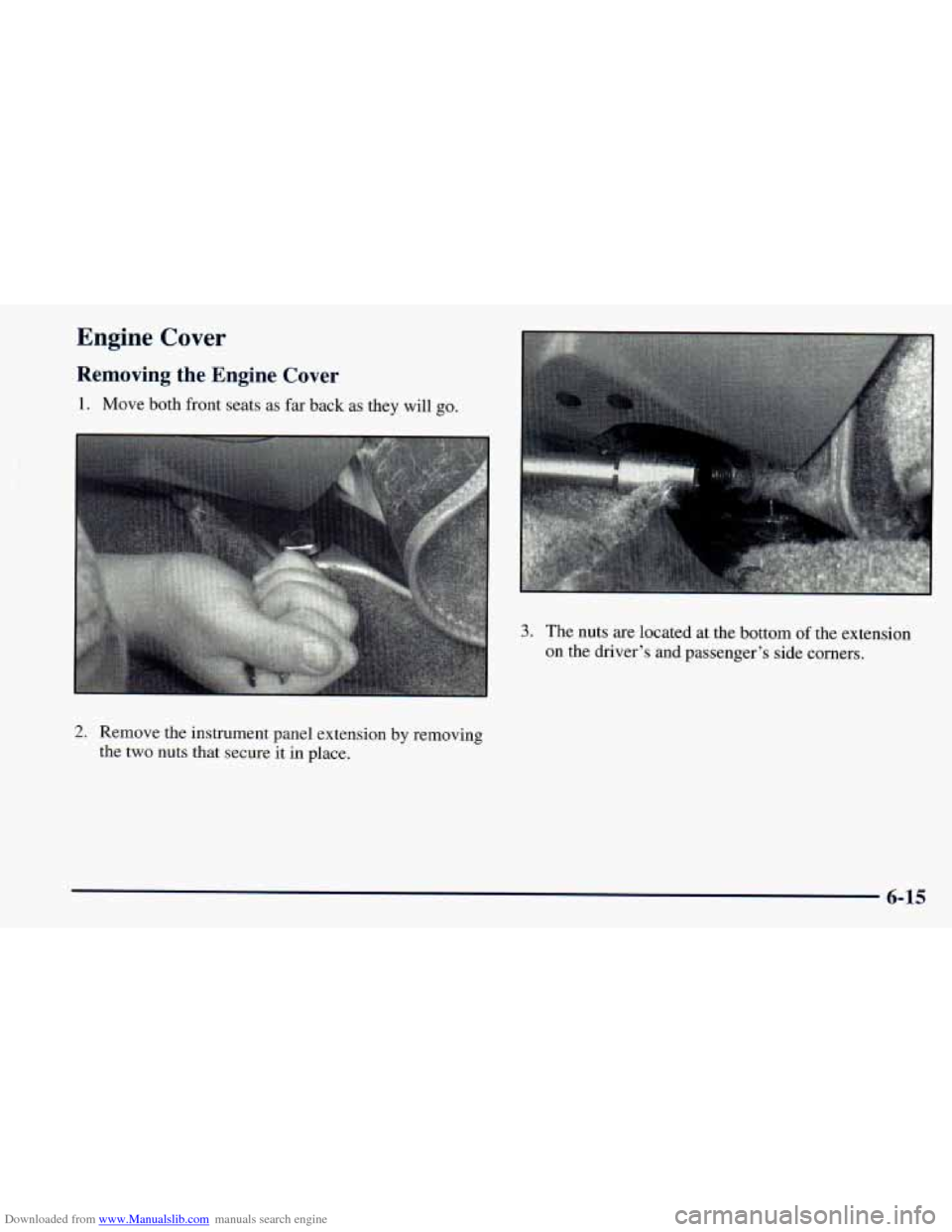
2. Remove the instrument panel extension by removing
the two nuts that secure it in place.
3. The nuts are located at the bottom of the extension
on the driver’s and passenger’s side corners.
6-15
Page 279 of 414
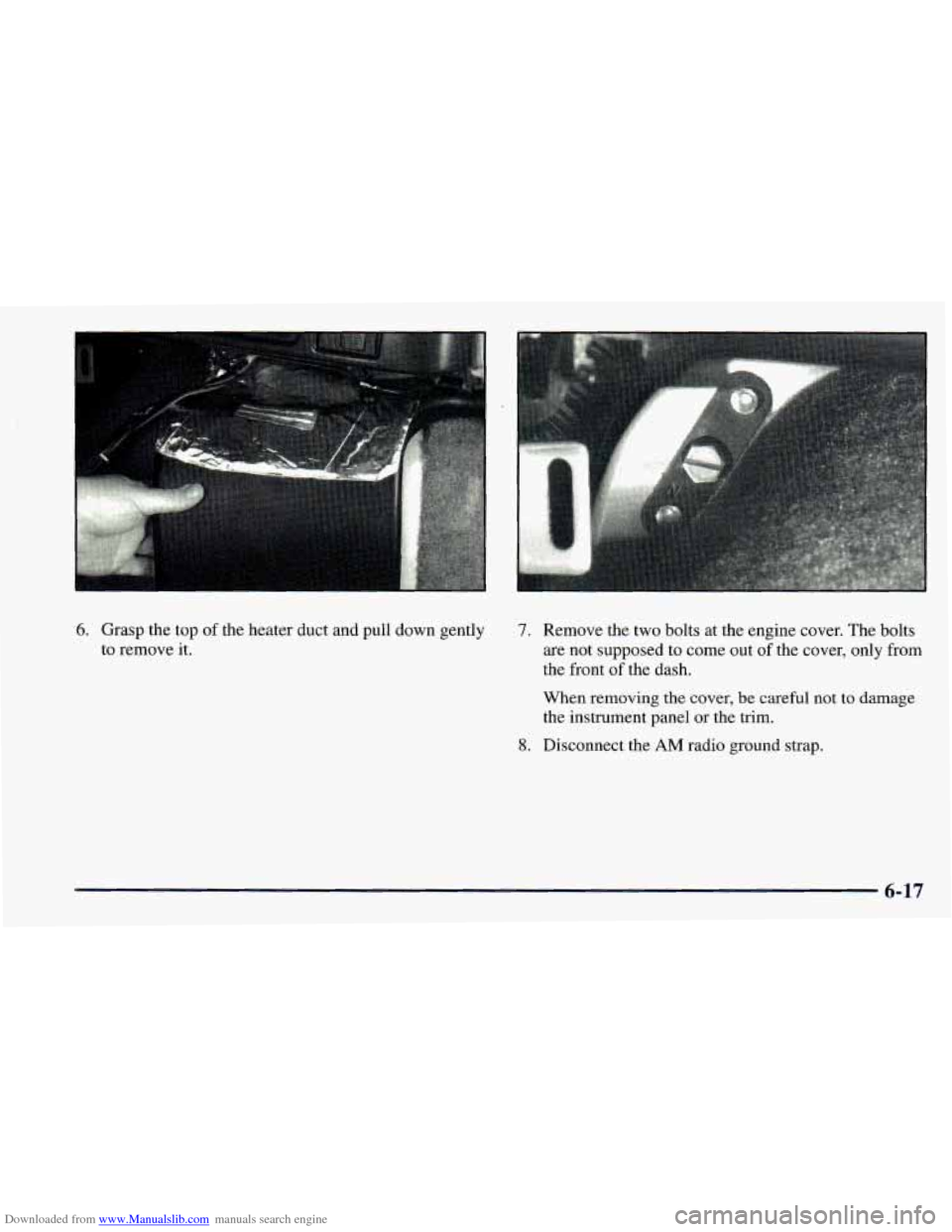
Downloaded from www.Manualslib.com manuals search engine 6. Grasp the top of the heater duct and pull down gently
to remove it. 7. Remove the two bolts at the engine cover. The bolts
are not supposed to come out of the cover, only from
the front of the dash.
When removing the cover, be careful not
to damage
the instrument panel or the trim.
8. Disconnect the AM radio ground strap.
6-17
Page 315 of 414
Downloaded from www.Manualslib.com manuals search engine Use warm water and a clean cloth.
0 Rub with a clean, damp cloth to remove dirt. You
0 Things like tar, asphalt and shoe polish will stain if
may have
to do it more than once.
you don’t get them off quickly. Use a clean cloth and
a vinyl/leather cleaner. See your dealer for
this product.
Cleaning Leather
Use a soft cloth with lukewarm water and a mild soap or
saddle soap and wipe dry with a soft cloth. Then, let the
leather dry naturally. Do
not use heat to dry.
For stubborn stains, use a leather cleaner. See your
dealer for this product.
Never use oils, varnishes, solvent-based or abrasive
cleaners, furniture polish or shoe polish
on leather.
0 Soiled or stained leather should be cleaned
immediately. If dirt is allowed to work into the
finish, it can harm the leather.
Cleaning the Top of the Instrument Panel
Use only mild soap and water to clean the top surfaces
of the instrument panel. Sprays containing silicones or
waxes may cause annoying reflections in the windshield
and even make it difficult
to see through the windshield
under certain conditions.
Cleaning Interior Plastic Components
Use only a mild soap and water solution on a soft
cloth or sponge. Commercial cleaners may affect the
surface finish.
Cleaning the Built-in Child Restraint
Your built-in child restraint may be cleaned with mild
soap and lukewarm water. Don’t use household cleaners.
They may weaken the harness or damage plastic parts.
The built-in child restraint pad is attached to the child
restraint cushion and seatback with fastener strips.
You
can remove the pad, machine wash it in cold water on a
gentle cycle and tumble dry it on a low heat setting.
Never bleach or iron the pad, and don’t dry clean it.
6-53
Page 321 of 414
Downloaded from www.Manualslib.com manuals search engine Vehicle Identification Number (VIN)
II
I
ENGINE/l998 7 - ASSEMBLY
CODE MODEL YEAR
PLANT I
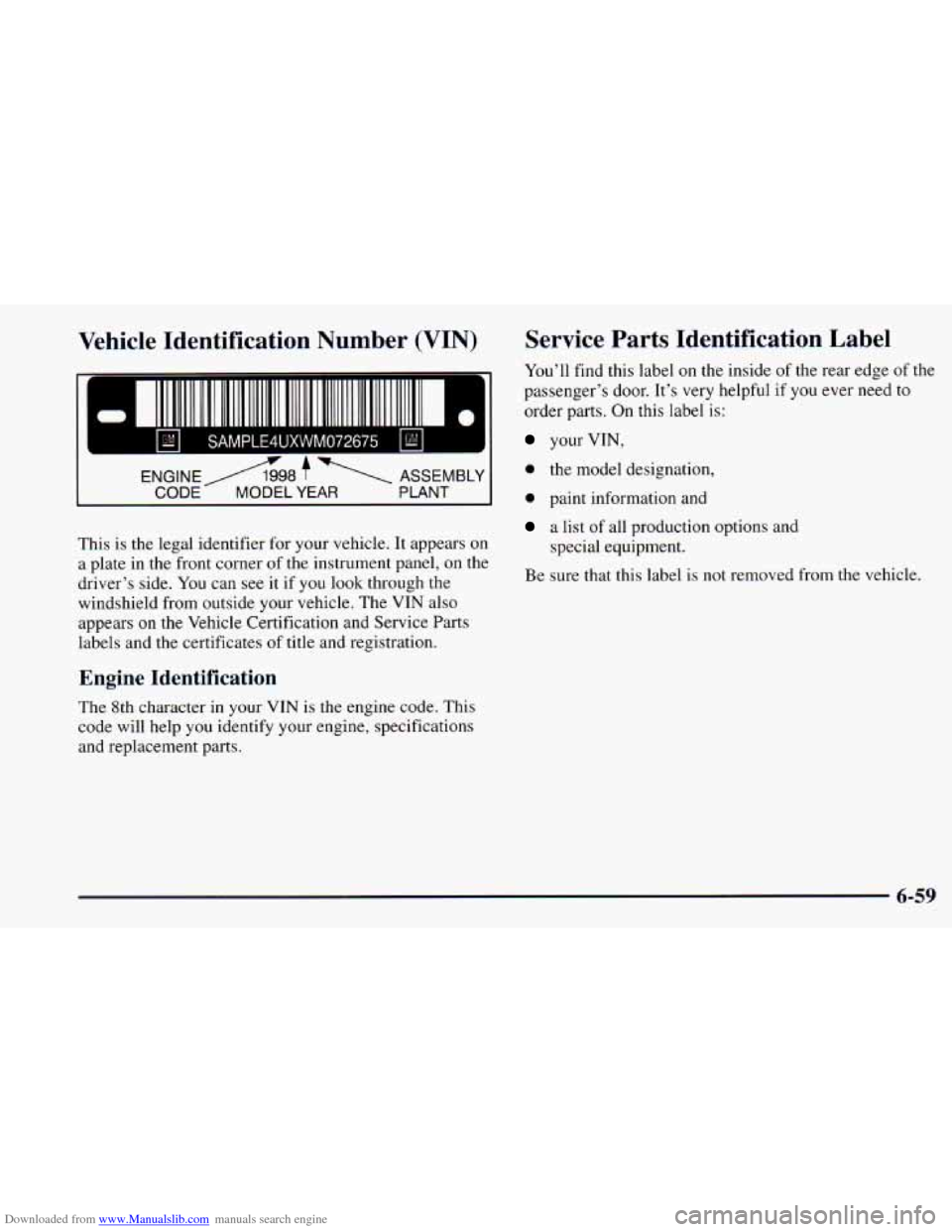
This is the legal identifier for your vehicle. It appears on
a plate in the front corner
of the instrument panel, on the
driver’s side.
You can see it if you look through the
windshield from outside your vehicle.
The VIN also
appears on the Vehicle Certification and Service Parts
labels and the certificates of title and registration.
Engine Identification
The 8th character in your VIN is the engine code. This
code will help you identify your engine, specifications
and replacement parts.
Service Parts Identification Label
You’ll find this label on the inside of the rear edge of the
passenger’s door. It’s very helpful if
you ever need to
order parts.
On this label is:
your VIN,
0 the model designation,
0 paint information and
a list of all production options and
special equipment.
Be sure that this label
is not removed from the vehicle.
6-59
Page 323 of 414
Downloaded from www.Manualslib.com manuals search engine 11
Fuses and Circuit Breakers
The wiring circuits in your vehicle are protected from
short circuits by a combination of fuses, circuit breakers
and fusible thermal links. This greatly reduces the
chance of fires caused by electrical problems.
Look at the silver-colored band inside the fuse. If the
band is broken or melted, replace the fuse. Be sure you
replace a bad fuse with a new one of the identical size
and rating.
Spare fuses and a fuse puller are located in the
underhood electrical center.
You can remove fuses with
the fuse puller. Remember to replace any of the spare
fuses you use,
so you will have some if you ever need
them again.
If you ever have a problem on the road and don’t have a
spare fuse, you can borrow one that has the same
amperage. Just pick some feature of your vehicle that
you can get along without
-- like the radio or cigarette
lighter
-- and use its fuse, if it is the correct amperage.
Replace
it as soon as you can.
There are two fuse blocks in your vehicle: one is inside
the vehicle and one is in the engine compartment.
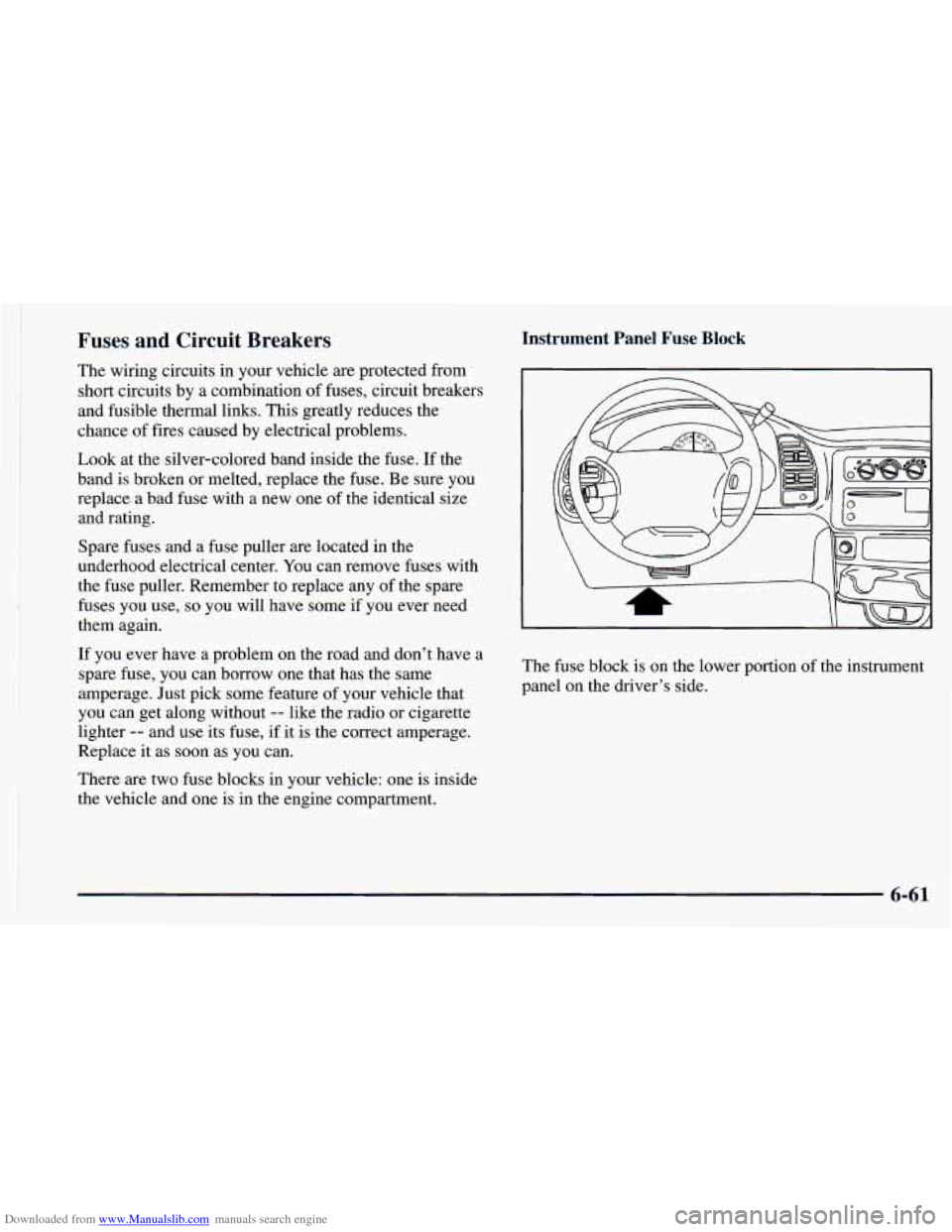
Instrument Panel Fuse Block
The fuse block is on the lower portion of the instrument
panel on the driver’s side.
6-61
Page 388 of 414
Downloaded from www.Manualslib.com manuals search engine For prompt assistance, please have the following
information available
to give the Customer
Assistance Representative:
Your name, address, home and business
telephone numbers
0 Vehicle Identification Number (This is available
from the vehicle registration or title, or the plate at
the top left
of the instrument panel and visible
through the windshield.)
Dealership name and location
0 Vehicle delivery date and present mileage
0 Nature of concern
We encourage you to call us so we can give your inquiry
prompt attention. However,
if you wish to write
Chevrolet, address your inquiry to:
Chevrolet Motor Division
Chevrolet Customer Assistance Center
P.O. Box 7047
Troy, MI 48007-7047
In Canada, write to:
General Motors of Canada Limited
Customer Communication Centre, 163-005
1908 Colonel Sam Drive
Oshawa, Ontario L1H 8P7 Refer to your Warranty and
Owner Assistance
Information booklet
for addresses of
GM Overseas offices.
When contacting Chevrolet, please remember that your concern will likely be resolved in the dealership,
using the dealer’s facilities, equipment and personnel.
That
is why we suggest you follow Step One first if
you have a concern.
Customer Assistance for Text
Telephone (TTY)
Users
To assist customers who are deaf, hard of hearing, or
speech-impaired and who
use Text Telephones (TTYs),
Chevrolet has
TTY equipment available at its Customer
Assistance Center. Any TTY user can communicate with
Chevrolet by dialing: 1-800-833-CHEV.
(TTY users in
Canada can dial 1-800-263-3830.)