Page 227 of 414
Downloaded from www.Manualslib.com manuals search engine 5. Check that the jumper cables don’t have loose or
missing insulation.
If they do, you could get a shock.
The vehicles could be damaged too.
Before you connect the cables, here are some basic
things you should know. Positive
(+) will go to
positive
(+) and negative (-) will go to a metal
engine part. Don’t connect positive
(+) to negative
(-) or you’ll get a short that would damage the
battery and maybe other parts too.
A CAUTION:
Fans or other moving engine parts can injure yo1
badly. Keep your hands away from moving parts once the engine
is running.
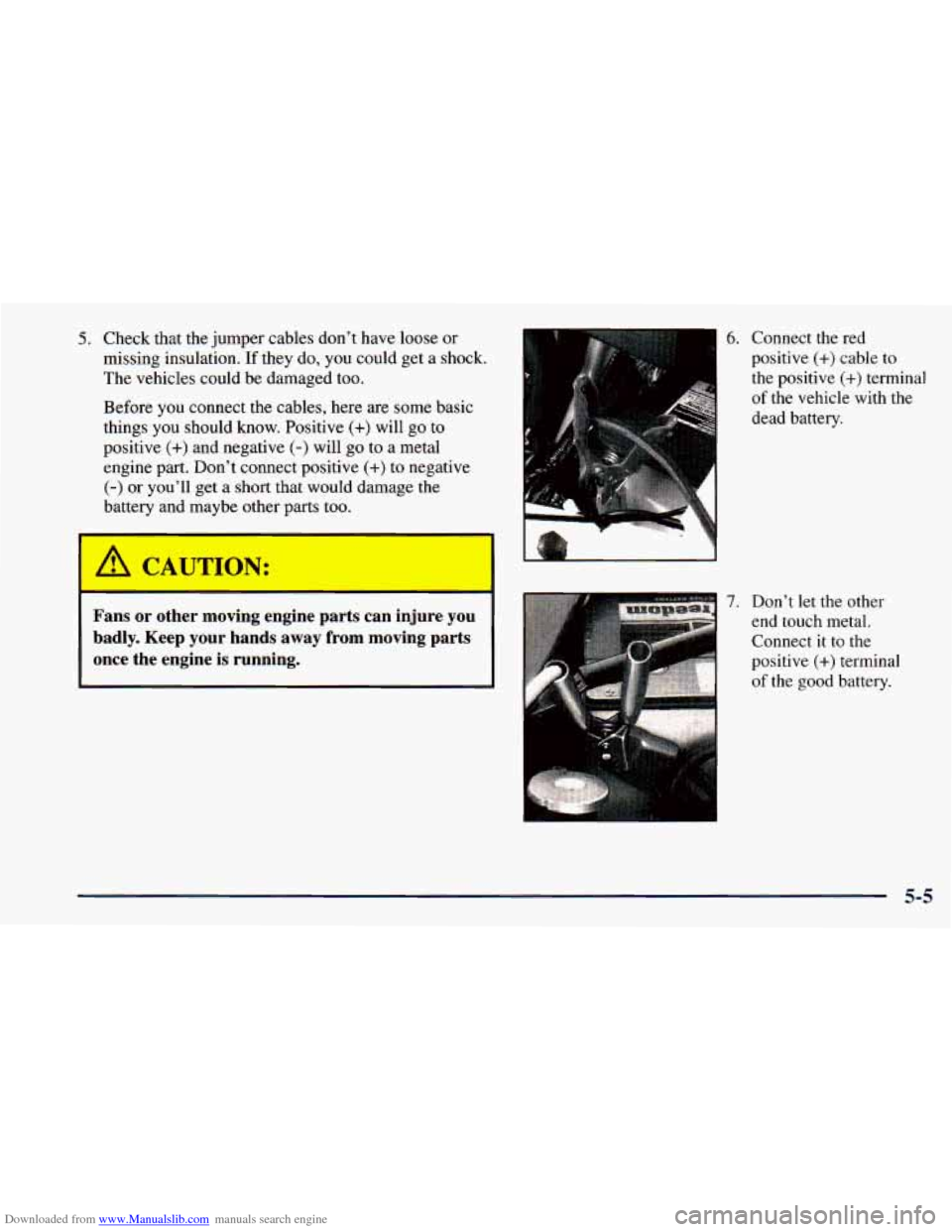
5. Connect the red
positive
(+) cable to
the positive
(+) terminal
of the vehicle with the
dead battery.
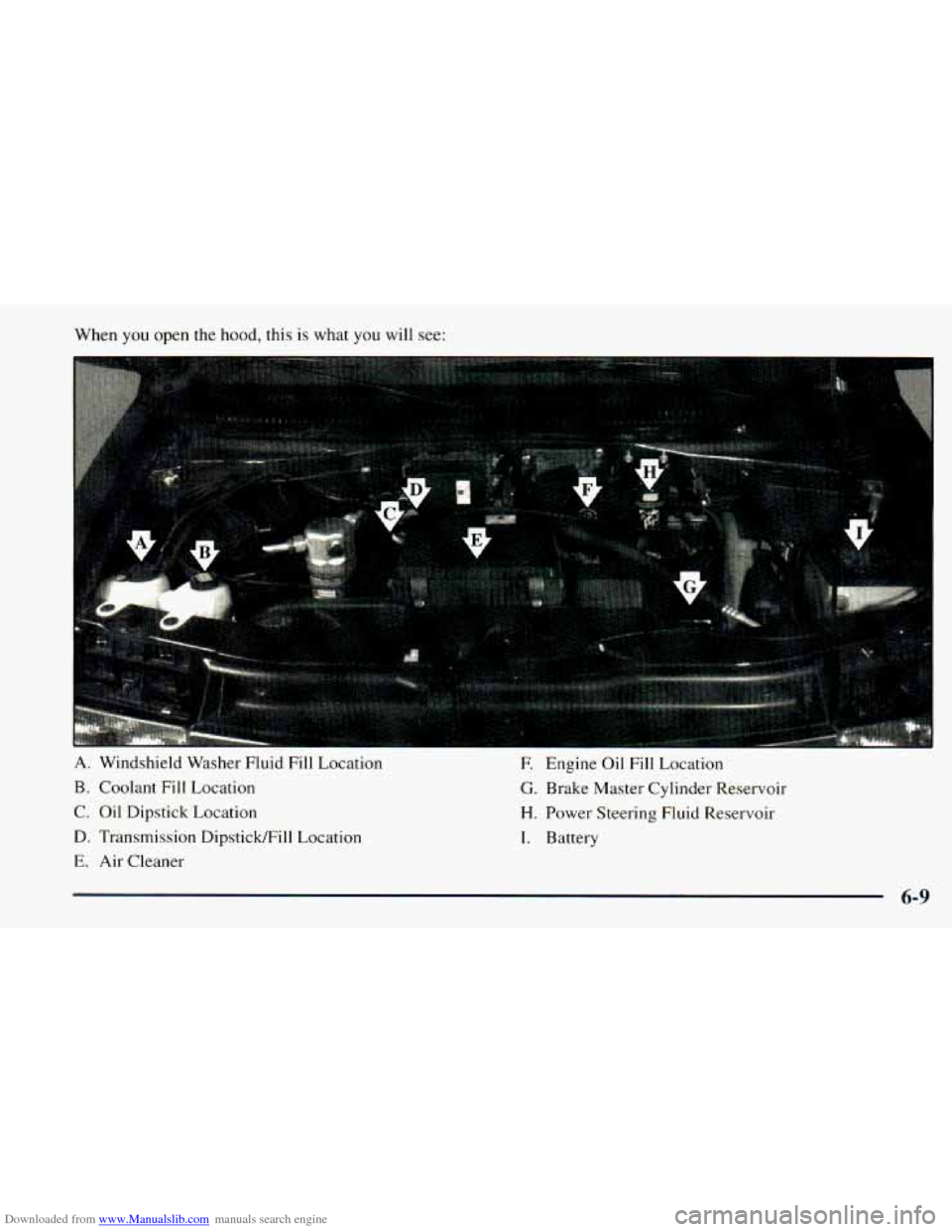
Don’t let the other
end touch metal.
Connect
it to the
positive
(+) terminal
of the good battery.
Page 228 of 414
Downloaded from www.Manualslib.com manuals search engine 9.
10.
8. Now connect the black
negative
(-) cable to
the good battery’s
negative
(-) terminal.
Don’t
let the other end
touch anything until the
next step.
11. Try to start the vehicle with the dead battery.
If it won’t start after a few tries, it probably
needs service.
12. Remove the cables in reverse order to prevent
electrical shorting. Take care that they don’t touch
each other or any other metal.
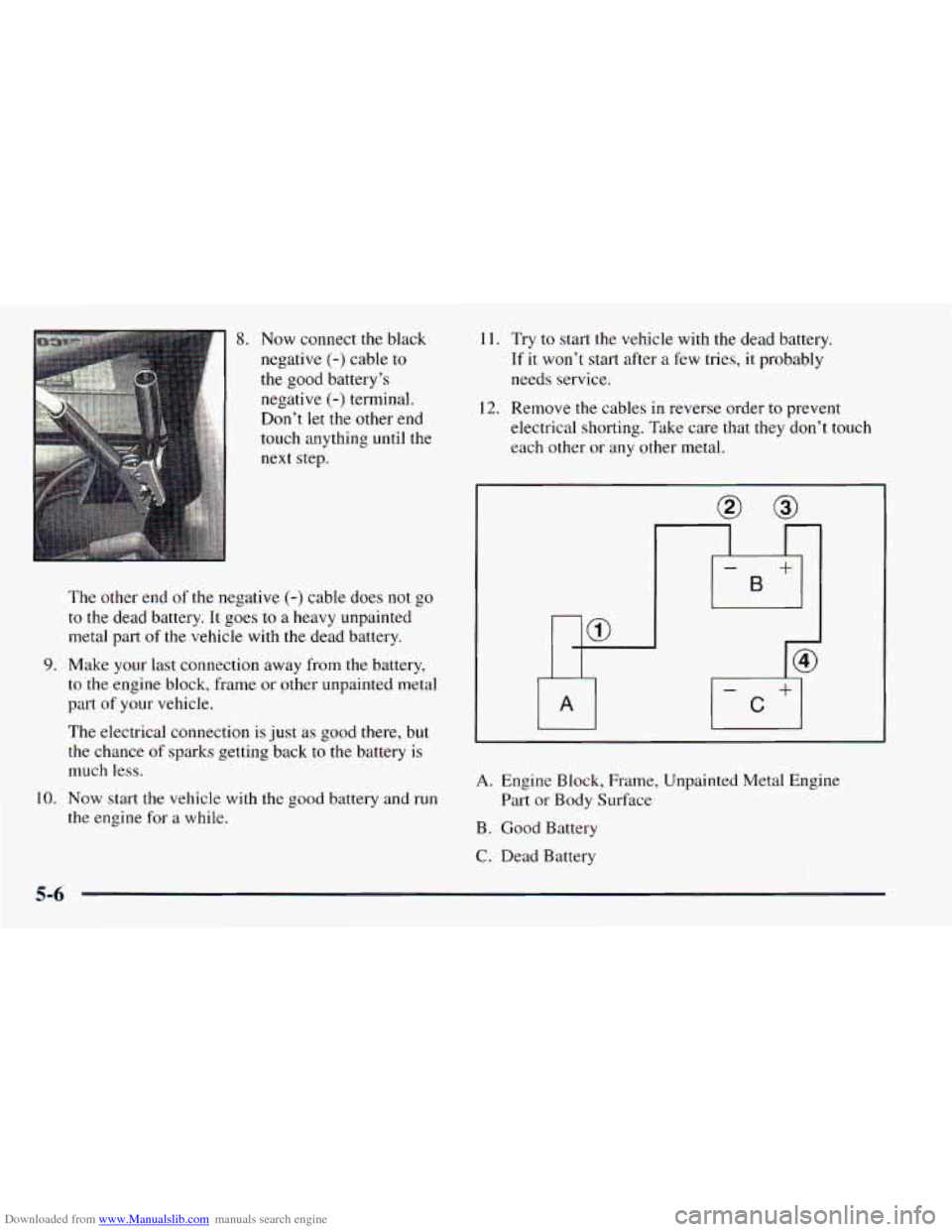
The other end of the negative
(-) cable does not go
to the dead battery. It goes to a heavy unpainted
metal part
of the vehicle with the dead battery.
Make your last connection away from the battery,
to the engine block, frame or other unpainted metal
part of your vehicle.
The electrical connection is just
as good there, but
the chance
of sparks getting back to the battery is
much less.
Now start the vehicle with the good battery and run
the engine
for a while.
1Al
A. Engine Block, Frame, Unpainted Metal Engine
B. Good Battery
C. Dead Battery
Part
or Body
Surface
J
5-6
Page 263 of 414

Downloaded from www.Manualslib.com manuals search engine Section 6 Service and Appearance Care
Here you will find information about the care of your vehicle. This section begins with service and fuel information,
and then it shows how to check important fluid and lubricant levels. There is also technical infc lation about your
6-2
6- 3
6-
5
6-7
6-7
6- 10
6- 15
6- 19
6-20
6-23
6-25
6-25
6-28
6-29 6-29
6-30
6-3
1
6-35 vehicle,
and a part devoted to its appearance care.
Service
Fuel
Filling Your Tank
Filling a Portable Fuel Container
Checking Things Under the Hood
Engine Oil Engine Cover
Air Cleaner
Automatic Transmission Fluid
All-Wheel Drive
Rear Axle
Engine Coolant
Radiator Pressure Cap
Thermostat
Power Steering Fluid
Windshield Washer Fluid
Brakes
Battery 6-36
6-36
6-42
6-42
6-5 1
6-5
1
6-53
6-55
6-56
6-57
6-57
6-58
6-59
6-59 6-60
6-67
6-68
6-69 Bulb
Replacement
Halogen Bulbs
Windshield Wiper Blade Replacement
Tires
Appearance Care
Cleaning the Inside of Your Vehicle
Cleaning the Built-in Child Restraint
Cleaning the Outside
of Your Vehicle
Cleaning Tires
Finish Damage
Underbody Maintenance
Appearance Care Materials Chart
Vehicle Identification Number (VIN)
Service Parts Identification Label
Electrical System
Capacities and Specifications
Air Conditioning Refrigerants
Normal Maintenance Replacement Parts
6-1
Page 271 of 414
Downloaded from www.Manualslib.com manuals search engine When you open the hood, this is what you will see:
A. Windshield Washer Fluid Fill Location
B. Coolant Fill Location
C. Oil Dipstick Location
D. Transmission DipsticWill Location
E. Air Cleaner
F. hngine Oil b111 Location
G. Brake Master Cylinder Reservoir
H. Power Steering Fluid Reservoir
I. Battery
6-9
Page 297 of 414

Downloaded from www.Manualslib.com manuals search engine Your rear drum brakes don’t have wear indicators, but if
you ever hear a rear brake rubbing noise, have the rear
brake linings inspected immediately.
Also, the rear
brake drums should be removed and inspected each time
the tires are removed for rotation or changing. When
you have the front brake pads replaced, have the rear
brakes inspected, too.
Brake linings should always be replaced as complete
axle sets.
See “Brake System Inspection” in Section
7 of this
manual under Part C “Periodic Maintenance
Inspections.”
Brake Pedal Travel
See your dealer if the brake pedal does not return to
normal height, or if there is a rapid increase in pedal
travel. This could be a sign of brake trouble.
Brake Adjustment
Every time you make a brake stop, your disc brakes
adjust for wear.
If your brake pedal goes down farther than normal, your
rear drum brakes may need adjustment. Adjust them by
backing up and firmly applying the brakes a few times.
Replacing Brake System Parts
The braking system on a modern vehicle is complex. Its
many parts have to be
of top quality and work well
together if
the vehicle is to have really good braking.
Your vehicle was designed and tested with top-quality
GM brake parts. When you replace parts
of your braking
system
-- for example, when your brake linings wear
down and
you have to have new ones put in -- be sure
you get new approved
GM replacement parts. If you
don’t, your brakes may no longer work properly. For
example,
if someone puts in brake linings that are wrong
for your vehicle, the balance between your front and
rear brakes can change
-- for the worse. The braking
performance you’ve come to expect can change in many
other ways
if someone puts in the wrong replacement
brake parts.
Battery
Every new vehicle has an ACDelco Freedom@ battery.
You never have to add water to one
of these. When it’s
time for a new battery, we recommend an ACDelco
Freedom battery. Get one that has the replacement
number shown on the original battery’s label.
6-35
Page 298 of 414
Downloaded from www.Manualslib.com manuals search engine Vehicle Storage
If you’re not going to drive your vehicle for 25 days or
more, remove the black, negative (-) cable from the
battery. This will help keep your battery from
r nin Sown.
A CAUTION:
Batteries have acid that can burn you and gas
that can explode. You can be badly hurt if you
aren’t careful. See “Jump Starting” in the Index
for tips on working around
a battery without
getting hurt.
Contact your dealer to learn how
to prepare your vehicle
for longer storage periods.
Also, for your audio system, see “Theft-Deterrent
Feature’’ in the Index.
Bulb Replacement
For any bulb changing procedure not listed in this
section, contact your
GM dealer service department.
Before replacing any bulbs, make sure all lamps are off
and the vehicle
is not running. See “Replacement Bulbs”
in the Index.
Halogen Bulbs
---
A CAUTION:
Halogen bulbs have pressurized gas inside and
can burst
if you drop or scratch the bulb. You or
others could be injured. Be sure to read and
follow the instructions on the bulb package.
6-36
Page 326 of 414
Downloaded from www.Manualslib.com manuals search engine Underhood Electrical Center
c
SThRTER ENABLE ENABLE =CLAY
(,,,) (-) (COLI-
I
I
[ LIGHTING 1
(7)
(T)
(-)
(-)
The underhood electrical center is located toward the
rear
of the engine compartment on the driver’s side.
Lift the hood and open
the cover to gain access to this
fuse block.
Feed Usage
AUX B Upfitter Battery Feed
AUX A Upfitter Accessory Feed
Relay
A/C Relay (Rear Heat and A/C)
Upfitter Accessory Relay
Starter Enable Relay
A/C Enable Relay
Export Only Relay
Fuel Pump Relay
6-64
Page 327 of 414

Downloaded from www.Manualslib.com manuals search engine Fuse/Circuit Breaker Usage
UPFIT-BATT Upfitter Battery Power Stud, Trailer
UPFIT-ACCY Upfitter Accessory Relay
Wiring
Harness
Spare
Fuse Puller*
Spare
Spare
ECM-B
HORN
A/C COMP
RR DEFOG
ENG-I
Fuse/Circuit Breaker Usage
IGN-E
ECM-I
Not used
LIGHTING
Not used
Not used Fuel Pump Relay and Motor, VCM,
Oil Pressure Switch/Sender
Horn Relay and Horn
A/C Enable Relay and Compressor
Heater-A/C Control Selector Switch,
Rear Window Defogger
Oxygen Sensors, Camshaft Position
Sensor, Mass Air Flow Sensor,
Evaporative Emission Canister Purge
Solenoid, Linear EGR Valve
Solenoid, VCM EGR HI BATT
IGN A
IGN B
ABS
NC
RR HTRIAC
Spare A/C
Enable Relay Coil
Fuel Injectors
1-6, Crankshaft
Position Sensor, VCM, Coil Driver
Module (EST)
Park Lamps Fuse, DRL Fuse,
Headlamp and Panel Dimmer Switch
SteeringBecurity Fuse, Courtesy
Fuse, ACSY CB, Stop/Hazard Fuse,
Auxiliary Power Fuse, Cigar Lighter
Fuse, Radio Battery Fuse
Starter Relay, Ignition Switch
Ignition Switch
Electronic Brake Control Module Blower Motor Resistor, Blower
Relay
Auxiliary Heater NC Relay
Not used
*A fuse puller is included
in the underhood electrical
center. You will also find spare fuses.
6-65