Page 259 of 378
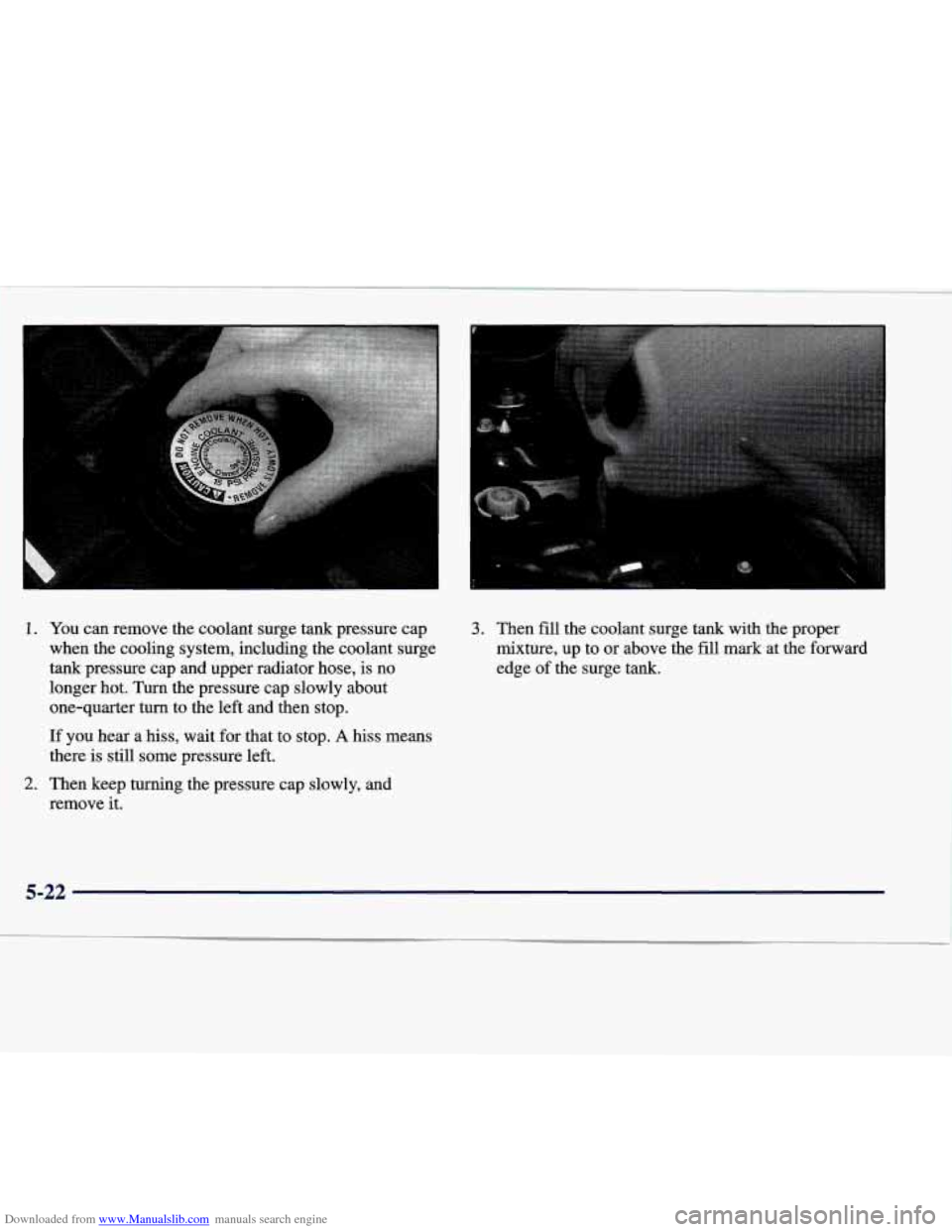
Downloaded from www.Manualslib.com manuals search engine 1. You can remove the coolant surge tank pressure cap
when the cooling system, including the coolant surge
tank pressure cap and upper radiator hose,
is no
longer hot. Turn the pressure cap slowly about
one-quarter turn to the left and then stop.
If you hear a hiss, wait for that to stop. A hiss means
there is still some pressure left.
2. Then keep turning the pressure cap slowly, and
remove it.
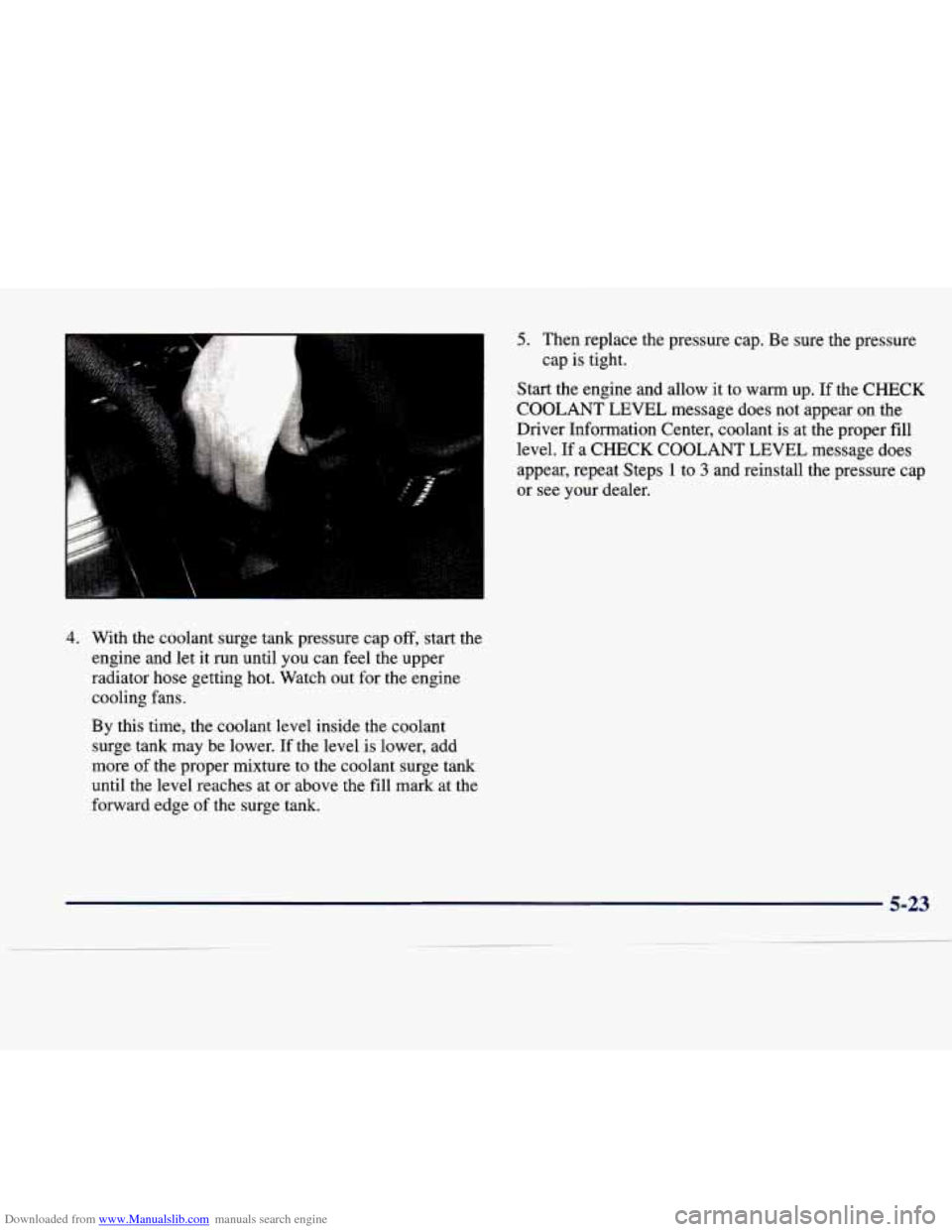
3. Then fill the coolant surge tank with the proper
mixture, up to or above the
fill mark at the forward
edge of the surge tank.
5-22
Page 260 of 378
Downloaded from www.Manualslib.com manuals search engine c'
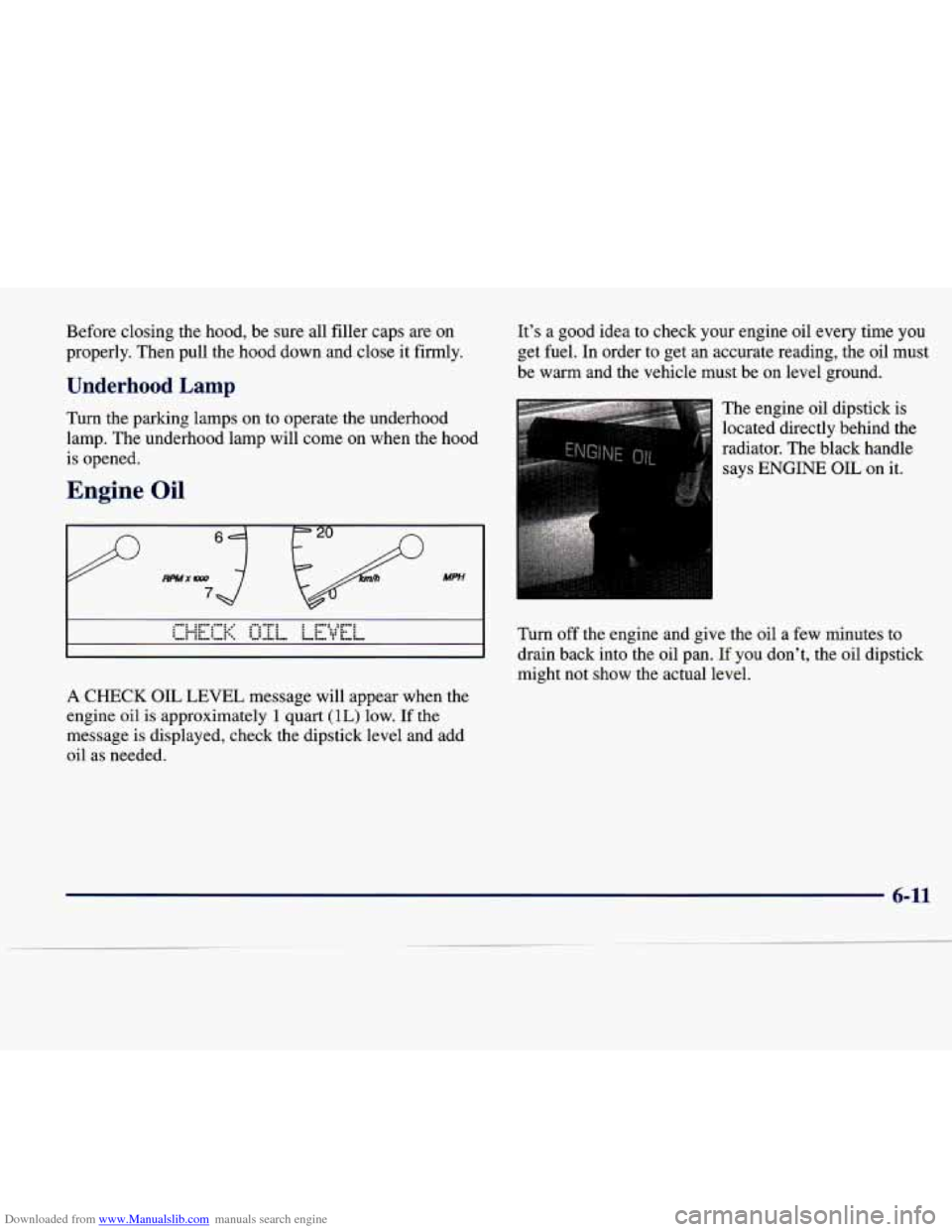
4. With the coolant surge tank pressure cap off, start the
engine and let it run until you can feel the upper
radiator hose getting hot. Watch out for the engine
cooling fans.
By this time, the coolant level inside the coolant
surge tank may be lower.
If the level is lower, add
more
of the proper mixture to the coolant surge tank
until the level reaches at or above the fill mark at the
forward edge of the surge tank.
5. Then replace the pressure cap. Be sure the pressure
Start the engine and allow
it to warm up. If the CHECK
COOLANT LEVEL message does not appear on the
Driver Information Center, coolant is at the proper fill
level. If
a CHECK COOLANT LEVEL message does
appear, repeat Steps
1 to 3 and reinstall the pressure cap
or see your dealer.
cap
is tight.
Page 286 of 378
Downloaded from www.Manualslib.com manuals search engine Before closing the hood, be sure all filler caps are on
properly. Then pull the hood down and close it firmly.
Underhood Lamp
Turn the parking lamps on to operate the underhood
lamp. The underhood lamp will come on when the hood
is opened.
Engine Oil
It's a good idea to check your engine oil every time you
get fuel. In order to get an accurate reading, the oil must
be warm and the vehicle must be on level ground.
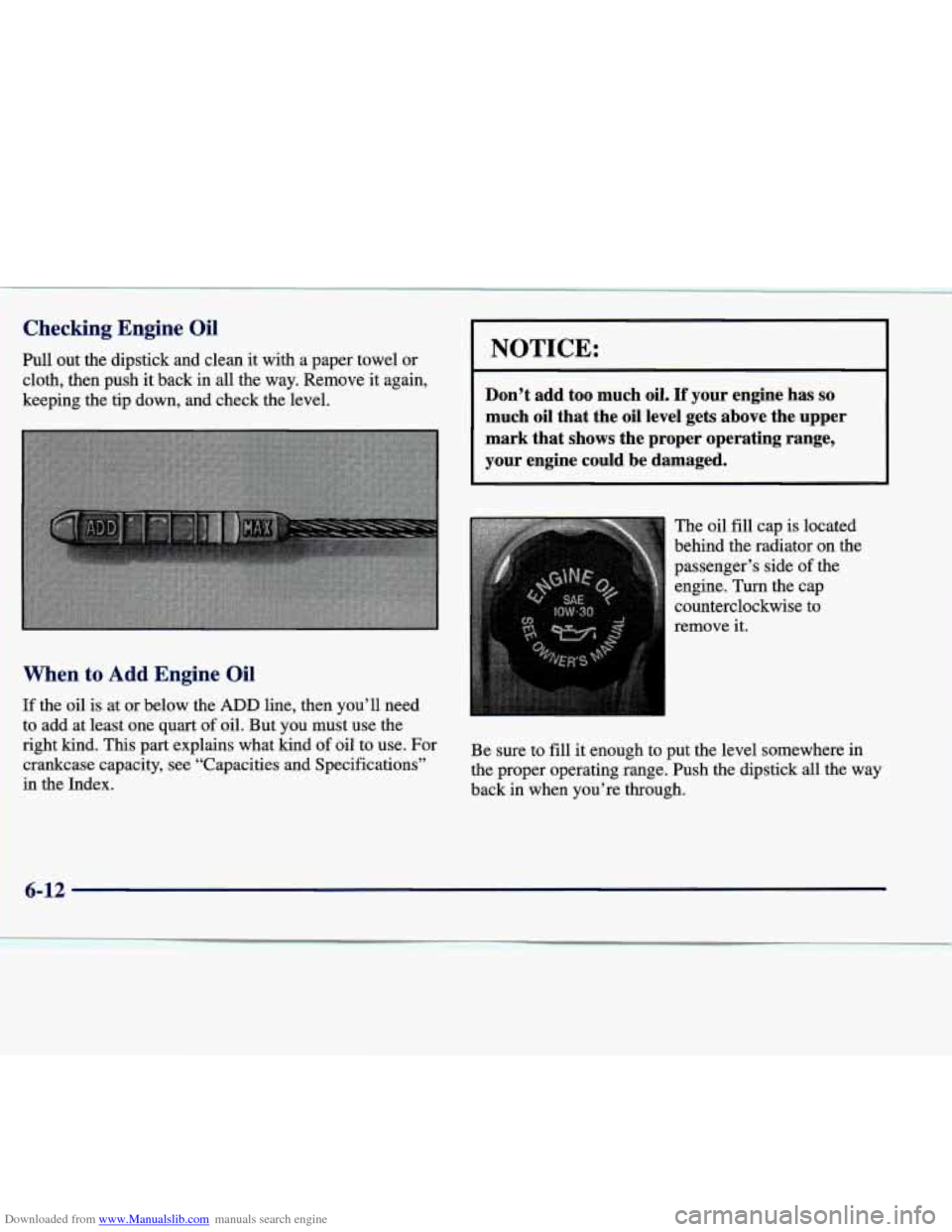
The engine oil dipstick is
located directly behind the
radiator. The black handle
says
ENGINE OIL on it.
Turn off the engine and give the oil a few minutes to
drain back into the oil pan.
If you don't, the oil dipstick
might not show the actual level.
A CHECK OIL LEVEL message will appear when the
engine
oil is approximately 1 quart (IL) low. If the
message is displayed, check the dipstick level and add
oil as needed.
6-11
Page 287 of 378
Downloaded from www.Manualslib.com manuals search engine Checking Engine Oil
Pull out the dipstick and clean it with a paper towel or
cloth, then push it back in all the way. Remove it again,
keeping the tip down, and check the level.
When to Add Engine Oil
If the oil is at or below the ADD line, then you’ll need
to add at least one quart
of oil. But you must use the
right kind. This part explains what kind
of oil to use. For
crankcase capacity, see “Capacities and Specifications’’
in the Index.
NOTICE:
Don’t add too much oil. If your engine has so
much oil that the oil level gets above the upper
mark that shows the proper operating range,
your engine could be damaged.
The oil fill cap is located
behind the radiator on the
passenger’s side of the
engine. Turn the cap
counterclockwise to
remove it.
Be sure to fill it enough to put the level somewhere
in
the proper operating range. Push the dipstick all the way
back in when you’re through.
6-12
Page 295 of 378
Downloaded from www.Manualslib.com manuals search engine To get the right reading, the fluid should be at normal
operating temperature, which is
180°F to 200°F (82°C
to 93°C).
Get the vehicle warmed up by driving about 15 miles
(24 km) when outside temperatures are above 50°F
(10°C). If it's colder than 50°F ( 10°C), you may have
to drive longer.
Checking the Fluid Level
a
0
Park your vehicle on a level place. Keep the
engine running.
With the parking brake applied, place the shift
lever
in PARK (P).
With your
foot on the brake pedal, move the shift
lever through each gear range, pausing for about
three seconds in each range. Then, position the shift
lever in PARK
(P).
Let the engine run at idle for three to five minutes. Then, without shutting
off the engine, follow these steps:
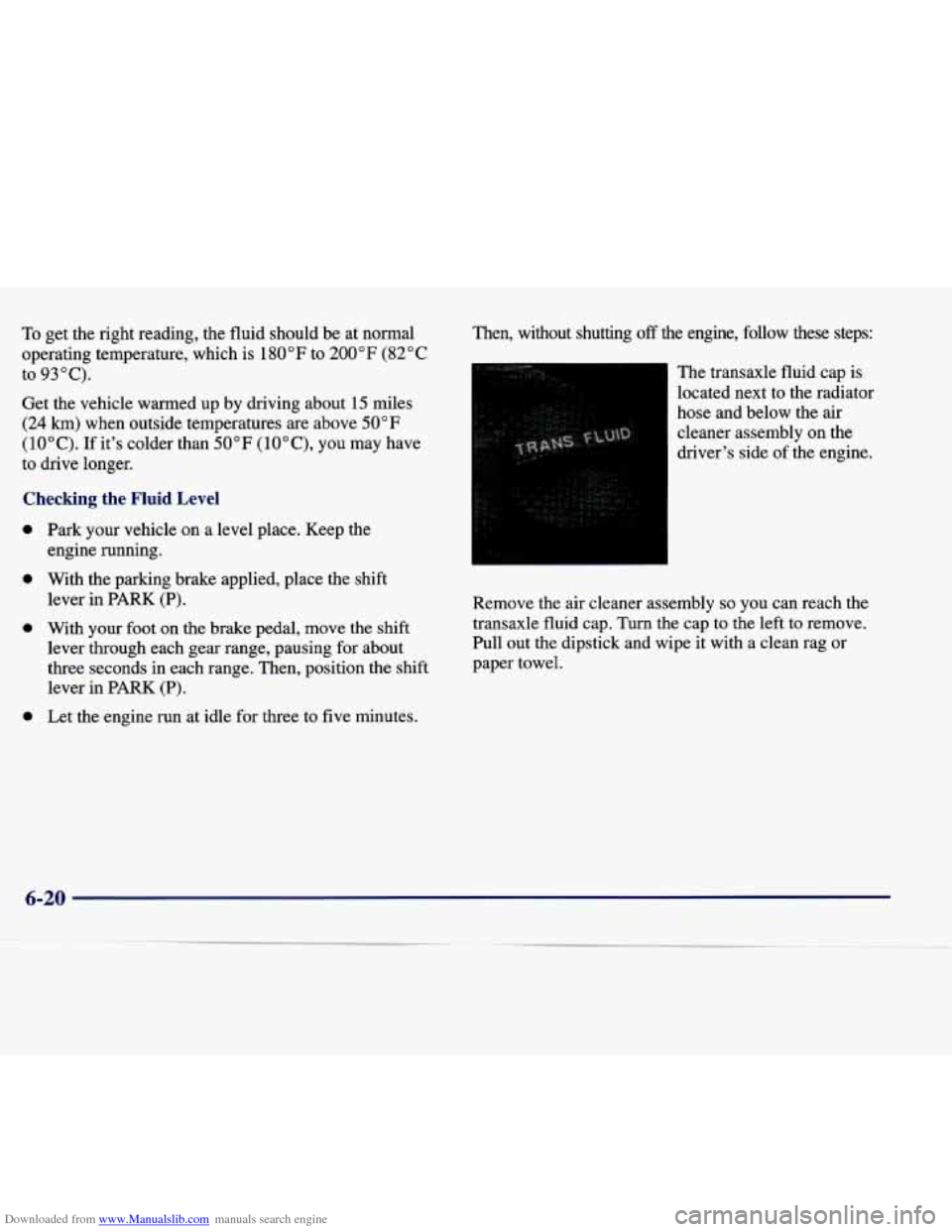
The transaxle fluid cap is
located next to the radiator
hose and below the air cleaner assembly on the
driver's side
of the engine.
Remove the
air cleaner assembly so you can reach the
transaxle
fluid cap. Turn the cap to the left to remove.
Pull out the dipstick and wipe it with a clean rag or
paper towel.
6-20
Page 299 of 378
Downloaded from www.Manualslib.com manuals search engine Checking Coolant
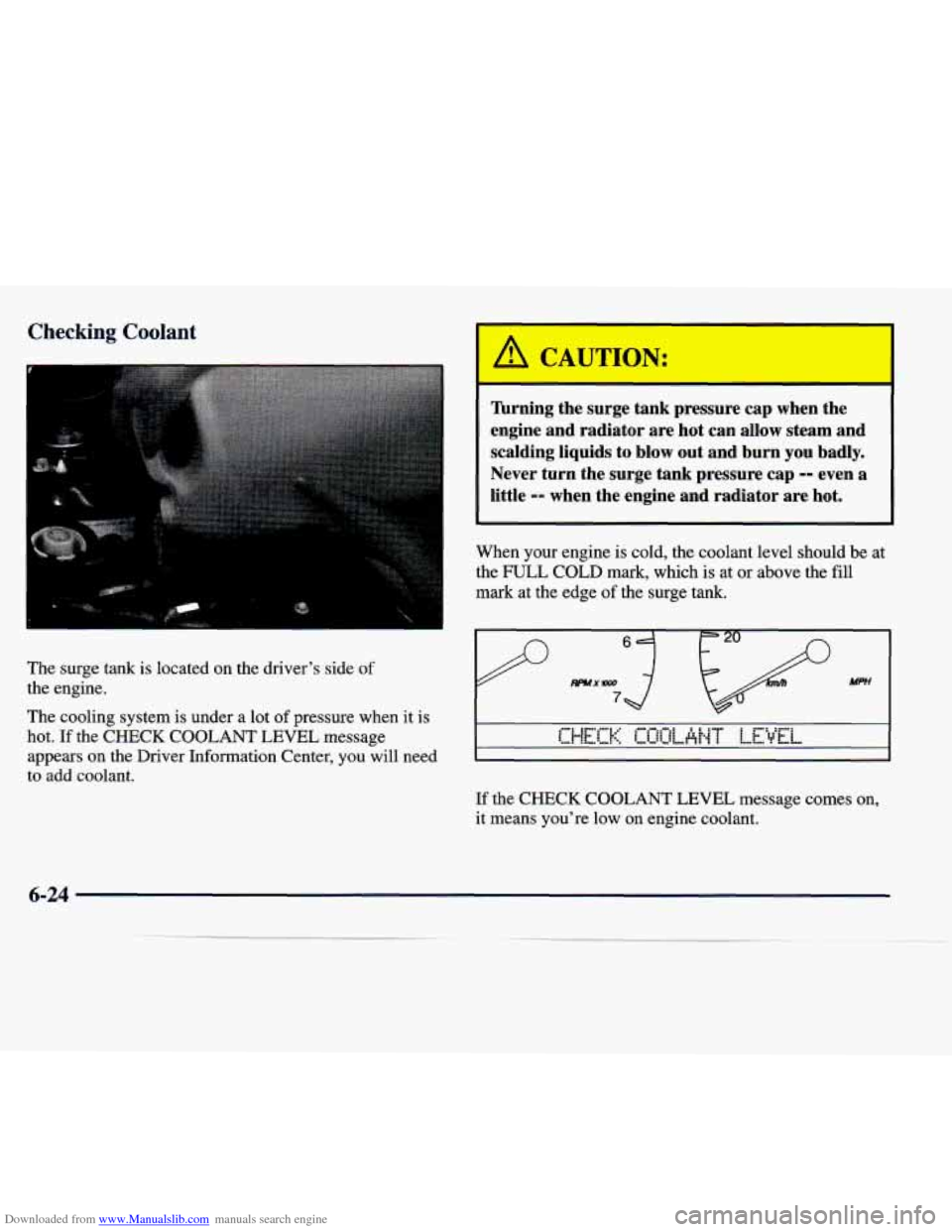
The surge tank is located on the driver's side of
the engine.
The cooling system
is under a lot of pressure when it is
hot. If the CHECK COOLANT LEVEL message
appears on the Driver Information Center,
you will need
to add coolant.
Turning the surge tank pressure cap when the
engine and radiator are hot can allow steam and
scalding liquids to blow out and burn you badly.
Never turn the surge tank pressure cap
-- even a
little
-- when the engine and radiator are hot.
When your engine is cold, the coolant level should be at
the FULL COLD
mark, which is at or above the fill
mark at the edge of the surge tank.
Mffl
If the CHECK COOLANT LEVEL message comes on,
it means you're low on engine coolant.
6-24
Page 300 of 378
Downloaded from www.Manualslib.com manuals search engine Adding Coolant
If you need more coolant, add the proper DEX-COOL@
coolant mixture at the surge tank, but only when the
engine
is cool.
I A CAUTION: I
You can be burned if you spill coolant on hot
engine parts. Coolant contains ethylene glycol,
and it will burn if the engine parts are hot
enough. Don’t spill coolant on
a hot engine.
~~
When replacing the surge tank pressure cap, make sure
it is tight.
Surge Tank Pressure Cap
I NOTICE:
The surge tank cap is a 15 psi (105 kPa)
pressure-type cap and must be tightly installed to
prevent coolant loss and possible engine damage
from overheating.
Two and one-half turns are
required to
seal the cap.
If the surge tank pressure cap needs to be replaced, a
GM cap is recommended.
Thermostat
Engine coolant temperature is controlled by a thermostat
in the engine coolant system. The thermostat stops the
flow of coolant through the radiator until the coolant
reaches a preset temperature.
If your thermostat needs to be replaced, a GM
thermostat is recommended.
6-25