1998 CADILLAC ELDORADO ignition
[x] Cancel search: ignitionPage 192 of 380
Downloaded from www.Manualslib.com manuals search engine When using a scrubbing action, non-abrasive cleaning
cassette,
it is normal for the cassette to eject because
your unit
is equipped with a cut tape detection feature
and a cleaning cassette may appear as a broken tape.
To
prevent the cleaning cassette from being ejected, use the
following steps.
1. Turn the ignition to RUN or ACCESSORY.
2. Turn the radio off.
3. Press and hold the SOURCE button for two
seconds. The tape symbol on the display will flash
three times.
4. Turn the radio on and insert the scrubbing action
cleaning cassette.
5. Eject the cleaning cassette after the manufacturer’s
When the cleaning cassette has been ejected, the cut tape
detection feature is active again.
You may also choose a non-scrubbing action, wet-type
cleaner which uses a cassette with a fabric belt to clean
the tape head. This type
of cleaning cassette will not
eject on its own.
A non-scrubbing action cleaner may
not clean
as thoroughly as the scrubbing type cleaner.
The use of a non-scrubbing action, dry-type cleaning
cassette is not recommended.
recommended
cleaning
time.
If your vehicle is equipped with the AM-FM Stereo with
Cassette Tape Player, press and hold EJECT for five
seconds
to reset the CLN indicator after you clean the
player. The radio will display
--- to show the indicator
was reset.
If your vehicle is equipped with any other radio, press
and hold
EJECT for three seconds to reset the CLEAN
TAPE indicator after you clean the player. The radio will
display CLEAN TAPE
MSG CLEARED to show the
indicator was reset.
Cassettes are subject to wear and the sound quality
may degrade over time. Always make sure the cassette
tape is in good condition before you have your tape
player serviced.
Care of Your Compact Discs
Handle discs carefully. Store them in their original cases
or other protective cases and away from direct sunlight
and dust. If the surface of a disc
is soiled, dampen a
clean, soft cloth in a mild, neutral detergent solution and
clean it, wiping from the center
to the edge.
Be sure never to touch the signal surface when handling
discs. Pick up discs by grasping the outer edges or the
edge of the hole and the outer edge.
3-36
Page 193 of 380
Downloaded from www.Manualslib.com manuals search engine Care of Your Compact Disc Player
The use of CD lens cleaner discs is not advised, due to
the risk
of contaminating the lens of the CD optics with
lubricants internal
to the CD mechanism.
Power Antenna Mast Care
Your power antenna will look its best and work well
if it's cleaned from time to time.
To clean the
antenna mast:
1. Turn on the ignition and radio to raise the antenna.
2. Dampen a clean cloth with mineral spirits or
equivalent solvent.
3. Wipe the cloth over the mast sections, removing
4. Wipe dry with a clean cloth.
any
dirt.
5. Make the antenna go up and down by turning the
radio or ignition
off and on.
6. Repeat if necessary.
I NOTICE:
Don't lubricate the power antenna. Lubrication
could damage it.
NOTICE:
Before entering an automatic car wash, turn off
your radio to make the power antenna go down.
This will prevent the mast from possibly getting
damaged.
If the antenna does not go down when
you turn the radio
off, it may be damaged or
need to be cleaned.
In either case, lower the
antenna by hand by carefully pressing the
antenna down.
If the mast portion of your antenna is damaged, you can
easily replace it. See your dealer for
a replacement kit
and follow the instructions in the kit.
3-37
Page 223 of 380
Downloaded from www.Manualslib.com manuals search engine L
r
I
r i
r I
I A CAUTION:
Coasting downhill in NEUTRAL (N) or with the
ignition
off is dangerous. Your brakes will have to
do all the work of slowing down. They could get so
hot that they wouldn’t work well. You would then
have poor braking or even none going down
a hill.
You could crash. Always have your engine running
and your vehicle in gear when you go downhill.
f I
i
Know how to go uphill. You may want to shift down
to a lower gear. The lower gears help cool your engine
and transaxle, and you can climb the
hdl better.
Stay in your own lane when driving on two-lane
roads in hills or mountains. Don’t swing wide or cut
across the center of the road. Drive at speeds that let
you stay in your own lane.
As you go over the top of a hill, be alert. There could be
something in your lane, like a stalled car or an accident.
You may
see highway signs on mountains that warn of
special problems. Examples are long grades, passing or
no-passing zones, a falling rocks area or winding
roads. Be alert to these and take appropriate action.
Winter Driving
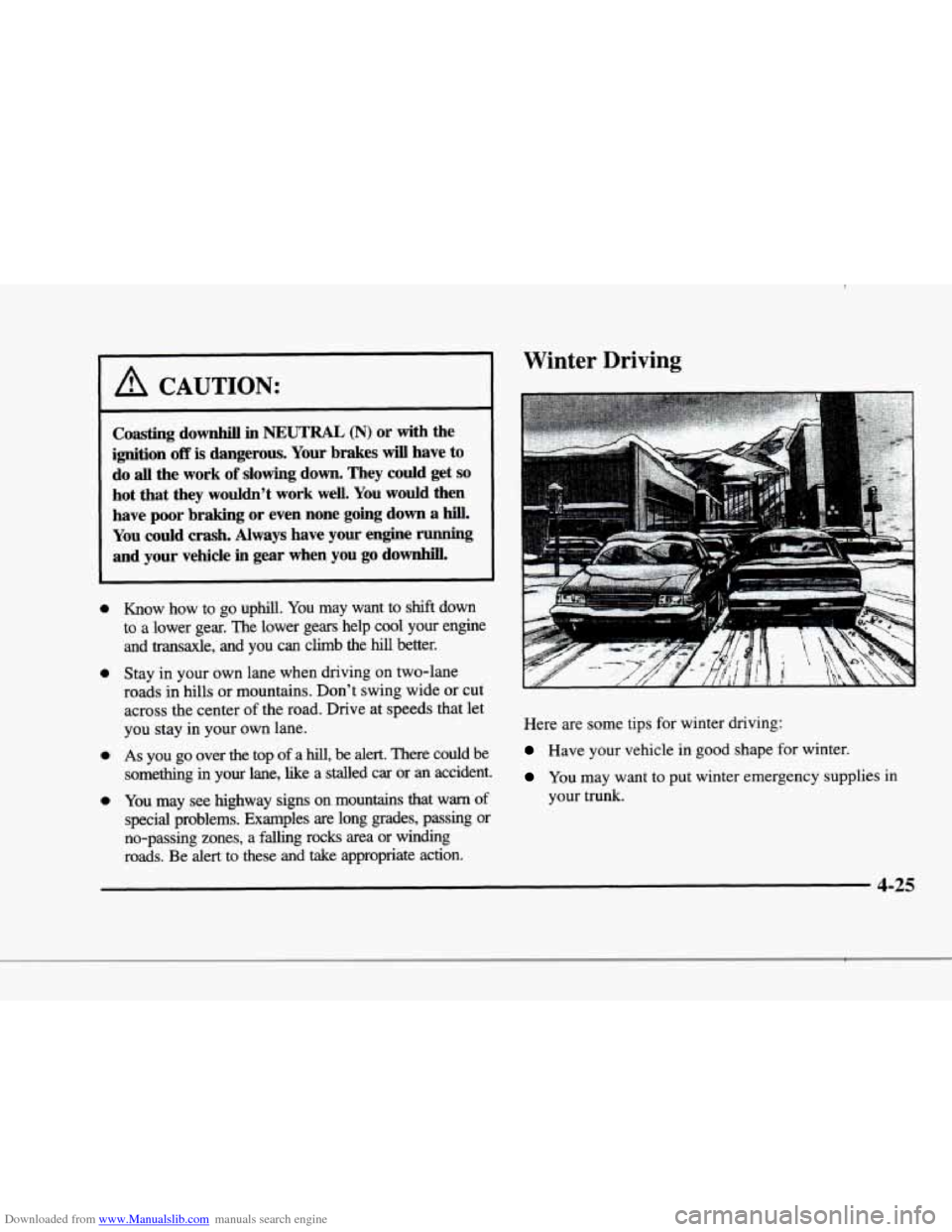
Here are some tips for winter driving:
Have your vehicle in good shape for winter.
You may want to put winter emergency supplies in
your trunk.
~ 4-25 P i I
Page 244 of 380

Downloaded from www.Manualslib.com manuals search engine NOTICE:
Ignoring these steps could result in costly damage
to your vehicle that wouldn’t be covered by
your warranty.
Trying to start your vehicle by pushing or pulling
it won’t work, and it could damage your vehicle.
1. Check the other vehicle. It must have a 12-volt
battery with a negative ground system.
I NOTICE:
If the other system isn’t a 12-volt system with a
negative ground, both vehicles can be damaged.
2. Get the vehicles close enough so the jumper cables
can reach, but be sure the vehicles aren’t touching
each other. If they are, it could cause a ground
connection you don’t want.
You wouldn’t be able
to start your vehicle and the bad grounding could
damage the electrical systems.
3. Turn off the ignition on both vehicles. Unplug
unnecessary accessories plugged into the cigarette
lighter.
Turn off all lamps that aren’t needed as well
as radios. This will avoid sparks and help save both
batteries. In addition,
it could save your radio!
4. Open the hoods and locate the batteries. Find
the positive (+) and negative (-) terminals on
each battery.
1 A CAUTION:
~ ~~~~~ ~ ~
An electric fan can start up even when the engine
is
not running and can injure you. Keep hands,
clothing and tools away from any underhood
electric fan.
5-4
Page 250 of 380
Downloaded from www.Manualslib.com manuals search engine A vehicle can fall from a car carrier if it isn’t
adequately secured. This can cause a collision,
serious personal injury and vehicle damage. The
vehicle should be tightly secured
with chains or
steel cables before it is transported.
Don’t use substitutes (ropes, leather straps,
canvas webbing, etc.) that can be cut by sharp
edges underneath the towed vehicle. Always use
T-hooks inserted in the front T-hook
slots or
R-hooks inserted in the rear R-hook
slots. Never
use J-hooks. They
will damage drivetrain and
suspension components.
When your vehicle is being towed, have the ignition key
turned to
OFF. The steering wheel should be clamped in
a straight-ahead position, with a clamping device
designed for towing service.
Do not use the vehicle’s
steering column lock for this. The transaxle should be
in
NEUTRAL (N) and the parking brake released.
Don’t have your vehicle towed on the drive wheels
unless
you must. If the vehicle must be towed on the
drive wheels, be sure to follow the speed and distance
restrictions later in this section
or your transaxle will be
damaged. If these limitations must be exceeded, then the
drive wheels have to be supported on
a dolly.
5-10
Page 301 of 380
Downloaded from www.Manualslib.com manuals search engine If the fluid level is low, add only enough of the proper
fluid to bring
the level into the cross-hatched area on
the dipstick.
1. Pull out the dipstick.
2. Using a long-neck funnel, add enough fluid at the
dipstick hole
to bring it to the proper level.
It doesn’t take much fluid, generally less than
one pint
(0.5 L). Don’t ovegi’ll.
-
NOTICE:
We recommend you use only fluid labeled
DEXRON@-111, because fluid with that label
is
made especially for your automatic transaxle.
Damage caused by fluid other than DEXRON-I11
is not covered by your new vehicle warranty.
3. After adding fluid, recheck the fluid level as
described under “How
to Check.”
4. When the correct fluid level is obtained, push the
dipstick back
in all the way.
How to Reset Transaxle Fluid
Change Indicator:
Your vehicle is equipped with a transaxle fluid change
indicator.
A CHANGE TRANS FLUID message will
display
on the Driver Information Center (DIC) when
the powertrain computer determines that the transaxle
fluid needs to be changed or at each
100,000 miles
(160 000 km) interval, whichever occurs first. See your
Maintenance Schedule booklet for more information.
When this message appears, change
the transaxle fluid
and reset the transaxle fluid life indicator as follows:
1. Turn the ignition on but do not start the engine.
2. Press and hold the OFF and rear defog buttons on
the climate control system at the same time until
the TRANS FLUID RESET message appears on
the DIC.
6-21
Page 318 of 380
Downloaded from www.Manualslib.com manuals search engine Windshield Wiper
Blade Replacement
It’s a good idea to clean or replace the wiper blade
assembly
on a regular basis or when worn. For proper
windshield wiper blade length and type, see “Normal
Maintenance Replacement
Parts” later in this section.
To replace the wiper blade assembly:
1. Turn the ignition key to ACCESSORY and turn the
wipers on. Position the wipers on the windshield
in
the “mid” wipe position. Then with the door open,
turn the key to
OFF.
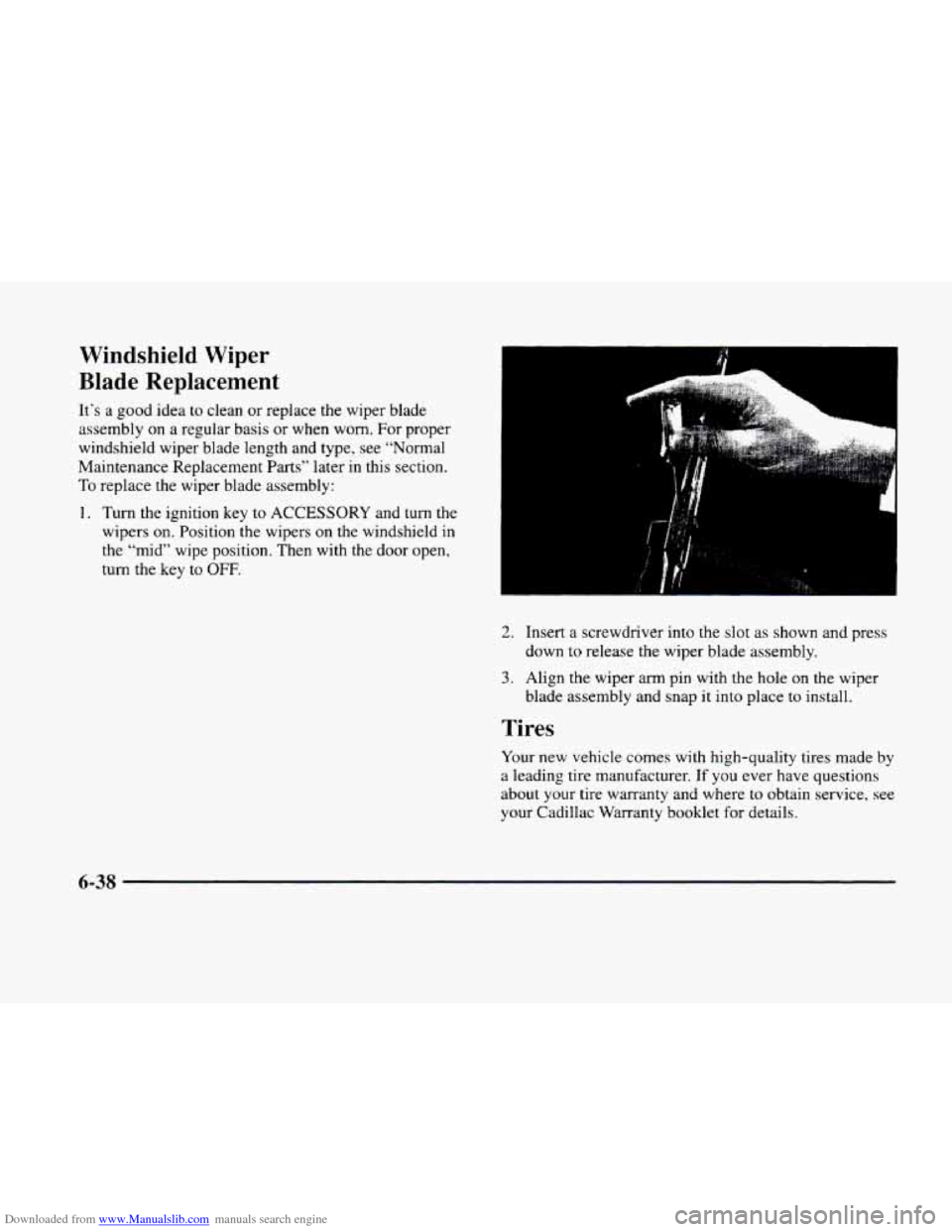
2. Insert a screwdriver into the slot as shown and press
down to release the wiper blade assembly.
3. Align the wiper arm pin with the hole on the wiper
blade assembly and snap
it into place to install.
Tires
Your new vehicle comes with high-quality tires made by
a leading tire manufacturer. If you ever have questions
about your tire warranty and where
to obtain service, see
your Cadillac Warranty booklet for details.
6-38
Page 337 of 380

Downloaded from www.Manualslib.com manuals search engine Fuse
BODY 1
BODY 2
BODY 3
Usage
Road Sensing Suspension (RSS) Fuse
(ETC Only), Convenience Fuse, BATT
Fuse, Antenna Fuse, Passenger and
Driver Seat Belt Comfort Solenoids,
Trunk and Fuel Door Release
Solenoids and Relays, Door
Lock/Unlock Relays, Damper Relay
(ETC Only), Parking Lamp Relay,
Right and Left Park Fuse, Rear Fog
Lamp Relay (Export)
Defog Relay, Pull-Down Fuse, Right
and
Left Heated Seat Fuse, Electronic
Level Control (ELC) Fusemelay,
Antenna Fuse, Heated Mirror Fuse,
Heated Backlite Fuse, Electronic Level,
Control Breaker
Controlled Power Relay, Controlled
Power Back-up Relay, Cluster
Fuse,
Platform Zone Module (PZM) Fuse,
Radio Fuse,
DAB Relay, Trunk and
Fuel Door Release Relay, High-Beam
Relay, Comfort Fuse, AMP (Bose
Only) Fuse, Right and Left Bose Relay
Fuse Usage
INADVERT Inadvertent Power Relay, Interior
Lamps Fuse, Cigarette Lighter-
1 Fuse,
Courtesy Lamp Relay
LAMPS
IGN 1
Headlamps Fusemelay, High/Low
Beam Control Relay, Fog Lamp
Fuse,
DlU Fuse, Hazard Fuse, Mirror Fuse,
Inadvertent Power Relay, Right and
Left High-Beam Fuse, Right and Left
Low-Beam
Fuse, Stop Fuse, Fog Lamp
Relay, DRL Relay
Rear Ignition-
1 Relay, Wiper Fuse,
Relay Ignition-
1 Fuse, Supplemental
Inflatable Restraint (SIR) Fuse, Accessory Relay
WINDOWS Delayed Accessory Bus (DAB) Relay
SEATS
BATT
3
BATT 2
Horn Relay, Driver and Passenger
Lumbar IdOut Relays, Driver and
Passenger Up/Down Relays
Steering Column Ignition Switch
Steering Column Ignition Switch
6-57