1998 CADILLAC ELDORADO light
[x] Cancel search: lightPage 136 of 380
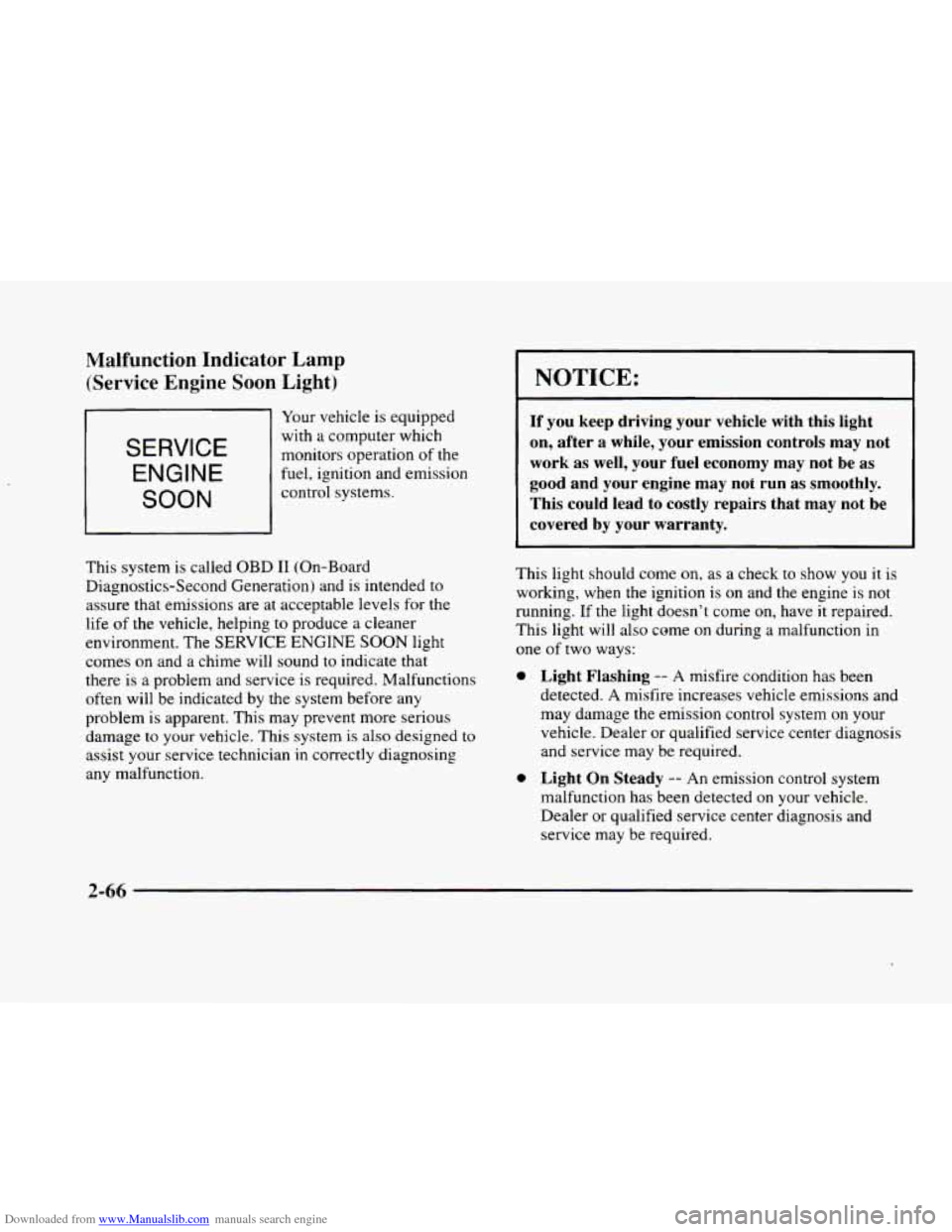
Downloaded from www.Manualslib.com manuals search engine Malfunction Indicator Lamp (Service Engine
Soon Light)
SERVICE
ENGINE
SOON
Your vehicle is equipped
with
a computer which
monitors operation
of the
fuel, ignition and emission
control systems.
This system is called
OBD I1 (On-Board
Diagnostics-Second Generation) and
is intended to
assure that emissions are at acceptable levels for the
life
of the vehicle, helping to produce a cleaner
environment. The
SERVICE ENGINE SOON light
comes
on and a chime will sound to indicate that
there is
a problem and service is required. Malfunctions
often will be indicated by the system before any
problem
is apparent. This may prevent more serious
damage
to your vehicle. This system is also designed to
assist your service technician in correctly diagnosing
any malfunction.
0
0
NOTICE:
If you keep driving your vehicle with this light
on, after a while, your emission controls may
not
work as well, your fuel economy may not be as
good and your engine may
not run as smoothly.
This could lead to costly repairs that may not be
covered by your warranty.
This light should come on, as a check to show you it is
working, when the ignition is on and the engine is
not
running. If the light doesn’t come on, have it repaired.
This light will also come on during
a malfunction in
one
of two ways:
Light Flashing -- A misfire condition has been
detected. A misfire increases vehicle emissions and
may damage the emission control system on your
vehicle. Dealer or qualified service center diagnosis
and service may be required.
Light On Steady -- An emission control system
malfunction has been detected on your vehicle.
Dealer or qualified service center diagnosis and
service
may be required.
2-66
Page 137 of 380
Downloaded from www.Manualslib.com manuals search engine If the Light Is Flashing
The following may prevent more serious damage to
your vehicle:
0 Reducing vehicle speed.
0 Avoiding hard accelerations.
0 Avoiding steep uphill grades.
If you are towing a trailer, reduce the amount of
cargo being hauled as soon as it is possible.
If the light stops flashing and remains
on steady, see “If
the Light Is On Steady” following.
If the light continues to flash, when
it is safe to do so,
stop the vehicle. Find a safe place to park your vehicle.
Turn the key
off, wait at least 10 seconds and restart the
engine. If the light remains
on steady, see “If the Light
Is On Steady” following. If the light is still flashing,
follow the previous steps, and drive the vehicle to your
dealer or qualified service center for service.
If the Light Is On Steady
You may be able to correct the emission system
malfunction by considering the following:
Did
you recently put fuel into your vehicle?
If
so, reinstall the fuel cap, making sure to fully install
the cap. The diagnostic system can determine if the fuel cap
has been left
off or improperly installed. A loose or
missing fuel cap will allow fuel to evaporate into the
atmosphere. A few driving trips with the cap properly
installed should turn the light
off.
Did you just drive through a deep puddle of water?
If
so, your electrical system may be wet. The condition
will usually be corrected when the electrical system
dries
out. A few driving trips should turn the light off.
Are you low on fuel?
As your engine starts to run out of fuel, your engine may
not run as efficiently as designed since small amounts of
air are sucked into the fuel line causing a misfire. The
system can detect this. Adding fuel should correct this
condition. Make sure to install the fuel cap properly. It
will take a few driving trips to
turn the light off.
Have you recently changed brands of fuel?
If so, be sure to fuel your vehicle with quality fuel (see
“Fuel” in the Index). Poor fuel quality will cause your
engine not to run as efficiently as designed. You may
notice this as stalling after start-up, stalling when you
put the vehicle into gear, misfiring, hesitation on
acceleration or stumbling on acceleration. (These
conditions may go away once
the engine is warmed up.)
This will be detected by the system and cause the light
to turn on.
2-67
Page 138 of 380
Downloaded from www.Manualslib.com manuals search engine If you experience one or more of these conditions,
change the fuel brand
you use. It will require at least
one full tank
of the proper fuel to turn the light off.
If none of the above steps have made the light turn off,
have your dealer or qualified service center check the
vehicle. Your dealer has the proper test equipment and
diagnostic tools to fix any mechanical
or electrical
problems that may have developed.
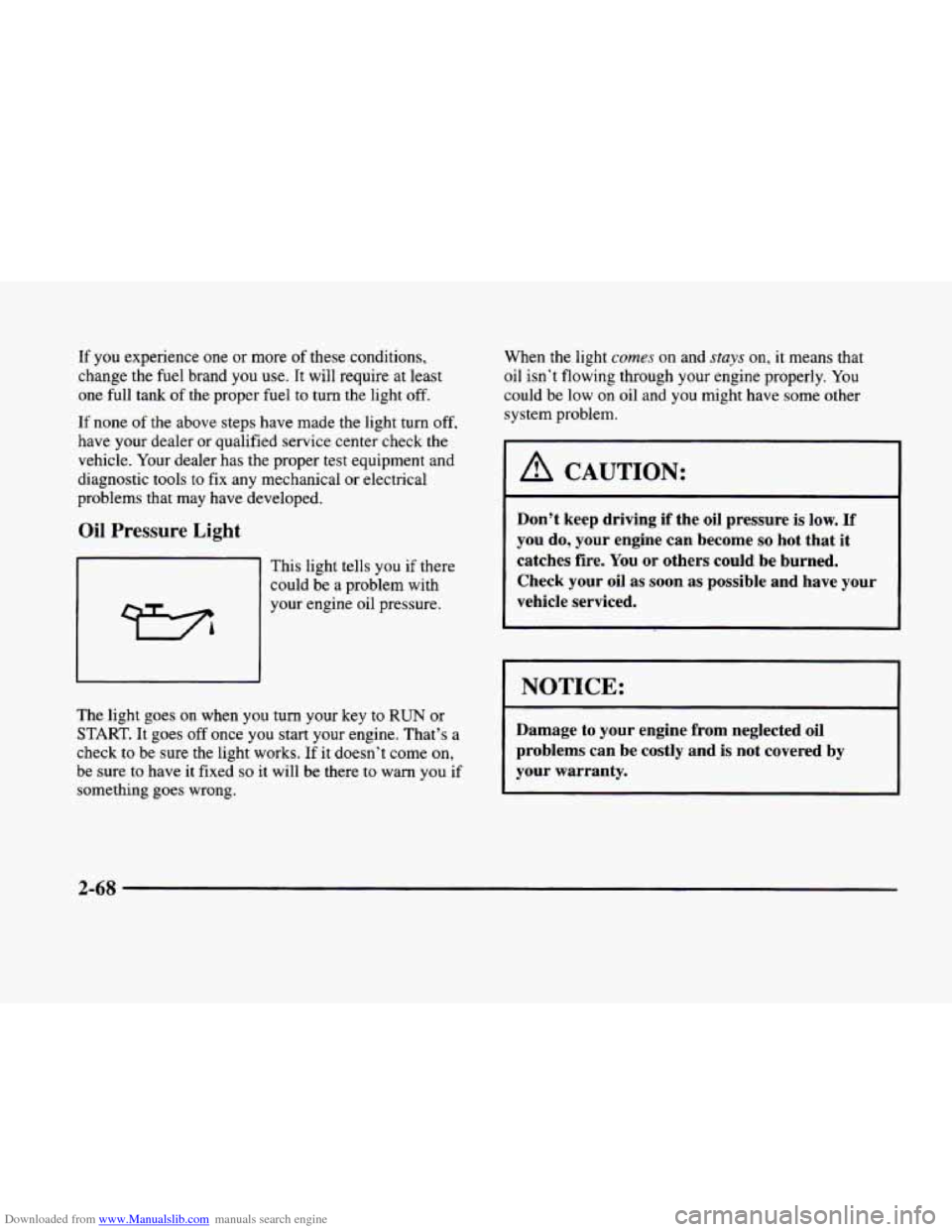
Oil Pressure Light
This light tells you if there
could be a problem with
your engine oil pressure.
The light goes
on when you turn your key to RUN or
START. It goes off once you start your engine. That’s a
check
to be sure the light works. If it doesn’t come on,
be sure to have it fixed so it will be there to warn you if
something goes wrong. When the light
cumes on
and stays on, it means that
oil isn’t flowing through your engine properly. You
could
be low on oil and you might have some other
system problem.
1 A CAUTION:
Don’t keep driving if the oil pressure is low. If
you do, your engine can become so hot that it
catches fire. You
or others could be burned.
Check your oil as soon as possible and have your
vehicle serviced.
I NOTICE: 1
Damage to your engine from neglected oil
problems can be costly and is not covered by
your warranty.
2-68
Page 143 of 380

Downloaded from www.Manualslib.com manuals search engine CHECK BRAKE FLUID LEVEL - 37: This message
will display if the ignition is in
RUN to inform the
driver that the brake fluid level is low. Check the brake
reservoir level and add fluid as needed. Have the brake
system serviced by a technician as soon as possible. If
the brake warning light is on, follow the directions in
that part.
CHECK COOLANT LEVEL - 2: This message will
appear when there is a low level
of engine coolant.
Have
the cooling system serviced by a technician as
soon as possible.
CHECK FUEL GAUGE - 39: This message will
appear when the fuel supply is less than
4 gallons
( 15.2 L) and the display is turned off (digital clusters
only).
A single chime will also sound when this
message is displayed.
CHECK GAS CAP - 61: This message will appear if
the gas cap has not been fully tightened. You should
recheck your gas cap to ensure that it’s fully tightened.
CHECK OIL LEVEL - 36: For correct operation of
the low oil sensing system, your vehicle should be on a
level surface. A false CHECK OIL LEVEL message
may appear if the vehicle is parked on grades. The oil
level sensing system does not check for actual oil level
if
the engine has been off for a short period of time, and
the oil level is never sensed while the engine is running. If
the CHECK
OIL LEVEL message appears and your
vehicle has been parked on level ground with the engine
off for at least 30 minutes, the oil level should be
checked by observing
the oil dipstick. Prior to checking
the oil level,
be sure the engine has been off for five
minutes and your vehicle is on
a level surface. Then
check the dipstick and add oil
if necessary. See “Engine
Oil” in the Index.
CHECK WASHER FLUID - 25: This message will
appear for several seconds indicating that you need
washer solvent.
CRUISE ENGAGED - 43: This message will
appear for a few seconds when
you select a speed at
which to cruise.
DOOR A JAR - 141: A door other than the driver’s
is open or ajar when this message appears. The
vehicle’s engine must be running and the transaxle not
in PARK (P) for this message to display. A chime will
also sound when the vehicle’s speed is greater than
5 mph (8 km/h).
DRIVER DOOR AJAR - 140: This message will
display when the vehicle
is being shifted out of
PARK (P) with the engine running to signal that the
driver’s
door is open or ajar. A chime will also sound
when the vehicle’s speed is greater
than 5 mph (8 km/h).
Page 144 of 380

Downloaded from www.Manualslib.com manuals search engine ENGINE COOLANT HOT-IDLE ENGINE - 44:
This message will appear when the engine coolant
temperature is over
248 “F ( 126” C). To avoid added
strain on a hot engine, turn off the climate control
system. Stop and allow your vehicle to idle until it cools
down or the message
is removed. If it does not cool
down, turn off the engine and have
it serviced before
driving it again. Severe engine damage can result from
an overheated engine.
See “Engine Overheating” in
the Index.
ENGINE HOT - AC OFF - 16: This message displays
when the engine coolant becomes hotter than the normal
operating temperature.
To avoid added strain on a hot
engine, the air conditioning compressor is automatically
turned
off so that air conditioned air is not delivered.
If
the coolant temperature returns to normal, you
must select AC to return to a normal A/C compressor
operation.
If this message continues to appear, have
the system repaired as soon as possible to avoid
compressor damage.
ENGINE MISFIRE -- EASE OFF GAS
PEDAL
- 114: An engine misfire has occurred.
You’
11 need to ease off the gas pedal.
ENGINE OVERHEATED - STOP ENGINE - 42:
This message will appear when the engine has
overheated. Stop and
turn the engine off immediately to
avoid severe engine damage. See “Engine Overheating”
in the Index. A multiple chime will also sound when this
message
is displayed.
ENGINE POWER REDUCED - 41: This message
informs you that your vehicle is reducing engine power
because the transaxle is being placed
in gear under
conditions that may cause damage to the vehicle
powertrain or vehicle acceleration.
FUEL LEVEL LOW - 11: This message serves as a
warning that the fuel level in the tank is critically low.
Stop for fuel soon.
HEADLAMPS SUGGESTED - 23: If it’s dark
enough outside and the twilight sentinel control is
off,
a HEADLAMPS SUGGESTED message will display
on the Driver Information Center (DIC). This message
informs the driver that turning
on the exterior lamps
is recommended even though the Daytime Running
Lamps (DRL) are still illuminated (it’s become dark
enough outside to require the headlamps and/or other
exterior lamps).
2-74
Page 146 of 380

Downloaded from www.Manualslib.com manuals search engine SERVICE A/C SYSTEM - 14: This message appears
when the electronic sensors that control the air
conditioning and heating systems are no longer working.
Have the climate control system serviced if you notice
a drop in heating and air conditioning efficiency.
SERVICE AIR BAG - 83: There is a problem with the
Supplemental Inflatable Restraint (air bag) system when
this message appears. Let only a qualified technician
work
on your vehicle. See your dealership for service
at once.
SERVICE BRAKE FLUID SWITCH - 37: A defect
in the brake fluid detection circuit causes
this message
to display if the ignition
is in RUN. Have the brake
system serviced by
a technician as soon as possible.
If the brake warning light is on, refer to the directions
listed in that part.
SERVICE CHARGING SYSTEM - 102: This
message will display when a problem with the charging
system has
been detected. Have your vehicle serviced at
your dealership.
SERVICE ELECTRIC SYS - 106: This message will
display if an electrical problem has occurred within the
Powertrain Control Module
(PCM). Have your vehicle
serviced by your dealership.
SERVICE FUEL SYSTEM - 101: The PCM has
detected a problem within the fuel system when this
message appears. See your dealership
for service.
SERVICE IDLE CONTROL - 107: A problem
with the idle control has occurred when this
message displays. Drive your vehicle to the dealership
for service.
SERVICE RIDE SYS - 84: This message is displayed
to indicate that the suspension system is not operating
properly.
To correct this problem, have your vehicle
serviced at your dealership.
SERVICE STEERING SYS - 127: This message is
displayed when a problem has been detected
in the
Magnasteer
TM variable effort steering system. Service
is required.
A single chime will also sound when this
message
is displayed.
SERVICE TRANSMISSION - 100: If a problem is
detected with the transaxle,
this message will appear.
Have your vehicle checked by your dealership.
SERVICE VEHICLE SOON - 3: If a problem is
detected with the transaxle, this message will appear.
Have your vehicle checked by your dealership.
2-76
Page 151 of 380
Downloaded from www.Manualslib.com manuals search engine If a no response is made after the DOORS LOCK IN
GEAR prompt is displayed, FEATURE
OFF will appear.
The automatic door locking system has been disabled
and no other door lock messages will be displayed.
LGHTS FLSH
AT UNLOCK, which is the next
available personalization feature to display, will appear
next. See “Lock/Unlock Confirmation” in
the Index for
more information.
If a yes response is made after the
DOORS LOCK IN
GEAR prompt
is displayed, FEATURE ON appears.
The automatic door locking system is enabled and
allows the DRIVR UNLOCK IN PARK prompt to
appear. Choosing this prompt advances
you to LGHTS
FLSH
AT UNLOCK whereas a no response will
display the DWR UNLOCK KEY OFF prompt.
If DRIVR UNLOCK KEY OFF is chosen, FEATURE
ON appears. You will advance to the LGHTS FLSH
AT UNLOCK prompt. If you don’t choose this
prompt, FEATURE OFF appears as well as the next
prompt
-- DOORS UNLOCK IN PARK. If this prompt
is chosen, FEATURE ON appears. If a no response
was made. DOORS UNLOCK
KEY OFF will appear.
At this point, a yes or no response automatically brings
up the LGHTS FLSH
AT UNLOCK feature.
Lock/Unlock Confirmation
This personalization feature allows the driver to
program the parlung lamps to blink when the lock or
unlock buttons on the remote keyless entry transmitter
are pressed.
to program the horn to sound when the lock
button is pressed and/or to program
the exterior lamps to
turn on when the unlock button is pressed. Press the
TRIP
RESET button to answer yes, press the INFO
RESET button to indicate no or press the INFO button
to skip to the next personalization feature.
To begin programming, your vehicle’s ignition must be
in RUN. Press and hold the INFO and
INFO RESET
buttons at the same time to display the following
prompts. LOCKKJNLOCK confirmation is the second
feature to appear:To skip past the first personalization
feature, press the Information (INFO) button.
LGHTS FLSH AT UNLOCK: Parking lamps blink
twice when
the unlock button on the remote keyless
entry transmitter is pressed.
LIGHTS FLASH AT LOCK: Parking lamps blink
once when the lock button on the remote keyless entry
transmitter is pressed.
HORN SOUNDS AT LOCK: Horn sounds when
the lock button on the remote keyless entry transmitter
is pressed.
2-81
Page 152 of 380
Downloaded from www.Manualslib.com manuals search engine EXT LIGHTS AT UNLOCK: Exterior lamps (parking
lamps, taillamps, sidemarker lamps, license plate lamps,
low-beam headlamps, etc.) turn
on when the unlock
button
on the remote keyless entry transmitter is pressed
and
it is dark outside. These lamps stay on for about 20
seconds or until the key is turned OFF.
The prompts listed here appear in the same order as
displayed on
the Driver Information Center (DIC).
FEATURE
ON appears when a yes response is made
and FEATURE OFF appears with a no response. To
skip
to the next personalization feature (REMOTE
RECALL MEMORY), press the
INFO button.
Remote Recall Memory (If Equipped with
Memory Personalization)
Memory settings that have been previously programmed
(climate control settings,
radio preset settings, exterior
lighting choices, remote confirmation choices and
programmable automatic door lock choices) can be
recalled by using the remote keyless entry transmitter or
by placing the key in your vehicle’s ignition. Before
you begin
programming, make sure that your
vehicle’s ignition
is in RUN. To begin programming,
press the
INFO and INFO RESET buttons at the same
time for about two seconds. As mentioned, remote recall
memory
is the third feature to appear. To skip past the
first two personalization features, press the
INFO button.
When REMOTE RECALL MEMORY appears, the
driver is able to recall memory settings when the unlock
button on the remote keyless entry transmitter is
pressed. Press
the TRIP RESET button to select or press
the
INFO RESET button to answer no and to continue
on to the next prompt. FEATURE ON displays when a
yes response
is made.
If
a no response was made, the KEY IN RECALL
MEMORY prompt will’ show next.
This choice recalls
memory settings when the key is placed
in your
vehicle’s ignition. FEATURE
ON displays for a yes
response, and FEATURE
OFF for a no response. A yes
or
no response is required.
2-82