1998 CADILLAC ELDORADO brake
[x] Cancel search: brakePage 148 of 380
Downloaded from www.Manualslib.com manuals search engine TOP SPEED - FUEL OFF - 111: This message will
appear when the
PCM senses that the maximum speed
for your vehicle has been reached. The speed
of your
vehicle will decrease several mph as the fuel supply is
cut off. This allows your vehicle
to stay in a stable
operating range.
TRACTION ENGAGED - 91: When your traction
control system is limiting wheel spin, the TRACTION
ENGAGED message will be displayed. Slippery road
conditions may exist if this message is displayed,
so
adjust your driving accordingly. This message will stay
on for a few seconds after the traction control system
stops limiting wheel spin.
TRACTION OFF - 89: This message will be displayed
after the traction control has been turned
off.
TRACTION READY - 90: This message informs the
driver that the traction control system
is available. This
occurs when the traction odoff button in the glove box
has been returned to an on position (pressing the button
once turns the traction control system off pressing the
button again turns the system back on). This message
also self cancels after five seconds.
TRACTION SUSPENDED - 56: This message
displays when the traction control system has been
temporarily shut off because your vehicle’s brakes
have overheated. This message does not indicate
a
problem with your vehicle’s traction control system.
After a few minutes,
the traction control system will
be available again and the TRACTION READY
message will appear.
TRANS FLUID RESET - 48: With the engine not
running and the ignition on, press and hold the OFF
and rear defog buttons until the TRANS FLUID
RESET message appears on the Driver Information
Center
(DIC) (between five and 20 seconds).
TRANS HOT IDLE ENG - 112: This message
indicates that the trans’axle fluid in your vehicle is too
hot. Stop and allow your vehicle
to idle until it cools
down or until this message is removed.
TRUNK OPEN - 24: This message indicates that the
trunk
is open when your vehicle’s ignition is in RUN.
TURN SIGNAL ON - 20: This message is a reminder,
after driving about
1 mile (1.6 km/h), that you have the
turn signal
on. A multiple chime will also sound when
this message is displayed.
Page 200 of 380
Downloaded from www.Manualslib.com manuals search engine Defensive Driving
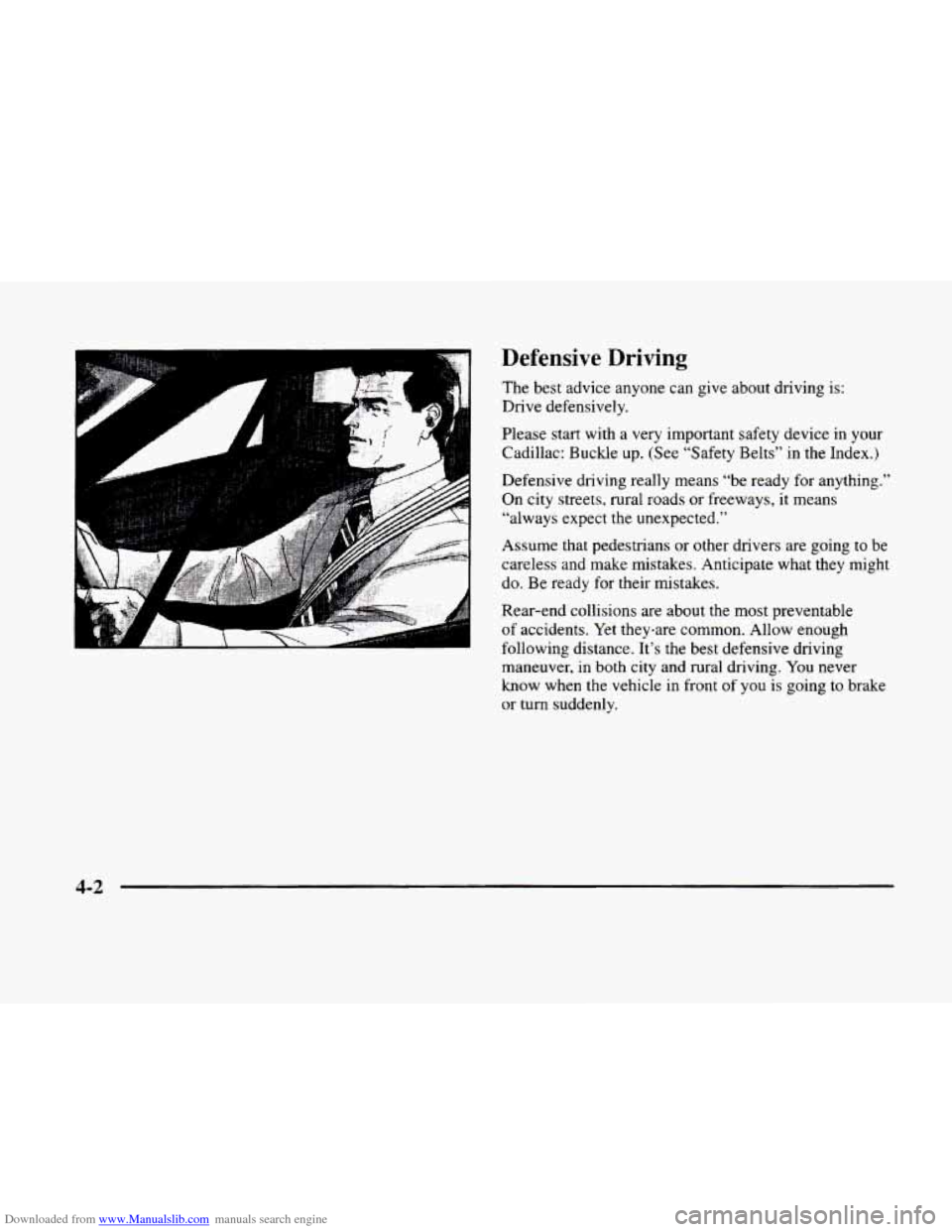
The best advice anyone can give about driving is:
Drive defensively.
Please start with a very important safety device
In your
Cadillac: Buckle up.
(See “Safety Belts” in the Index.)
Defensive driving really means “be ready for anything.”
On city streets, rural roads or freeways, it means
“always expect the unexpected.”
Assume that pedestrians or other drivers are going to be
careless and make mistakes. Anticipate what they might
do. Be ready for their mistakes.
Rear-end collisions
are about the most preventable
of accidents. Yet theyaare common. Allow enough
following distance. It’s the best defensive driving
maneuver,
in both city and rural driving. You never
know when the vehicle in front of you is going
to brake
or turn suddenly.
4-2
Page 204 of 380
Downloaded from www.Manualslib.com manuals search engine Control of a Vehicle
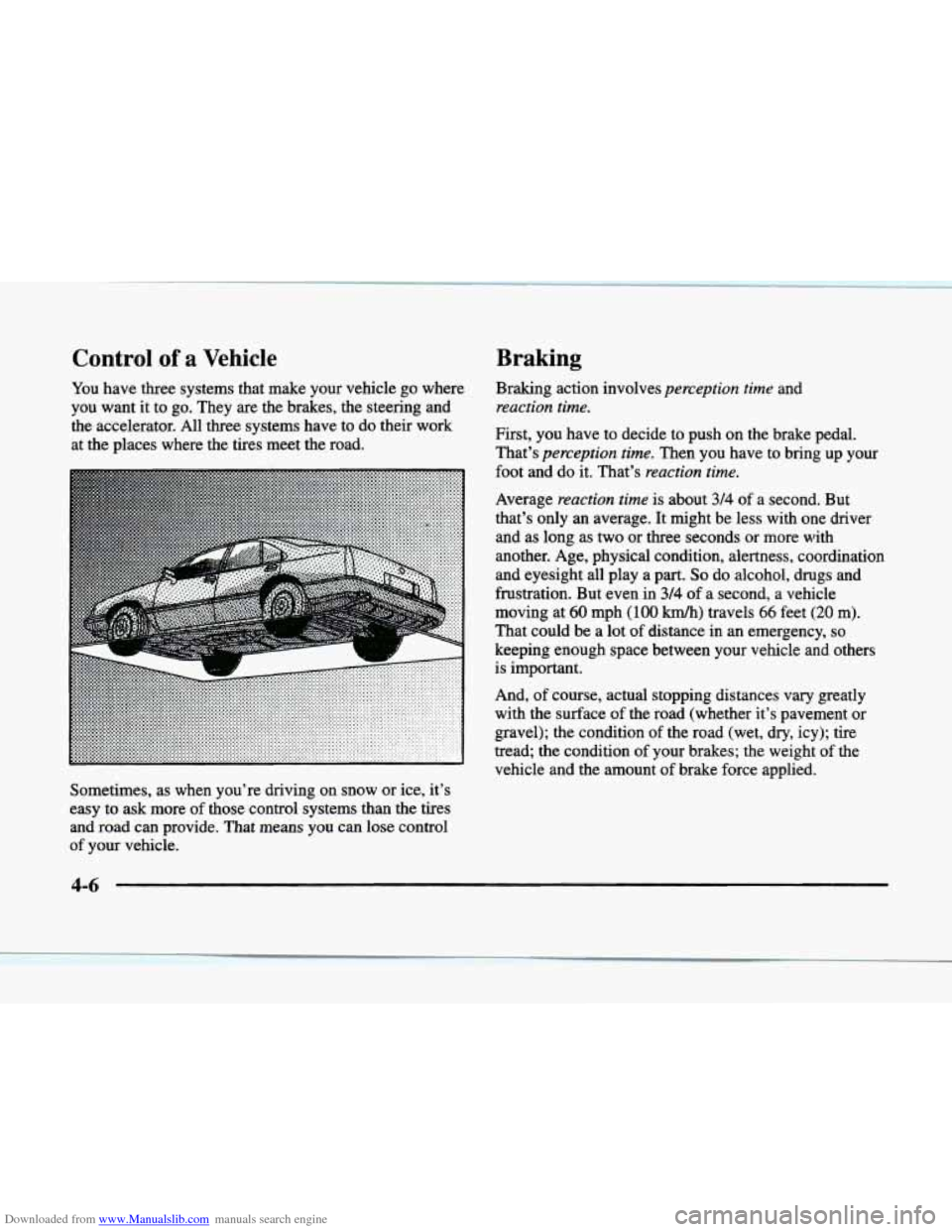
You have three systems that make your vehicle go where
you want it to go. They are the brakes, the steering and
the accelerator. All three systems have to do their work
at the places where the tires meet the road.
L
-4
. . , . . . .
. . . . . . . ....... .....
P
Braking
Braking action involves perception time and
reaction time.
First, you have to decide to push on the brake pedal.
That’s
perception time. Then you have to bring up your
foot and do it. That’s
reaction time.
Average reaction time is about 314 of a second. But
that’s only an average. It might be less with one driver
and as long as two or three seconds or more with
another. Age, physical condition, alertness, coordination
and eyesight all play a part.
So do alcohol, drugs and
frustration. But even in
3/4 of a second, a vehicle
moving at
60 mph (100 km/h) travels 66 feet (20 m).
That could be a lot of distance in an emergency,
so
keeping enough space between your vehicle and others
is important.
And, of course, actual stopping distances
vary greatly
with the surface
of the road (whether it’s pavement or
gravel); the condition
of the road (wet, dry, icy); tire
tread; the condition of your brakes; the weight
of the
vehicle and the amount of brake force applied.
Sometimes, as when you’re driving on snow or ice, it’s
easy to ask more of those control systems than the tires
and road can provide. That means you can lose control
of your vehicle.
4-6
Page 205 of 380
Downloaded from www.Manualslib.com manuals search engine Avoid needless heavy braking. Some people drive in Anti-Lock Brakes (ABS)
spurts -- heavy acceleration followed by heavy
braking
-- rather than keeping pace with traffic. This is a
mistake. Your brakes may not have time
to cool between
hard stops. Your brakes will wear
out much faster if you
Your vehicle has anti-lock brakes (ABS). ABS is an
advanced electronic braking
system that will help
prevent a braking skid.
do a lot of heavy braking. If you keep pace with the
traffic and allow realistic following distances,
you will
eliminate a lot
of unnecessary braking. That means
better braking and longer brake life.
If your engine ever stops while you’re driving, brake
normally but don’t pump your brakes.
If you do, the
pedal may get harder
to push down. If your engine
stops,
you will still have some power brake assist. But
you will use it when you brake, Once the power assist is
used up, it may take longer to stop and the brake pedal
will
be harder to push. When you
start your engine and begin to drive away,
your anti-lock brake system
will check itself. You may
hear a momentary motor or clicking
noise while this test
is going on, and you may even notice that your brake
pedal moves a little. This is normal.
If there’s a problem with the
anti-lock brake system, this
warning light will stay on.
See “Anti-Lock Brake
System Warning Light” in
the Index.
4-7
Page 206 of 380
Downloaded from www.Manualslib.com manuals search engine ii
."
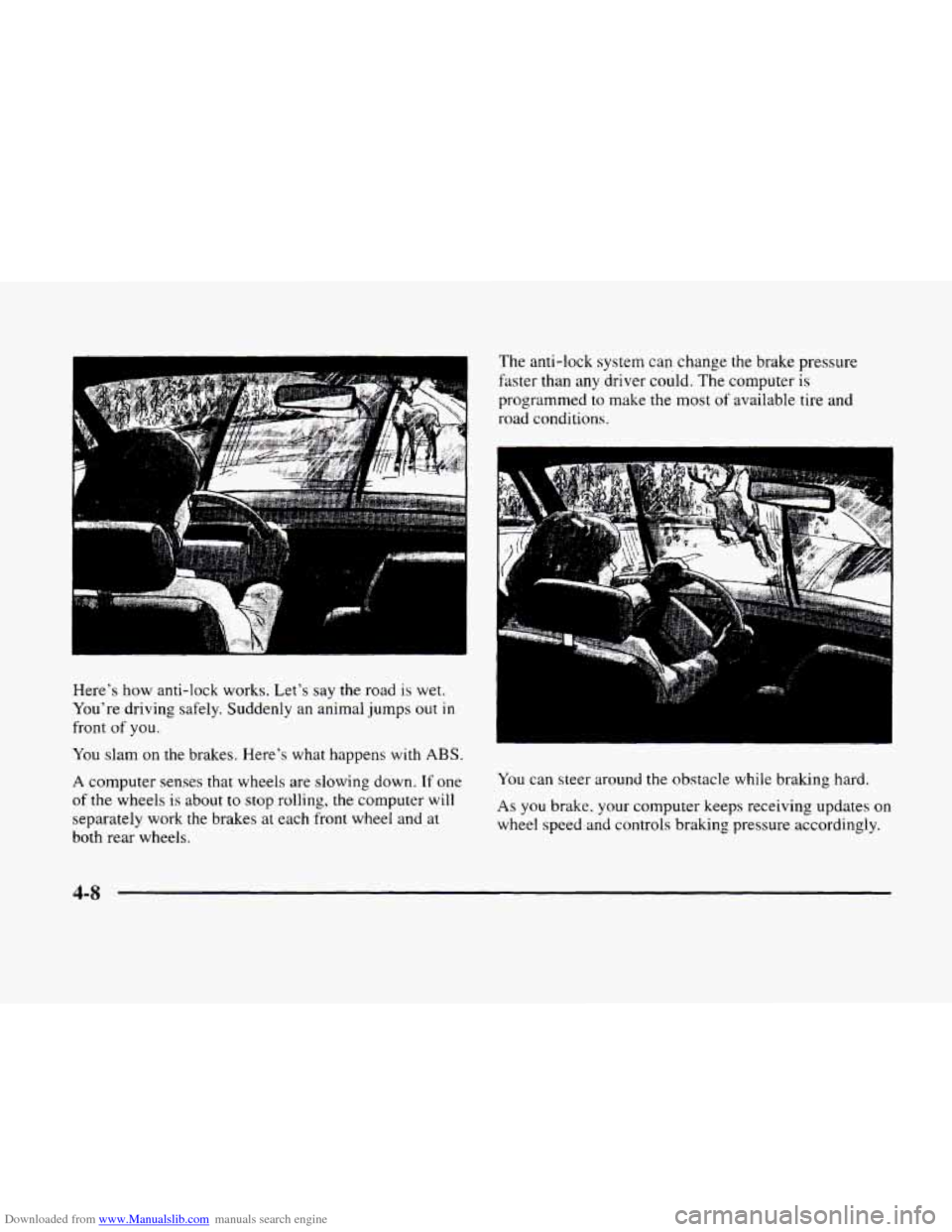
Here's how anti-lock works. Let's say the road is wet.
You're driving safely. Suddenly an animal jumps
out in
front of you.
You slam on the brakes. Here's what happens with ABS.
A computer senses that wheels are slowing down. If one
of the wheels is about to stop rolling, the computer will
separately work the brakes at each front wheel and at
both rear wheels. The
anti-lock system can change
the brake pressure
fdster than any driver could. The computer is
programmed to make the most
of available tire and
road conditions.
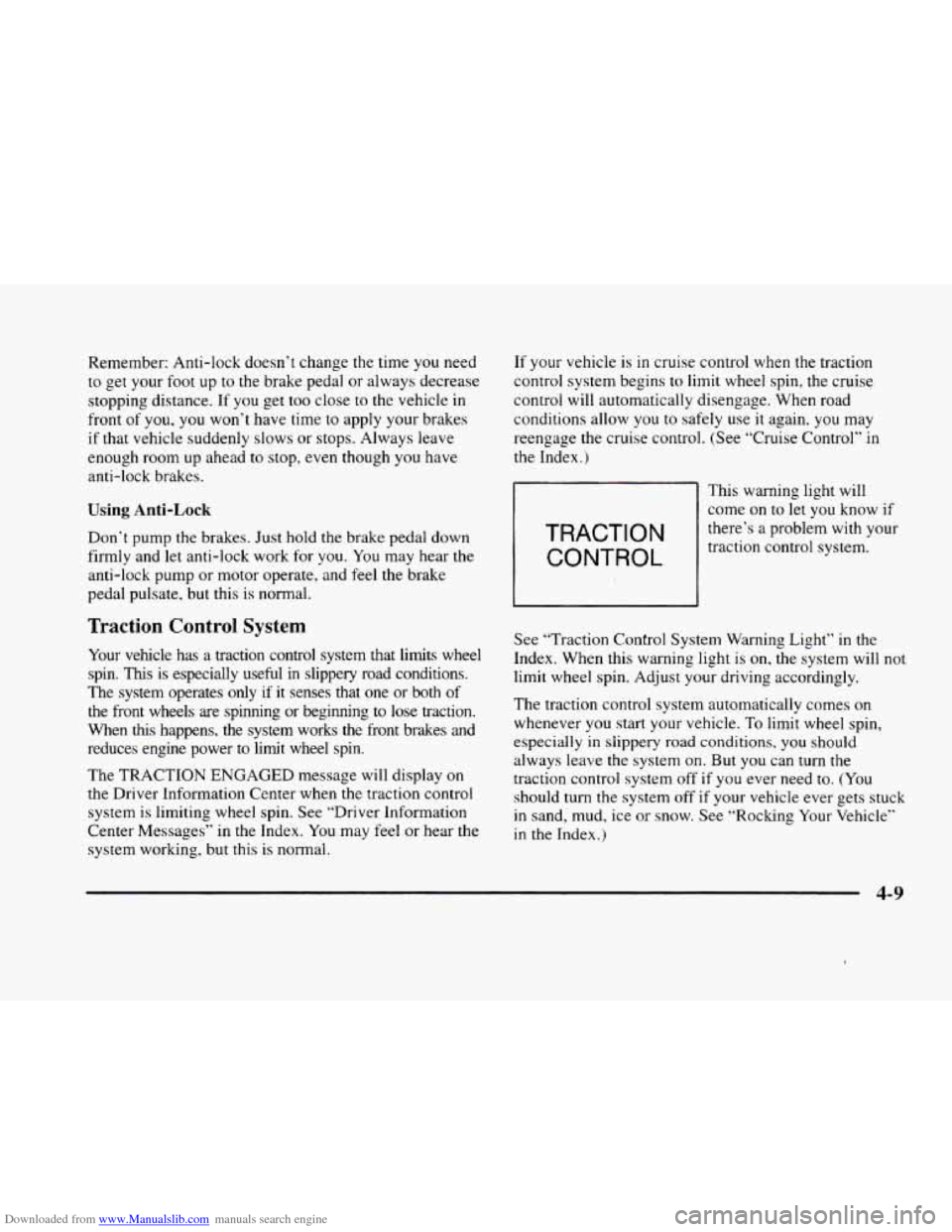
You can steer around the obstacle while braking hard.
As you brake, your computer keeps receiving updates on
wheel speed and controls braking pressure accordingly.
4-8
Page 207 of 380
Downloaded from www.Manualslib.com manuals search engine Remember: Anti-lock doesn’t change the time you need
to get your foot up to the brake pedal or always decrease
stopping distance. If you get too close to the vehicle in
front
of you, you won’t have time to apply your brakes
if that vehicle suddenly slows or stops. Always leave
enough room up ahead to stop, even though you have
anti-lock brakes.
Using Anti-Lock
Don’t pump the brakes. Just hold the brake pedal down
firmly and let anti-lock work for you. You may hear the
anti-lock pump or motor operate, and feel the brake
pedal pulsate, but this is normal. If
your vehicle
is in cruise control when the traction
control system begins
to limit wheel spin, the cruise
control will automatically disengage. When road
conditions allow you
to safely use it again, you may
reengage the cruise control. (See “Cruise Control” in
the Index.)
TRACTION
CONTROL
This warning light will
come
on to let you know if
there’s a problem with your
traction control system.
Traction Control System
Your vehicle has a traction control system that limits wheel
spin.
This is especially useful in slippery road conditions.
The system operates only
if it senses that one or both of
the front wheels are spinning or beginning to
lose traction.
When
this happens, the system works the front brakes and
reduces engine power to
limit wheel spin.
The TRACTION ENGAGED message will display on
the Driver Information Center when
the traction control
system
is limiting wheel spin. See ‘.Driver Infomation
Center Messages” in the Index. You may feel or hear the
system working, but this is normal. See
“Traction Control System Warning Light” in the
Index. When this warning light is
on. the system will not
limit wheel spin. Adjust
your driving accordingly.
The traction control system automatically comes on
whenever
you start your vehicle. To limit wheel spin,
especially
in slippery road conditions, you should
always leave the system on. But you can turn the
traction control system
off if you ever need to. (You
should turn the system off if your vehicle ever gets stuck
in sand, mud, ice or snow. See “Rocking Your Vehicle”
in the Index.)
4-9
Page 208 of 380
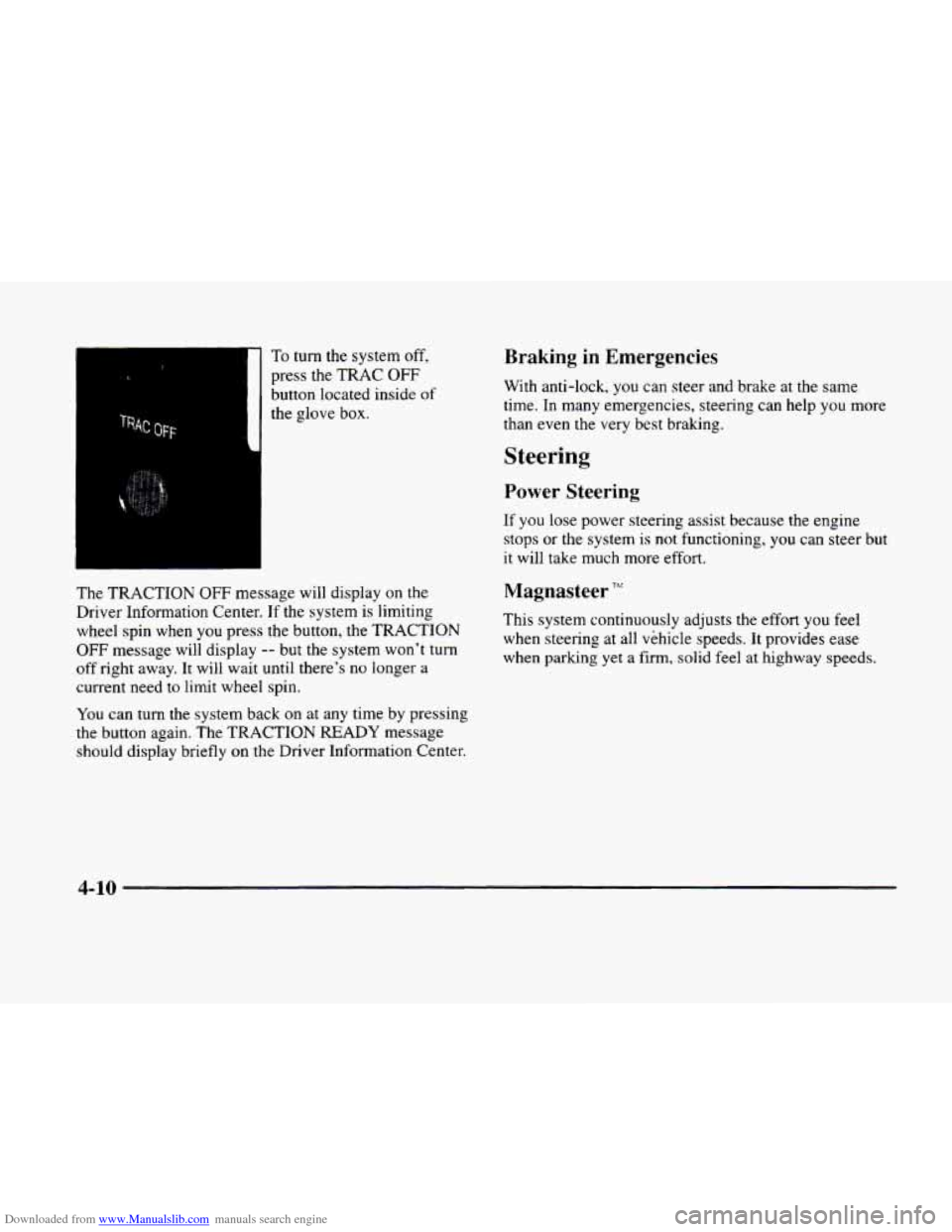
Downloaded from www.Manualslib.com manuals search engine To turn the system off,
press the TRAC OFF
button located inside of
the glove box.
The TRACTION OFF message will display on the
Driver Information Center.
If the system is limiting
wheel spin when you press the button, the TRACTION
OFF message will display -- but the system won’t turn
off right away. It will wait until there’s no longer a
current need
to limit wheel spin.
You can turn the system back on at any time by pressing
the button again.
The TRACTION READY message
should display briefly
on the Driver Information Center.
Braking in Emergencies
With anti-lock, you can steer and brake at the same
time. In many emergencies, steering can help you more
than even
the very best braking.
Steering
Power Steenng
If you lose power steering assist because the engine
stops
or the system is not functioning, you can steer but
it will take much more effort.
Magnasteer TFr‘
This system continuously adjusts the effort you feel
when steering
at all vehicle speeds. It provides ease
when parking yet a firm,
solid feel at highway speeds.
4-10
Page 210 of 380
Downloaded from www.Manualslib.com manuals search engine Steering in Emergencies
There are times when steering can be more effective
than braking. For example, you come over a hill and
find
a truck stopped in your lane, or a car suddenly pulls
out from nowhere, or a child darts out from between
parked cars and stops right
in front of you. You can
avoid these problems by braking
-- if you can stop in
time. But sometimes you can’t: there isn’t room.
That’s the time for evasive action
-- steering around
the problem.
Your vehicle can perform very well in emergencies like
these. First apply your brakes. (See “Braking in
Emergencies’? earlier in this section.) It is better to
remove as much speed as
you can from a possible
collision. Then steer around the problem, to the
left or
right depending
on the space available.
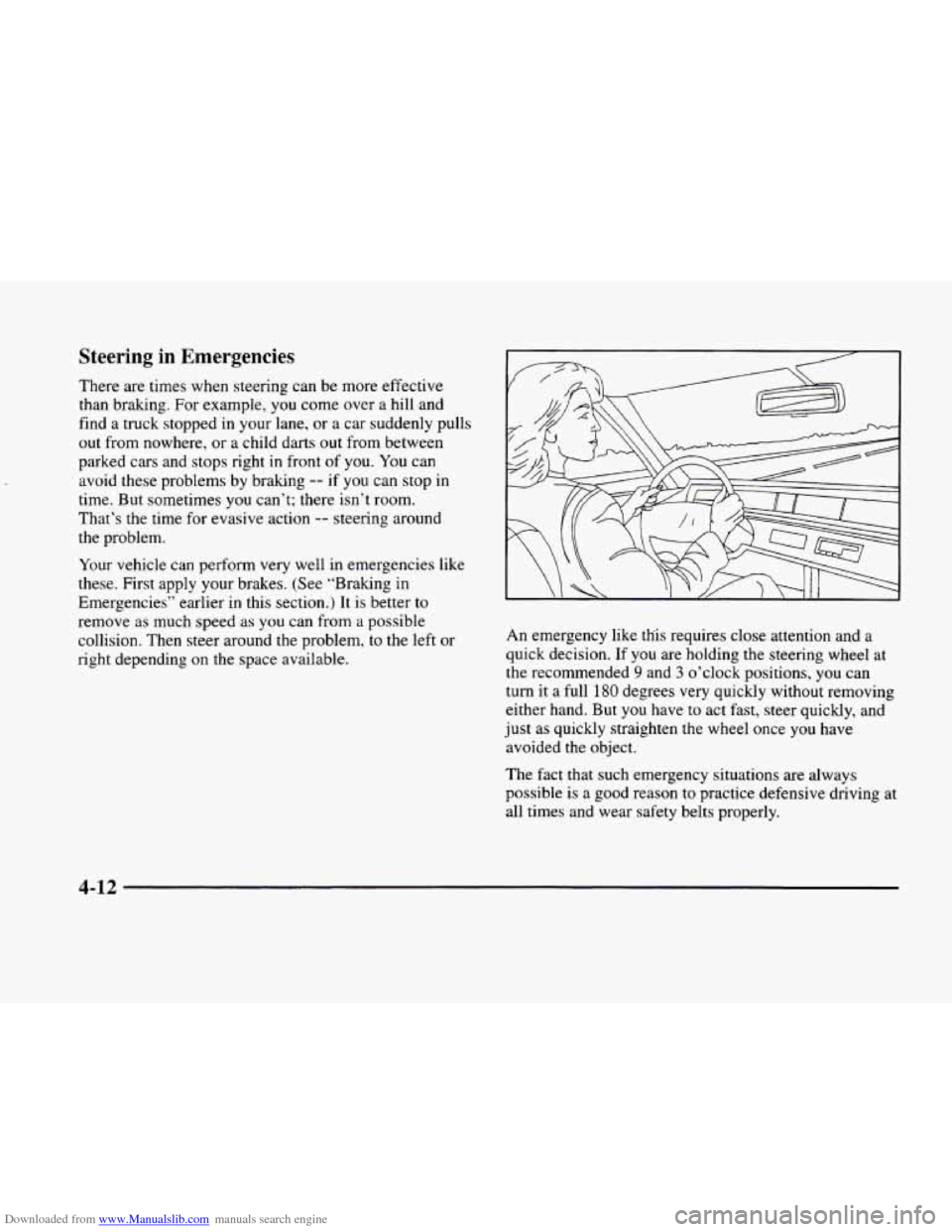
An emergency like this requires close attention and a
quick decision.
If you are holding the steering wheel at
the recommended
9 and 3 o’clock positions, you can
turn it a full 180 degrees very quickly without removing
either hand. But you have to act fast, steer quickly, and
just as quickly straighten the wheel once you have
avoided the object.
The fact that such emergency situations are always
possible
is a good reason to practice defensive driving at
all times and wear safety belts properly.
4-12