1998 CADILLAC ELDORADO spare tire
[x] Cancel search: spare tirePage 273 of 380
Downloaded from www.Manualslib.com manuals search engine Storing the Flat Tire and Tools
1 A CAUTION:
~~
Storing a jack, a tire or other equipment in the
passenger compartment
of the vehicle could
cause injury. In
a sudden stop or collision, loose
equipment could strike someone. Store
all these
in the proper place.
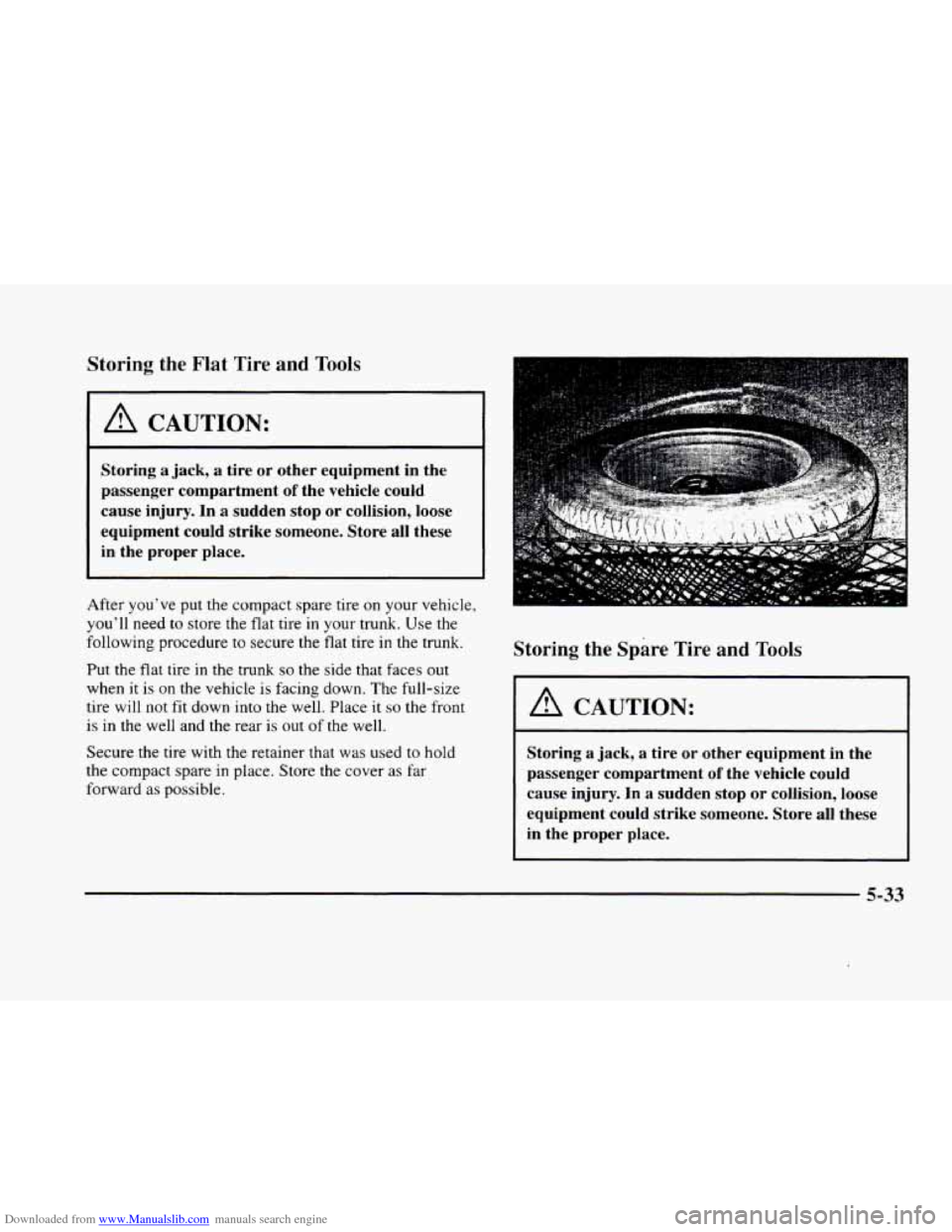
After you've put the compact spare tire on your vehicle,
you'll need to store the flat tire in your trunk. Use the
following procedure to secure the flat tire in the trunk.
Put the flat tire in the trunk
so the side that faces out
when
it is on the vehicle is facing down. The full-size
tire will not fit down into
the well. Place it so the front
is in the well and the rear
is out of the well.
Secure the tire with
the retainer that was used to hold
the compact spare in place. Store the cover as far
forward as possible.
Storing the Spare Tire and Tools
A CAUTION:
Storing a jack, a tire or other equipment in the
passenger compartment
of the vehicle could
cause injury.
In a sudden stop or collision, loose
equipment could strike someone. Store
all these
in the proper place.
5-33
Page 274 of 380
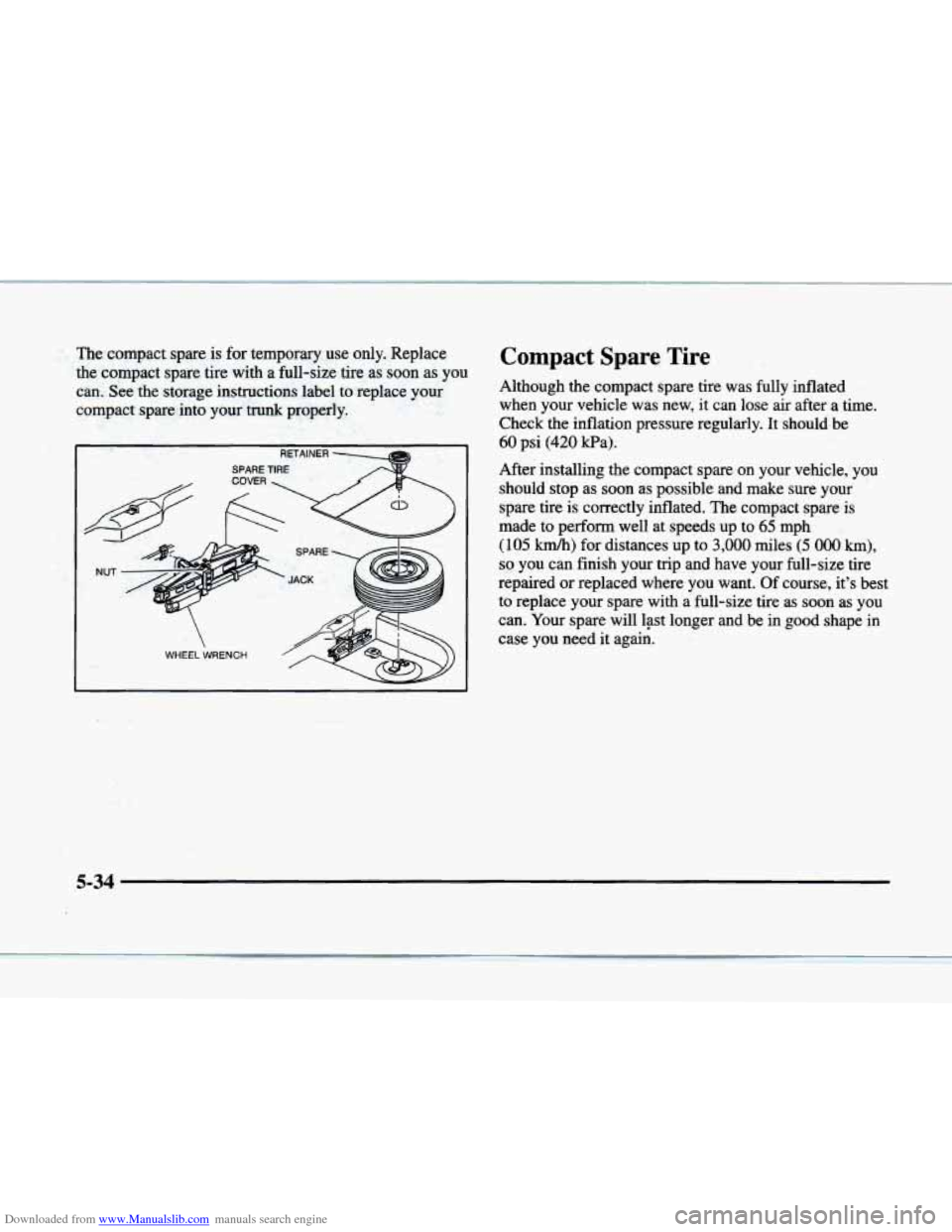
Downloaded from www.Manualslib.com manuals search engine The compact spare is for temporary use only. Replace
the compact spare tire with a full-size tire as
soon as you
can. See the storage instructions label
to replace your
compact spare into your
tfrmk properly.'
SPARE TIRE 7
WHEEL WRENCH
Compact Spare Tire
Although the compact spare tire was fully inflated
when your vehicle was new, it can lose
air after a time.
Check the inflation pressure regularly.
It should be
60 psi (420 kPa).
After installing the compact spare on your vehicle, you
should stop as soon as possible and make sure your
spare tire is correctly inflated. The compact spare is
made to perform well at speeds up
to 65 mph
(105 km/h) for distances up to 3,000 miles (5 000 km),
so you can finish your trip and have your full-size tire
repaired or replaced where you want. Of course, it's best
to replace your spare with a full-size tire as soon as you
can. Your spare will lgst longer and be
in good shape in
case you need it again.
5-34
Page 275 of 380
Downloaded from www.Manualslib.com manuals search engine r
r
r
r
2 P
r
r
r
r
NOTICE:
When the compact spare is installed, don’t take
your vehicle through an automatic car wash with
guide rails. The compact spare can get caught
on
the rails. That can damage the tire and wheel,
and maybe other parts
of your vehicle.
Don’t use your compact spare on other vehicles.
And don’t
mix your compact spare tire or wheel with
other wheels or tires. They won’t fit. Keep your spare
tire
and its wheel together.
NOTICE:
Tire chains won’t fit your compact spare. Using
them can damage your vehicle and can damage
the chains too. Don’t use tire chains on your
compact spare.
If You’re Stuck: In Sand, Mud,
Ice or Snow
What you don’t want to do when your vehicle is stuck is
to spin your wheels too fast. The method known
as
“rocking” can help you get out when you’re stuck, but
you must use caution.
A CAUTION:
If you let your tires spin at high speed, they can
explode, and you or others could be injured.
And, the transaxle or other parts
of the vehicle
can overheat. That could cause an engine
compartment fire or other damage. When you’re
stuck, spin the wheels as little
as possible. Don’t
spin the wheels above
35 mph (55 km/h) as shown
on the speedometer.
5-35
Page 320 of 380
Downloaded from www.Manualslib.com manuals search engine NOTICE:
Don’t let anyone tell you that underinflation or
overinflation
is all right. It’s not. If your tires
don’t have enough air (underinflation), you can
get
the following:
Too much flexing
Too much heat
0 Tire overloading
0 Bad wear
Bad handling
Bad fuel economy.
If your tires have too much air (overinflation),
you can get the following:
Unusual wear
Bad handling
0 Rough ride
0 Needless damage from road hazards. When
to Check
Check your tires once a month or more.
Don’t forget your compact spare tire. It should be at
60
psi (420 Wa).
How to Check
Use a good quality pocket-type gage to check tire
pressure.
You can’t tell if your tires are properly inflated
simply by looking
at them. Radial tires may look
properly inflated even when they’re underinflated.
Be sure to put the valve caps back on the valve
stems. They help prevent leaks by keeping out dirt
and moisture.
Tire Inspection and Rotation
Tires should be rotated every 6,000 to 8,000 miles
( 10 000 to 13 000 km). Any time you notice unusual
wear, rotate your tires as soon as possible and
check wheel alignment. Also check for damaged
tires or wheels. See “When It’s Time for New Tires”
and “Wheel Replacement” later in this section for
more information.
a
Page 321 of 380
Downloaded from www.Manualslib.com manuals search engine The purpose of regular rotation is to achieve more
uniform wear for all tires
on the vehicle. The first
rotation is
the most important. See “Scheduled
Maintenance Services” in
the Maintenance Schedule
booklet for scheduled rotation intervals.
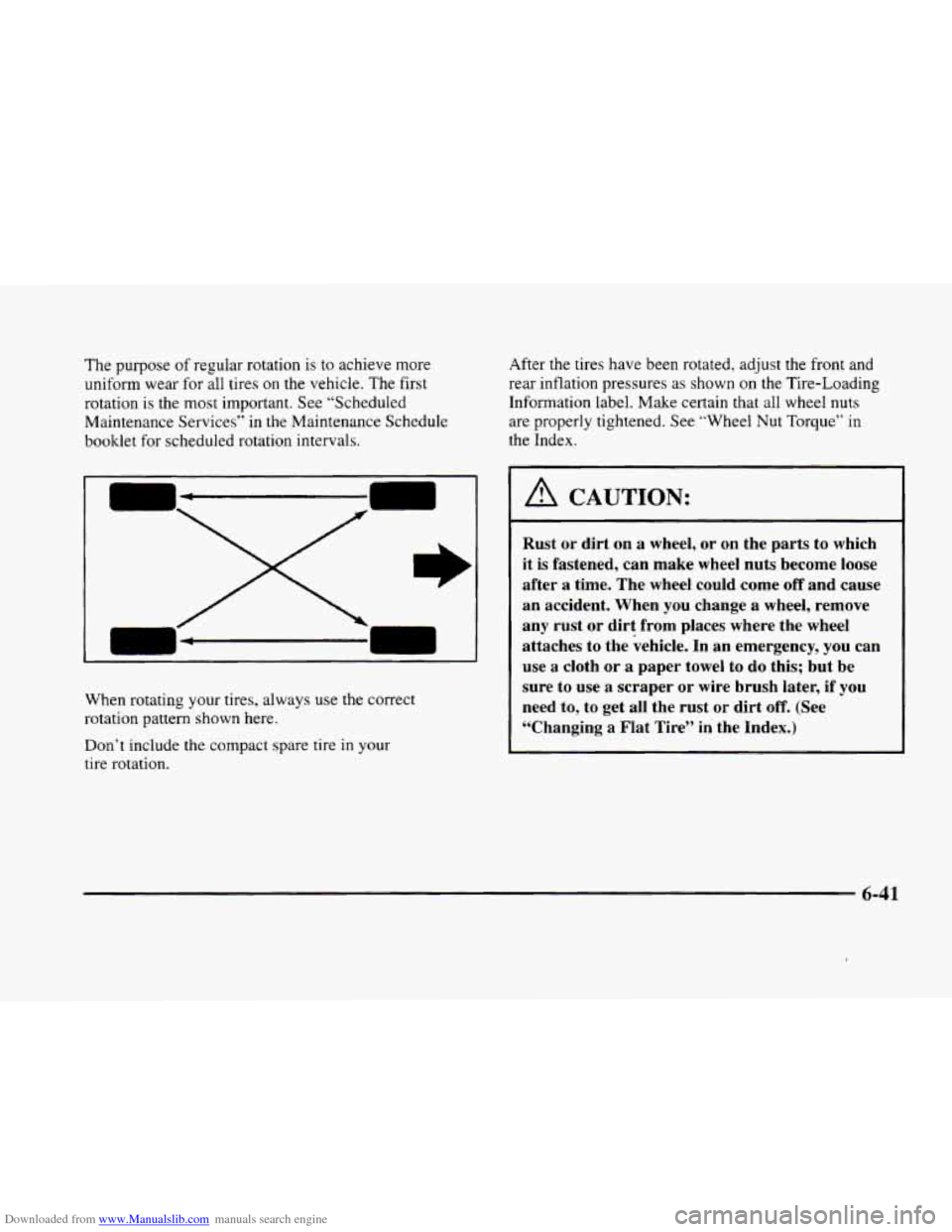
When rotating your tires, always
use the correct
rotation pattern shown here.
Don’t include the compact spare tire
in your
tire rotation. After the tires have been rotated,
adjust
the front and
rear inflation pressures as shown
on the Tire-Loading
Information label. Make certain that all wheel nuts
are properly tightened. See “Wheel Nut Torque” in
the Index.
I A CAUTION:
Rust or dirt on a wheel, or on the parts to which
it
is fastened, can make wheel nuts become loose
after a time. The wheel could come
off and cause
an accident. When you change
a wheel, remove
any rust or dirt from places where the wheel
attaches to the vehicle.
In an emergency, you can
use a cloth or a paper towel
to do this; but be
sure to use a scraper or wire brush later, if you
need to, to get all the rust or dirt
off. (See
“Changing a Flat Tire” in the Index.)
6-41
Page 323 of 380
Downloaded from www.Manualslib.com manuals search engine I A CAUTION:
Mixing tires could cause you to lose control while
driving.
If you mix tires of different sizes or types
(radial and bias-belted tires), the vehicle may not
handle properly, and you could have a crash.
Using tires of different sizes may also cause
damage to
your vehicle. Be sure to use the same
size and type tires on
all wheels.
It’s all right to drive with your compact spare,
though. It
was developed for use on your vehicle.
A CAUTION:
If you use bias-ply tires on your vehicle, the
wheel rim flanges could develop cracks after
many miles of driving.
A tire and/or wheel could
fail suddenly, causing
a crash. Use only radial-ply
tires with the wheels
on your vehicle.
Uniform Tire Quality Grading
The following information relates to the system
developed by the United States National Highway
Traffic Safety Administration, which grades tires by
treadwear. traction and temperature performance.
(This applies only to vehicles sold in the United States.)
The grades are molded
on the sidewalls of most
passenger car tires. The Uniform Tire Quality Grading
system does
not apply to deep tread, winter-type snow
tires, space-saver or temporary
use spare tires, tires with
nominal rim diameters of
10 to 12 inches (25 to 30 cm),
or
to some limited-production tires.
While the tires available on General Motors passenger
cars and light trucks may vary with respect to these
grades, they must also conform to Federal safety
requirements and additional General Motors Tire
Performance Criteria (TPC) standards.
6-43
Page 365 of 380
Downloaded from www.Manualslib.com manuals search engine Cleaning Alummum or Chrome Wheels
................... 6-52
Fabric
...................................... 6-48
Glass
....................................... 6-50
Inside
of Your Vehicle ......................... 6-47
Instrument Panel
............................. 6-49
Leather
..................................... 6- 49
Outside
of Your Vehicle ........................ 6-50
Speakercovers .............................. 6-49
Special Problems
............................. 6-48
Stains
................................. 6.48. 6.49
Tires
....................................... 6-52
Vinyl
....................................... 6-48
Wheels
..................................... 6-52
Windshield and Wiper Blades
................... 6-50
WoodPanels
................................. 6-49
Climate Control Panel
............................ 3-2
Climate Control Personalization
.................... 3-9
Climate Control
. Steering Wheel Controls ............ 3-9
Climate Control System
........................... 3-2
Clock . Setting the ................................ 3-9
Comfort Controls
................................ 3-2
Compact Disc Care ............................. 3-36
Compact Disc Player
....................... 3-17. 3-26
Cornpact Disc Player Errors .................. 3- 17. 3.26
Compact Spare
Tire ............................. 5-34
Console Shift Lever ............................. 2-26
Continuous Variable
- Road Sensing Suspension ...... 2-84
Control
of a Vehicle .............................. 4-6
Convenience Net
............................... 2-50
Convex Outside Mirror
.......................... 2-48
Compass
. Rearview Mirror
with ................... 2-45 Coolant
................................ ?. 6-22, 6-23
Heater, Engine
............................... 2-20
SurgeTank .................................. 5-20
Cooling System ................................
Damage. Finish ............................... 6-52
Damage . Sheet Metal ............................ 6-52
Daytime Running Lamps
......................... 2-40
Dead Battery
................................... 5-3
Defects. Reporting Safety ................... 7- 12. 7- 13
Defensive Driving ................................ 4-2
Defogger. Rear Window
.......................... 3-8
Defrosting ..................................... 3-8
Digital Control Buttons .......................... 2-70
Dimensions, Vehicle ............................ 6-64
Dolby
B Noise Reduction .............. 3-1 3. 3- 16. 3-25
Door Central Unlocking System
....................... 2-4
MapPocket
................................. 2-49
OpenMessage
............................... 2-73
Driver Door Open Message
....................... 2-73
DIC .......................................... 2-70
Locks ....................................... 2-4
.. ~ .. 8-3
Page 372 of 380
Downloaded from www.Manualslib.com manuals search engine Shifting Automatic Transaxle
.............
Into PARK (P) ..................
Out of PARK (P) ................
Shoulder Belt Tightness Adjustment ...
Signaling Turns ...................
SIR .............................
Skidding .........................
Sound Equipment, Adding ...........
Spare Tire, Compact ................
Speaker Covers, Cleaning ...........
Specificaticns and Capacities .........
Speech Impaired . Customer Assistance .
Stability System Engaged Message ....
Stains, Cleaning ...................
Starting Disabled Remove Key Message
Steam
...........................
In Emergencies ..................
Magnasteer TM ...................
Power .........................
Tips ...........................
Wheel, Tilt .....................
Steering Wheel Controls ............
Storage Compartments ..............
Storage Mode Personalization ........
Storage, Vehicle ...................
Stuck: In Sand, Mud, Ice or Snow .....
Sun Visors .......................
Sunglasses Storage Compartment .....
Speedometer ......................
Starting Your Engine ...............
Steering .........................
........
........
........
........
........
........
........
........
........
........
........
........
........
........
........
........
........
........
........
........
........
........
........
........
........
........
........
........
........
........
........
..... 2-21
..... 2-26
..... 2-28
..... 1-14
..... 2-32
..... 1-20
..... 4-15
..... 3-34
..... 5-34
..... 6-49
..... 6-64
...... 7-4
..... 2-59
..... 2-77
6.48. 6.49
..... 2-77
..... 2-19
..... 5-16
..... 4-10
..... 4-12
..... 4-10
..... 4-10
..... 4-11
..... 2-32
. 3.9. 3.33
..... 2-49
..... 2-43
..... 6-31
..... 5-35
..... 2-51
..... 2-49
Sunroof ....................................... 2- 52
Supplemental Inflatable Restraint .................. 1-20
Surge Tank, Coolant
............................. 5-20
Surge Tank Pressure Cap
......................... 6-25 ...
Symbols, Vehicle ................................ x111
Tachometer .................................. 2-60
TapePlayerCare
............................... 3-35
Telephone. Cellular
............................. 2-51
Temperature Controls
............................. 3-2
Theft ......................................... 2-13
Valet Lockout Button
.......................... 2-15
Theft System ProbledCar May Not Restart Message
. . 2-77
Theft-Deterrent Alarm System
.................... 2-14
Thermostat
.................................... 6-25
Third Gear, Automatic Transaxle
................... 2-24
Tilt Steering Wheel ............................. 2-32
Time, Setting the
................................. 3-9
Tire-Loading Information Label
................... 4-30
Alignment and Balance
........................ 6-44
BuyingNew
................................. 6-42
ChangingaFlat
.............................. 5-24
Tire
Loading
................................... 4-30
Tires
......................................... 6-38
Chains
..................................... 6-46
Cleaning
.................................... 6-52
Compactspare
............................... 5-34
Inflation
.................................... 6-39
Inspection and Rotation
........................ 6-40
Loading
.................................... 4-30
Pressure .................................... 6-39
8-10