Downloaded from www.Manualslib.com manuals search engine Brake Wear
Your vehicle has four-wheel disc brakes.
Disc brake pads have built-in wear indicators that
make a high-pitched warning sound when the brake
pads are worn and new pads are needed. The sound
may come and go or be heard all the time your vehicle
is moving (except when you are pushing on the brake
pedal firmly).
I A CAUTION:
The brake wear warning sound means that soon
your brakes won’t work well. That could lead to
an accident, When you hear the brake wear
warning sound, have your vehicle serviced.
NOTICE:
Continuing to drive with worn-out brake pads
could result
in costly brake repair.
Some driving conditions or climates may cause a brake
squeal when the brakes
are first applied or lightly
applied. This does not mean something is wrong with
your brakes.
Properly torqued wheel nuts are necessary
to help
prevent brake pulsation. When tires are rotated,
inspect brake pads for wear and evenly torque wheel
nuts
in the proper sequence to GM specifications.
Brake linings should always be replaced as complete
axle sets.
See “Brake System Inspection”
in Section 7 of the
Maintenance Schedule booklet under Part
C “Periodic
Maintenance Inspections.”
Brake Pedal Travel
See your dealer if the brake pedal does not return to
normal height, or if there is a rapid increase in pedal
travel. This could be a sign of brake trouble.
Brake Adjustment
Every time you apply the brakes, with or without the
vehicle moving, your brakes adjust for wear.
6-30
Downloaded from www.Manualslib.com manuals search engine When It’s Time for New Tires
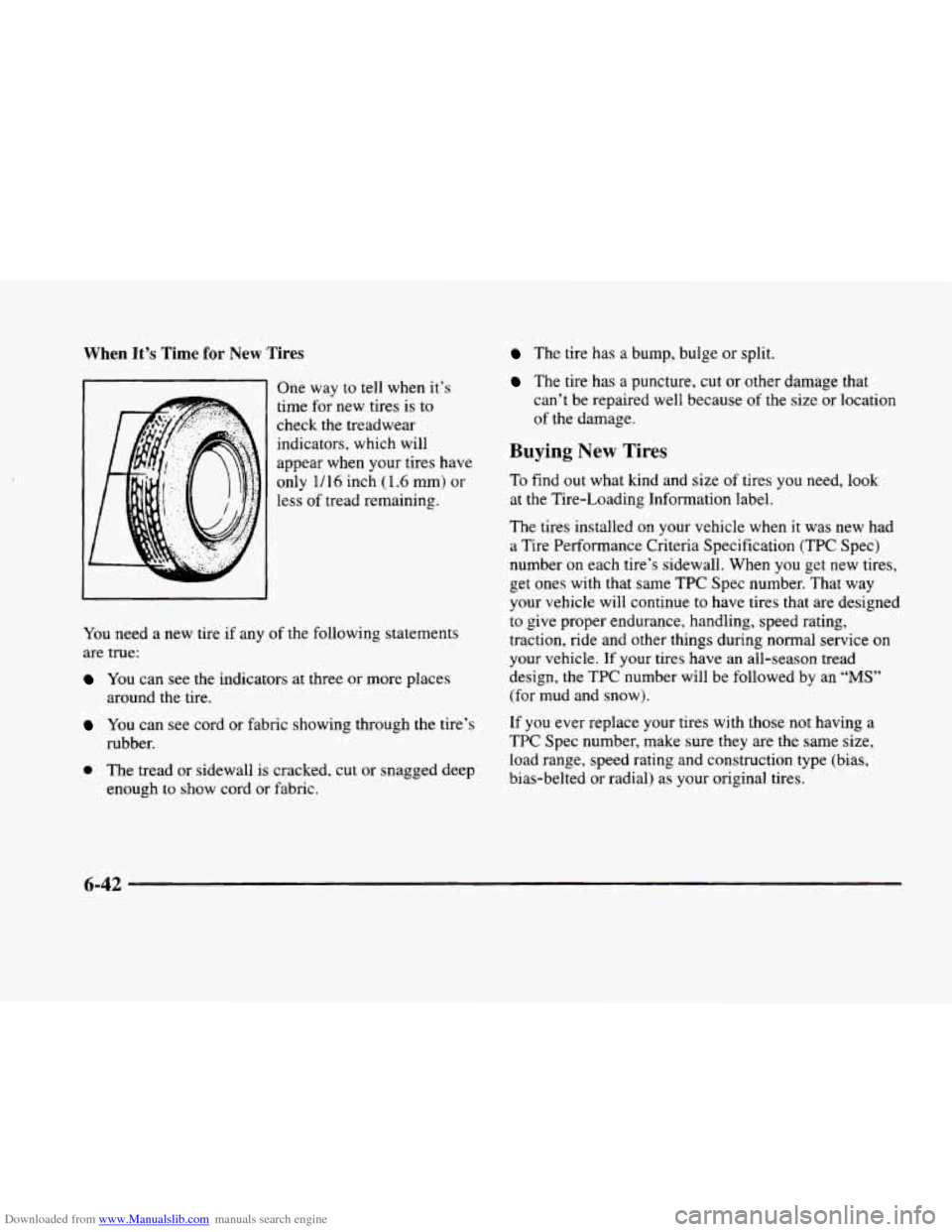
~ One way to tell when it’s
time for new tires is to
check the treadwear
indicators, which will
appear when your tires have
only 1/16 inch (1.6 mm) or
less of tread remaining.
You need a new tire if any
of the following statements
are true:
You can see the indicators at three or more places
around the tire.
You can see cord or fabric showing through the tire’s
rubber.
The tire has a bump, bulge or split.
The tire has a puncture, cut or other damage that
can’t be repaired well because
of the size or location
of the damage.
Buying New Tires
To find out what kind and size of tires you need, look
at the Tire-Loading Information label.
The tires installed on your vehicle when
it was new had
a Tire Performance Criteria Specification (TPC Spec)
number
on each tire’s sidewall. When you get new tires,
get ones with that same
TPC Spec number. That way
your vehicle will continue to have tires that are designed
to give proper endurance, handling, speed rating,
traction, ride and other things during normal service on
your vehicle.
If your tires have an all-season tread
design, the
TPC number will be followed by an ”MS”
(for mud and snow).
If you ever replace your tires with those not having
a
TPC Spec number, make sure they are the same size,
load range, speed rating and consiruction type (bias,
0 The tread or sidewall is cracked, cut or snagged deep bias-belted or radial) as your original tires.
enough to show cord or fabric.
6-42
Downloaded from www.Manualslib.com manuals search engine Hooks. Garment ................................ 2-51
Horn ......................................... 2-31
How to Reset the Oil Life Indicator ................. 6- 15
HVAC Steering Wheel Controls .................... 3-9
Hydraulic Brake Warning Lights ................... 2-62
Hydroplaning
.................................. 4-19
Ice Possible Message ........................... 2-75
Ignition Positions
............................... 2- 17
Illuminated Entry ............................... 2-43
Illuminated Visor Vanity Mirrors
................... 2-5 1
Inflation. Tire .................................. 6-39
Instrument Panel
............................... 2-56
Brightness Control
............................ 2-42
CleaningtheTop
............................. 6-49
Clusters
.................................... 2- 58
Interior Lamps
................................. 2-42
Jack. Tire
............................... 5.26. 5.27
Jump Starting
................................... 5-3
Keyless Entry System . Remote .................... 2-6
Keys .......................................... 2-2
Labels Certification
................................. 4-30
Service Parts Identification ..................... 6-55
Tire-Loading Information
...................... 4-30
Vehicle Identification Number
................... 6-55
Lamps ........................................ 2-39
Interior ..................................... 2-42
On Reminder ................................ 2-40
Panel
....................................... 2-42
Underhood
.................................. 6-11
Latches. Seatback
................................ 1-6
Leaving Your Vehicle
with the Engine Running ....... 2-27
Light Sensor. Twilight Sentinel
.................... 2-42
Lighter
....................................... 2-50
Leaving
Your Vehicle
............................. 2-6
Lights Air Bag Readiness
....................... 1.21. 2.61
Anti-Lock Brake System Warning
............ 2.64. . 4.7 _-
Brake System W&ing ......................... 2-62
Charging System Indicator ...................... 2-62
Engine Coolant Temperature Warning
............. 2-65
Oil Pressure ................................. 2-68
Parking Brake Indicator
........................ 2-63
Safety Belt Reminder'
...................... 1-7.2-61
Service Engine
Soon .......................... 2-66
Traction Control System Warning
............ 2-64. 4-9
Loading Your Vehicle
........................... 4-30
Locks
......................................... 2-4
Anti-Lockout Feature
.......................... 2-5
Automatic Door ............................... 2-5
Door
........................................ 2-4
PowerDoor
.................................. 2-5
Programmable Automatic Door
.............. 2-5 . 2-80
Trunk Release
................................ 2-10
LockAJnlock Confirmation
....................... 2-81
Low Refrigerant A/C Off Message ................. 2-75
Lumbar Controls
................................ 1-3
8-6