1998 CADILLAC DEVILLE air condition
[x] Cancel search: air conditionPage 173 of 386
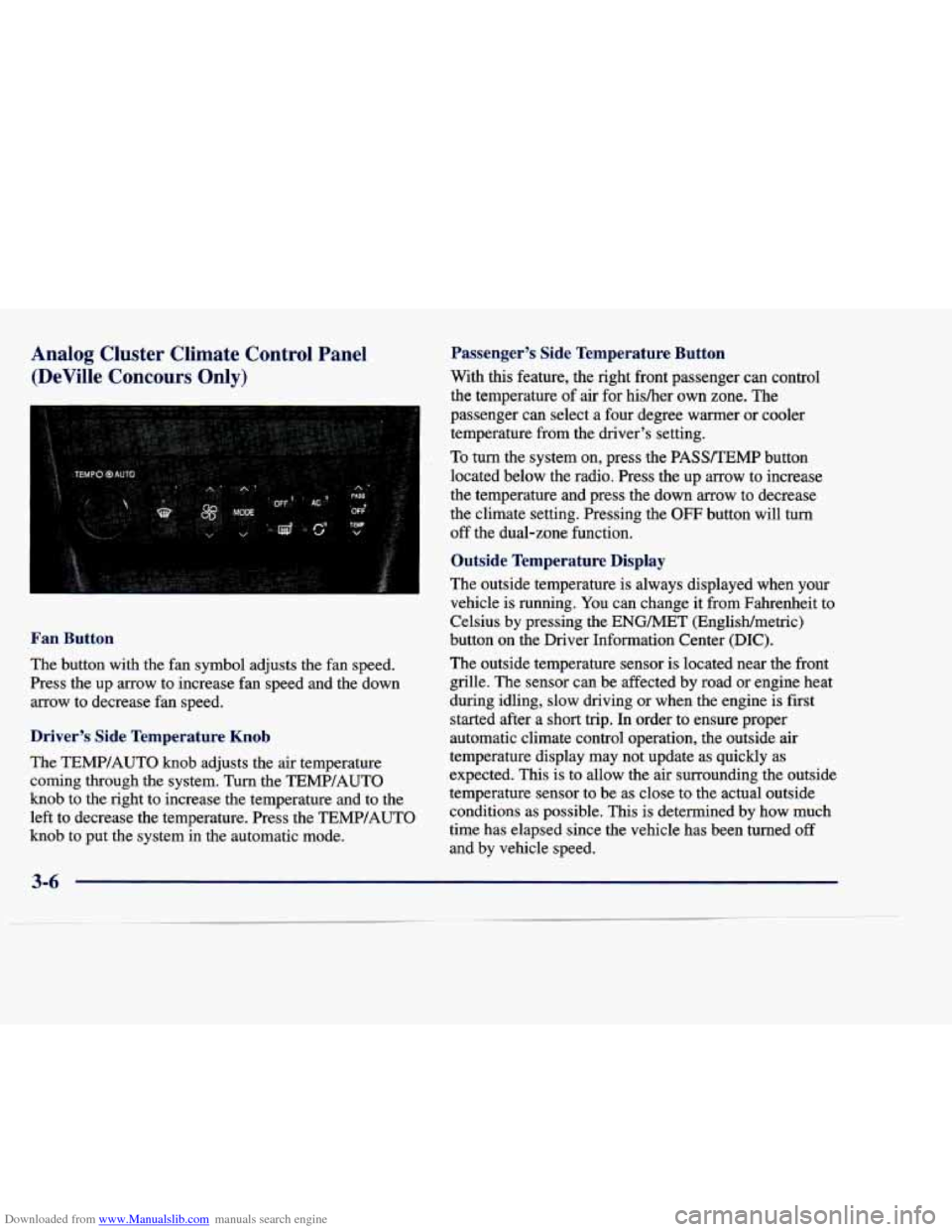
Downloaded from www.Manualslib.com manuals search engine Analog Cluster Climate Control Panel (DeVille Concours Only)
Fan Button
The button with the fan symbol adjusts the fan speed.
Press the up arrow to increase €an speed and the down
arrow to decrease fan speed.
Driver’s Side Temperature Knob
The TEMP/AUTO knob adjusts the air temperature
coming through the system. Turn the TEMP/AUTO
knob to the right to increase the temperature and to the
left to decrease the temperature. Press the TEMP/AUTO
knob to put the system
in the automatic mode.
Passenger’s Side Temperature Button
With this feature, the right front passenger can control
the temperature of
air for hisher own zone. The
passenger can select a four degree warmer or cooler temperature from the driver’s setting.
To turn the system on, press the PASS/TEMP button
located below the radio. Press the up arrow to increase
the temperature and press the down arrow to decrease
the climate setting. Pressing the
OW button will turn
off the dual-zone function.
Outside Temperature Display
The outside temperature is always displayed when your
vehicle is running. You can change it from Fahrenheit to
Celsius by pressing the
ENGMET (English/metric)
button on the Driver Information Center
(DIC).
The outside temperature sensor is located near the front
grille. The sensor can be affected by road or engine heat
during idling, slow driving or when the engine is first
started after a short trip. In order to ensure proper
automatic climate control operation, the outside air
temperature display may not update as quickly as
expected. This is to allow the air surrounding the outside
temperature sensor to be as close to the actual outside conditions as possible. This is determined by how much
time has elapsed since the vehicle has been turned
off
and by vehicle speed.
3-6
Page 174 of 386

Downloaded from www.Manualslib.com manuals search engine Mode Button
Press this button to deliver air through the floor, middle
or windshield outlets. The system will stay in the
selected mode until the
MODE button is pushed again.
Press the up or down arrow to cycle through the
available modes.
Automatic Operation
When the system is set for automatic operation, sensors
will control the air delivery mode. Air will come from
the floor, middle or windshield outlets. The fan speed
will vary as the system maintains the selected
temperature setting.
Be careful not to put anything over the solar sensor
located in the middle of the instrument panel near the
windshield. This sensor is used by the automatic system
to regulate temperature.
To find your comfort zone, start with the 75°F (24°C)
setting and allow about
30 minutes for the system to
regulate. Turn the TEMP/AUTO knob to adjust the
temperature
if necessary. If you choose 60 "F (1 6 " C),
the system will remain at that maximum cooling
setting and will not regulate fan speed. If you choose the
temperature
of 90°F (32"C), the system will remain at
that maximum heating setting and will not regulate fan speed. Choosing either maximum setting will not cause
the system to heat or cool any faster. With the automatic setting, the air conditioning
compressor automatically cycles when needed to cool
the air. In cold weather, when the system senses the
need for heat, the airflow will be directed out the floor
outlets.
As the interior temperature approaches a desired
setting, the blower speed will decrease.
To maintain
interior comfort, the airflow may move to the instrument
panel
air outlets and floor outlets (bi-level mode). On
bright sunny days in cold weather, the airflow may come
out of the air conditioning outlets (AC mode) to
maintain comfort and prevent stuffiness.
If your vehicle is sitting out on a hot day and you have
it set on AUTO,
the air will first flow out the floor air
outlets for a few seconds. That is normal. This is to
expel hot air from the air outlets.
As the air is cooled,
the airflow will move through the air conditioning
outlets.
If you start your vehicle with the fan setting
on HI, it will skip the air conditioning purge.
To avoid blowing cold air in cold weather, the
system will delay turning on the fan until warm air is
available. The length of delay depends on the outside
air temperature, engine coolant temperature or the time
since the engine was last started. As the coolant warms
up, the blower fan speed will gradually increase and air will flow from the heater outlets, with some
airflow to the windshield to prevent fogging under
most normal conditions.
3-7
Page 176 of 386

Downloaded from www.Manualslib.com manuals search engine OFF: Press this button to turn the system off. Fresh
air will continue to flow through the vehicle, and the
system will try
to maintain the previously set
temperature. The outside temperature will show on
the display when the system is
OFF.
AC: Press this button to turn the air conditioning on and
off. The system will cool and dehumidify the air inside
the vehicle. In the
AUTO mode, the display will show
that
AC is active, but the air conditioning compressor
only operates when the system determines it is needed.
0 RECIRCULATION: Press this button to limit the
amount of fresh air entering your vehicle. This is helpful
when you are trying to cool the air quickly or limit odors
entering your vehicle. In the
AUTO mode, the system
will use recirculation as necessary to cool the air.
Pressing the recirculation button will change the
operation to a manual mode and the air will recirculate
non-stop. Press this button again to turn off the
recirculation feature.
If you notice the windows fogging, press the recirculation button to exit the recirculation mode.
Electronic Solar Sensor
The sensor monitors the sun's solar radiation and is
located on top of the instrument panel near the
windshield. The
ECC panel uses this information to
automatically make the necessary temperature and
airflow adjustments to maintain your comfort.
3-9
Page 177 of 386

Downloaded from www.Manualslib.com manuals search engine . 3.
Air Conditioning
.On hot days, open the windows long enough to let hot
inside
air escape. This reduces the time it takes for your
vehicle to cool down. Then keep your windows closed
for the
air conditioner to work its best. I ,
With the digital cluster climate control panel, press the
AUTOLECON button to assist 'in cooling air and in
maintaining proper airflow. Adjust the temperature to a
comfortable setting by pressing the blue,button to cool
your vehicle and pressing the red button to warm your
vehicle. Press the fan button
arrows up or down to
,adjust the fan speed.
If your vehicle has a climate control panel (which is
standard with the analog cluster), press the AC button
or
the TEMPLAUTO knob to turn the system on. The
system'will cool and dehumidify the
air inside the
vehicle. Also while in the AUTO mode, the system will
use recirculation as necessary
to cool the air. You may
also need to adjust- the interior temperature and the fan
speed as needed.
When'the
air conditioner is on, you may sometimes
notice slight changes
in your vehicle's engine speed
and power. This is normal because the system is
designed to cycle the compressor
on and off to keep
the desiied temperature.
Heating
With the digital cluster climate control panel, press the
AUTOECON button to direct airflow and to help save
fuel. Adjust the temperature, if necessary, by pressing
the blue button to decrease temperature and pressing the
red button to increase temperature.
Also remember to
adjust the fan speed by pressing the up or downarrow.
If your vehicle has a climate control panel (which is
standard with the analog cluster), press the
MODE
button to select heater. Adjust the interior temperature to a comfortable level and if the fan speed needs adjusting,
press the up
or down arrow.
With each system, outside
air will be brought in and sent
through the floor, air conditioning or bi-level outlets
(depending on the condition). The heater works best
if
you keep your windows closed whiIe using it.
3-10 1 _--- -
Page 178 of 386

Downloaded from www.Manualslib.com manuals search engine Ventilation System
Your vehicle's flow-through ventilation system supplies
outside air into the vehicle when it is moving. Outside
air will also enter the vehicle when the heater or the air
conditioning fan is running.
The direction
of airflow to the rear seats can be adjusted
if you have the optional full console (DeVille Concours
Only). Move the fan lever to adjust the blower speed
from LO to
HI. Motre the vent lever to direct the airflow.
The front outlets are located in the center and at each
side
of the instrument panel. You can adjust the
direction of airflow by moving the center control levers
or you can stop the aifflow by moving the lever located
on each side
of the outlets downward.
3-11
Page 179 of 386

Downloaded from www.Manualslib.com manuals search engine ~~~
~~
~ Ventilation Tips
Keep the hood and front air inlet free of ice, snow
or any other obstruction (such as leaves). The
heater and defroster will work far better, reducing
the chance of fogging the inside of the windows.
of objects. This helps circulate
air throughout
your vehicle.
Keep the air path under the front seats clear
Defogging and Defrosting
On cool, humid days, use DEFOG (digital cluster
climate control panel only) to keep the windshield
and side windows clear. Use DEFROST to remove fog or ice from the windshield quickly in extremely humid
or cold conditions.
With the digital cluster climate control panel, press
the DEFOG button and adjust the fan speed by pressing the fan button up or down.
If you use DEFROST,
adjust the fan speed the same way.
If you select
DEFROST from AUTO, the system will control the
fan speed. The temperature will also need to be
adjusted to your comfort level. Press the blue button
to decrease the temperature and the red button
to
increase the temperature. If your vehicle has a climate control panel (which
is
standard with the analog cluster). If you select
DEFROST, adjust the fan speed by pressing the fan
button up or down. If you select DEFROST from
AUTO, the system will control the fan speed. The
temperature also needs to be adjusted by turning the
TEMP/AUTO knob.
Note that recirculation is not available in the defiost
or defog modes.
Rear Window Defogger
The lines you see on the
rear window warm the glass. Press
this button to
turn on the rear defogger.
With it, the rear window
and both outside rearview
mirrors are heated.
The system will automatically shut
off after 10 minutes.
If further defogging is desired, press the button again.
Do not attach a temporary vehicle license, tape or decals
across the defogger grid on the rear window.
3-12
Page 226 of 386

Downloaded from www.Manualslib.com manuals search engine If your vehicle starts to slide, ease your foot off the
accelerator pedal and quickly steer the way you want the
vehicle to go. If you start steering quickly enough, your
vehicle may straighten out. Always be ready for a
second skid if it occurs.
If you have Stabilitrak, you may see the STABILITY
ENGAGED message on the Driver Information Center. See “Stability Engaged Message” in the Index.
Of course, traction is reduced when water, snow, ice,
gravel or other material is on the road. For safety, you’ll
want to slow down and adjust your driving to these
conditions. It
is important to slow down on slippery
surfaces because stopping distance will be longer and
vehicle control more limited.
While driving on a surface with reduced traction, try
your best to avoid sudden steering, acceleration or
braking (including engine braking by shifting to a lower gear). Any sudden changes could cause the tires
to
slide. You may not realize the surface is slippery until
your vehicle is skidding. Learn to recognize warning
clues
-- such as enough water, ice or packed snow on
the road to make a “mirrored surface”
-- and slow down
when you have any doubt.
Remember: Any anti-lock brake system
(ABS) helps
avoid only the braking skid.
Driving at Night
Night driving is more dangerous than day driving. One
reason is that some drivers are likely to
be impaired -- by
alcohol or drugs, with night vision problems, or by fatigue.
4-15
Page 264 of 386

Downloaded from www.Manualslib.com manuals search engine Engine Overheating
You will find an ENGINE COOLANT HOT, IDLE
ENGINE message or an ENGINE
OVERHEATED
STOP, ENGINE message on the Driver Information
Center (DIC). You will
also hear a chime. There is also
an engine temperature warning light andor gage on the
instrument panel. See “Engine Coolant Temperature
Warning Light” or “Engine Coolant Temperature Gage”
in the Index.
Overheated Engine Protection
Operating Mode
NOTICE:
After driving in the overheated engine protection
operating mode, to avoid engine damage, allow
the engine to cool before attempting any repair.
The engine oil will be severely degraded. Repair
the cause of coolant loss, change the oil and reset
the oil life indicator. See “Engine Oil, When to
Change” in the Index.
Should an overheated engine condition exist and the
message ENGINE OVERHEATED STOP ENGINE is
displayed, an overheat protection mode which alternates
firing groups
of four cylinders helps prevent engine
damage.
In this mode, you will notice a loss in power
and engine performance. This operating mode allows
your vehicle to be driven to a safe place in
an
emergency; you may drive up to 50 miles (80 lun).
Towing a trailer in the overheat protection mode should
be avoided.
5-15