1998 CADILLAC CATERA ignition
[x] Cancel search: ignitionPage 89 of 346

Downloaded from www.Manualslib.com manuals search engine 1. Without pushing the accelerator pedal, turn your ignition key to START. When the engine starts, let
go of the key. The idle speed will go down as your
engine gets warm.
NOTICE:
Holding your key in START for longer than
15 seconds at a time will cause your battery to be
drained much sooner. And the excessive heat
can
damage your starter motor. Wait about 15 seconds
between each
try to help avoid draining your
battery
or damaging your starter.
2. If it doesn’t start right away, hold your key in
START for about three seconds at a time until
your
engine starts. Wait about 15 seconds between each
try to help avoid draining your battery or damaging
your starter.
3. If your engine still won’t start (or starts but then
stops), it could
be flooded with too much gasoline.
Try pushing your accelerator
pedal all the way to the
floor and holding it there as you hold the key in
START for about three seconds. If the vehicle starts
briefly but then stops again, do the
same thing.
NOTICE:
Your engine is designed to work with the
electronics in your vehicle.
If you add electrical
parts or accessories, you could change the way
the engine operates. Before adding electrical
equipment, check with your dealer.
If you don’t,
your engine might not perform properly.
If you ever have to have your vehicle towed, see
the
part of this manual that tells how to do it
without damaging your vehicle. See “Towing
Your Vehicle” in the
Index.
Page 92 of 346

Downloaded from www.Manualslib.com manuals search engine Ensure the shift lever is fully in PARK (P) range before
starting the engine. Your
vehicle has a
Brake-Transmission Shift Interlock (BTSI).
You have to fully apply the regular brakes
before you
can shift from PARK
(P) when the ignition key is in ON.
If you cannot shift out of PARK (P), ease pressure on
the shift lever
-- push the shift lever all the way into
PARK
(P) as you maintain brake application. Then
move the shift lever into the gear you wish. See
“Shifting Out
of PARK (P)” in this section.
REVERSE (R): Use this gear to back up.
To rock your vehicle back and forth to get out of snow,
ice or sand without damaging the transmission, see
“Stuck: In Sand, Mud,
Ice or Snow” in the Index.
NEUTRAL (N): The engine doesn’t connect with the
wheels when driving in NEUTRAL
(N). Use
NEUTRAL
(N) to restart your vehicle when you’re
already moving or when your vehicle is being towed. Shifting
out of PARK (P) or NEUTRAL (N) while
your engine
is “racing” (running at high speed) is
dangerous. Unless your foot is firmly on the
brake pedal, your vehicle could move very
rapidly. You could lose control and hit people or
objects. Don’t shift out of
PARK (P) or
NEUTRAL (N) while your engine is racing.
NOTICE:
Damage to the transmission caused by shifting
out of
PARK (P) or NEUTRAL (N) with the
engine racing isn’t covered by your warranty.
Page 95 of 346

Downloaded from www.Manualslib.com manuals search engine This feature is for improved traction only when the road
surface is slippery and is not intended for continuous use
or when the vehicle
is stuck in sand, mud, ice, snow or
gravel. Drive as usual for normal road conditions.
This feature automatically turns off when any of the
following conditions occur:
When the ignition is turned off.
If the shift lever is placed in PARK (P), THIRD (3),
SECOND (2), or FIRST (1).
If you press and hold the accelerator pedal past its
resistance point for more than two seconds.
When speed falls below 25 mph (40 km/h).
0 Once the vehicle reaches 67 mph (108 km/h).
To turn this feature off, press the button again.
Whenever you start your vehicle, the transmission is in
the normal mode.
Parking Brake
To set the parking brake, hold the regular brake pedal
down with your foot and pull up on the parking brake
lever.
If the ignition is on, the brake system warning
light will come on.
Page 97 of 346

Downloaded from www.Manualslib.com manuals search engine 2. Move the shift lever into PARK (P) like this: Leaving Your Vehicle With the
Engine Running
3.
4.
5.
6.
Pull the button on the shift lever handle up and then
push the shift lever all the way toward the front
of
your vehicle into PARK (P). Release the button.
With your right foot still holding the brake pedal down, set the parking brake.
Move the ignition key to
LOCK.
Remove the ignition key and take it with you. If you
can leave your vehicle with the key
in your hand,
your vehicle is in PARK
(P).
L
It can be dangerous to leave your vehicle with the
engine running. Your vehicle could move
suddenly if the shift lever is not fully in
PARK (P)
with the parking brake firmly set. And, if you
leave the vehicle with the engine running, it could
overheat and even catch fire. You or others could
be injured. Don’t leave your vehicle with the
engine running unless you have to.
If you have to leave your vehicle with the engine
running, be sure your vehicle
is in PARK (P) and the
parking brake is firmly set before you leave it. After
you’ve moved the shift lever into PARK
(P), hold the
regular brake pedal down. Then,
see if you can move the
shift lever away from PARK (P) without pressing the
button on the shift lever handle. If you can, it means that
the shift lever wasn’t fully locked
into PARK (P).
Page 98 of 346

Downloaded from www.Manualslib.com manuals search engine Torque Lock
If you are parking on a hill and you don’t shift your
transmission into PARK (P) properly, the weight of the
vehicle may put too much force on the parking pawl
in
the transmission. You may find it difficult to pull the
shift lever out of PARK (P). This is called “torque lock.”
To prevent torque lock, set the parking brake and then
shift into PARK
(P) properly before you leave the
driver’s seat.
To find out how, see “Shifting Into
PARK (P)” in the Index.
If torque lock does occur, you may need to have another
vehicle push yours a little uphill to take some of the
pressure from the parking pawl in the transmission,
so
you can pull the shift lever out of PARK (P).
Shifting Out of PARK (P)
Your vehicle has a Brake-Transmission Shift Interlock
(BTSI). You have to fully apply the regular brakes
before you can shift from PARK (P) when the ignition is
in
ON. See “Automatic Transmission” in the Index.
If you cannot shift out
of PARK (P), ease pressure on
the shift lever
-- push the shift lever all the way into
PARK (P) as you maintain brake application. Then
move the shift lever into the gear you want. If you ever
hold the brake pedal down but still can’t shift out of
PARK
(P), try this:
1. Turn the ignition key to OFF. Open and close the
driver’s door to turn off the Retained Accessory
Power (RAP) feature.
2. Apply and hold the brake until the end of Step 8.
Page 102 of 346
Downloaded from www.Manualslib.com manuals search engine Windows
Power Windows
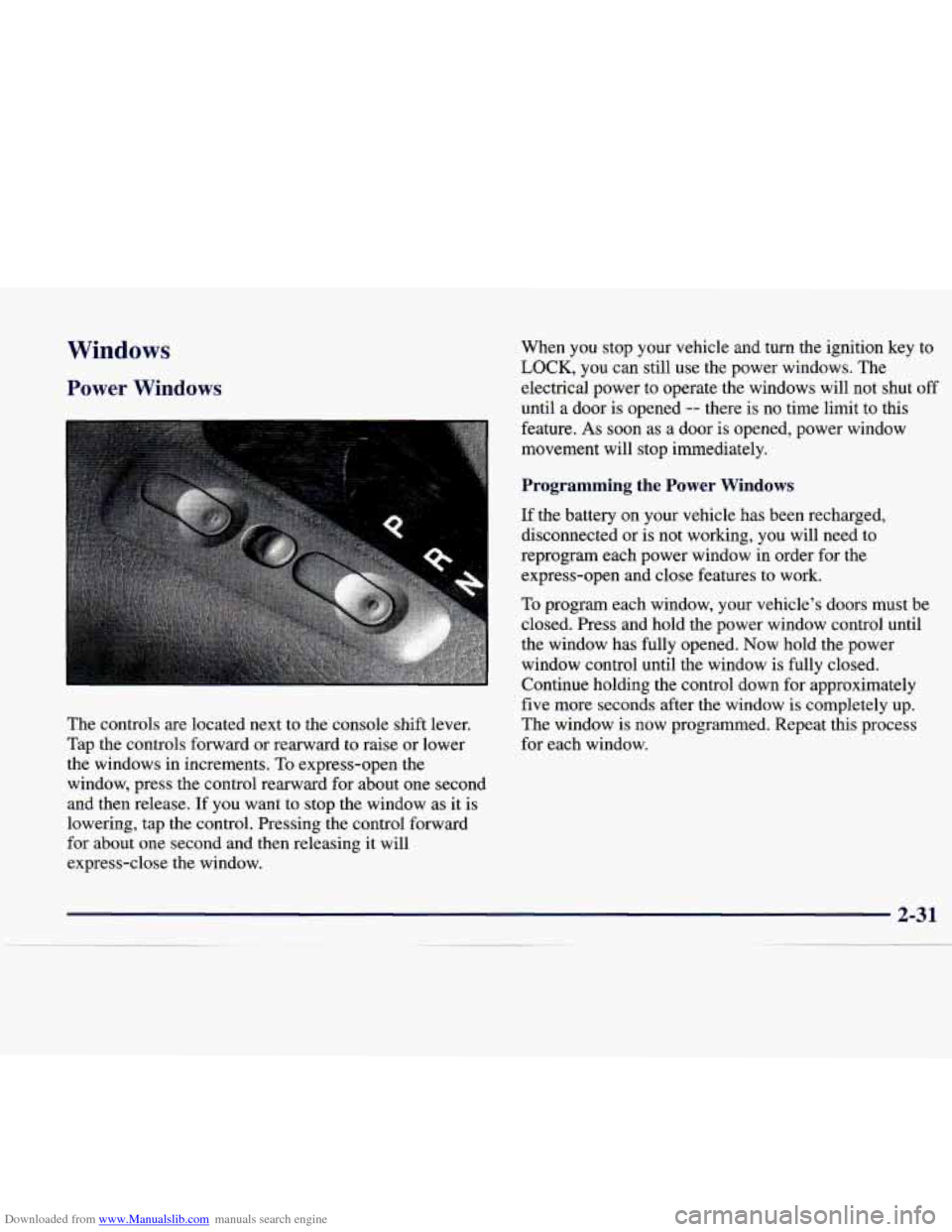
The controls are located next to the console shift lever.
Tap the controls forward or rearward to raise or lower
the windows in increments.
To express-open the
window, press the control rearward for about one second
and then release.
If you want to stop the window as it is
lowering, tap the control. Pressing the control forward
for about one second and then releasing it will
express-close the window. When
you stop your vehicle and turn the ignition key to
LOCK, you
can still use the power windows. The
electrical power to operate the windows will not shut
off
until a door is opened -- there is no time limit to this
feature.
As soon as a door is opened, power window
movement will stop immediately.
Programming the Power Windows
If the battery on your vehicle has been recharged,
disconnected or is not working, you will need to
reprogram each power window in order for the
express-open and close features to work.
To program each window, your vehicle’s doors must be
closed. Press and hold the power window control until
the window has fully opened. Now hold the power
window control until the window is fully closed.
Continue holding the control down for approximately
five more seconds after the window is completely up.
The window is now programmed. Repeat this process
for each window.
Page 110 of 346

Downloaded from www.Manualslib.com manuals search engine Passing Another Vehicle While Using Cruise Control
Use the accelerator pedal to increase your speed. When
you take your foot off the pedal, your vehicle will slow
down to the cruise control speed you set earlier.
Using Cruise Control on Hills
How well the cruise control will work on hills depends
upon your speed, load and the steepness
of the hills.
When going up steep hills, you may have to step on the
accelerator pedal to maintain your speed. When going
downhill, you may have to brake or shift to a lower gear
to keep your speed down. Of course, applying the brake
takes you out of cruise control. Many drivers find this to
be too much trouble and don’t use cruise control on
steep hills.
Ending Cruise Control
There are two ways to end cruise control:
0 Step lightly on the brake pedal.
0 Press the OFF button at the end of the cruise lever.
Erasing Speed Memory
The cruise control set speed memory is erased when you
turn off the cruise control or the ignition.
Exterior Lamps .
These controls on the left side of the instrument panel
operate the following lamp systems:
-g- Lamp control dial (operates all lamps except
twilight sentinel, fog lamps and brightness control). Pull
this dial toward you
to turn on the interior lamps and
push the dial back in to turn the lamps off.
Page 111 of 346

Downloaded from www.Manualslib.com manuals search engine ‘00s 0 Parking lamps, front and rear sidemarker
lamps, taillamps, license plate lamps, ashtray lamps,
backlighting to the radio controls and instrument
panel lights.
so Headlamps.
$0 Fog lamps.
Twilight sentinel.
OFF Turns the twilight sentinel system off.
Instrument panel brightness control.
Turn the lamp control dial to the right (to the first
position) to turn
on the parking lamps, front and rear
sidemarker lamps, taillamps, license plate lamps, ashtray
lamps, instrument panel lights and backlighting to the
center console controls. Turn the lamp control dial all
the way to the right (to the second position) to turn on
the low-beam headlamps.
Turn the lamp control dial
to the left to turn the
lamps off.
Headlamps
Turn the lamp control dial all the way to the right to turn
on the low-beam headlamps.
10 turn on the high-beam headlamps, the low-beam
headlamps must already be on. Push the turn signal lever
on the left side of the steering wheel away from you to
engage the high-beam headlamps. Pull the lever toward
you to return to the low-beam headlamps. For more
information, see “Headlamp High/Low Changer” earlier
in this section.
Turn the lamp control dial all the way to the left to turn
the headlamps
off.
Note that if the headlamps are activated while driving
and then you turn your vehicle’s ignition off while the
lamp dial is still turned
on, the headlamps will turn off.
If, however, you open the driver’s door while the lamp
dial is still turned on, a warning chime will sound
reminding you to turn the lamp control dial to
OFF. This
will stop the warning chime from sounding. (If you want
the headlamps to remain on, you must manually turn the
lamp control dial
off and then back on to the headlamp
position. The headlamps will stay on until manually
turned off again.)