1998 BMW CONVERTIBLE child seat
[x] Cancel search: child seatPage 11 of 179
Contents
At a glance
Controls and features
Cockpit16
Instrument cluster18
Indicator and warning
lamps20
Hazard warning system22
Hazard warning triangle22
First-aid kit22
Refueling23
Fuel specification23
CARB OBD II interface24
Tire inflation pressures25
Locks and security systems:
Keys30
Electronic immobilizing device35
Doors31
Trunk lid33
Luggage compartment34
Power windows35
Sliding/tilt sunroof36
Convertible top operation37
Adjustments:
Seats43
Steering wheel45
Mirrors46
Passenger safety systems:
Safety belts47
Child restraint system48
Installing child seats49
Airbags50
Child-safety locks52
Rollover protection system Ð
convertible52
Driving:
Steering/ignition lock54
Starting the engine54
Switching off the engine55
Parking brake56
Manual transmission57
Automatic transmission58
Turn signals/high beam60
Wiper/washer system61
Cruise control62
Everything under control:
Odometer63
Tachometer63
Energy control63
Fuel gauge64
Coolant temperature gauge64
Service Interval Display64
Multi-Information Display (MID)66
Outside temperature display
and digital clock68
Check Control71
Check Control with outside
temperature display and
digital clock74
Onboard computer77
Technology for driving comfort
and safety:
Automatic stability control
plus traction (ASC+T)84
Page 29 of 179

28
Locks and security systems:
Keys30
Electronic vehicle immobilizer 30
Doors31
Luggage compartment lid33
Luggage compartment34
Power windows35
Sliding/tilt sunroof36
Convertible top operation37
Adjustments:
Seats43
Steering wheel45
Mirrors46
Passenger safety systems:
Safety belts47
Child restraint system48
Installing child seats49
Airbags50
Child-safety locks52
Rollover protection system Ð
convertible52Driving:
Steering/ignition lock54
Starting the engine54
Switching off the engine55
Parking brake56
Manual transmission57
Automatic transmission58
Turn signals/high beam60
Wiper/washer system61
Cruise control62
Everything under control:
Odometer63
Tachometer63
Energy control63
Fuel gauge64
Coolant temperature gauge64
Service Interval Display64
Multi-Information Display (MID)66
Outside temperature display
and digital clock68
Check Control71
Check Control with outside
temperature display and
digital clock74
Onboard computer77
Page 33 of 179
32
a
Children can lock the doors from
inside. Therefore, you should always
remove the key and take it with you to
ensure that you can unlock the car from
the outside at all times.c
In an accident, the central locking sys-
tem automatically unlocks the doors
and the interior lamps switch on.
Depending on the version, the hazard
warning flashers are also activated.
a
Avoid using the inside lock buttons
to lock the rear doors while driving, as
these doors would then fail to unlock au-
tomatically in the event of an accident.c
Opening doors from the insidePull interior door handle of a front door
twice in succession (the initial pull
unlocks the door, the second opens it).
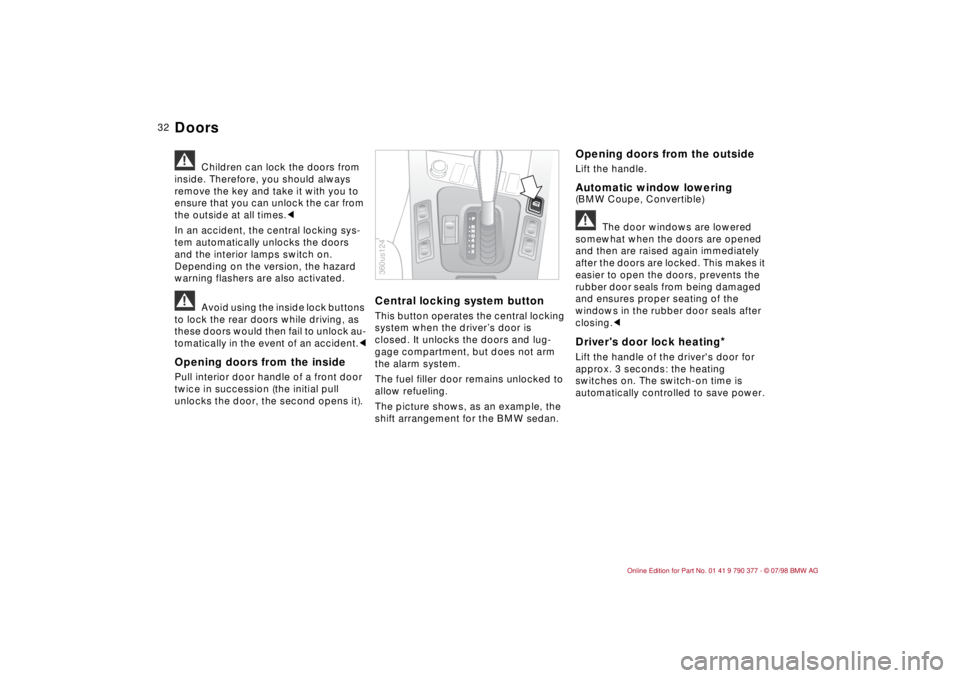
Central locking system buttonThis button operates the central locking
system when the driverÕs door is
closed. It unlocks the doors and lug-
gage compartment, but does not arm
the alarm system.
The fuel filler door remains unlocked to
allow refueling.
The picture shows, as an example, the
shift arrangement for the BMW sedan.
Opening doors from the outsideLift the handle.Automatic window lowering (BMW Coupe, Convertible)a
The door windows are lowered
somewhat when the doors are opened
and then are raised again immediately
after the doors are locked. This makes it
easier to open the doors, prevents the
rubber door seals from being damaged
and ensures proper seating of the
windows in the rubber door seals after
closing.c
Driver's door lock heating
*
Lift the handle of the driver's door for
approx. 3 seconds: the heating
switches on. The switch-on time is
automatically controlled to save power.
S
360us124
Doors
Page 36 of 179

35
At a glanceControls Car careRepairsTechnicalDataIndex
Operational from ignition key posi-
tion 1.
dDepress the rocker switch until you
feel resistance:
The window continues to move as
long as the rocker switch is pressed.
dBriefly press the rocker switch to just
beyond the pressure point (one-
touch mode):
The window moves automatically.
Press and let go again to stop move-
ment.
The one-touch mode can be used to
open and close the front windows and
to open the rear windows
*.On vehicles equipped with front and
rear
* power windows:
There are separate switches located
below the rear windows (except on the
BMW Convertible).
Safety switch
* (arrow)
In this way the actuation of the windows
by means of rear switches, e.g., by chil-
dren, can be prevented.a
Always keep the safety switch
(arrow) in the depressed position when
children ride in the rear seat.
Always remove the key from the ignition
when leaving the vehicle.c
After the ignition is switched off, the
windows remain operational
dwith the ignition key at position 1 and
0, or removed, or
dwhen the front doors are open (max.
15 minutes) or until the front doors
are opened for the Þrst time.
Convenience modeAfter closing the doors, hold the key in
the lock position:
Any windows still open will close.a
Careless and inattentive closing of
the windows can lead to injuries.c
Safety featureIf one of the windows encounters resis-
tance while closing, it will respond by
halting and then opening somewhat
again.
You can deactivate this protective func-
tion, (e.g., in case of unauthorized intru-
sion into the vehicle) by pressing the
switch beyond its pressure point and
holding it there.
360us302Power windows*
Page 48 of 179

47
At a glanceControls Car careRepairsTechnicalDataIndex
Always fasten your seat belt before
starting off.
To fasten: make sure you hear the catch
engage in the belt buckle.
To release: press the red button in the
buckle, hold the belt and guide it back
into its reel.
The safety belt inertial mechanism
locks:
din a sudden stop or crash
dwhen you pull it sharply
dduring abrupt braking and
acceleration
din curves
dwhen the vehicle is at an
extreme angle.The safety belt can be adjusted individ-
ually to different body sizes with the
belt height adjustment:
Downward adjustment (1):
Push button downward.
Upward adjustment (2):
Grasp deflection fitting on ribbed side
sections and slide upward.
a
For your own safety, please ob-
serve the following when putting on the
safety belt, otherwise its protective
function may be impaired. Also ensure
that the other occupants follow these in-
structions.
Never allow more than one person to
wear a single safety belt. Never allow in-
fants or small children to ride in a pas-
senger's lap.
Avoid twisting the belt while routing it
firmly across the hips and shoulder. Do
not allow the belt to rest against hard or
fragile objects in your pockets. The
safety belt must not run across the
wearer's neck, nor should it be trapped
or abraded by coming into contact with
sharp edges or objects.
The belt should rest as firmly as possible
against your body You should avoid
wearing clothing that prevents it from
doing so. Pull the belt periodically to re-
tention it across your shoulder. In the
event of a frontal collision, a loose lap
belt could slide over your hips, leading
to abdominal injury. Due to the in-
creased distance between belt and
body, there would also be a delay before
restraint becomes effective.
360de032
360de033
Safety belts
Page 49 of 179
48
Expectant mothers should always wear
their safety belts, taking care to position
the lap belt against the lower hips,
where it will not exert pressure against
the abdominal area.
Never attempt to modify the safety
belts.c
For care instructions refer to page 134.Never install a rear-facing child restraint
system in the front passenger's seat!
Never attempt to modify either the
safety belts or any child restraint sys-
tem.
Should the safety belts be damaged or
stretched in an accident, the entire belt
system - including safety belt tension-
ers - must be replaced and the anchor-
ing mounts inspected at a BMW
Retailer.
If the safety belt tensioner has been
activated, a distance of roughly 0.8 in
(20 mm) will remain between the safety
belt lock and the tensioner module.
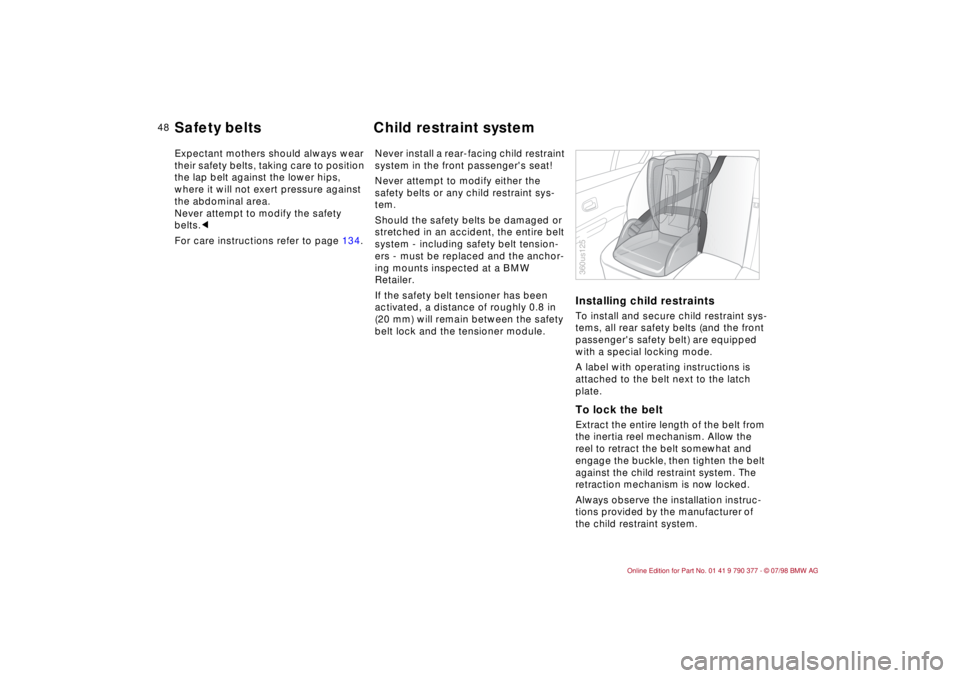
Installing child restraintsTo install and secure child restraint sys-
tems, all rear safety belts (and the front
passenger's safety belt) are equipped
with a special locking mode.
A label with operating instructions is
attached to the belt next to the latch
plate.To lock the beltExtract the entire length of the belt from
the inertia reel mechanism. Allow the
reel to retract the belt somewhat and
engage the buckle, then tighten the belt
against the child restraint system. The
retraction mechanism is now locked.
Always observe the installation instruc-
tions provided by the manufacturer of
the child restraint system.360us125
Safety belts Child restraint system
Page 50 of 179

49
At a glanceControls Car careRepairsTechnicalDataIndex
To release the beltRelease the buckle, remove the child
restraint device and allow the inertia
reel to retract the belt completely.b
Please also make this information
available to your passengers and urge
them to observe the instructions for
safety belt use.c
For care instructions refer to page 134.All passengers, and especially children,
should use a restraint device when
riding in the car.
Infants or small children should never
be permitted to ride on a passenger's
lap.
Children should always sit in the rear
seat and use, depending on age, either
a child restraint system or the safety
belts installed in the vehicle. Accident
statistics have shown that children are
safer when properly restrained in the
rear seats than when riding in the front.
Infants and toddlers should be secured
with a child restraint system appropri-
ate for their size.
Children of six years and older should
wear safety belts.Commercially available child seats
complying with legal standards are
designed to be secured using either a
lap belt or a combined lap-shoulder
belt. Because improperly installed
restraint systems can increase the risk
of injury to children, we strongly urge
you to carefully read and follow the
instructions supplied with the system.
Should the child restraint system of your
choice require the use of a securing or
tether strap, note that three anchoring
points (arrows) have been provided for
mounting it in your vehicle.
Ask your BMW Retailer to perform the
necessary installation work.
360us126
BMW Sedan/Coupe
Child restraint system Installing child seats
Page 51 of 179
50
a
Before install-
ing any child re-
straint device or
child seat, please
read the follow-
ing:
Never install a rearward-facing child
restraint system in the front passenger
seat of this car.
Your car is equipped with an airbag
supplemental restraint system for the
front passenger. Because the backrest
on any rear-facing child restraint sys-
tem (of the kind designed for infants
under 1 year and 20 lbs.) would be
within the airbag's deployment range,
you should never mount such a device
in the front passenger seat, as the
impact of the airbag against the child
restraint's backrest could lead to seri-
ous or fatal injuries.
If it is necessary for a child (not an
infant) to ride in the front seat, certain precautions should be taken. First,
move the passenger seat as far away
from the dashboard as possible. This
important precaution is intended to
maximize the distance between the air-
bag and the child. Older children should
be tightly secured with the safety belt.
Younger children should be secured in
an appropriate forward-facing child
restraint system that has first been
properly secured with a safety belt.
We strongly urge you to carefully read
and observe the instructions for instal-
lation and use provided by the child re-
straint's manufacturer whenever you
use such a device.
Always ensure that all occupants (of
all ages) remain properly and securely
restrained at all times.c
All rear seating positions in your vehicle
meet the recommendations of SAE
J1819, an industry recommended prac-
tice for securing child restraint systems
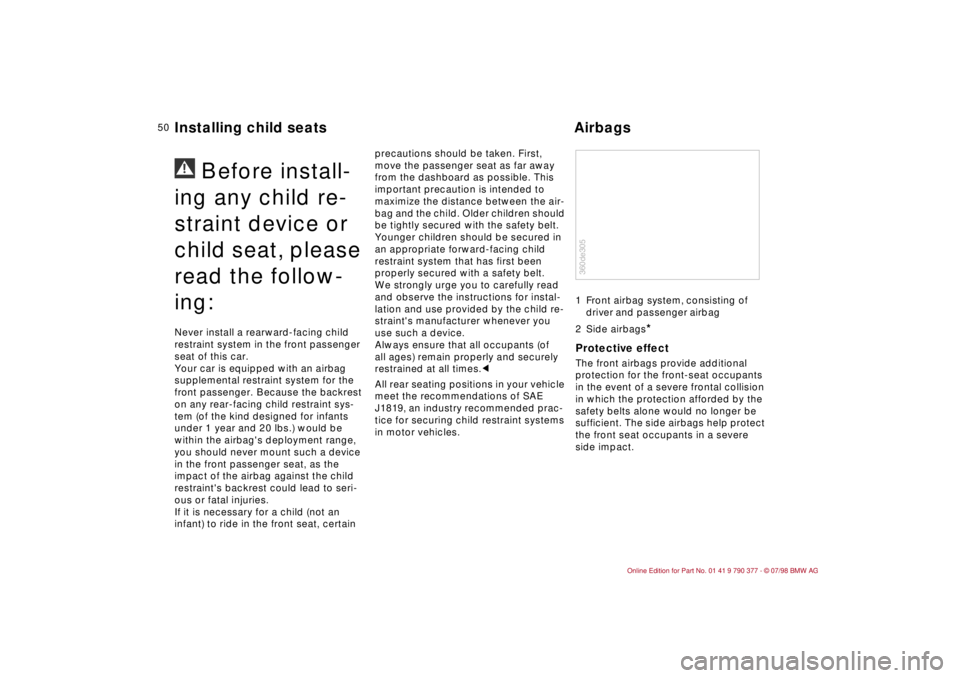
in motor vehicles.1 Front airbag system, consisting of
driver and passenger airbag
2 Side airbags
*
Protective effectThe front airbags provide additional
protection for the front-seat occupants
in the event of a severe frontal collision
in which the protection afforded by the
safety belts alone would no longer be
sufficient. The side airbags help protect
the front seat occupants in a severe
side impact.360de305
Installing child seats Airbags