Page 110 of 179
10 9
At a glanceControlsCar careRepairsTechnicalDataIndex
Even in winter, when the hardtop may
be in constant use, the fabric top does
not need to be removed. Before storing
the fabric top in the convertible top
compartment, it must be absolutely dry
to prevent the formation of water and
mildew spots.
Two persons are required for mounting
and removal. Use extreme care when
working to prevent paint damage and
damage to the body and hardtop.
To make it easier to mount and remove
the hardtops, you can purchase a spe-
cially developed hardtop lift
* from your
BMW Retailer.
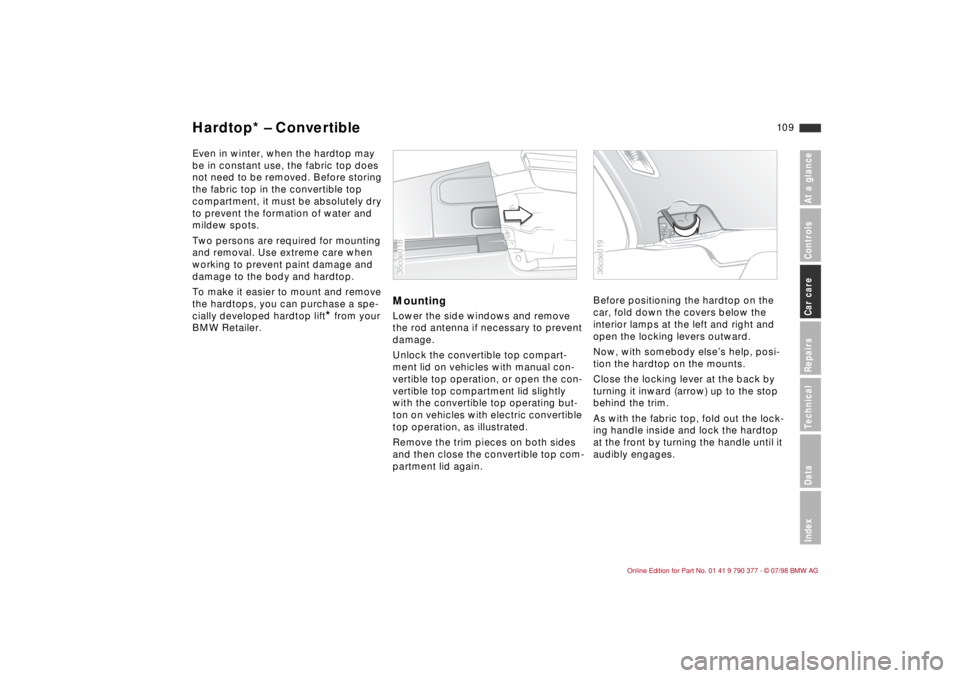
MountingLower the side windows and remove
the rod antenna if necessary to prevent
damage.
Unlock the convertible top compart-
ment lid on vehicles with manual con-
vertible top operation, or open the con-
vertible top compartment lid slightly
with the convertible top operating but-
ton on vehicles with electric convertible
top operation, as illustrated.
Remove the trim pieces on both sides
and then close the convertible top com-
partment lid again.Before positioning the hardtop on the
car, fold down the covers below the
interior lamps at the left and right and
open the locking levers outward.
Now, with somebody elseÕs help, posi-
tion the hardtop on the mounts.
Close the locking lever at the back by
turning it inward (arrow) up to the stop
behind the trim.
As with the fabric top, fold out the lock-
ing handle inside and lock the hardtop
at the front by turning the handle until it
audibly engages.36cde018
36cde019
Hardtop* Ð Convertible
Page 119 of 179
11 8
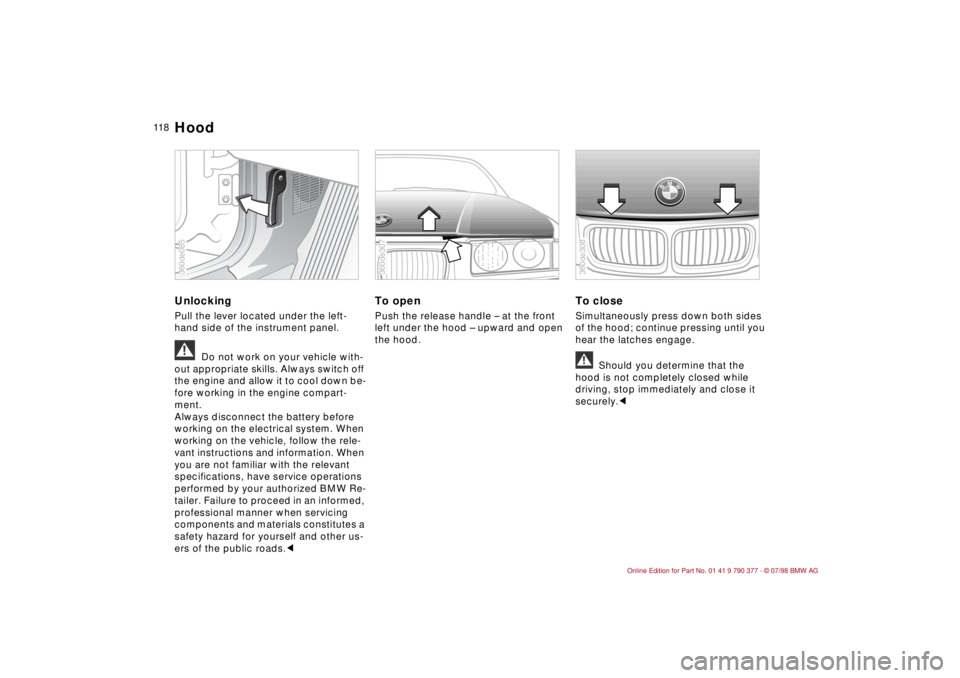
Unlocking Pull the lever located under the left-
hand side of the instrument panel.a
Do not work on your vehicle with-
out appropriate skills. Always switch off
the engine and allow it to cool down be-
fore working in the engine compart-
ment.
Always disconnect the battery before
working on the electrical system. When
working on the vehicle, follow the rele-
vant instructions and information. When
you are not familiar with the relevant
specifications, have service operations
performed by your authorized BMW Re-
tailer. Failure to proceed in an informed,
professional manner when servicing
components and materials constitutes a
safety hazard for yourself and other us-
ers of the public roads.c
To openPush the release handle Ð at the front
left under the hood Ð upward and open
the hood.
To closeSimultaneously press down both sides
of the hood; continue pressing until you
hear the latches engage.a
Should you determine that the
hood is not completely closed while
driving, stop immediately and close it
securely.c
360de085
BMW360de307
BMW
360de308
Hood
Page 128 of 179

12 7
At a glanceControlsCar careRepairsTechnicalDataIndex
Coolant level with engine cold: up to
the KALT/COLD mark on the transpar-
ent coolant expansion tank.
The coolant is a mixture of water and
extended-duty antifreeze with corrosion
inhibitor. Always maintain the prescribed
all-season 50:50 mixture ratio for year-
round protection against internal corro-
sion. No other additives are required.
Replace the coolant every three years.
To add coolantWait until the engine cools before re-
moving the cap from the expansion
tank. Before unscrewing the cap, en-
sure that the needle on the temperature
gauge is in the blue sector to avoid
scalding.
dStart by turning the cap counter-
clockwise. Pause to allow any accu-
mulated pressure to escape, then
open.
dAdd coolant up to the KALT/COLD
mark. Excess coolant drains off
through the overßow line.a
Do not add coolant while the
engine is hot.
To avoid the possibility of damage later
on, never use anything other than
factory-approved nitrite and amino-free
long-term antifreeze and corrosion
protectant. Your authorized BMW
Retailer is familiar with the official
specifications.
Antifreeze with corrosion protectant is
toxic. Always store in original contain-
ers only, keeping them tightly closed.
Store well out of reach of children.
When disposing of it, observe the
applicable environmental protection
laws.Long-term antifreeze and corrosion
protectant contains the flammable
substance ethylene glycol. You should
therefore avoid spilling it on hot engine
components, as it could catch fire and
cause serious burns.c
A
Observe the applicable environ-
mental protection laws when disposing
of used antifreeze.c
360de099Coolant
Page 141 of 179
14 0
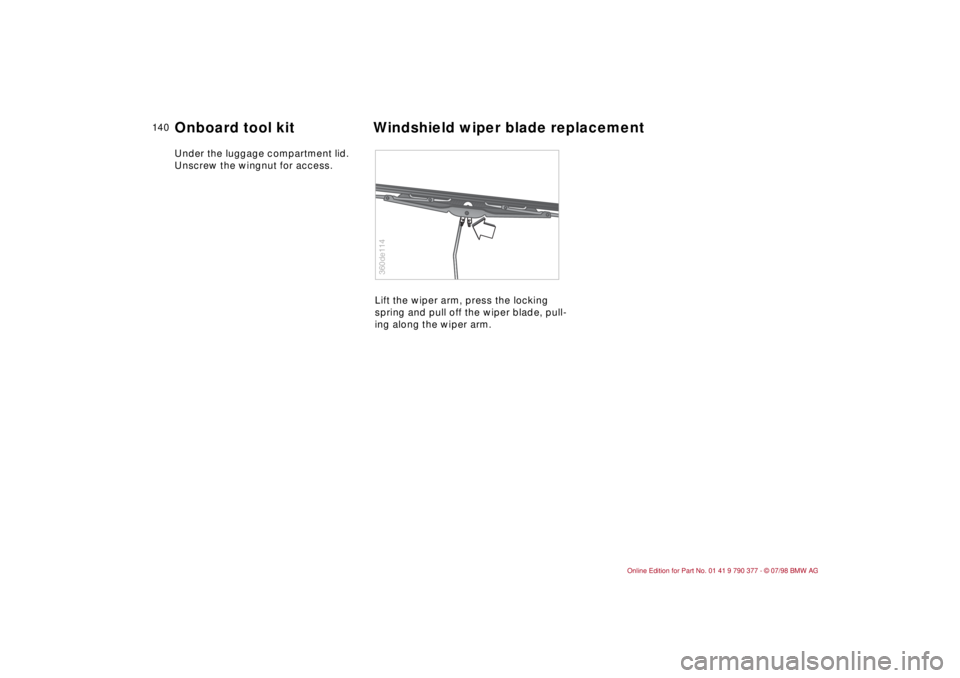
Under the luggage compartment lid.
Unscrew the wingnut for access.
Lift the wiper arm, press the locking
spring and pull off the wiper blade, pull-
ing along the wiper arm.
360de114
Onboard tool kit Windshield wiper blade replacement
Page 144 of 179
14 3
At a glanceControlsCar careRepairsTechnicalDataIndex
Taillamps 1 Turn signal yellow
21 watt bulb
2 Backup lamp white
21 watt bulb
3 Brake lamp red
21 watt bulb
4 Taillamp red
5 watt bulbdRemove the lamp cover after releas-
ing the locking device.
dOnce you have found the lamp
holder for the defective bulb, push it
gently to the rear while turning to the
left to remove.
dUse the same procedure to remove
the bulb.
Center brake lamp
*
21 watt bulb
dOpen the luggage compartment lid.
dPush the bulb holder's release knob
gently to the rear while turning to the
left to remove.
dUse the same procedure to remove
the bulb.
BMW Convertible:
LED strip in luggage compartment lid.
Please contact a BMW Retailer in the
case of a malfunction.
12
3
4
360us093
360de119
360de120
Bulb replacement
Page 147 of 179
14 6
a
Change tires only on a flat, hard
surface affording good traction. Avoid
jacking the car on a soft or slippery sup-
port surface (snow, ice, loose gravel,
etc.), as it could slide sideways.
Take extra care to ensure that the base
of the jack is positioned on a solid sup-
port surface.
Never use wooden blocks or similar
objects to support the base of the jack,
as the weight of the car could exceed
their support capacity.
Never lie beneath the vehicle or start
the engine while the car is supported by
the jack - risk of fatal injury.
Additional precautions to observe when
changing flat tires:
When pulling over on the roadside to
change a tire, always try to park the car
as far as possible from passing traffic.
Switch on the hazard flashers.
All passengers should be outside the
car and well away from your immediate
working area (e.g., behind the guard-
rail).Turn the steering wheel to the straight-
ahead position, remove the key and
engage the steering lock. Shift into 1st
or reverse (selector lever in Park with
automatic) and engage the parking
brake.
If a warning triangle or portable hazard
warning lamp is available, set it up on
the roadside at an appropriate distance
from the rear of the vehicle. Observe all
safety guidelines and regulations.c
b
To avoid rattling noises, note the
positions of the tools and return them to
their original positions.c
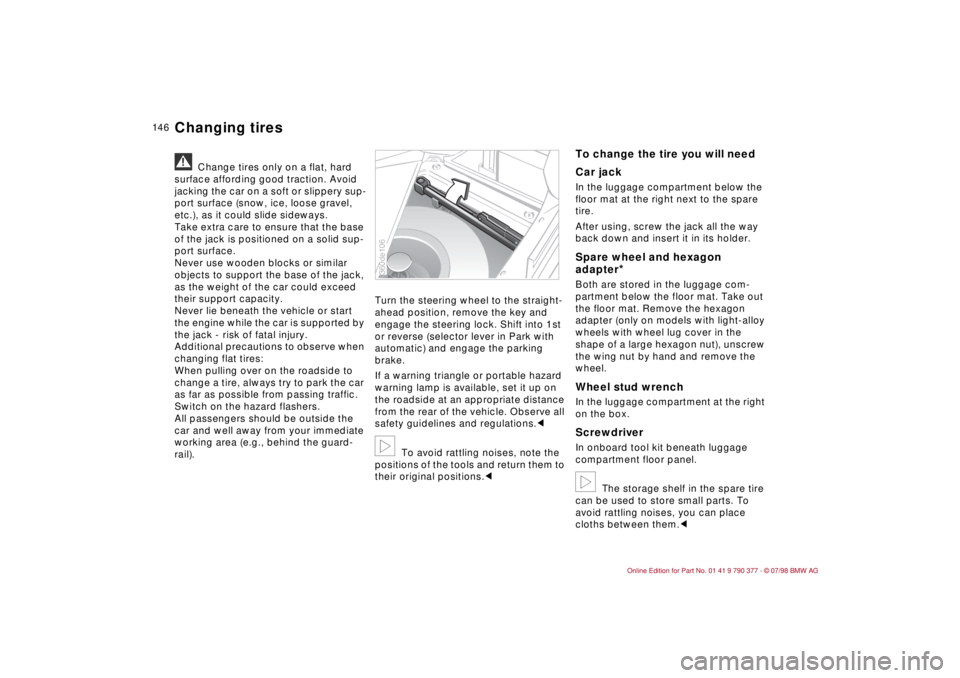
To change the tire you will need
Car jackIn the luggage compartment below the
floor mat at the right next to the spare
tire.
After using, screw the jack all the way
back down and insert it in its holder.Spare wheel and hexagon
adapter
*
Both are stored in the luggage com-
partment below the floor mat. Take out
the floor mat. Remove the hexagon
adapter (only on models with light-alloy
wheels with wheel lug cover in the
shape of a large hexagon nut), unscrew
the wing nut by hand and remove the
wheel.Wheel stud wrench In the luggage compartment at the right
on the box. ScrewdriverIn onboard tool kit beneath luggage
compartment floor panel.b
The storage shelf in the spare tire
can be used to store small parts. To
avoid rattling noises, you can place
cloths between them.c
360de106
Changing tires
Page 153 of 179
15 2
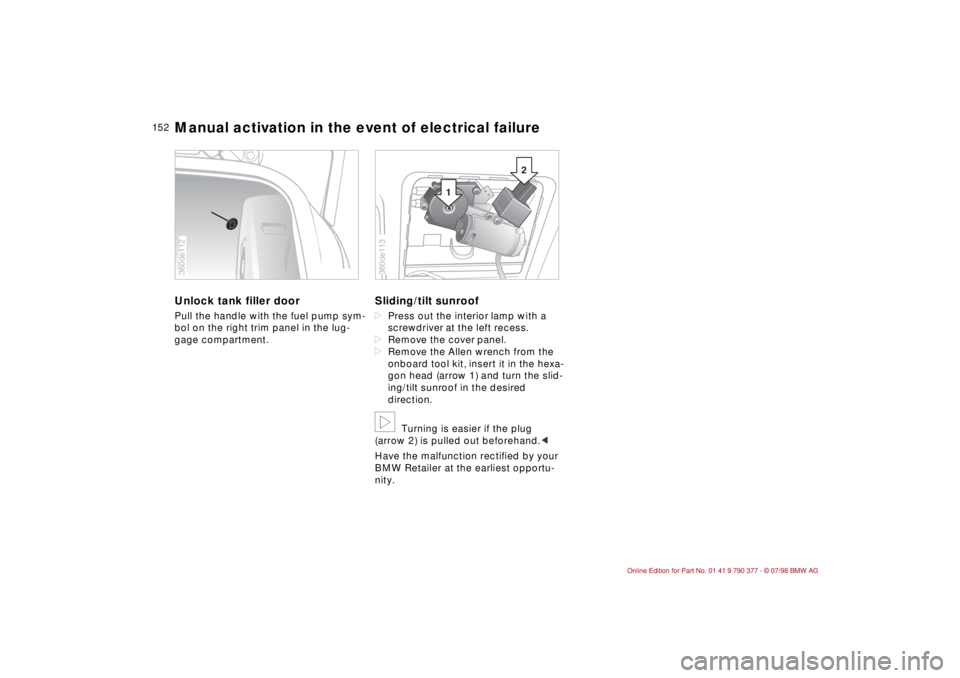
Unlock tank filler door Pull the handle with the fuel pump sym-
bol on the right trim panel in the lug-
gage compartment.
Sliding/tilt sunroof dPress out the interior lamp with a
screwdriver at the left recess.
dRemove the cover panel.
dRemove the Allen wrench from the
onboard tool kit, insert it in the hexa-
gon head (arrow 1) and turn the slid-
ing/tilt sunroof in the desired
direction.b
Turning is easier if the plug
(arrow 2) is pulled out beforehand.c
Have the malfunction rectified by your
BMW Retailer at the earliest opportu-
nity.
360de112
2
1
360de113
Manual activation in the event of electrical failure
Page 157 of 179

15 6
Deceleration sensors continuously
monitor the physical forces acting upon
the vehicle. If a frontal impact results in
deceleration, for which the protection
afforded by safety belts no longer suf-
fices, the gas generators of the driver's
and the passenger's airbags ignite
simultaneously. The passenger's air-
bag is activated only when a special
sensor indicates that the front passen-
ger's seat is occupied.
In the event of a severe side impact the
side airbag
* is activated on the side on
which the impact occurred.
The airbags, which are under the cover
of the steering wheel, in the instrument
panel or the side trim panels of the front
doors, are deployed and inflated by the
gas within a few milliseconds. In the
process they tear or push apart the pro-grammed separation points in their
upholstered covers.
Because the inflation process must be
virtually instantaneous, it is necessarily
accompanied by a certain amount of
ignition and inflation noise. The gas
which the system employs to inflate the
airbag is not dangerous, and the asso-
ciated smoke is quickly dissipated.
The entire process is completed within
one twentieth of a second.Automatic Stability Control plus Trac-
tion helps maintain stable and con-
trolled vehicle response by inhibiting
slip at the drive wheels.
The system employs special sensors to
monitor wheelspeed and relay the data
to the system's electronic control unit,
which uses this information to calculate
slip rates at the individual wheels.
Depending on the driving situation, two
forms of remedial action can then be
taken by the system: it reacts to slip-
page caused by large amounts of
excess torque by instructing the engine
management system to reduce power
output. As a supplementary measure,
the system will also respond to an
especially pronounced tendency to-
ward traction loss at either of the drive
wheels with automatic individual appli-
cation of the affected wheel's brakes.
This achieves a locking action compa-
rable with a controlled limited-slip dif-
ferential. This brake action is active up
to 25 mph (40 km/h). From 25 mph
(40 km/h) upward, a diminished brake
action improves the traction up to
60 mph (100 km/h).
390de012Airbags ASC+T*