1998 BMW 740I air condition
[x] Cancel search: air conditionPage 106 of 211
105n
RepairsIndexOverview Controls Car care Technology Data
Automatic climate control Rear passenger-area air conditioning
*
Microfilter, activated-charcoal
filterThe microfilter removes dust and pollen
from the incoming air. The activated-
charcoal filter provides additional pro-
tection by filtering gaseous pollutants
from the outside air. Your BMW center
replaces the filter assemblies as a stan-
dard part of your scheduled mainte-
nance. A substantial reduction in air
flow indicates that the filter needs to be
replaced early.
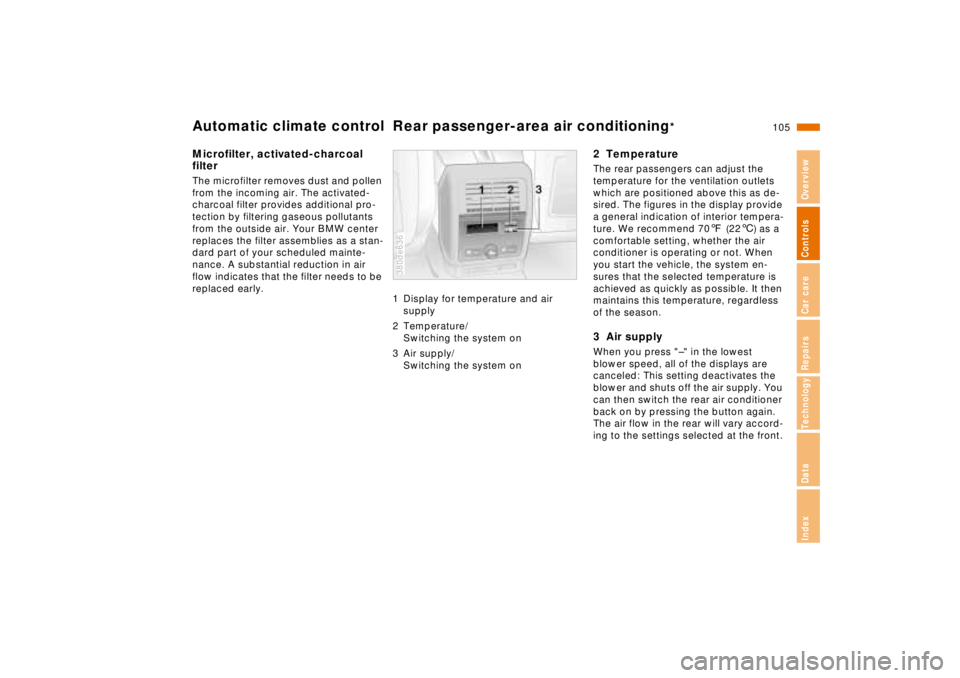
1 Display for temperature and air
supply
2 Temperature/
Switching the system on
3 Air supply/
Switching the system on
380de636
2 TemperatureThe rear passengers can adjust the
temperature for the ventilation outlets
which are positioned above this as de-
sired. The figures in the display provide
a general indication of interior tempera-
ture. We recommend 707 (226) as a
comfortable setting, whether the air
conditioner is operating or not. When
you start the vehicle, the system en-
sures that the selected temperature is
achieved as quickly as possible. It then
maintains this temperature, regardless
of the season.3 Air supplyWhen you press "–" in the lowest
blower speed, all of the displays are
canceled: This setting deactivates the
blower and shuts off the air supply. You
can then switch the rear air conditioner
back on by pressing the button again.
The air flow in the rear will vary accord-
ing to the settings selected at the front.
Page 122 of 211
Overview
Controls and features
Operation, care
and maintenance
Owner service procedures
Technical data
Index Advanced technology
121n
RepairsIndexOverview Controls Car care Technology Data
Special operating instructions:
Break-in procedure122
Driving notes123
Catalytic converter124
Antilock Brake System
(ABS)125
Disc brakes126
Brake system128
Winter operation128
Power steering130
Level control system130
Cellular phone131
Radio reception131
Wheels and tires:
Tire inflation pressure132
Tire condition132
Tire replacement133
Tire rotation133
Wheel and tire
combinations134
Winter tires135
Snow chains135
Approved wheel and tire
specifications136Under the hood:
Hood137
Engine compartment138
Washer fluids142
Washer nozzles142
Engine oil143
Coolant146
Brake fluid147
Oil for power steering/
Level control system148
Vehicle Identification
Number148
Care and maintenance:
The BMW Maintenance
System149
Caring for your car150
Airbags156
Vehicle storage156
Laws and regulations:
Technical modifications to the
vehicle157
OBD connector158
Page 126 of 211
125n
RepairsIndexOverview Controls Car care Technology Data
Antilock Brake System (ABS)The conceptABS enhances active safety by helping
to prevent the wheels from locking dur-
ing brake applications. The reason:
Locked wheels are dangerous. When
the front wheels slide, the driver loses
steering control over the vehicle. Trac-
tion loss at the rear wheels can cause
the rear end to break into an uncon-
trolled skid.
The system can achieve the shortest
braking distances possible under most
conditions (on straights and in curves,
on asphalt, ice, wet road surfaces, etc.).
ABS is designed to meet two essential
requirements during every brake appli-
cation:
>To help provide vehicle stability
>To help maintain steering control and
maneuverability – on all types of road
surfaces (asphalt, concrete, mud, wet
pavement, snow, ice).
Braking with ABSThe system becomes operative once
the vehicle exceeds a speed of approx.
6 mph (10 km/h). The ABS is deactivated
whenever the vehicle's speed drops
back below approx. 4 mph (6 km/h). This
means that the wheels can lock in the fi-
nal phase of a panic stop – a factor of no
significance in actual use.
If you are in a situation which requires
full braking, you will exploit the full bene-
fits of the ABS system if you apply maxi-
mum brake pressure ("panic stop").
Since the vehicle maintains steering re-
sponsiveness, you can avoid possible
obstacles with a minimum of steering ef-
fort, despite the full brake application.
The ABS system closed-loop control cir-
cuit cycles in fractions of a second.
A pulsation at the brake pedal indicates
to the driver that ABS is active, that is,
that the vehicle is within its maximum
braking range. In addition, a pulsation – a
result of the control function cycles – in-
dicates to the driver that vehicle speed
should be reduced to adapt to road sur-
face conditions when there is reduced
traction and grip between tires and road
surface (slippery road surface).
Always depress the brake pedal with
constant pressure. Keep the brake pedal
down. Do not pump the brakes.In driving conditions where there is a
loose upper surface together with a
subsurface which provides better trac-
tion (on gravel or snow, for instance), or
with snow chains, the braking distance
may also be longer than when the
wheels are locked. However, ABS con-
tinues to provide enhanced vehicle sta-
bility and steering response under
these conditions.
Information for your safetyNot even ABS can suspend the laws of
physics. ABS alone cannot prevent ac-
cidents when the brakes are applied
without an adequate safety interval be-
tween vehicles, if the car is driven at an
excessive rate of speed in curves, or if
aquaplaning occurs. Responsibility for
these types of situations remains in the
hands (and at the feet) of the driver. You
should never allow the added safety of
ABS to lull you into a false sense of se-
curity, or mislead you into taking in-
creased risks that could affect your own
safety and that of others.
Do not make any modifications to
the ABS system.
Service procedures on ABS are to be
performed by authorized technicians
only.<
Page 127 of 211
126n
Antilock Brake System (ABS) Disc brakesIn the event of a fault
If the ABS warning lamp in the
instrument cluster comes on, re-
fer to page 21. The brake sys-
tem then reverts to conventional
operation as on vehicles without
ABS. However, have the brake
system checked by your BMW center
as soon as possible. To prevent unde-
tected defects and cumulative faults
from adversely affecting the brake sys-
tem, refer any problems to your autho-
rized BMW center at the earliest oppor-
tunity.
Disc brakes furnish optimum decelera-
tion and braking control and greater
fade resistance under heavy use.
When the vehicle is driven only occa-
sionally, during extended periods when
the vehicle is not used at all, and in op-
erating conditions where brake applica-
tions are less frequent, there is an in-
creased tendency for corrosion of the
rotors and accumulation of contamina-
tion on the brake pads. This occurs be-
cause the minimal pressure which must
be exerted by the pads to clean the ro-
tors by brake applications is not
reached.
If the brake rotors are corroded, they
will tend to respond to braking with a
pulsating effect which even extended
application will fail to cure.
We recommend the use of original
BMW brake pads and compo-
nents, otherwise driving safety can be
impaired.<
Page 128 of 211
127n
RepairsIndexOverview Controls Car care Technology Data
Disc brakesDriving notesWhile driving in wet conditions and in
heavy rain, it is a good idea to apply
light pressure to the brake pedal every
few miles. Watch traffic conditions to
ensure that this maneuver does not en-
danger other road users. The heat gen-
erated in this braking process helps dry
the brake pads and rotors.
Maximum braking force is obtained
while the wheels continue to rotate,
peaking when the wheels remain on the
verge of locking without actually doing
so. ABS maintains this state automati-
cally. If the ABS fails, you should revert
to the staggered braking technique de-
scribed below (refer to page 129).
Extended or steep mountain descents
do not necessarily have to lead to re-
duced braking efficiency; downshift to a
gear in which only minimal periodic
brake applications are required - move
the selector lever to the appropriate
lower range.
You can continue to increase the brak-
ing effect of the engine by selecting a
lower gear - you can select transmis-
sion ranges as low as position 2 for ex-
treme conditions.Should engine braking prove inade-
quate, you should still avoid extended,
continuous braking. Instead of main-
taining low to moderate pressure over
an extended period of time, you should
decelerate the vehicle by applying more
substantial force on the pedal (watch
for following traffic!) and then pausing
before repeating the application. This
staggered braking technique allows the
brakes to cool in the intervals between
active braking phases, preventing over-
heating and ensuring that full braking
capacity remains available at all times.
Do not coast with the transmission
selector lever in neutral. Do not
drive with the engine shut off. The en-
gine provides no braking effect when
the transmission is in neutral, and there
is no power-assist for braking or steer-
ing when the engine is shut off.
Never allow floor mats, carpets or any
other objects to protrude into the area
around the accelerator and brake ped-
als and obstruct their movement.<
Dynamic Brake Control (DBC)
*
If you apply the brakes rapidly, this sys-
tem automatically produces the maxi-
mum braking force boost and thus
helps to achieve the shortest possible
braking distance during "panic stops."
All of the benefits of the ABS system
are exploited under these circum-
stances.
Do not reduce the pressure on the
brake pedal for the duration of the
brake application. When the brake
pedal is released, the DBC is deacti-
vated.
In the event of a malfunction, the
warning lamp comes on with a
yellow light. Conventional brak-
ing efficiency is available with-
out limitations.
Have the system checked and
repaired at your BMW center as soon
as possible.
For "Information for your safety"
covering the ABS system, refer to
page 125. This information also gener-
ally applies for DBC.<
Page 129 of 211
128n
Brake system Winter operationBrake fluid level
The warning lamp for the brake
hydraulic system comes on or
the message "Check Brake
Fluid" appears in the Check
Control:
The brake fluid level is too low in the
reservoir. Refer to page 147.
If the brake fluid level is too low and
brake pedal travel has become notice-
ably longer, there may be a defect in
one of the brake system's hydraulic cir-
cuits.
The remaining circuit continues to pro-
vide adequate brake-system perfor-
mance.
Proceed to the nearest authorized
BMW center. Higher brake appli-
cation pressure may be necessary un-
der these conditions, and brake pedal
travel may be significantly longer.
Please remember to adapt your driving
style accordingly.<
The warning lamp also comes on with
the "Check Brake Pads" message in the
Check Control.
Brake padsThe message "Check Brake Pads" ap-
pears in the Check Control:
The brake pads have reached their min-
imum pad thickness. Proceed to the
nearest authorized BMW center as
soon as possible to have the pads re-
placed.
We recommend the use of original
BMW brake pads and compo-
nents, otherwise driving safety can be
impaired.<
The onset of winter is often accompa-
nied by rapid changes in weather. Ad-
aptations in driving style should be ac-
companied by preparations on the
vehicle itself to ensure that your vehicle
operation through the winter remains
safe and trouble-free.CoolantBe sure that the coolant mixture is kept
at the year-round ratio of 50:50 (water
and antifreeze/corrosion protection).
This mixture provides protection
against freezing down to approx. –347
(–376). Replace the coolant every four
years.LocksBMW door lock deicer can be used to
free the locks if they are frozen. This
deicer also contains lubricant.
After using deicer, treatment with BMW
lock barrel grease is recommended.
Page 130 of 211
129n
RepairsIndexOverview Controls Car care Technology Data
Winter operationRubber seals and componentsIn order to prevent the weather-strip-
ping from freezing, apply rubber treat-
ment or a silicone spray to the seals on
the doors, hood and luggage compart-
ment lid.
A full range of car care products is
available from your BMW center.< Snow chainsBMW snow chains
* can be fitted on
both summer and winter tires in re-
sponse to severe winter road condi-
tions. Mount them in pairs on the rear
wheels only, and be sure to comply with
the manufacturer's safety instructions.
Do not exceed a maximum speed of
30 mph (50 km/h). In this situation
(snow chains mounted), deactivate the
ASC+T or DSC
*. Refer to page 92.
Starting offWhen starting off in deep snow or when
rocking the car to free it, we recom-
mend that you switch the ASC+T or
DSC
* off. Refer to page 92.
Driving on low-traction road
surfacesUse smooth, gentle pressure to control
the accelerator pedal. Avoid excessive
engine speeds and shift to the next
higher gear at an early point. Adapt
your speed and driving style when ap-
proaching grades. Maintain an ade-
quate distance between yourself and
the car ahead.BrakesWinter road conditions substantially re-
duce the amount of traction available
between the tires and the road surface;
the resulting increases in braking dis-
tance are considerable and should be
continually borne in mind.
ABS is intended to prevent the wheels
from locking during brake applications,
thus helping to maintain vehicle stability
and steering response. If the ABS does not respond in a critical
braking situation and the wheels lock:
Reduce the pressure on the brake
pedal until the wheels just start to roll
again while still maintaining enough
force to continue braking.
Following that, increase pedal pressure
again. Reduce the pressure as the
wheels lock, then reapply pressure, etc.
This type of staggered braking will re-
duce the braking distance, and the ve-
hicle still remains responsive to steer-
ing.
You can then attempt to steer around
hazards after you have reduced pres-
sure on the brake pedal.
Do not shift down on slick road
surfaces. Doing so could cause
the rear wheels to lose traction and
skid, which could result in the loss of
vehicle control.<
Page 133 of 211
132n
Tire inflation pressure Tire conditionInformation for your safetyThe factory-approved radial tires are
matched to the car and have been se-
lected to provide optimum safety and
driving comfort on your car.
It is not merely the tire's service life, but
also driving comfort and - above all else
- driving safety which depend on the
condition of the tires and the mainte-
nance of the specified tire pressure.
Incorrect inflation pressure is a frequent
cause of tire damage. They also influ-
ence the roadholding ability of your
BMW.
Check tire inflation pressures – in-
cluding the spare tire – regularly,
at least every two weeks and before be-
ginning a longer trip. If this is not done,
incorrect tire pressures can cause driv-
ing instability and tire damage, ulti-
mately resulting in accidents.<
Tire tread
– tire damage
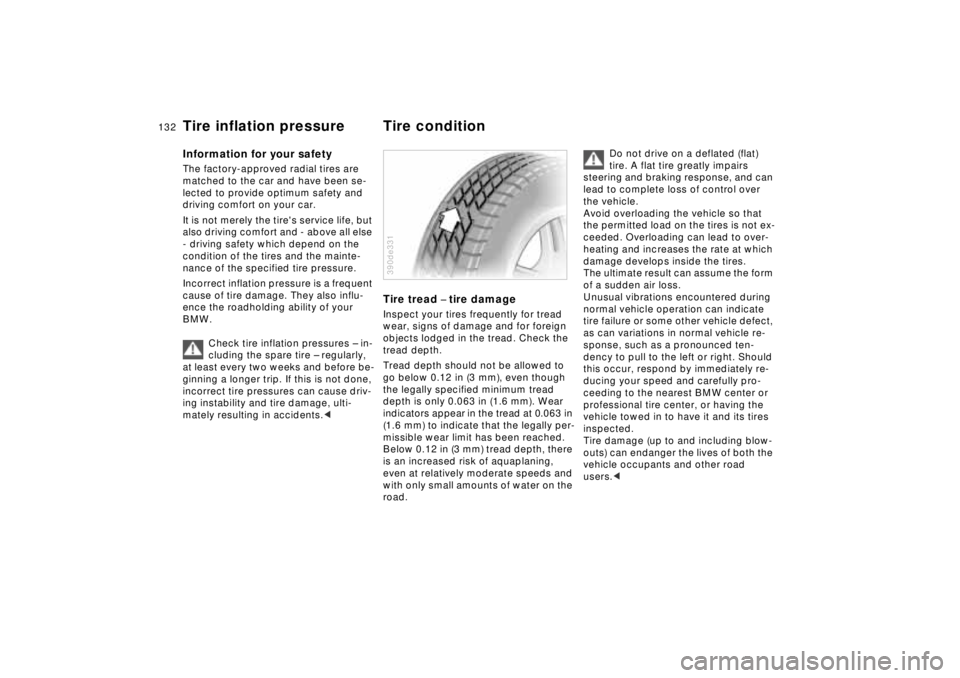
Inspect your tires frequently for tread
wear, signs of damage and for foreign
objects lodged in the tread. Check the
tread depth.
Tread depth should not be allowed to
go below 0.12 in (3 mm), even though
the legally specified minimum tread
depth is only 0.063 in (1.6 mm). Wear
indicators appear in the tread at 0.063 in
(1.6 mm) to indicate that the legally per-
missible wear limit has been reached.
Below 0.12 in (3 mm) tread depth, there
is an increased risk of aquaplaning,
even at relatively moderate speeds and
with only small amounts of water on the
road.390de331
Do not drive on a deflated (flat)
tire. A flat tire greatly impairs
steering and braking response, and can
lead to complete loss of control over
the vehicle.
Avoid overloading the vehicle so that
the permitted load on the tires is not ex-
ceeded. Overloading can lead to over-
heating and increases the rate at which
damage develops inside the tires.
The ultimate result can assume the form
of a sudden air loss.
Unusual vibrations encountered during
normal vehicle operation can indicate
tire failure or some other vehicle defect,
as can variations in normal vehicle re-
sponse, such as a pronounced ten-
dency to pull to the left or right. Should
this occur, respond by immediately re-
ducing your speed and carefully pro-
ceeding to the nearest BMW center or
professional tire center, or having the
vehicle towed in to have it and its tires
inspected.
Tire damage (up to and including blow-
outs) can endanger the lives of both the
vehicle occupants and other road
users.<