1997 TOYOTA TACOMA start
[x] Cancel search: startPage 72 of 221
71
Your automatic transmission has a shift
lock system to minimize the possibility of
incorrect operation. This means you can
only shift out of Pº position when the brake
pedal is depressed (with the ignition
switch in ONº position and the selector le- ver pulled toward you).
(a) Normal driving
1. Start the engine as instructed in How to start the engineº in Part 3. The trans- mission must be in Pº or Nº.
2. With your foot holding down the brake pedal, shift the selector lever to Dº.
In Dº position, the automatic transmis-
sion system will select the most suitable
gear for running conditions such as nor-
mal cruising, hill climbing, hard towing, etc.
Always turn the overdrive switch on for
better fuel economy and quieter driving. If
the engine coolant temperature is low, the transmission will not shift into the over-
drive gear even with the overdrive switch on.
Never put your foot on the
accelerator pedal while shifting. CAUTION
!
3. Release the parking brake and brake pedal. Depress the accelerator pedal
slowly for smooth starting.
(b) Using engine braking
To use engine braking, you can downshift the transmission as follows: Turn off the overdrive switch. The O/D
OFFº indicator light will come on and the transmission will downshift to the
third gear.
Shift into the 2º position. The trans-
mission will downshift to the second
gear when the vehicle speed drops
down to or lower than 131 km/h (81
mph), and more powerful engine brak-
ing will be obtained.
Shift into the Lº position. The trans-mission will downshift to the first gear
when the vehicle speed drops down to
or lower than 63 km/h (39 mph), and
maximum engine braking will be ap- plied. Vehicles with cruise control-When the
cruise control is being used, even if you
downshift the transmission by turning offthe overdrive switch, engine braking will
not be applied because the cruise control
is not cancelled. For ways to decrease the
vehicle speed, see Cruise controlº in
this
chapter.
Be careful when downshifting on a
slippery surface. Abrupt shifting
could cause the vehicle to spin or skid. CAUTION
!
(c) Using 2º and Lº positions The 2º and Lº positions are used for
strong engine braking as described pre-
viously. With the selector lever in 2º or Lº, you
can start the vehicle in motion as with the
lever in Dº. With the selector lever in 2º, the vehicle
will start in the first gear and automatically
shift to the second gear.
With the selector lever in Lº, the trans-
mission is engaged in the first gear.
Page 76 of 221
75
Your automatic transmission has a shift
lock system to minimize the possibility of
incorrect operation. This means you can
only shift out of Pº position when the brake
pedal is depressed (with the ignition
switch in ONº position and the lock re-
lease button depressed).
(a) Normal driving
1. Start the engine as instructed in How to start the engineº in Part 3. The trans- mission must be in Pº or Nº.
When the front drive control lever is in L4º
(low-speed position, four-wheel drive),
the driving pattern selector setting has no
effect on gear shift timing. (See Four-
wheel drive systemº in this Chapter for in-
formation of the front drive control lever.)
2. With your foot holding down the brake
pedal, shift the selector lever to Dº.
In Dº position, the automatic transmis-
sion system will select the most suitable
gear for running conditions such as nor-
mal cruising, hill climbing, hard towing, etc. Always turn the overdrive switch on for
better
fuel economy and quieter driving. If
the engine coolant temperature is low or
when the front drive control lever is in L4º
(low-speed position, four-wheel drive),
the transmission will not shift into the
overdrive gear even with the overdrive
switch on. (See Four-wheel drive sys-
temº in this Chapter for information of the
front drive control lever.)
Never put your foot on the
accelerator pedal while shifting. CAUTION
!
3. Release the parking brake and brake pedal. Depress the accelerator pedal
slowly for smooth starting.
(b) Using engine braking
To use engine braking, you can downshift the transmission as follows: Turn off the overdrive switch. The O/D
OFFº indicator light will come on andthe transmission will downshift to the
third gear.
Shift into the 2º position. The trans-
mission will downshift to the second
gear when the vehicle speed dropsdown to or lower than the followingspeed, and more powerful engine
braking will be obtained.
Front drive control lever in H2º and H4º 3RZ-FE engine 106km/h (66 mph)
.
5VZ-FE engine 114 km/h (71 mph) .
Front drive control lever in L4º
3RZ-FE engine 36 km/h (22 mph) . .
5VZ-FE engine 38 km/h (24 mph) . .
Shift into the Lº position. The trans-mission will downshift to the first gear
when the vehicle speed drops down to
or lower than the following speed, and
maximum engine braking will be ap-plied.
Front drive control lever in H2º and H4º 3RZ-FE engine 51km/h (32 mph) . .
5VZ-FE engine 55 km/h (34 mph) . .
Front drive control lever in L4º
3RZ-FE engine 9km/h (6 mph) . . . .
5VZ-FE engine 10 km/h (6 mph) . .
Page 77 of 221
76Vehicles with cruise controlÐWhen the
cruise control is being used, even if you
downshift the transmission by turning offthe overdrive switch, engine braking will
not be applied because the cruise control
is not cancelled. For ways to decrease the
vehicle speed, see Cruise controlº in
this
chapter.
Be careful when downshifting on a
slippery surface. Abrupt shifting
could cause the vehicle to spin or skid. CAUTION
!
(c) Using 2º and Lº positions
The 2º and Lº positions are used for
strong engine braking as described pre-
viously. With the selector lever in 2º or Lº, you
can start the vehicle in motion as with the
lever in Dº. With the selector lever in 2º, the vehicle
will start in the first gear and automatically
shift to the second gear.
With the selector lever in Lº, the trans-
mission is engaged in the first gear.
NOTICE
Be careful not to overrev the en- gine. Watch the tachometer to
keep engine rpm from going intothe red zone. The approximate
maximum allowable speed foreach position is given below for
your reference:Front drive control lever in H2º or
H4º- 3RZ-FE engine
2º 109 km/h (68 mph). . . . . .
Lº 60 km/h (37 mph) . . . . .
5VZ-FE engine 2º 120 km/h (75 mph). . . . . .
Lº 66 km/h (41 mph) . . . . .
Front drive control lever in L4º-
3RZ-FE engine 2º 43 km/h (27 mph). . . . . .
Lº 22 km/h (14 mph) . . . . .
5VZ-FE engine
2º 46 km/h (29 mph). . . . . .
Lº 25 km/h (16 mph) . . . . .
Do not continue hill climbing or
hard towing for a long time in the
2º or Lº position. This maycause severe automatic transmis-
sion damage from overheating.To prevent such damage, use Dº
position for hill climbing or hardtowing.
(d) Backing up
1. Bring the vehicle to a complete stop.
2. With the brake pedal held down with
your foot, shift the selector lever to the
Rº position.
NOTICE
Never shift into reverse while the vehicle is moving.
(e) Parking
1. Bring the vehicle to a complete stop.
2. Pull the parking brake lever fully to se-
curely apply the parking brake.
3. With the brake pedal pressed down,
shift the selector lever the Pº position.
Page 89 of 221
88To check the indicator bulb, turn the igni-
tion key to the ONº position, but do not
start the engine.
Do not keep driving with the
differential lock switch on.
CAUTION
!
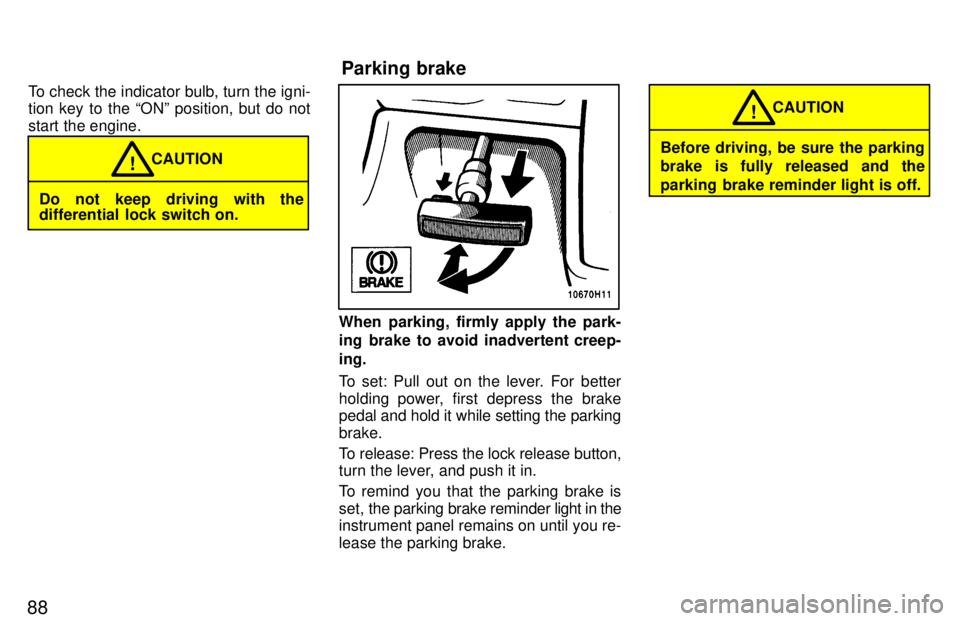
When parking, firmly apply the park-
ing brake to avoid inadvertent creep- ing.
To set: Pull out on the lever. For better
holding power, first depress the brake
pedal and hold it while setting the parking brake.
To release: Press the lock release button,
turn the lever, and push it in.
To remind you that the parking brake is
set,
the parking brake reminder light in the
instrument panel remains on until you re-lease the parking brake.
Before driving, be sure the parking
brake is fully released and the
parking brake reminder light is off. CAUTION
!
Parking brake
Page 92 of 221

91
The indicator light goes out after it
comes on.
If this is the case, contact your Toyota
dealer and have your vehicle inspected.
To crank the engine without depress- ing the clutch pedal, push the switch
with the ignition on.
The switch stays on as long as the ignition
is on. And it will automatically turn off
when the ignition is off.
This switch cancels the clutch start sys-
tem, which is designed to keep the starter
motor from operating if the clutch pedal is
not depressed all the way down.
The switch allows the vehicle to be driven
out of difficult situations by cranking the
engine with the clutch engaged. Never use the switch for normal engine
starting. Be sure to
follow the starting pro-
cedure instructed in How to start the en- gineº in Part 3.
Clutch start cancel switch
(four-wheel
drive models with
manual transmission)
Page 115 of 221
11 4
CAUTION!
When driving off-road or in rugged
terrain, do not drive at excessive
speeds, jump the vehicle, or strike
objects, etc. This may cause loss of
control or vehicle rollover. You are
also risking expensive damage to
your vehicle's suspension and chassis. Drive gently and avoid high speeds.
Your vehicle does not need an elaborate
break-in. But following a few simple tips
for the first 1600 km (1000 miles) can add
to the future economy and long life of your vehicle:
Do not drive over 88 km/h (55 mph).
Run the engine at moderate speed be- tween 2000 and 4000 rpm.
Avoid full-throttle starts.
Try to avoid hard stops during the first
300 km (200 miles).
Do not drive slowly with the manual
transmission in a high gear.
Do not drive for a long time at any
single speed, either fast or slow.
Do not tow a trailer during the first 800
km (500 miles)
Four-wheel drive models with free-
wheeling hubs onlyÐ For the first 500 km (300 miles):
We recommend that you use high range,
two-wheel drive, with both free-wheeling
hubs engaged. For information on the four-wheel drive system and the front hubs, see Four-wheel drive system in Chapter 1-6. FUEL TYPE
Your new vehicle must use only un-
leaded gasoline.
To help prevent gas station mixups, your
Toyota has a new smaller fuel tank opening.
The special nozzle on pumps with unleaded
fuel will fit it, but the larger standard nozzle
on pumps with leaded gas will not.
Do not use leaded gasoline. Use of
leaded gasoline will cause the
three-way catalytic converter to lose its effectiveness and theemission control system to function improperly. Also, thiscan increase maintenance costs.
NOTICE
OCTANE NUMBER
Select Research Octane Number 91 (Oc-
tane Rating 87) or higer.
Use of unleaded fuel with an octane num- ber or rating lower than stated above will
cause persistant heavy knocking. If se-
vere, this will lead to engine damage.Fuel
Break-in period
Page 116 of 221
11 5
If your engine knocks...
If you detect heavy knocking even when
using the recommended fuel, or if you
hear steady knocking while holding a
steady sp
eed on level roads, consult your
Toyota dealer.
However, now and then, you may notice
light knocking for a short time while accel-
erating or d riving up hills. This is no cause
for concern.
GASOLINES CONTAINING DETER-
GENT ADDITIVES
Toyota recommends use of gasolines
that contain detergent additives to
avoid build-up of engine deposits.
For further details, ask your Toyota dealer
or a local gasoline retailer.
GASOLINES CONTAINING MTBE
Gasolines that contain MTBE (Methyl
Tertiary-Butyl Ether) are available in
the market. If you use a gasoline mixed
with MTBE, make certain that it does
not contain more than 15% of MTBE.
If the use of gasolines containing MTBE causes poor driveability and/or poor fuel
economy, you should discontinue the use
of fuels containing MTBE. GASOLINES CONTAINING ALCOHOL I
f the use of gasohol in your T oyota, be
sure that it is u nleaded, has an octane
rating no lower than 87 and does not
contain more than 10% ethonol.
Gasohol is a mixture of gasoline and etha-
nol.
Toyota does not recommend the use of
gasolines containing m ethonol. If you use
gasoline containing methonol, use only
gasoline meeting the requirements above
and also containing less than 5% metha-
nol with cosolvents and corrosion inhibi-
tors for methanol.
FUEL TANK CAPACITY
Do not use gasohol other thanstated above. It will cause fuel
system damage or vehicle perfor-
mance problems.
If driveability problems are en-countered (poor hot starting, va-
porizing, engine knock, etc.), dis-continue the use.
Take care not to spill gasohol dur-
ing refueling. Gasohol may causepaint damage.
NOTICE
FUEL TANK CAPACITY
Two-wheel drive models
57 L (15.1 gal., 12.5 Imp. gal.)
Four-wheel drive models 68 L (18.0 gal., 15.0 Imp. gal.)
Page 117 of 221
11 6If you plan to drive your Toyota in
another country... First,
comply with the vehicle registration
laws. Second, confirm the availability of the
correct fuel (unleaded and minimum oc- tane number).
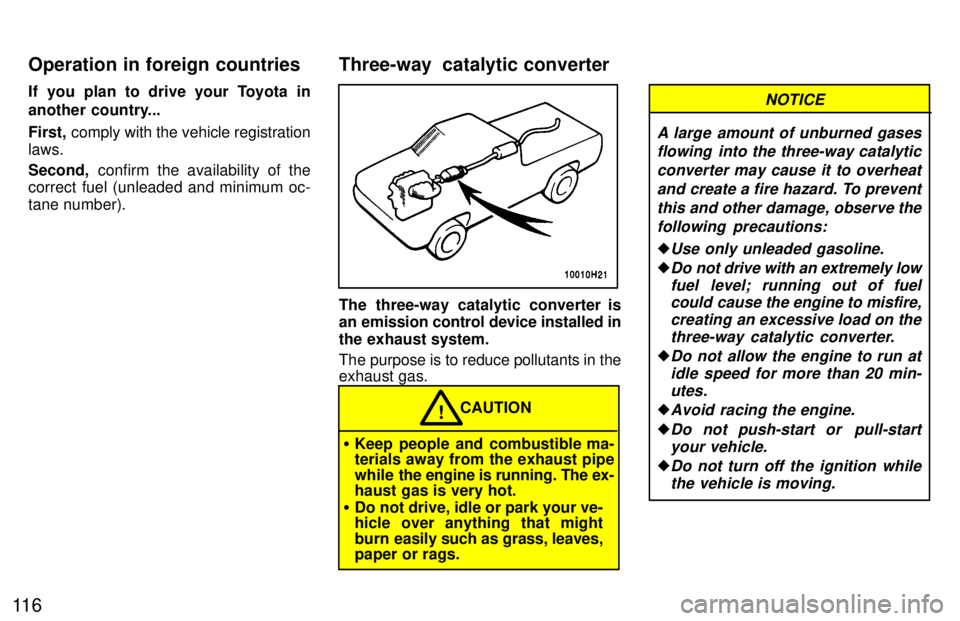
The three-way catalytic converter is
an emission control device installed in
the exhaust system.
The purpose is to reduce pollutants in the exhaust gas.
CAUTION!
Keep people and combustible ma- terials away from the exhaust pipe
while the engine is running. The ex-
haust gas is very hot.
Do not drive, idle or park your ve-
hicle over anything that might
burn easily such as grass, leaves,
paper or rags.
A large amount of unburned gases
flowing into the three-way catalytic
converter may cause it to overheatand create a fire hazard. To prevent this and other damage, observe thefollowing precautions:
Use only unleaded gasoline.
Do not drive with an extremely lowfuel level; running out of fuelcould cause the engine to misfire,
creating an excessive load on the
three-way catalytic converter.
Do not allow the engine to run at idle speed for more than 20 min-
utes.
Avoid racing the engine.
Do not push-start or pull-startyour vehicle.
Do not turn off the ignition whilethe vehicle is moving.
NOTICE
Three-way catalytic converter
Operation in foreign countries