138
When restarting out after parking on a slope:
1. With the transmission in Pº position,
start the engine. Be sure to keep the brake pedal depressed.
2. Shift into the 2º, Lº or Rº position.
3. Release the parking brake and brake pedal and slowly pull or back away
from the wheels blocks. Stop and ap-ply your brakes.
4. Have someone retrieve the blocks.
CAUTION
Do not exceed 72 km/h (45 mph) or
the posted towing speed limit,
whichever is lower. Because insta-
bility (swaying) of a towing ve-
hicle-trailer combination usually
increases as the speed increases,
exceeding 72 km/h (45 mph) may cause loss of control.
Slow down and downshift before
descending steep or long downhill
grades. Do not make suddendownshifts
Avoid holding the brake pedal
down too long or too frequently.
This could cause the brakes to
overheat and result in reduced
braking efficiency.! Getting
more kilometers/mileage from a li-
ter/gallon of fuel is easy-just take it easy.
It will help make your vehicle last longer,
too. Here are some specific tips on how to
save money on both fuel and repairs: Keep your tires inflated at the cor- rect pressure. Underinflation causes
tire wear and wastes fuel. See Chapter
7-2 for instructions.
Do not carry unneeded weight in
your vehicle. Excess weight puts a
heavier load on the engine, causing greater fuel consumption.
Avoid lengthy warm-up idling.
Once the engine is running smoothly,
begin drivingÐ but gently. Remem-
ber, however, that on cold winter
days this may take a little longer.
Accelerate slowly and smoothly.
Avoid jackrabbit starts.
Avoid long engine idling. If you have
a long wait and you are not in traffic, it
is better to turn off the engine and start
again later.
Avoid engine lug or overrevving.
Use a gear position suitable for the
road on which you are travelling.
How to save fuel and make
your vehicle last longer, too
1461. Reduce
your speed gradually, keeping
a straight line. Move cautiously off the
road to a safe place well away from the
traf fic. Avoid stopping on the center di-
vider of a highway. Park on a level spotwith firm ground.
2. Stop the engine and turn on your emergency flashers.
3. Firmly set the parking brake and put the transmission in Pº.
4. Have everyone get out of the vehicle on the side away from traffic.
5. Read the following instructions thor- oughly.
When jacking, be sure to observe
the following to reduce the poss- ibility of personal injury: Follow jacking instructions.
Use the jack only for lifting your
vehicle during wheel changing.
Never get beneath the vehicle
when supported by the jack.
Do not start or run the engine
while your vehicle is supported bya jack. CAUTION
!
NOTICE
Do not continue driving with a deflated tire. Driving even a short
distance can damage a tire beyondrepair.
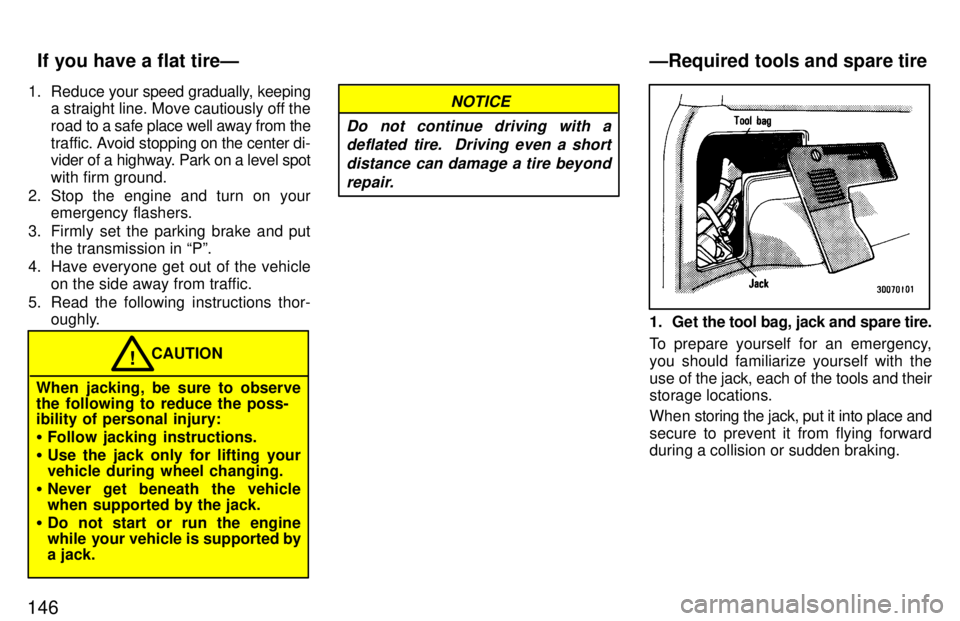
1. Get the tool bag, jack and spare tire.
To prepare yourself for an emergency, you should familiarize yourself with the
use of the jack, each of the tools and their storage locations.
When storing the jack, put it into place and secure to prevent it from flying forward
during a collision or sudden braking.
If you have a flat tireÐ
ÐRequired tools and spare tire