Page 56 of 159
81
YOUR RADIO ANTENNA
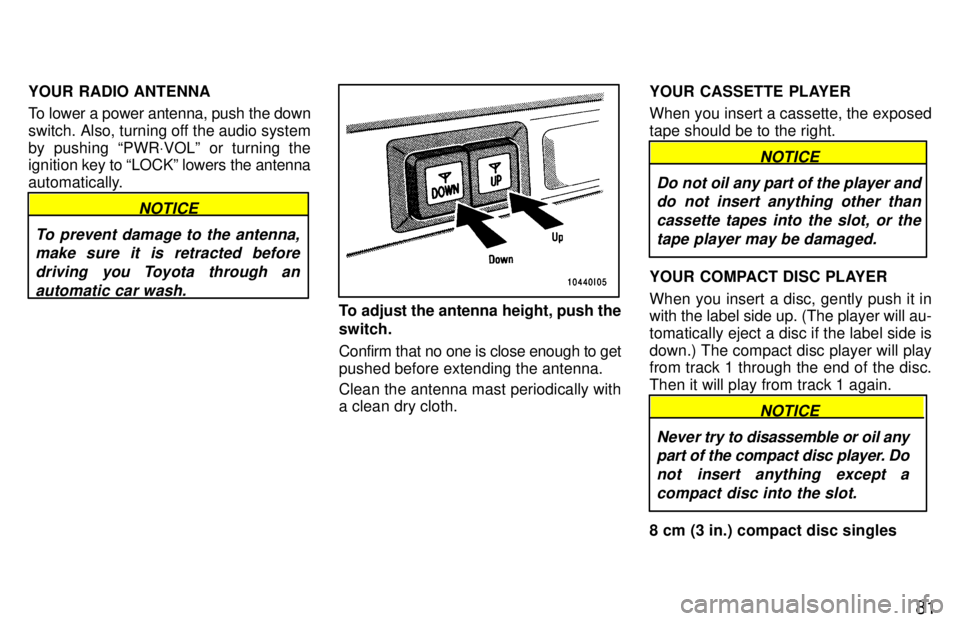
To lower a power antenna, push the down
switch. Also, turning off the audio systemby pushing PWR
VVOLº or turning the
ignition key to LOCKº lowers the antenna
automatically.
To prevent damage to the antenna,
make sure it is retracted before
driving you Toyota through anautomatic car wash.
NOTICE
To adjust the antenna height, push the switch.
Confirm that no one is close enough to get
pushed before extending the antenna. Clean the antenna mast periodically with a clean dry cloth. YOUR CASSETTE PLAYER
When you insert a cassette, the exposed tape should be to the right.
Do not oil any part of the player and
do not insert anything other than
cassette tapes into the slot, or thetape player may be damaged.
NOTICE
YOUR COMPACT DISC PLAYER
When you insert a disc, gently push it in with the label side up. (The player will au-
tomatically eject a disc if the label side isdown.) The compact disc player will play
from track 1 through the end of the disc. Then it will play from track 1 again.
Never try to disassemble or oil any
part of the compact disc player. Do
not insert anything except a compact disc into the slot.
NOTICE
8 cm (3 in.) compact disc singles
Page 78 of 159

103
Here are some common reception prob-
lems that probably do not indicate a prob- lem with your radio: FM
Fading and driving stationsÐGenerally,
the effective range of FM is about 40 km
(25 miles). Once outside this range, you
may notice fading and drifting, which in- crease with the distance from the radio
transmitter. They are often accompanied by distortion.
Multi-pathÐFM signals are reflective,
making it
possible for two signals to reach
your antenna at the same time. If this hap-
pens, the signals will cancel each other
out, causing a momentary flutter or loss of
reception.
Static and flutteringÐThese occur when
signals are blocked by buildings, trees, or other large objects. Increasing the bass
level may reduce static and fluttering.
Station swappingÐIf the FM signal you are listening to is interrupted or weak-
ened, and there is another strong station
nearby on the FM band, your radio may
tune in the second station until the original
signal can be picked up again. AM FadingÐAM broadcasts are reflected by the upper atmosphere-especially atnight. These reflected signals can inter-
fere with those received directly from the radio station, causing the radio station tosound alternately strong and weak.
Station interferenceÐWhen a reflected
signal and a signal received directly from a radio station are very nearly the same
frequency, they can interfere with each
other,
making it difficult to hear the broad-
cast.
StaticÐAM is easily affected by external sources of electrical noise, such as high
tension power lines, lightening, or electri-cal motors. This results in static.
CARING FOR YOUR CASSETTE PLAY-
ER AND TAPES
For high performance from your cassette
player and tapes:
Clean the tape head and other parts regu-
larly. A dirty tape head or tape path can de-
crease sound quality and tangle your
cassette tapes. The easiest way to
clean them is by using a cleaning tape.
(A wet type is recommended.) Use high-quality cassettes.
Low-quality cassette tapes can cause
many problems, including poor sound, inconsistent playing speed, and
constant auto-reversing. They can
also get stuck or tangled in the cas-
sette player.
Do not use a cassette if it has been
damaged or tangled or if its label is
peeling off.
Do not leave a cassette in the player if
you are not listening to it, especially if it is hot outside.
Store cassettes in their cases and out
of direct sunlight.
Avoid using cassettes with a total play-
ing time longer than 100 minutes (50
minutes per side). The tape used in
these cassettes is thin and could get
stuck or tangled in the cassette player.
Page 156 of 159

199
4. STOP 10A: Stop lights, multiport fuel
injection system/sequential multiport fuel injection system, cruise control
cancel device, automatic transmission
shift lock system
5. DEFOG 20 A: Rear window defogger
6. WIPER 20 A: Windshield wipers and
washer, rear window wiper and wash-er
7. GAUGE 10 A: Gauges and meters,
service reminder indicators and warn-
ing buzzers (except discharge and
open door warning lights), back-up lights
8. TURN 7.5 A: Turn signal lights 9. ECU-IG 15 A:
Cruise control system
10. ECU-B 10 A: SRS airbag system
11. REAR-HTR 20 A: Air conditioning
system
12. IGN 7.5 A: Multiport fuel injection sys-
tem/sequential multiport fuel injection
system, emission control system,
SRS airbag system
13. A.C 10 A: Air conditioning system
14. DIFF 30 A: Differential lock system
15. CHARGE 7.5 A: Charging system,
discharge warning light
16. EFI 15 A: Multiport fuel injection sys-
tem/sequential multiport fuel injection system
17. CDS-F AN 20 A: No circuit
18. HEAD (RH) 15 A: Right-hand head-
lights
19. HEAD (LH) 15 A: Left-hand head-
lights
20. HAZ-HORN 15 A: Emergency flash-
ers, horns 21. DOME 10 A:
Interior lights, personal
light, luggage compartment light, igni-
tion switch light, open door warning
light, clock, radio, cassette tape play-
er, power antenna, vanity lights
Fuses (type B)
22. FL HEATER 40 A: Air conditioning
system
23. FL POWER 30 A: Power windows,
power door lock system, electric moon
roof.
Fuses (type C)
24. AM 1 50 A: All components in CIGº,
WIPERº, GAUGEº, TURNº, ECU-
IGº, REAR-HTRº, INº, DIFFº and
FL POWERº circuits
25. ABS 60 A: Anti-lock brake system