1997 TOYOTA LAND CRUISER charging
[x] Cancel search: chargingPage 36 of 159
61
NOTICE
Do not drive the vehicle with the oil pressure below the normal range
until the cause is fixed-it may ruin the engine.
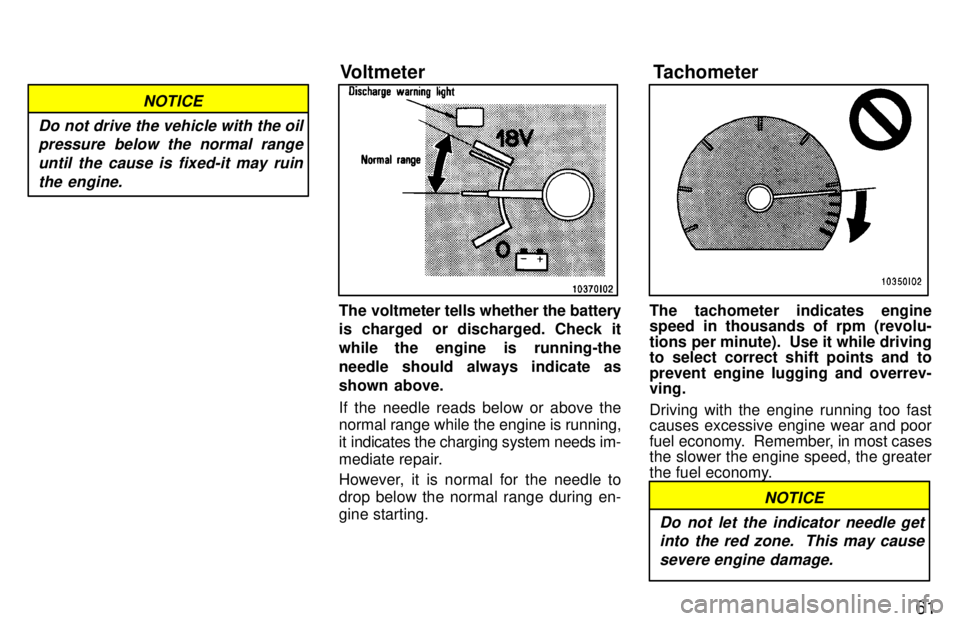
The voltmeter tells whether the battery
is charged or discharged. Check it
while the engine is running-the
needle should always indicate as
shown above.
If the needle reads below or above the normal range while the engine is running,
it indicates the charging system needs im-
mediate repair.
However, it is normal for the needle to
drop below the normal range during en-
gine starting.The tachometer indicates engine
speed in thousands of rpm (revolu-
tions per minute). Use it while driving
to select correct shift points and to
prevent engine lugging and overrev- ving.
Driving with the engine running too fast
causes excessive engine wear and poor
fuel economy. Remember, in most cases
the slower the engine speed, the greater
the fuel economy.
NOTICE
Do not let the indicator needle get into the red zone. This may cause
severe engine damage.
Voltmeter Tachometer
Page 38 of 159
63
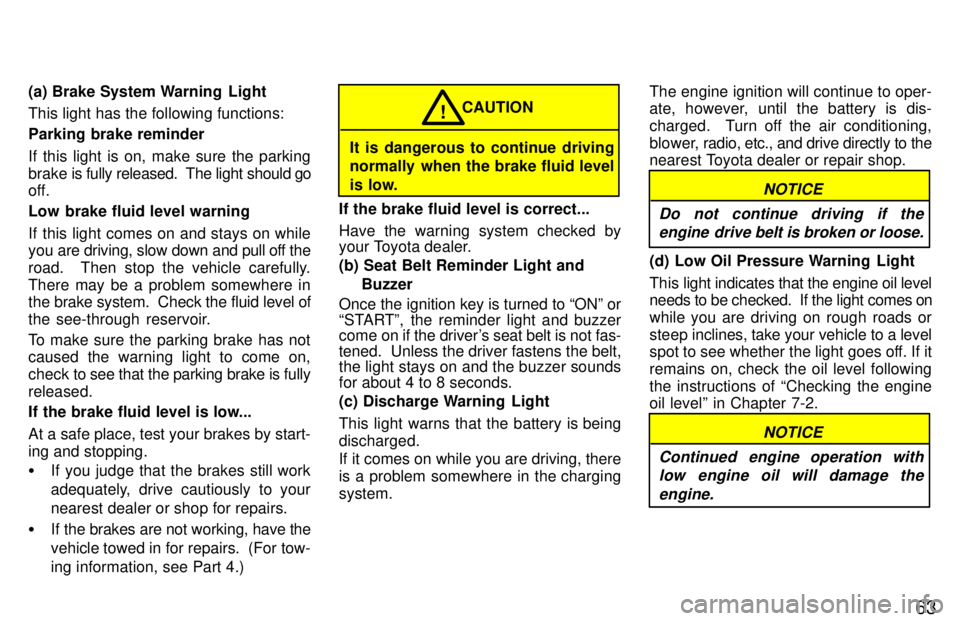
(a) Brake System Warning Light This light has the following functions: Parking brake reminder
If this light is on, make sure the parking
brake is
fully released. The light should go
off.
Low brake fluid level warning
If this light comes on and stays on while
you are driving, slow down and pull off the
road. Then stop the vehicle carefully.There may be a problem somewhere in
the brake system. Check the fluid level of
the see-through reservoir.
To make sure the parking brake has not
caused the warning light to come on,
check to see that the parking brake is fully
released.
If the brake fluid level is low...
At a safe place, test your brakes by start-
ing and stopping. If you judge that the brakes still work
adequately, drive cautiously to yournearest dealer or shop for repairs.
If the brakes are not working, have the
vehicle towed in for repairs. (For tow-
ing information, see Part 4.)
It is dangerous to continue driving
normally when the brake fluid level
is low. CAUTION
!
If the brake fluid level is correct...
Have the warning system checked by
your Toyota dealer. (b) Seat Belt Reminder Light and Buzzer
Once the ignition key is turned to ONº or
STARTº, the reminder light and buzzer
come on if the driver's seat belt is not fas- tened. Unless the driver fastens the belt, the light stays on and the buzzer sounds for about 4 to 8 seconds.
(c) Discharge Warning Light
This light warns that the battery is being discharged.
If it comes on while you are driving, there
is a problem somewhere in the chargingsystem. The engine ignition will continue to oper-
ate, however, until the battery is dis-
charged. Turn off the air conditioning,
blower, ra
dio, etc., and drive directly to the
nearest Toyota dealer or repair shop.
NOTICE
Do not continue driving if the engine drive belt is broken or loose.
(d) Low Oil Pressure Warning Light
This light indicates that the engine oil level
needs to be checked. If the light comes on
while you are driving on rough roads orsteep inclines, take your vehicle to a level
spot to see whether the light goes off. If itremains on, check the oil level followingthe instructions of Checking the engine
oil levelº in Chapter 7-2.
NOTICE
Continued engine operation with low engine oil will damage the
engine.
Page 119 of 159
144
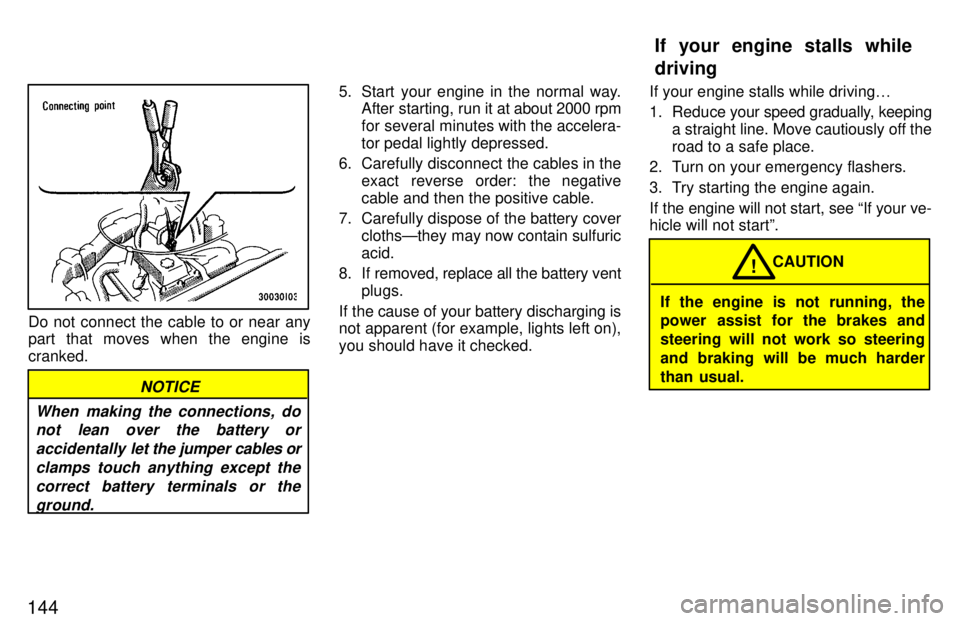
Do not connect the cable to or near any
part that moves when the engine is cranked.
NOTICE
When making the connections, do not lean over the battery or
accidentally let the jumper cables or
clamps touch anything except the correct battery terminals or theground.
5. Start your engine in the normal way. After starting, run it at about 2000 rpm
for several minutes with the accelera- tor pedal lightly depressed.
6. Carefully disconnect the cables in the exact reverse order: the negative
cable and then the positive cable.
7. Carefully dispose of the battery cover clothsÐthey may now contain sulfuricacid.
8. If removed, replace all the battery vent plugs.
If the cause of your battery discharging is
not apparent (for example, lights left on), you should have it checked. If your engine stalls while driving
0
1. Reduce your speed gradually, keeping
a straight line. Move cautiously off the
road to a safe place.
2. Turn on your emergency flashers.
3. Try starting the engine again.
If the engine will not start, see If your ve-
hicle will not startº.
If the engine is not running, the
power assist for the brakes and
steering will not work so steering
and braking will be much harder
than usual. CAUTION
!
If your engine stalls while driving
Page 154 of 159

197
ÐNon-maintenance battery Open voltage* at 20
C (68 F):
12.7 V Fully charged12.3 V Half charged
11.9 V Discharged
*: Voltage that is checked 20 minutes af-
ter the key is removed with all the lights
turned off
Charging rates: Non-maintenance battery 5 A max. Maintenance type batteryQuick charge 15 A max.
Slow charge 5 A max.
TRANSFER
Oil capacity, L (qt., lmp. qt.): 1.7 (1.8, 1.4)
Oil type: Multipurpose gear oil API GL-4 or
GL-5 Recommended oil viscosity: SAE 75W-90 AUTOMATIC TRANSMISSION Fluid capacity (drain and refill), L (qt., Imp. qt.):
Up to 1.9 (2.0, 1.7) Fluid type:
Automatic transmission fluid D-II or DEXRON [
III (DEXRON [
II)
DIFFERENTIAL
Oil capacity, L (qt., lmp. qt.): Front
With front and rear differential lock
system 2.75 (2.9, 2.4)
Without front and rear differential lock
system 2.80 (3.0, 2.5)
Rear 3.25 (3.4, 2.9) Oil type:
Hypoid gear oil API GL-5
Recommended oil viscosity:
AboveÐ18 5C (0 5F)
SAE 90 BelowÐ18 5C (0 5F)
SAE 80W or 80W-90 CHASSIS LUBRICATION Wheel bearings:
Lithium base wheel bearing grease, NLGI No. 2
Steering Knuckles: Molybdenm-disulfide lithium base chassis grease, NLGI No. 2
Propeller shafts:
Lithium base wheel bearing grease, NLGI No. 2
BRAKES Minimum pedal clearance when de- pressed with the pressure of 490 N (50
kgf, 110 lbf) with the engine running, mm(in.): 68 (2.7)
Pedal freeplay, mm (in.): 3' 6 (0.12 '0.24)
Pad wear limit, mm (in.):
1.0 (0.04)
Lining wear limit, mm (in.):
1.0 (0.04)
Parking brake adjustment when pulled with the force of 196 N (20 kgf, 44 lbf):
7' 9 clicks
Fluid type: SAE J1703 or FMVSS No. 116 DOT 3
Page 156 of 159

199
4. STOP 10A: Stop lights, multiport fuel
injection system/sequential multiport fuel injection system, cruise control
cancel device, automatic transmission
shift lock system
5. DEFOG 20 A: Rear window defogger
6. WIPER 20 A: Windshield wipers and
washer, rear window wiper and wash-er
7. GAUGE 10 A: Gauges and meters,
service reminder indicators and warn-
ing buzzers (except discharge and
open door warning lights), back-up lights
8. TURN 7.5 A: Turn signal lights 9. ECU-IG 15 A:
Cruise control system
10. ECU-B 10 A: SRS airbag system
11. REAR-HTR 20 A: Air conditioning
system
12. IGN 7.5 A: Multiport fuel injection sys-
tem/sequential multiport fuel injection
system, emission control system,
SRS airbag system
13. A.C 10 A: Air conditioning system
14. DIFF 30 A: Differential lock system
15. CHARGE 7.5 A: Charging system,
discharge warning light
16. EFI 15 A: Multiport fuel injection sys-
tem/sequential multiport fuel injection system
17. CDS-F AN 20 A: No circuit
18. HEAD (RH) 15 A: Right-hand head-
lights
19. HEAD (LH) 15 A: Left-hand head-
lights
20. HAZ-HORN 15 A: Emergency flash-
ers, horns 21. DOME 10 A:
Interior lights, personal
light, luggage compartment light, igni-
tion switch light, open door warning
light, clock, radio, cassette tape play-
er, power antenna, vanity lights
Fuses (type B)
22. FL HEATER 40 A: Air conditioning
system
23. FL POWER 30 A: Power windows,
power door lock system, electric moon
roof.
Fuses (type C)
24. AM 1 50 A: All components in CIGº,
WIPERº, GAUGEº, TURNº, ECU-
IGº, REAR-HTRº, INº, DIFFº and
FL POWERº circuits
25. ABS 60 A: Anti-lock brake system