1997 TOYOTA LAND CRUISER ABS
[x] Cancel search: ABSPage 27 of 159

31
The SRS airbags are not designed to inflate if the vehicle is subjected to a
side or rear impact, if it rolls over, or if
it is involved in a low-speed frontalcollision.The airbag sensor assembly consists of a
safing sensor and airbag sensor.
In a severe frontal impact, sensors detect
deceleration and the system triggers the
airbag inflators. Then a chemical reaction
in the inflators momentarily fills the air-
bags with non-toxic nitrogen gas to help
restrain the forward motion of the occu- pants.When the airbag inflates, they produce a fairly
loud noise and release some smoke
along with the nitrogen gas. This is notharmful and does not indicate a fire. Be
sure to wash off any residue as soon as
possible to prevent minor skin irritation.
Deployment of the airbags happens in a
fraction of a second, so the airbags must
inflate with considerable force. While the
system is designed to reduce serious inju-
ries, it may also cause minor burns or
abrasions and swellings.
Parts of the airbag module (steering
wheel hub, dashboard) may be hot for several minutes, but the airbags them- selves w ill not be hot. The airbags are de-
signed to inflate only once.
A crash severe enough to inflate the air-
bags may break the windshield as the ve-
hicle buckles. In vehicles with a passen-ger airbag the windshield may also be
damaged by absorbing some of the force
of the inflating airbag.
Page 39 of 159
64(e) Malfunction Indicator Lamp
This lamp comes on in the following cases.
a. The fuel tank is completely empty. (See Fuel gaugeº in Chapter 1-5 for in- structions.)
b. If it comes on while you are driving in case c, have your vehicle checked/re-
paired by your Toyota dealer as soon aspossible.
(f) Low Fuel Level Warning Light
This light comes on when the fuel level in
the tank becomes nearly empty. Fill up the tank as soon as possible.
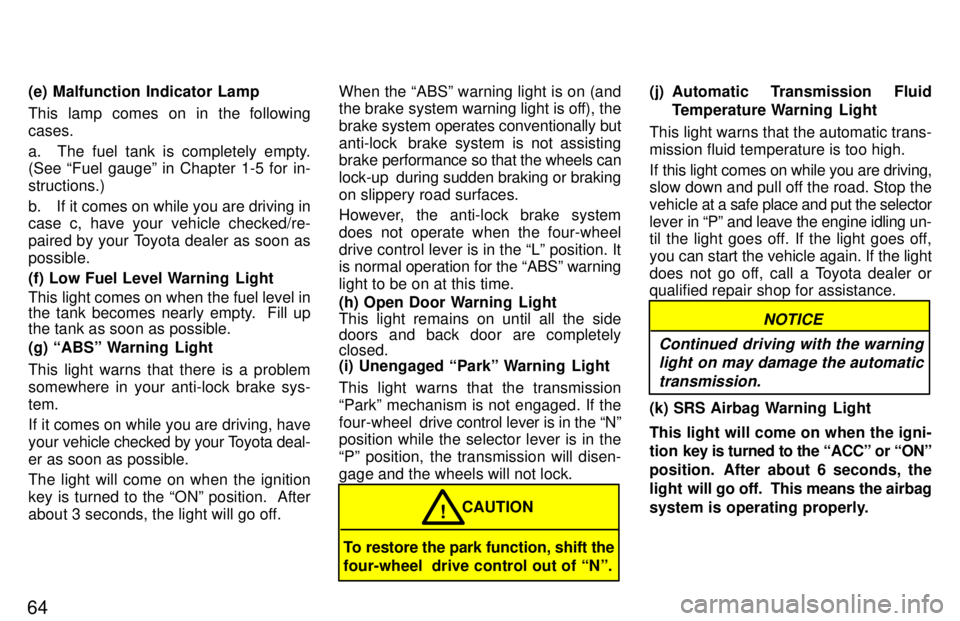
(g) ABSº Warning Light
This light warns that there is a problem
somewhere in your anti-lock brake sys-tem.
If it comes on while you are driving, have your
vehicle checked by your Toyota deal-
er as soon as possible.
The light will come on when the ignition
key is turned to the ONº position. After
about 3 seconds, the light will go off. When the ABSº warning light is on (and
the brake system warning light is off), the brake system
operates conventionally but
anti-lock brake system is not assisting brake performance so that the wheels can
lock-up during sudden braking or braking
on slippery road surfaces.
However, the anti-lock brake system
does not operate when the four-wheel
drive control lever is in the Lº position. It
is normal operation for the ABSº warning
light to be on at this time.
(h) Open Door Warning Light
This light remains on until all the side doors and back door are completely closed.
(i) Unengaged Parkº Warning Light
This light warns that the transmission
Parkº mechanism is not engaged. If the
four-wheel drive control lever is in the Nº
position while the selector lever is in the
Pº position, the transmission will disen-
gage and the wheels will not lock.
To restore the park function, shift the
four-wheel drive control out of Nº. CAUTION
! (j) Automatic Transmission Fluid
Temperature Warning Light
This light warns that the automatic trans- mission fluid temperature is too high.
If this light comes on while you are driving,
slow down and pull off the road. Stop the
vehicle at a safe place and put the selector
lever in Pº and leave the engine idling un-
til the light goes off. If the light goes off,
you can start the vehicle again. If the light
does not go off, call a Toyota dealer or
qualified repair shop for assistance.
NOTICE
Continued driving with the warning light on may damage the automatic
transmission.
(k) SRS Airbag Warning Light This light will come on when the igni-
tion key is turned to the ACCº or ONº
position. After about 6 seconds, the
light w ill go off. This means the airbag
system is operating properly.
Page 40 of 159

65
The warning light system monitors the air-
bag sensor assembly, inflators, warning
light, interconnecting wiring and powersources.
If either of the following conditions occurs, this indicates a malfunction somewhere inthe parts monitored by the warning light
system. Contact your Toyota dealer as
soon as possible to service the vehicle.
The light does not come on when the
ignition key is turned to the ACCº or
ONº position or remains on.
The light comes on while driving.
(l) Key Reminder Buzzer
This buzzer reminds you to remove the
key when you open the driver's door with the ignition key in the ACCº or LOCKºposition.
CHECKING SERVICE REMINDER INDI-
CATORS
1. Apply the parking brake.
2. Open one of the side doors or the back
door.
The open door warning light should come on. 3. Close the door.
The open door warning light should go off.
4. Place the four-wheel drive control le-
ver in
Nº position and the selector lever in Pº position.
5. Turn ignition key to ACCº.
The SRS airbag warning light should
come on. It goes off after about 6 sec-onds.
6. Turn the ignition key to ONº, but do not start the engine.
All the service reminder indicators except the open door warning light and SRS air-
bag warning light should come on. The
ABSº warning light goes off after about 3 seconds. If any service reminder indicator or warn-
ing buzzer does not function as described above, either the bulb is burned out or the
circuit is in need of repair. Have it checked
by your Toyota dealer as soon as pos- sible.
Page 98 of 159
123
For detailed information on the oil level
check,
see Checking the engine oil levelº
in Chapter 7-2. Tandem master cylinder brake system
The tandem master cylinder brake sys-
tem is a hydraulic system with two sepa-
rate sub-systems. If either sub-system
should fa
il, the other will still work. Howev-
er, the pedal will be harder to press, and
your stopping distance will be longer.
Also, the brake system warning light may come on.
CAUTION!
Do not drive your vehicle with only
a single brake system. Have your
brakes fixed immediately.
Brake booster
The brake booster uses engine vacuum to
power-assist the brakes. If the engine
should quit while you are driving, you can
bring the vehicle to a stop with normal
pedal pressure. There is enough reserve
vacuum for one or two stops - but no more!
CAUTION!
Do not pump the brake pedal if the
engine stalls. Each push on the
pedal uses up your vacuum re- serve.
Even if the power assist is com-
pletely lost, the brakes will still
work. But you will have to push
the pedal hard-much harder than
normal. And your braking dis- tance will be longer
ANTI-LOCK BRAKE SYSTEM (with ABSº warning light)
The anti- lock brake system is designed to
automatically help prevent lock- up of the
wheels during sudden braking or braking on
slippery road surfaces. This assists in pro-
viding directional stability and steering per -
formance of the vehicle under these cir -
cumstances.
The anti- lock brake system becomes op-
erative after the vehicle has accelerated to
a speed in excess of approximately 10 km/h
(6 mph). It stops operating when the vehicle
decelerates to a speed below approximate-
ly 5 km/h (3 mph).
You may hear a sound in the engine
compartment for a few seconds when the
engine is started or just after the vehicle is started. This means that the anti-lock
brake system is in the self check mode,
and does not indicate a malfunction.
Brake system
Page 99 of 159
124
Effective way to press the ABSº brake
pedal: When the anti-lock brake system
function is in action, you may feel the brake pedal pulsating and hear a noise.
In this situation, to let the anti-lock brake
system work for you, just hold the brake
pedal down more firmly. Do not pumpthe brake. This will result in reduced
braking performance.
The brake pedal pulsation caused by the
anti-lock brake system may indicate haz- ardous road surface conditions. Althoughthe anti-lock brake system assists in pro-
viding vehicle control, it is still important to
drive with all due care, because the anti-
lock brake system cannot overcome the
laws of physics that act on your vehicle: Braking capab ility is dependent on tire
friction with the road surface.
Even though the anti-lock brake sys-
tem is operating, a driver cannot main- tain full control on certain slippery road
surfaces, when cornering at highspeeds, or in violent maneuvers.
Avoid high speeds on wet roads. The
anti-lock brake system cannot elimi-
nate the risk of hydroplaning and lossof tire friction. Always maintain a safe distance from the
vehicle in
front of you. Compared with ve-
hicles not fitted with an anti-lock brake
system, your vehicle may require a longer
stopping distance in the following cases: Driving on rough, gravel or snow-cov-
ered roads.
Driving with tire chains installed.
Driving on roads where the road sur-
face is pitted or has other differencesin surface height.
CAUTION!
Do not use tires other than the
manufacturer 's designated tires, and
do not mix tires or wheels of different
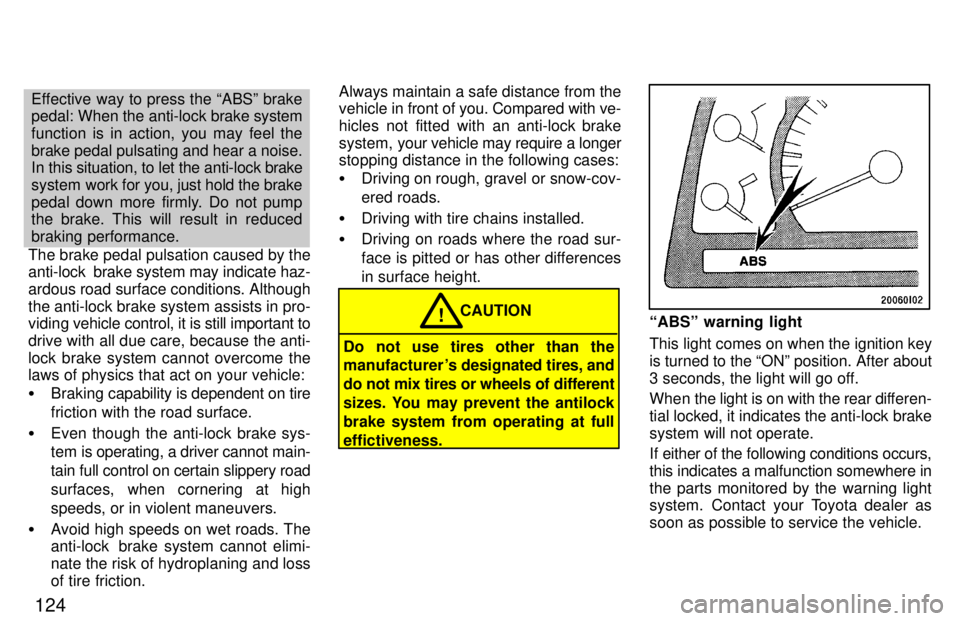
sizes. You may prevent the antilockbrake system from operating at fulleffictiveness.ABSº warning light
This light comes on when the ignition key is turned to the ONº position. After about
3 seconds, the light will go off.
When the light is on with the rear dif feren-
tial locked, it indicates the anti-lock brake
system will not operate.
If either of the following conditions occurs, this indicates a malfunction somewhere inthe parts monitored by the warning light
system. Contact your Toyota dealer as
soon as possible to service the vehicle.
Page 100 of 159

125
The light does not come on as de-
scribed above, or remains on.
The light comes on while driving with
the center differential unlocked
The light does not come on with the
center differential locked.
The system comes into operation with
the center differential locked.
Even if the anti-lock brake system should
fail, the brake system will still operate con-
ventionally. However, when the `ABS''
warning light is on (and the brake system
warning light is off), the anti-lock brake
system is not assisting brake perfor- mance so that the wheels can lock-up
during sudden braking or braking on slip-
pery road surfaces. Have your vehicle
checked by your Toyota dealer as soon as
possible
Drum-in-disc type parking brake sys- tem
Your vehicle has a drum-in-disc type
parking brake system. This type of brake
system needs bedding-down of the brake
shoes periodically or whenever the park-
ing brake shoes and/or drums are re- placed.
Have your Toyota dealer perform the bed-
ding-down.
The brake pads wear limit indicators
on your disc brakes give a warning
noise w hen the brake pads are worn to
where replacement is required.
If you hear a squealing or scraping noise
while driving, have the brake pads
checked and replaced by your Toyota
dealer as soon as possible. Expensive ro-
tor damage can result if the pads are not
replaced when necessary. When stowing luggage or cargo in the ve-
hicle, observe the following:
Put luggage or cargo in the trunk when
at all possible. Be sure all items are se- cured in place.
Be careful to keep the vehicle bal-
anced. Locating the weight as far for-
ward as possible helps maintain bal- ance.
For better fuel economy, do not carryunneeded weight.
CAUTION!
To prevent luggage or packages
from sliding forward during brak-
ing, do not stack anything behind
the front seats higher than the seatbacks.
Never allow anyone to ride in the
luggage compartment. It is not
designed for passengers. They
should ride in their seats with
their seat belts properly fastened.
Otherwise, they are much more
likely suffer serious bodily injury,in the event of sudden braking or a collision.
Brake pad wear limit indicators Luggage stowage precautions
Page 112 of 159

137
Avoid jerky starts or sudden accelera- tion.
Avoid jerky steering and sharp turns.
The trailer could hit your vehicle in a
tight turn. Slow down before making a
turn to avoid the necessity of sudden braking.
Remember that when making a turn,the trailer wheels will be closer than the vehicle wheels to the inside of the
turn. Therefore, compensate for this
by making a larger than normal turning
radius with your vehicle.
Backing w ith a trailer is difficult and re-
quires practice. Grip the bottom of the steering wheel and move your hand to
the left to move the trailer to the left. Move your hand to the right to move
the trailer to the right. (This procedure is generally opposite to that when
backing without a trailer). Also, just
turn the steering wheel a little at a time,
avoiding sharp or prolonged turning. Have someone guide you when back-
ing to reduce the risk of an accident.
Crosswinds and rough roads will ad-
versely affect handling of your vehicle
and trailer, causing sway. Pay atten-
tion to the rear from time to time to pre-
pare yourself for being passed by largetrucks or buses, which may cause your
vehicle and trailer to sway. If swaying
happens, firmly grip the steering wheel
and reduce speed immediately but
gradually. Never increase speed.
Steer straight ahead. If you make no
extreme correction with the steering or
brakes, the vehicle and trailer will sta-bilize itself.
Be careful when passing other ve-hicles. Passing requires considerable
distance. After passing a vehicle, do
not forget the length of your trailer and
be sure you have plenty of room be-
fore changing lanes.
In order to maintain engine braking ef-
ficiency, do not use the Dºposition.
Because of the added load of the trail-
er, your vehicle's engine may overheat
on hot days (at temperatures over 30 5C [85 5F]) when going up a long or
steep grade with a trailer. If the engine
coolant temperature gauge indicates
overheating, immediately turn off the
air conditioning (if in use), pull off the
road and stop in a safe spot. Refer to
If your vehicle overheatsº in Part 4 of this manual.
Always place wheel blocks under both
the vehicle and trailer wheels whenparking. Apply the parking brake firm-
ly. Put the transmission in Pº. Avoid
parking on a slope with a trailer, but if it cannot be avoided, do so only afterperforming the following:
1. Apply the brakes and hold.
2. Have someone place wheel blocks un-
der both the vehicle and trailer wheels.
3. When the wheel blocks are in place, release your brakes slowly until the blocks absorb the load.
4. Apply the parking brake firmly.
5. Shift into Pº and turn off the engine.
Page 147 of 159
178If the level is low, add SAE J1703 or
FMVSS No. 116 DOT 3 brake fluid to the
brake reservoir. Remove and replace the reservoir cover
by hand. Fill the brake fluid to the dotted
line.
This brings the fluid to the correct lev-
el when you put the cover back on.
Use only newly opened brake fluid. Once
opened, brake fluid absorbs moisture
from the air, and excess moisture can cause a dangerous loss of braking.
CAUTION!
Take care when filling the reservoir
because brake fluid can harm your
eyes and damage painted surfaces. If
fluid gets in your eyes, flush your
eyes with clean water.
If you spill the fluid, be sure to wash
it off with water to prevent it from
damaging the parts or painting.
NOTICE
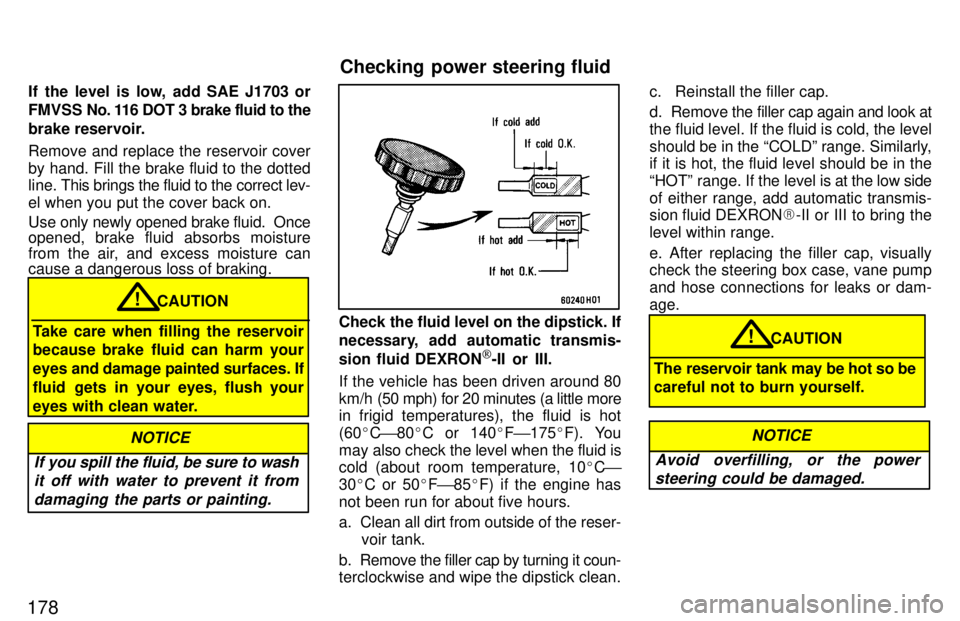
Check the fluid level on the dipstick. If
necessary, add automatic transmis-
sion fluid DEXRON [
-II or III.
If the vehicle has been driven around 80
km/h (50 mph) for 20 minutes (a little more
in frigid temperatures), the fluid is hot(60 C ' 80 C or 140 F ' 175 F). You
may also check the level when the fluid is
cold (about room temperature, 10 C '
30 C or 50 F ' 85 F) if the engine has
not been run for about five hours.
a. Clean all dirt from outside of the reser- voir tank.
b. Remove the filler cap by turning it coun- terclockwise and wipe the dipstick clean. c. Reinstall the filler cap.
d. Remove the filler cap again and look at the fluid level. If the fluid is cold, the level
should be in the COLDº range. Similarly, if it is hot, the fluid level should be in the
HOTº range. If the level is at
the low side
of either range, add automatic transmis-
sion fluid DEXRON -II or III to bring the
level within range.
e. After replacing the filler cap, visually check the steering box case, vane pump
and hose connections for leaks or dam-age.
CAUTION!
The reservoir tank may be hot so be
careful not to burn yourself.
Avoid overfilling, or the power steering could be damaged.
NOTICE
Checking power steering fluid