1997 TOYOTA LAND CRUISER towing
[x] Cancel search: towingPage 35 of 159

60
The gauge indicates the engine cool-
ant temperature when the ignition
switch is on. The engine operating
temperature will vary with changes in weather and engine load.
If the needle moves into the red zone,
stop your vehicle and allow the engine to cool.
Your vehicle may overheat during severe operating conditions, such as: Driving up a long hill on a hot day.
Reducing speed or stopping after high
speed driving.
Idling for a long period with the air con-
ditioning on in stop-and-go traffic.
Towing a trailer.
NOTICE
Do not remove the thermostat in
the engine cooling system as this
may cause the engine to overheat. The thermostat is designed tocontrol the flow of coolant to keep
the temperature of the engine within the specified operatingrange.
Do not continue driving with an
overheated engine. See If yourvehicle overheatsº in Part 4.
The oil pressure gauge indicates en-
gine oil pressure when the ignition
switch is on. Check it while driving to
make sure that the needle is in the
proper range.
If the oil pressure should stay below the
normal range, pull off the road to a safe
place and stop the engine immediately.
Call a Toyota dealer or qualified repair
shop for assistance.
Oil pressure may not built up when the oil
level is too low. The oil pressure gauge is not designed to indicate oil level, and the
oil level must be checked using the leveldipstick.
Oil pressure gauge
Engine coolant temperature gauge
Page 44 of 159
69
Your automatic transmission has a shift
lock system to minimize the possibility of
incorrect operation. This means you can
only shift out of Pº position when the brake
pedal is depressed (with the ignition
switch in ONº position and the lock re-
lease button depressed). (a) Normal driving
1. Start the engine as instructed in How to start the engineº in Part 3. The trans- mission must be in Pº or Nº.
2. With your foot holding down the brake pedal, shift the selector lever to Dº.
In Dº position, the automatic transmis-
sion system will select the most suitable
gear for running conditions such as nor-
mal cruising, hill climbing, hard towing, etc.
Always turn the overdrive switch on for
better fuel economy and quieter driving. If
the engine coolant temperature is low, thetransmission will not shift into overdrive
gear even with the overdrive switch on.
Never put your foot on the accelerator pedal while shifting. CAUTION
!
3. Release the parking brake and brake pedal. Depress the accelerator pedal
slowly for smooth starting.
(b) Using engine braking
To use engine braking, you can downshift the transmission as follows: Turn off the overdrive switch. The O/D
OFFº indicator light will come on and the transmission will downshift to the
third gear.
Shift into the 2º position. The trans-
mission will downshift to the second
gear when the vehicle speed drops down to or lower than the following speed, and more powerful engine
braking will be obtained.
Four-wheel drive control lever
in Hº 116 km/h (72 mph) . . . . . . . . .
Four-wheel drive control lever
in Lº 40 km/h (25 mph) . . . . . . . . . . .
Shift into the Lº position. The trans-
mission will downshift to the first gear.
When the vehicle speed drops down to
or lower than the following speed, and
maximum engine braking will be ap- plied.
Four-wheel drive control lever
in Hº 56 km/h (34 mph) . . . . . . . . . .
Four-wheel drive control lever
in Lº 13 km/h (8 mph) . . . . . . . . . . . .
When the cruise control is being used, even if you downshift the transmission by
turning off the overdrive switch, engine
braking will not be applied because the
cruise control is not cancelled. For ways
to decrease the vehicle speed, see
Cruise controlº in this chapter.
Be careful when downshifting on a
slippery surface. Abrupt shifting
could cause the vehicle to spin orskid. CAUTION
!
Page 45 of 159
70(c) Using the 2º and Lº positions
The 2º and Lº positions are used for
strong engine braking as described pre-
viously. With the selector lever in 2º or Lº, you
can start the vehicle in motion as with the
lever in Dº. With the selector lever in 2º, the vehicle
will
start in the first gear and automatically
shift to the second gear.
With the selector lever in Lº, the trans-
mission is engaged in the first gear.
NOTICE
Be careful not to overrev the en- gine. Watch the tachometer to
keep engine rpm from going intothe red zone. The approximate
maximum allowable speed foreach position is given below for
your reference:MAXIMUM ALLOWABLE SPEEDS
km/h (mph)
Transmission Transfer
L H2 44 (27) 109 (67)
L 22 (13) 56 (34)
Do not continue hill climbing orhard towing for a long time in the
2º or Lº position. This maycause severe automatic transmis-
sion damage from overheating.To prevent such damage, use Dº
position for hill climbing or hardtowing.
(d) Backing up
1. Bring the vehicle to a complete stop.
2. With the brake pedal held down with
your foot, shift the selector lever to the
Rº position.
NOTICE
Never shift into reverse while the vehicle is moving.
(e) Parking
1. Bring the vehicle to a complete stop.
2. Pull the parking brake lever up fully to securely apply the parking brake.
3. With the brake pedal pressed down, shift the selector lever to the Pº posi- tion. If the four-wheel drive control is in the Nº
position while the selector lever is in the
Pº position, the transmission will damage
and the wheels will not lock.
While the vehicle is moving, never
attempt to move the selector lever
into Pº position under any circum-
stances. Serious mechanical dam-
age and loss of vehicle control may result.
CAUTION
!
(f) Good driving practice If the transmission is repeatedly up-
shifted and downshifted between third
gear and overdrive when climbing a
gentle slope, the overdrive switch
should be turned off. Be sure to turn the switch on immediately afterward.
When towing a trailer, in order to main-
tain engine braking efficiency, do not use overdrive.
Page 100 of 159
125
The light does not come on as de-
scribed above, or remains on.
The light comes on while driving with
the center differential unlocked
The light does not come on with the
center differential locked.
The system comes into operation with
the center differential locked.
Even if the anti-lock brake system should
fail, the brake system will still operate con-
ventionally. However, when the `ABS''
warning light is on (and the brake system
warning light is off), the anti-lock brake
system is not assisting brake perfor- mance so that the wheels can lock-up
during sudden braking or braking on slip-
pery road surfaces. Have your vehicle
checked by your Toyota dealer as soon as
possible
Drum-in-disc type parking brake sys- tem
Your vehicle has a drum-in-disc type
parking brake system. This type of brake
system needs bedding-down of the brake
shoes periodically or whenever the park-
ing brake shoes and/or drums are re- placed.
Have your Toyota dealer perform the bed-
ding-down.
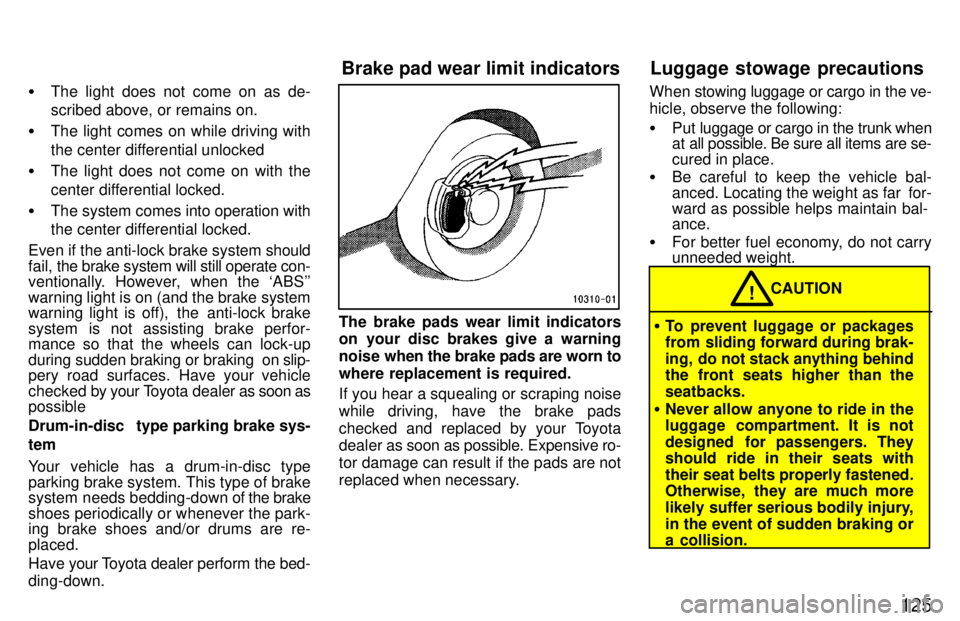
The brake pads wear limit indicators
on your disc brakes give a warning
noise w hen the brake pads are worn to
where replacement is required.
If you hear a squealing or scraping noise
while driving, have the brake pads
checked and replaced by your Toyota
dealer as soon as possible. Expensive ro-
tor damage can result if the pads are not
replaced when necessary. When stowing luggage or cargo in the ve-
hicle, observe the following:
Put luggage or cargo in the trunk when
at all possible. Be sure all items are se- cured in place.
Be careful to keep the vehicle bal-
anced. Locating the weight as far for-
ward as possible helps maintain bal- ance.
For better fuel economy, do not carryunneeded weight.
CAUTION!
To prevent luggage or packages
from sliding forward during brak-
ing, do not stack anything behind
the front seats higher than the seatbacks.
Never allow anyone to ride in the
luggage compartment. It is not
designed for passengers. They
should ride in their seats with
their seat belts properly fastened.
Otherwise, they are much more
likely suffer serious bodily injury,in the event of sudden braking or a collision.
Brake pad wear limit indicators Luggage stowage precautions
Page 104 of 159

Part 3How to start the engineÐ
(a) Before cranking
Before starting the engine
129
STARTING AND DRIVING
Before starting the engine
How to start the engine
Tips for driving in various condi- tions
Off-road driving precautions
Winter driving tips
Trailer towing
How to save fuel and make your
vehicle last longer, too
1. Check
the area around the vehicle be-
fore entering it.
2. Adjust seat position, seatback angle, head restraint height and steering
wheel angle.
3. Adjust inside and outside rear view mirrors.
4. Lock all doors.
5. Fasten seat belts. 1. Apply the parking brake firmly.
2. Turn off unnecessary lights and acces-
sories.
3. Put the selector lever in Pº. If you need to restart the engine while the ve-
hicle is moving, put the selector lever
in Nº. A starter safety device will pre-
vent the starter from operating if the selector lever is in any drive position.
4. Depress the brake pedal and hold it to the floor until driving off.
Page 109 of 159
134
Your vehicle is designed primarily as a
passenger - and - load - carrying vehicle.
Towing a trailer will have an adverse ef
fect
on handling, performance, braking, dura-
bility and driving economy (fuel consump-
tion, etc.). Your safety and satisfaction de-
pend on the proper use of correct
equipment and cautious driving habits.
For your safety and the safety of others,you must not overload your vehicle or
trailer. Ask your local T oyota dealer for fur-
ther details before towing. WEIGHT LIMITS
Before towing, make sure the total
trailer weight, gross combination
weight, gross vehicle weight, grossaxle weight and trailer tongue load are
all within the limits.
The total trailer weight and tongue load
can be measured with platform scales
found at a highway weighing station,
building supply company, trucking com-
pany, junk yard, etc.
CAUTION
The total trailer weight (trailer
weight plus its cargo load) must
not exceed the following. Exceed-
ing this weight is dangerous. If
towing a trailer over 907 kg (2000
lb.), it is necessary to use a sway
control device with a sufficient ca-
pacity.
Without towing package 1587 kg (3500 lb.) With towing package 2268 kg (5000 lb.)
The gross combination weight
(sum of your vehicle weight plus
its load and the total trailer
weight) must not exceed the fol- lowing.
Without towing package 4547 kg (10025 lb.) With towing package
5228 kg (11525 lb.)!
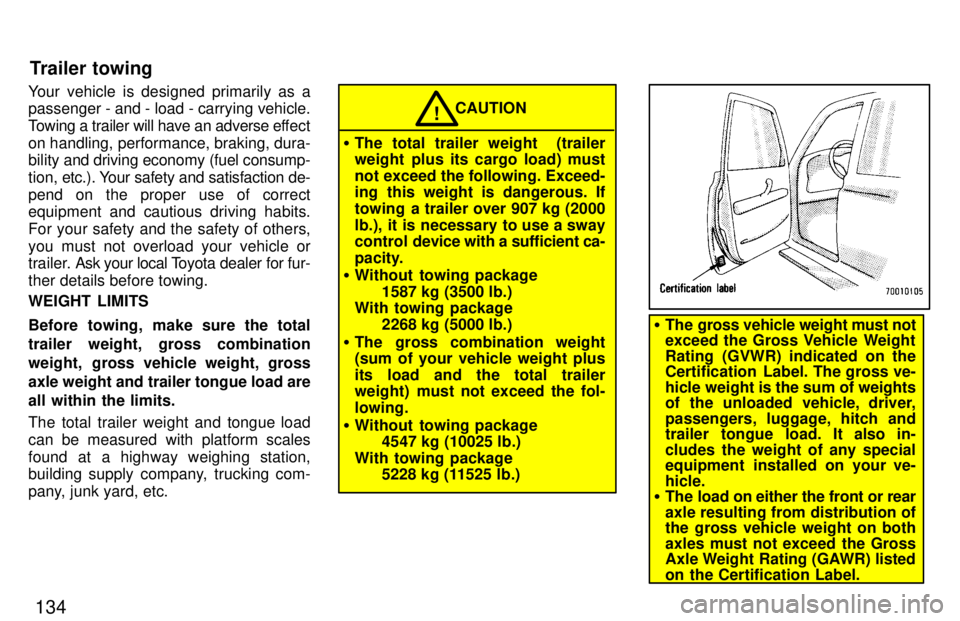
The gross vehicle weight must not
exceed the Gross Vehicle Weight
Rating (GVWR) indicated on the
Certification Label. The gross ve-
hicle weight is the sum of weights
of the unloaded vehicle, driver, passengers, luggage, hitch and
trailer tongue load. It also in-
cludes the weight of any special
equipment installed on your ve- hicle.
The load on either the front or rearaxle resulting from distribution of
the gross vehicle weight on both
axles must not exceed the Gross
Axle Weight Rating (GAWR) listed
on the Certification Label.
Trailer towing
Page 110 of 159
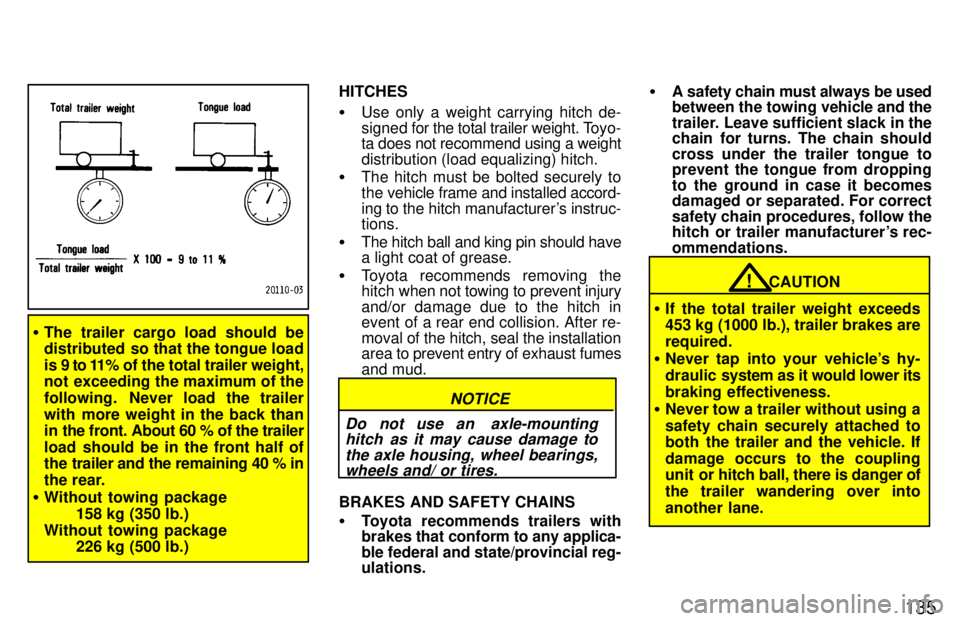
135
The trailer cargo load should be
distributed so that the tongue load
is 9 to 11% of the total trailer weight,
not exceeding the maximum of the
following. Never load the trailer
with more weight in the back than
in the front. About 60 % of the trailer
load should be in the front half of
the trailer and the remaining 40 % in
the rear.
Without towing package 158 kg (350 lb.)Without towing package 226 kg (500 lb.) HITCHES
Use only a weight carrying hitch de-
signed for the total trailer weight. Toyo-
ta does not recommend using a weight
distribution (load equalizing) hitch.
The hitch must be bolted securely to
the vehicle frame and installed accord-
ing to the hitch manufacturer's instruc- tions.
The hitch ball and king pin should havea light coat of grease.
Toyota recommends removing thehitch when not towing to prevent injury
and/or damage due to the hitch in
event of a rear end collision. After re- moval of the hitch, seal the installation
area to prevent entry of exhaust fumes
and mud.
Do not use an axle-mounting hitch as it may cause damage to
the axle housing, wheel bearings,wheels and/ or tires.
NOTICE
BRAKES AND SAFETY CHAINS Toyota recommends trailers with
brakes that conform to any applica-
ble federal and state/provincial reg-ulations.
A safety chain must always be used
between the towing vehicle and the
trailer. Leave sufficient slack in the
chain for turns. The chain should cross under the trailer tongue to
prevent the tongue from dropping
to the ground in case it becomes
damaged or separated. For correct
safety chain procedures, follow the
hitch or trailer manufacturer's rec- ommendations.
CAUTION!
If the total trailer weight exceeds
453 kg (1000 lb.), trailer brakes are required.
Never tap into your vehicle's hy-
draulic system as it would lower its
braking effectiveness.
Never tow a trailer without using a
safety chain securely attached to
both the trailer and the vehicle. If
damage occurs to the coupling
unit or hitch ball, there is danger of
the trailer wandering over into
another lane.
Page 111 of 159

136
TIRES
Ensure that your vehicle's tires are
properly inflated. See Chapter 7-2 forinstructions.
The trailer tires should be inflated to
the pressure recommended by the
trailer manufacturer in respect to the
total trailer weight.
TRAILER LIGHTS Trailer lights must comply with federal,
state/provincial and local regulations. See your local recreational vehicle
dealer or rental agency for the correct type of wiring and relays for your trail-
er. Check for correct operation of the
turn signals and stop lights each time
you hitch up. Direct splicing may dam-
age your vehicle's electrical system
and cause a malfunction of your lights.
BREAK-IN SCHEDULE Toyota recommends that you do not
tow a trailer with a new vehicle or a ve-
hicle with any new power train compo-
nent (engine, transmission, differen- tial, wheel bearing, etc.) for the first
800 km (500 miles) of driving. MAINTENANCE
If you tow a trailer, your vehicle will re-
quire more frequent maintenance due
to the additional load. For this informa-
tion, please refer to the scheduled
maintenance information in the Own-
er 's Manual Supplement/Maintenance Scheduleº.
Retighten all fixing bolts of the towing
ball and bracket after approximately
1000 km (600 miles) of trailer driving.
PRE-T OWING SAFETY CHECK Check that your vehicle remains level
when a loaded or unloaded trailer is
hitched. Do not drive if the vehicle has
an abnormal nose-up or nose-down
condition, and check for improper
tongue load, overload, worn suspen-
sion or other possible causes.
Make sure the trailer cargo is securely
loaded so that it cannot shift.
Check that your rear view mirrors con-
form to any applicable federal, state/
provincial or local regulation. If not,
install the rear view mirrors required
for towing purpose. TRAILER TOWING TIPS
When towing a trailer, your vehicle will
handle differently than when not tow-
ing.
The three main causes of vehicle-
trailer accidents are driver error, ex-
cessive speed and improper trailer
loading. Keep these in mind when tow-
ing: Before starting out, check operation of
the lights and all vehicle-trailer con-
nections. After driving a short dis-
tance, stop and recheck the lights and
connections. Before actually towing a
trailer, practice turning, stopping and
backing with a trailer in an area away
from traffic until you learn the feel.
Because stopping distance may be in-
creased, vehicle-to-vehicle distance
should be increased when towing a
trailer. For each 16 km/h (10 mph) ofspeed, allow at least one vehicle and
trailer length between you and the ve-
hicle ahead. Avoid sudden braking asyou may skid, resulting in jackknifing
and loss of control. This is especially
true on wet or slippery surfaces.